A not so short story about air flow...

Yesterday I did some experimenting with different baffles and ducts,
each built temporarily
out of the cardboard backs from yellow notepads and held together with
masking tape.  (Not worried
about a fire, since it only ran for 10 minutes at a time like that, and
I was right there to
yank the plug and rip out the cardboard if something went wrong.)  The
system has a Supermicro H8DC8
motherboard in a Supermicro case.  This one:
http://www.supermicro.com/products/chassis/2U/823/SC823S-550LP.cfm

This is what that motherboard looks like without heat sinks:

http://www.supermicro.com/a_images/products/Aplus/MB/H8DC8_spec.jpg

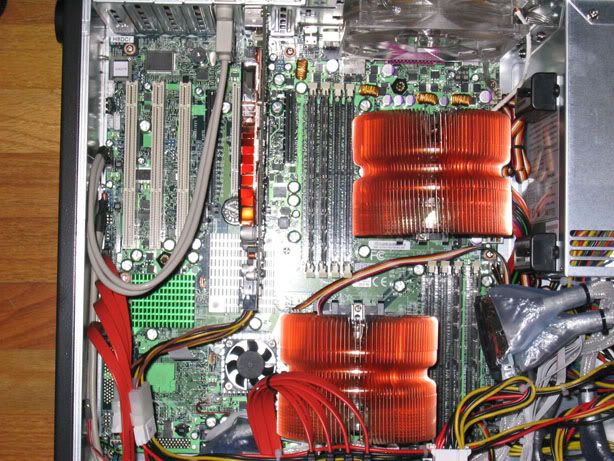
and here is a very similar motherboard with heat sinks in place (but
not my
motherboard, which uses conventional flat passive heat sinks, not the
big curved
orange monsters in the picture).

http://i19.photobucket.com/albums/b165/TeamScream/Wide-2.jpg

Notice the 50% overlap in the heat sinks in the direction of the
airflow?
That is the overlap with more conventional heat sinks too. Yes, it
really
does feed hot air from CPU1 into CPU2.   Putting a little wall in,
redirecting the hot air from CPU1 around CPU2 dropped CPU2's
temperature
by 4C.  Nothing else I tried made a bit of difference - including
lowering
the "ceiling" over CPU2.  CPU2 is still hotter than CPU1 even with that
fix.  The reason it will not get any better is that while there are 4
fans
in the system, they are not placed very well for this motherboard.  The
first one sends all of its air into the PS and so doesn't cool the CPUs
at all.  Totally a waste since the PS has a fan already.  The next fan
is partially blocked by CPU1, so maybe 3/4 of its air is available for
CPU2.
CPU1 then gets the remaining 1/4 of that fan, and most of the next fan,
so around 1 whole fan's worth.  The last fan blows over the chipset and
PCI slots, again, with no contribution to cooling the  CPUS.

For comparison, here is a Rio-works  HDAMA motherboard which we have.
For
this design airflow was taken into account.  Note that the CPU sockets
are
spaced farther apart perpendicular to the air flow.  It is very similar
hardware otherwise:

http://www.opteronics.com/images/16a_MBLarge.jpg

there are some pictures of these with heat sinks in place which may be
found
by google image search for "HDAMA motherboard" - I didn't want to link
to them as they
all seem to be on ebay and those links could disappear at any time.
Note how the
heatsinks do not overlap in the direction of the air flow?  We have one
of these,
with passive heatsinks of approximately the same shape, but a bit
taller,
stuffed into an old 2U case scavenged from an old machine.  In that
machine
the two CPUs run at very close to the same temperature.  The component
layout
in the case is very similar to the Supermicro except that the heat
sinks are not
overlapping, so here there is a fan lined up directly on center with
each CPU,
plus one to cool the chipset/PCI slots.  The PS gets by on its internal
fan.
The old case has been "optimized" for air flow by the simple expedient
of placing
the 3 fans as just described (originally there was just one fan in it),
plus
removing the front panel and as much of the back panel as possible,
including
the shield that normally goes around the jacks on the motherboard.

The HDAMA machine is pretty darn ugly, but it definitely "breathes"
better than
the Supermicro.

I found a product with the perfect properties for sticking
polypropylene sheets
together.  This is 3M "Jet-melt" 3731 hot melt adhesive.  (Also called
"Scotch-Weld").
Unfortunately I need about 2cc of it, but nobody sells it in sizes less
than 11 pounds!
The only place that sells anything in this whole 3M hot melt line as
single sticks is Digikey,
and the one they sell

http://parts.digikey.com/1/parts/440266-hot-melt-adhesive-vo-5-8-x2-3748-vo-tc.html

is not as heat resistant as the 3731.  Probably have to use 3748
though, since at least
it can be purchased easily.

Regards,

David Mathog
[email protected]
Manager, Sequence Analysis Facility, Biology Division, Caltech
_______________________________________________
Beowulf mailing list, [email protected] sponsored by Penguin Computing
To change your subscription (digest mode or unsubscribe) visit
http://www.beowulf.org/mailman/listinfo/beowulf