This is an automated email from the ASF dual-hosted git repository.

xiaoxiang781216 pushed a commit to branch master
in repository https://gitbox.apache.org/repos/asf/nuttx.git
commit af24d2094a26512b5e450fee24f25c9832362d02
Author: Jukka Laitinen <[email protected]>
AuthorDate: Tue Sep 15 08:53:28 2026 +0300

    Documentation/imxrt: Add documentation for imxrt118x arch and imxrt1180-evk

    Add the documentation for the new supported board configurations and for
the architecture,

    Assisted-by: Claude Code:claude-opus-4-7
    Signed-off-by: Jukka Laitinen <[email protected]>
---
 .../imxrt1180-evk/MIMXRT1180-EVK-TOP-IMG.jpg       | Bin 0 -> 44866 bytes
 .../arm/imxrt/boards/imxrt1180-evk/index.rst       | 261 +++++++++++++++++++++
 Documentation/platforms/arm/imxrt/index.rst        |  26 +-
 3 files changed, 286 insertions(+), 1 deletion(-)

diff --git
a/Documentation/platforms/arm/imxrt/boards/imxrt1180-evk/MIMXRT1180-EVK-TOP-IMG.jpg

b/Documentation/platforms/arm/imxrt/boards/imxrt1180-evk/MIMXRT1180-EVK-TOP-IMG.jpg
new file mode 100644
index 00000000000..1a1e5fd1506
Binary files /dev/null and
b/Documentation/platforms/arm/imxrt/boards/imxrt1180-evk/MIMXRT1180-EVK-TOP-IMG.jpg
 differ
diff --git a/Documentation/platforms/arm/imxrt/boards/imxrt1180-evk/index.rst
b/Documentation/platforms/arm/imxrt/boards/imxrt1180-evk/index.rst
new file mode 100644
index 00000000000..cc252883009
--- /dev/null
+++ b/Documentation/platforms/arm/imxrt/boards/imxrt1180-evk/index.rst
@@ -0,0 +1,261 @@
+================
+i.MX RT1180 EVK
+================
+
+.. tags:: arch:arm, arch:armv7m, arch:armv8m, arch:cm7, arch:cm33, chip:imxrt,
chip:imxrt1180, vendor:nxp, ethernet, usb
+
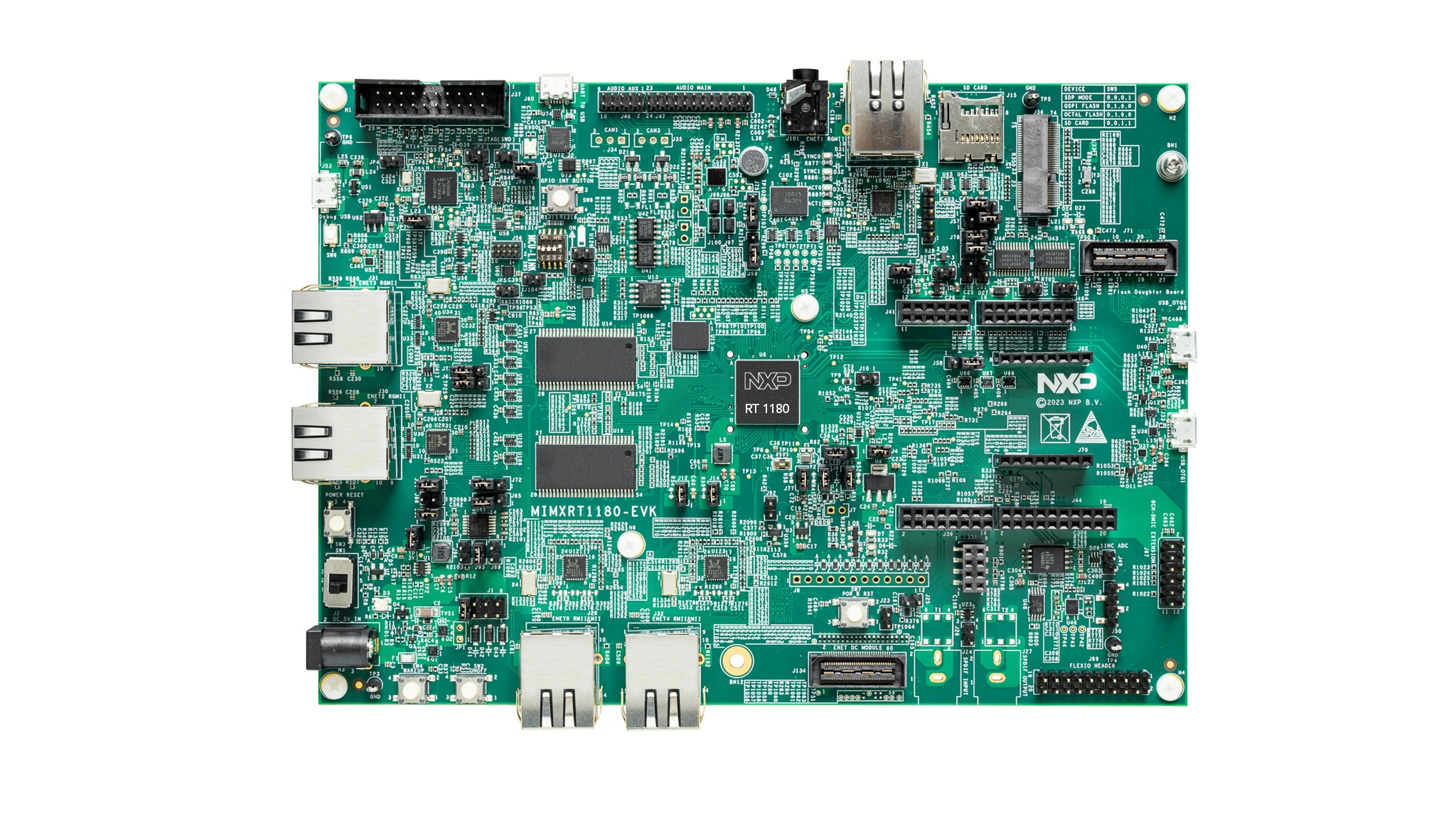
+The `i.MX RT1180 EVK
+<https://www.nxp.com/design/design-center/development-boards-and-designs/MIMXRT1180-EVK>`_
+is an evaluation kit from NXP. It is based on the MIMXRT1189 crossover
+microcontroller, which combines Arm Cortex-M33 and Cortex-M7 cores.
+See the `MIMXRT1180-EVK Quick Start Guide
+<https://www.nxp.com/docs/en/quick-reference-guide/IMXRT1180QSG.pdf>`_ for
+an overview of the board and its connectors.
+
+.. figure::
https://www.nxp.com/assets/images/en/dev-board-image/MIMXRT1180-EVK-TOP-IMG.jpg
+   :align: center
+   :alt: Top view of the i.MX RT1180 EVK
+   :width: 80%
+
+   i.MX RT1180 EVK top view. Image source: NXP.
+
+Features
+========
+
+- MIMXRT1189CVM8C microcontroller
+    - Cortex-M33 running at 266 MHz with NuttX
+    - Cortex-M7 running at 798 MHz with NuttX
+- Memory
+    - On-chip TCM and OCRAM
+    - 512-Mbit external SDRAM
+    - 128-Mbit FlexSPI1 QSPI NOR flash
+    - 512-Mbit HyperRAM
+    - MicroSD card socket
+- Connectivity and expansion
+    - MCU-Link debug interface with a virtual COM port
+    - 20-pin external JTAG/SWD connector
+    - Ethernet connectors
+    - USB host and device connectors
+    - CAN connector
+    - Arduino-compatible expansion headers
+- Audio codec, microphone, headphone jack, and speaker connections
+- Two software-controlled user LEDs
+
+The current NuttX configurations provide the serial console, USB device
+support, image generation, and multicore boot flow. The other on-board
+interfaces listed above are not enabled by the supplied configurations.
+
+Buttons and LEDs
+================
+
+The board port configures the following user LEDs during early
+initialization:
+
+=== ===== ========== =========
+LED Color Signal     GPIO
+=== ===== ========== =========
+D6  Green GPIO_AD_27 RGPIO4.27
+D7  Red   GPIO_AD_26 RGPIO4.26
+=== ===== ========== =========
+
+D7 is turned on during board initialization. The supplied configurations do
+not enable the NuttX automatic LED or user-button interfaces.
+
+Serial Console
+==============
+
+The default serial console is LPUART1 through the MCU-Link virtual COM port:
+
+============ ============ =============
+Function     Signal       Pad
+============ ============ =============
+Console TX   LPUART1_TX   GPIO_AON_08
+Console RX   LPUART1_RX   GPIO_AON_09
+============ ============ =============
+
+Connect the host to the MCU-Link USB connector J53. On Linux, the console is
+normally available as ``/dev/ttyACM0``.
+
+Pin Mapping
+===========
+
+The board port currently defines these on-board connections:
+
+============ ============= ==============================
+Pad          Function      Board connection
+============ ============= ==============================
+GPIO_AON_04  LPSPI1_SCK    On-board LPSPI NOR flash
+GPIO_AON_05  LPSPI1_PCS0   On-board LPSPI NOR flash
+GPIO_AON_06  LPSPI1_SDO    On-board LPSPI NOR flash
+GPIO_AON_07  LPSPI1_SDI    On-board LPSPI NOR flash
+GPIO_AON_08  LPUART1_TX    MCU-Link virtual COM port
+GPIO_AON_09  LPUART1_RX    MCU-Link virtual COM port
+GPIO_AON_15  LPI2C2_SDA    On-board peripherals
+GPIO_AON_16  LPI2C2_SCL    On-board peripherals
+GPIO_AD_26   GPIO4_IO26    Red user LED D7
+GPIO_AD_27   GPIO4_IO27    Green user LED D6
+============ ============= ==============================
+
+Consult the MIMXRT1180-EVK user manual (UM12021) and schematic, available from
+the NXP product page linked above, for the complete expansion-header pinout and
+any signal-sharing restrictions.
+
+Power Supply
+============
+
+The board requires a 5 V supply. It can be powered from the external 5 V input
+J2, or from a supported USB connector when the power-selection jumpers are
+configured accordingly. Use SW1 to turn the board on. Refer to the board user
+manual before changing the factory jumper settings or powering the board from
+more than one source.
+
+Installation
+============
+
+All testing has been conducted using the following Arm GNU Toolchain for the
+``arm-none-eabi`` target, available from the `Arm GNU Toolchain downloads page
+<https://developer.arm.com/downloads/-/arm-gnu-toolchain-downloads>`_:
+
+.. code-block:: console
+
+   $ arm-none-eabi-gcc --version
+   arm-none-eabi-gcc (Arm GNU Toolchain 13.2.rel1 (Build arm-13.7)) 13.2.1
20231009
+
+Building a Cortex-M33 image also requires ``python3`` with the ``venv``
+module, ``pip``, and either ``curl`` or ``wget``. The image-building helper
+creates a private Python environment and installs the pinned NXP SPSDK
+version automatically.
+
+Flashing requires the `SEGGER J-Link Software and Documentation Pack
+<https://www.segger.com/downloads/jlink/>`_ version 7.98a or later, one of:
+
+- a SEGGER J-Link probe connected to the 20-pin JTAG/SWD connector J37; or
+- the on-board MCU-Link probe, reflashed with SEGGER MCU-Link J-Link firmware
+  and connected through J53,
+
+and the boot-mode DIP switch SW5 set to ``0100`` (FlexSPI Quad SPI NOR boot).
+
+Building NuttX
+==============
+
+Select a configuration and build it from the NuttX repository root:
+
+.. code:: console
+
+   $ ./tools/configure.sh imxrt1180-evk:<config>
+   $ make -j$(nproc)
+
+The first Cortex-M33 build downloads the pinned NXP EdgeLock Enclave (ELE)
+firmware after displaying its license and installs SPSDK into
+``tools/imxrt1180/.cache``. Running the build implies acceptance of the NXP
+firmware license described in `License Exceptions`_.
+
+Flash Layout
+============
+
+The Cortex-M33 image is the bootable image. It contains the FlexSPI
+Configuration Block (FCB) at offset ``0x400`` and the AHAB container at offset
+``0x1000``. The Cortex-M7 image is programmed separately as a raw XIP payload.
+
+========== ======== ====== ==============================
+Address    Offset   Size   Contents
+========== ======== ====== ==============================
+0x28000000 0x0      512 KB Cortex-M33 image, ``flash.bin``
+0x28080000 0x80000  Rest   Cortex-M7 image, ``nuttx.bin``
+========== ======== ====== ==============================
+
+Flashing
+========
+
+Set the boot-mode DIP switch SW5 to ``0100`` for FlexSPI Quad SPI NOR boot.
+The ``flash-jlink.sh`` helper takes an image name and either a flash offset or
+an absolute address.
+
+The helper programs through the Cortex-M33 device profile because the RT1180
+ROM starts the Cortex-M33 first and initializes FlexSPI1 before the SEGGER
+flash loader runs. Always use the supplied helper for programming. The
+Cortex-M7 J-Link device profile is intended for debugging the running
+Cortex-M7 image, not for programming.
+
+To flash a standalone Cortex-M33 NSH image:
+
+.. code:: console
+
+   $ ./tools/configure.sh imxrt1180-evk:nsh-m33
+   $ make -j$(nproc)
+   $ boards/arm/imxrt/imxrt1180-evk/tools/flash-jlink.sh flash.bin 0x0
+
+To flash the Cortex-M33 bootloader and Cortex-M7 NSH images:
+
+.. code:: console
+
+   $ ./tools/configure.sh imxrt1180-evk:bl
+   $ make -j$(nproc)
+   $ cp flash.bin flash-bl.bin
+   $ make distclean
+   $ ./tools/configure.sh imxrt1180-evk:nsh
+   $ make -j$(nproc)
+   $ cp nuttx.bin nuttx-m7.bin
+   $ boards/arm/imxrt/imxrt1180-evk/tools/flash-jlink.sh flash-bl.bin 0x0
+   $ boards/arm/imxrt/imxrt1180-evk/tools/flash-jlink.sh nuttx-m7.bin 0x80000
+
+J-Link Debugging
+================
+
+The board port also supplies a J-Link GDB server helper for Cortex-M7:
+
+.. code:: console
+
+   $ boards/arm/imxrt/imxrt1180-evk/tools/gdbserver-jlink.sh
+
+Connect from another terminal:
+
+.. code:: console
+
+   $ arm-none-eabi-gdb nuttx
+   (gdb) target extended-remote localhost:2331
+   (gdb) monitor reset
+   (gdb) continue
+
+Configurations
+==============
+
+The board identifier for use with ``tools/configure.sh`` is
+``imxrt1180-evk``.
+
+nsh-m33
+-------
+
+Runs NuttShell (NSH) directly on the Cortex-M33. The RT1180 ROM boots
+``flash.bin`` from FlexSPI1 QSPI NOR. NSH is available on LPUART1 at
+the MCU-Link virtual COM port. This configuration also enables USB CDC/ACM
+and the ``ostest`` application.
+
+bl
+--
+
+Builds a minimal Cortex-M33 bootloader as ``flash.bin``. It sets the
+Cortex-M7 boot address to ``0x28080000``, releases that core, and then remains
+in an indefinite loop that periodically calls ``usleep``. Use this
+configuration together with ``nsh``; it does not provide an interactive shell
+itself.
+
+nsh
+---
+
+Runs NSH on the Cortex-M7. The output ``nuttx.bin`` is a raw XIP payload that
+must be programmed at offset ``0x80000`` and started by the ``bl``
+configuration. NSH is available on LPUART1 at the MCU-Link virtual COM port.
+This configuration also enables USB CDC/ACM and the ``ostest`` application.
+
+License Exceptions
+==================
+
+The Cortex-M33 image build downloads
+``mxrt1180b0-ahab-container.img`` from NXP's MCUXpresso SDK at a pinned commit.
+This proprietary EdgeLock Enclave firmware is covered by the LA_OPT NXP
+Software License, version 56 (April 2024). The download helper displays the
+source URL, license URL, and expected SHA-256 digest before downloading it.
+
+The NXP SPSDK Python package used to assemble the boot image is distributed
+under the BSD-3-Clause license.
diff --git a/Documentation/platforms/arm/imxrt/index.rst
b/Documentation/platforms/arm/imxrt/index.rst
index f1d0c425cba..9a22d8016b5 100644
--- a/Documentation/platforms/arm/imxrt/index.rst
+++ b/Documentation/platforms/arm/imxrt/index.rst
@@ -25,9 +25,33 @@ RT1060  Yes             Cortex-M7        600 MHz
 RT1064  Yes             Cortex-M7        600 MHz
 RT1160  No              Cortex-M7 + M4   600 Mhz + 240 MHz
 RT1170  Yes (Only M7)   Cortex-M7 + M4   1 GHz + 400 MHz
-RT1180  No              Cortex-M7 + M33  800 Mhz + 300 MHz
+RT1180  Yes             Cortex-M7 + M33  800 Mhz + 300 MHz
 ======  ==============  ===============  =================

+i.MX RT118x
+===========
+
+The i.MX RT118x family is supported on both the Cortex-M33 and Cortex-M7
+cores. The Cortex-M33 is the boot core; it can run NuttX directly, or it
+can run a small bootloader that releases the Cortex-M7 to run a separate
+NuttX image.
+
+The current clock configuration runs the Cortex-M7 at 798 MHz and the
+Cortex-M33 at 266 MHz due to ARM_PLL and divider setting limitations.
+
+RT118x uses the generation 3 clock configuration driver for the clock
+roots found on this family. It also uses the generation 3 IOMUXC driver
+for the RT118x pinmux layout and GPIO mode selection.
+
+RT118x uses the RGPIO driver and the matching RGPIO interrupt driver
+instead of the legacy i.MX RT GPIO block. The version 2 eDMA driver is
+selected for the newer RT118x eDMA IP.
+
+The EdgeLock Enclave driver provides the messaging path used for RT118x
+ELE firmware, and the TRDC driver configures access to RT118x memory and
+peripheral resources. The Cortex-M7 release helper is used by Cortex-M33
+firmware to set the Cortex-M7 boot vector and start the M7 core.
+
 Data and Instruction Cache
 ==========================