That patent mentions the need for a sun gear.  Not sure it's exactly the same
since this one doesn't.
> -----Original Message-----
> From: fxkl47BF--- via Emc-users [mailto:[email protected]]
> Sent: January-03-22 10:47 AM
> To: [email protected]
> Cc: [email protected]
> Subject: Re: [Emc-users] Harmonic Drive
>
> On Mon, 3 Jan 2022, John Dammeyer wrote:
>
> > Just go back on this subject to older postings from Todd where he posted
> > the FreeCAD files.  I then used those to create step files
> and loaded them into AlibreCAD.  Since then I've figured out how to make
> gears in AlibreCAD which had a Python Script that used
> diameter and # of teeth.  I modified the script to use module or diameter.
> >
> > To create the ring gear I first create a normal gear with the right number
> > of teeth, module and thickness and save that.  Then
> create a disk with the desired outside diameter and same thickness.  Then use
> a Boolean subtract with the gear file.  That creates the
> ring gear with say 60mm OD and either 100T or 101T.
> >
> > The spur gears are created separately as a 40T and 41T with the same size
> > center hole and three holes to connect the two so that
> at one point a pair of teeth line up perfectly.   An assembly is made from
> those two with constrictions to line them up.
> >
> > Then an assembly of the entire set is done.  As yet I'm not clever enough
> > to make the assembly constraints simulate the entire
> planet assembly moving around the ring gear.  And the reference lines I put
> on mine don't actually line up with the correct teeth for
> assembly.  But I whipped that all up in under an hour.
> >
> > Todd mentioned in a private email how the ratios work.
> > " It is because it isn't behaving quite like a normal compound planetary.
> > Because the planets of each set are fixed to each other,
> when the planets sets orbited around the fixed ring by the carrier, the
> driven ring gear is advanced by (and this is the key) the
> difference between the two ratios.  The result is when you turn the carrier
> one revolution, the planets of the fixed ring gear turn 2.5
> revolutions, therefore the driven ring's planets also turn 2.5 revolutions,
> since the ratio of the output set of gears is 2.4634, the ring
> is advanced the difference of the two ratios. So the final drive math is
> [101/41] / [(100/40)-(101/41)].  Or 2.4634/(2.5-2.4634) =
> approx. 67.3.  "
> >
> > It's actually 67.333...   If you want to get fussy.
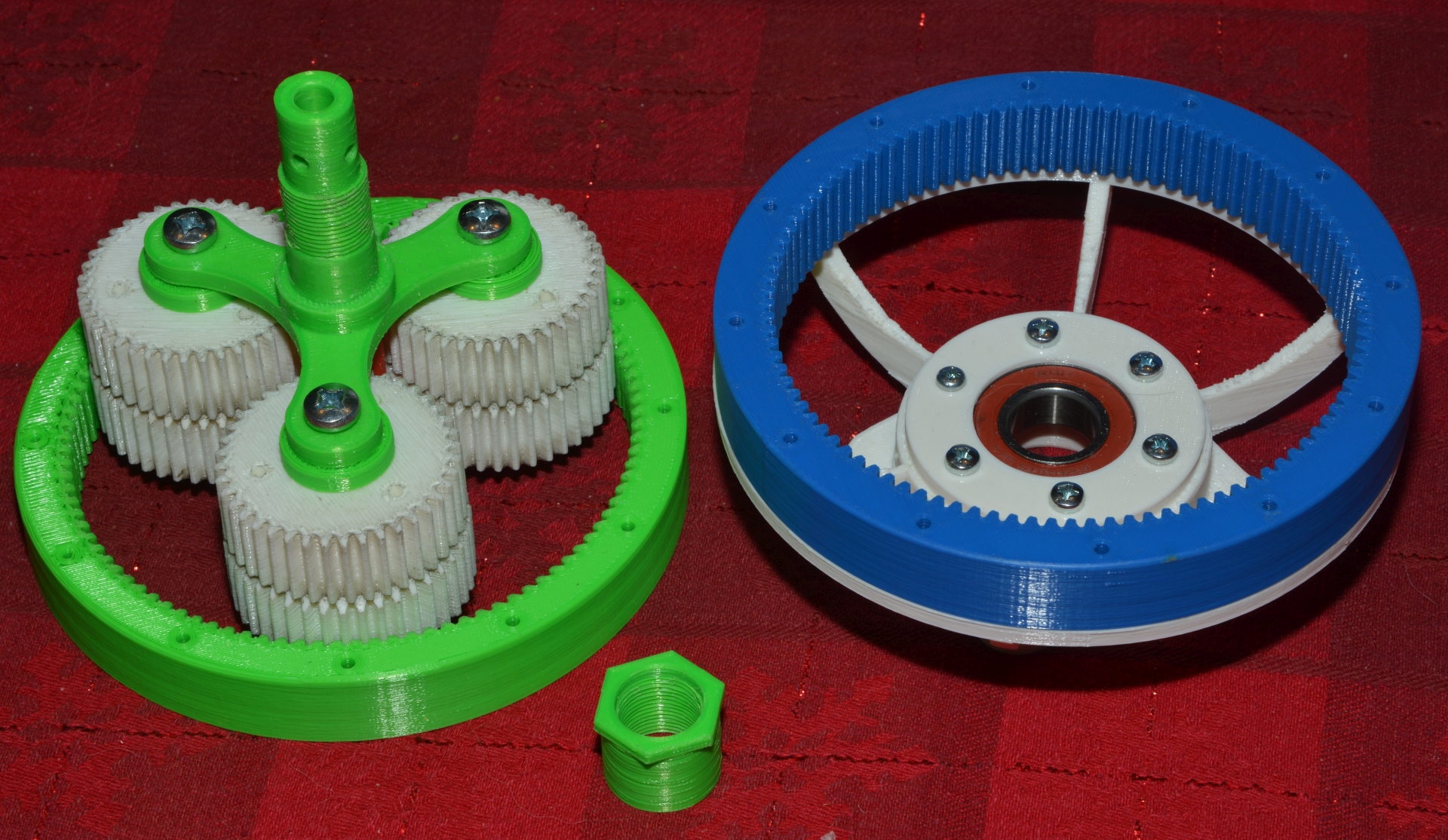
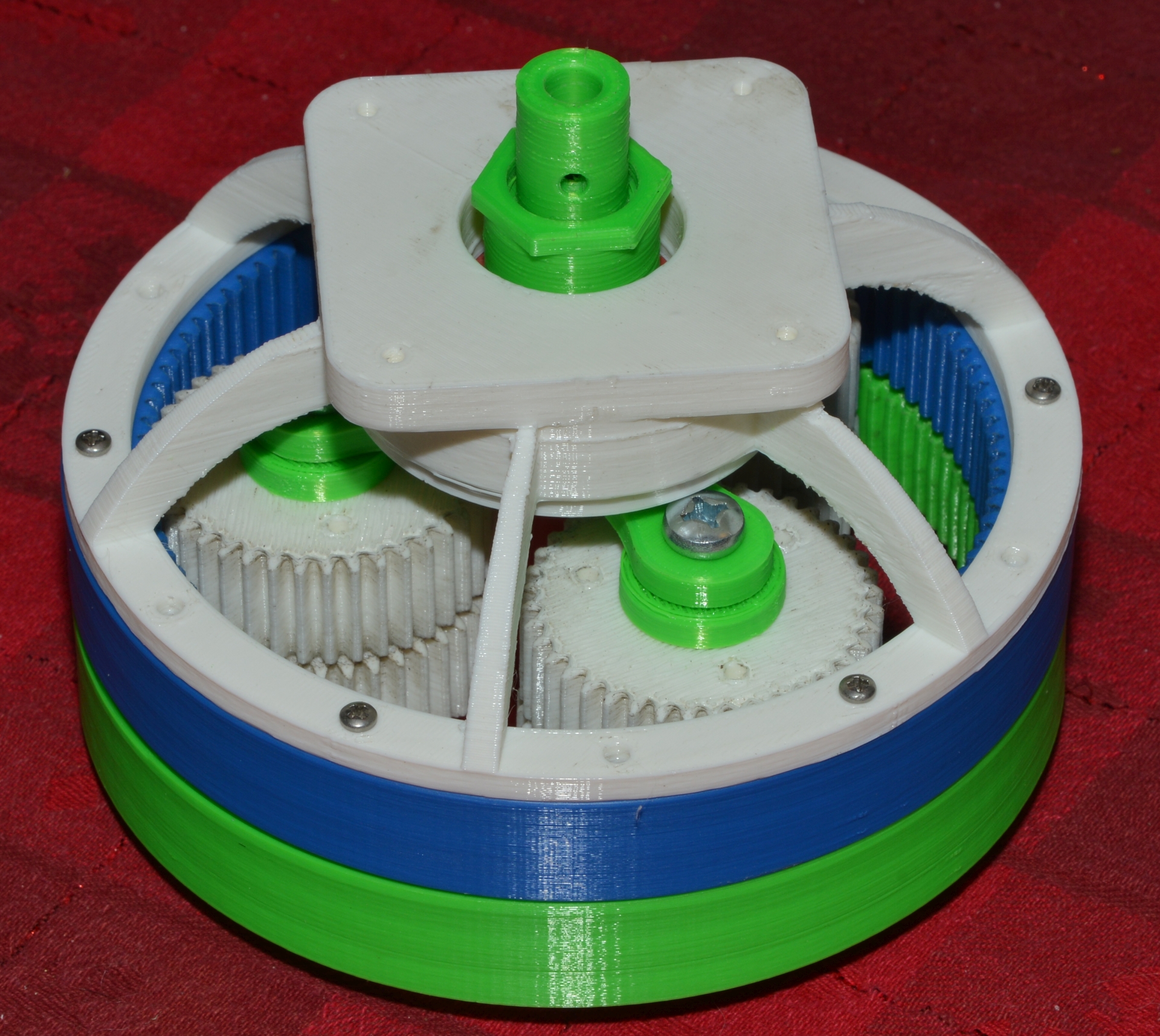
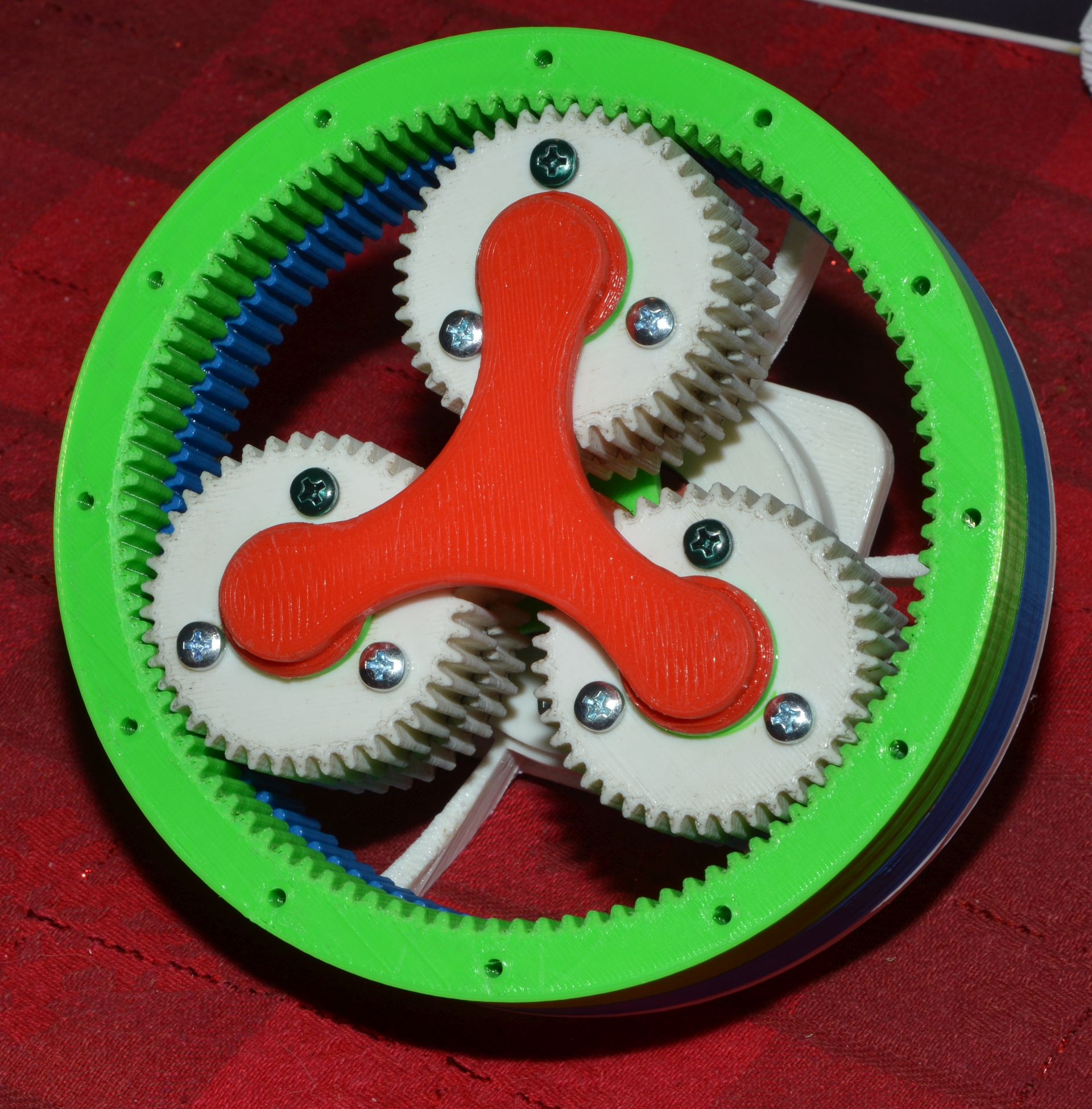
> > Here's my 3D printed version of the 150mm diameter gears.
> > http://www.autoartisans.com/harmonicdrive/BearingDriveShaft-1.jpg
> > http://www.autoartisans.com/harmonicdrive/BearingDriveShaft-2.jpg
> http://www.autoartisans.com/harmonicdrive/BearingDriveShaft-3.jpg
> >
> > The bearing holds the drive centered and when the 3 planets are properly
> > aligned requires very little torque to move the non-fixed
> ring gear.  However I have not yet come up with an inexpensive way to hold
> that gear in a way that it would be useful.  I've been
> playing with a deep groove in the ring gear and a holder outside that along
> with 80 of 5.5mm bearings.  And a bearing thrust washer
> is also needed.
> >
> > But the above example doesn't have bearings inside the planets either so
> > it's plastic on plastic.  I can provide the step files if you
> wish.
> >
> > John
> >
> >
> >
> >
> >> -----Original Message-----
> >> From: grumpy via Emc-users [mailto:[email protected]]
> >> Sent: January-03-22 4:44 AM
> >> To: Enhanced Machine Controller (EMC)
> >> Cc: grumpy
> >> Subject: Re: [Emc-users] Harmonic Drive
> >>
> >> January 3, 2022 9:54:10 AM CET John Dammeyer <[email protected]>
> >> wrote:
> >> For fun I created Todd's version with 0.5module gears.  The OD of the
> >> assembly
> >> is now 60mm compared to 150mm.   It would now be possible to choose a far
> >> east
> >> harmonic drive tapered roller assembly to hold the driven gear in place.
> >> Although they are expensive.
> >>
> >> Not sure what type of bearings, if any would be used for the planetary gear
> >> clusters.  I suppose one could press in bronze sleeves.  I guess it all
> >> depends
> >> on the duty cycle and target application.  If it's a 6 axis robot arm used
> >> for
> >> tool changing and placement/removal of milled parts then it's not running
> >> continuously.  Might well for the home or small shop be more than adequate.
> >>
> >> This example still has 67.3333333:1 reduction but if the fit is well set
> >> then
> >> the backlash is essentially zero which is different from normal planetary
> >> reduction drives.   Not sure how important that is for a 6 axis robot arm.
> >>
> >> In either case, using a 4th axis to create all three spur gears at the same
> >> time (one set of 40T and one set of 41 T) and then some sort of
> >> broaching/indexing to create the two ring gears the real issue is the outer
> >> bearing of the 101T output ring gear.  But overall not that difficult to
> >> create
> >> once you have the 0.5 module shaper style cutter.
> >>
> >> John
> >>
> >> Where can I find more info about Todd's planetary drive.
> >> It looks very familiar.
>
> I believe what he has made is a Wolfrom gear.
> There are quite a few variations.
> I made one a few years back with 45 teeth ring, 15 and 14 teeth planet, and
> 15 teeth sun.
> It had a 60:1 reduction.
> They are very compact.
> https://patents.google.com/patent/DE102019203257B3/en
>
>
>
> _______________________________________________
> Emc-users mailing list
> [email protected]
> https://lists.sourceforge.net/lists/listinfo/emc-users


_______________________________________________
Emc-users mailing list
[email protected]
https://lists.sourceforge.net/lists/listinfo/emc-users