EV Digest 2675

Topics covered in this issue include:
  1) Re: EV Digest Mode
        by gail <[EMAIL PROTECTED]>
  2) IC Battery Charger
        by "Buford, Joseph E" <[EMAIL PROTECTED]>
  3) Prius at the AWs
        by "Lawrence Rhodes" <[EMAIL PROTECTED]>
  4) Th!nking in Phoenix AZ
        by "Michael A. Radtke" <[EMAIL PROTECTED]>
  5) Re: AC controllers/contactor controller
        by "Mark Thomasson" <[EMAIL PROTECTED]>
  6) Re: AC controllers
        by "Mark Thomasson" <[EMAIL PROTECTED]>
  7) RE: Th!nking in Phoenix AZ
        by [EMAIL PROTECTED]
  8) Car show in Phoenix AZ
        by "Mike Pengelly" <[EMAIL PROTECTED]>
  9) Re: AC controllers/contactor controller
        by "garry" <[EMAIL PROTECTED]>
 10) RE: Th!nking in Phoenix AZ
        by Bruce EVangel Parmenter <[EMAIL PROTECTED]>
 11) Re: ev
        by "garry" <[EMAIL PROTECTED]>
 12) Escort EV limbo?
        by David Brandt <[EMAIL PROTECTED]>
 13) Re: AC controllers
        by Lee Hart <[EMAIL PROTECTED]>
 14) More Go-Kart EV ideas
        by Matthew Muelver <[EMAIL PROTECTED]>
 15) Re: Evercells versus Yellow tops
        by [EMAIL PROTECTED]
 16) That time of the year again...
        by [EMAIL PROTECTED]
 17) Re: Sob... I think if fried my motor.
        by Jim Coate <[EMAIL PROTECTED]>
 18) Re: Sob... I think if fried my motor.
        by "1sclunn" <[EMAIL PROTECTED]>
 19) Re: Sob... I think if fried my motor. (Zapi HFM 400 controller)
        by "Roy LeMeur" <[EMAIL PROTECTED]>
 20) Re: Sob... I think if fried my motor.
        by Rich Rudman <[EMAIL PROTECTED]>
 21) Re: Escort EV limbo?
        by Bob Bath <[EMAIL PROTECTED]>
 22) Re: Escort EV limbo?
        by "1sclunn" <[EMAIL PROTECTED]>
 23) Re: Evercel question
        by "Jon \"Sheer\" Pullen" <[EMAIL PROTECTED]>
 24) Seeking: Ride to Thursday's CARB meet, speak now or ...
        by Bruce EVangel Parmenter <[EMAIL PROTECTED]>
 25) Re: Better range from less weight
        by "Joe Smalley" <[EMAIL PROTECTED]>
--- Begin Message ---
I receive the evdl messages one at a time and never get HTML attachments,
although sometimes there is a note which says an HTML message has been
removed.  I am very happy with the list as it is, have no interest in
looking at yahoo messages.  Quite often I am not using a mail tool which
can read HTML so I much prefer plain text which can be seen in anything.

Gail

On Mon, 24 Mar 2003, Mike Burgess wrote:

> I subscribe to the digest, and am getting several a day, in
> 50K chunks.  Each digest has HTML attached messages, and
> about 90% redundent quotes.
>
>   Anyone know if I can "suspend" my subscription on weekends
> when I am gone, or will I have to un-sub and re-sub myself?
>
> I'm not sure about the purpose of the list, when the
> yahoo group (which I find is much easier to read) exists.
> In the group, you can set digest, individual, or web reading.
>   Mike  ( in Los Angeles, no EV, and none in sight to be
>          able to buy from a mfg that I can afford. )
>
>
>
> --- In [EMAIL PROTECTED], "Thomas Shay" <[EMAIL PROTECTED]> wrote:
> > For about three days my EV Discussion List messages have been
> coming
> > in digest form.  And the messages are attachments which I can't
> open.
> > I can read the individual messages in the Yahoo! Group, EVList
> which is
> > a poorer way to handle messages.   Is this my unique problem or are
> > others having the same problem?
> >
> > Tom Shay
>
> __________________________________________________
> Do you Yahoo!?
> Yahoo! Platinum - Watch CBS' NCAA March Madness, live on your desktop!
> http://platinum.yahoo.com
>
>
--- End Message ---
--- Begin Message ---
>From EE Product News Products of the Week

2. Multi-Chemistry Battery Charger IC Cuts Circuit Size by Half

Claiming to eliminate up to 40% or more of the discrete components needed in charging
circuits, the LTC4008 4A, multi-cell, multi-chemistry, battery-pack charger measures
just 5.6 centimeters squared in a 20-pin SSOP. Paired with a microcontroller, the
device charges NiCd, NiMH, Li-Ion, and lead-acid batteries and drives external MOSFETs
synchronously with an efficiency of better than 95%. Charging current is programmable
to an accuracy of �4% with external resistors. Specifications include an input range
from 6V to 28V, output range from 3V to 28V, and a voltage accuracy of �0.8%. A
thermistor-sensor input is included that suspends charging if a high-temperature
condition is detected. Charging automatically resumes when battery temperature is
within safe limits. Additionally, the device provides indicator outputs for charging,
C/10, current detection, ac adapter present, and input current. Other features include
noise-free operation with all types of output capacitors, including ceramic, and ac
adapter current limiting that allows products to operate while their battery packs
charge.
Price starts at $3.70 each/1,000. LINEAR TECHNOLOGY CORP., Milpitas, CA. (408)
432-1900.

DATASHEET: http://lists.planetee.com/cgi-bin3/flo/y/eP840F7lbN0EnN08Os0Ap

Joe Buford
310-416-9319
Boeing Satellite Systems
 702   \O/
[XXXXX]-H-[XXXXX]
       /0\   GEO
--- End Message ---
--- Begin Message ---
2.
YOU CAN HARDLY PRIUS OUT OF 'EM
Some stars toned down the glitz at last night's Academy Awards
ceremony in acknowledgement of the war in Iraq, while others toned
down their energy consumption, arriving at the event in gas-electric
hybrid cars instead of gas-guzzling stretch limos.  Actress Cameron
Diaz was chauffeured to the Oscars in her own Toyota Prius.  "I drive
it every day," she told reporters.  Harrison Ford, Susan Sarandon,
Tim Robbins, and Robin Williams also made the trip in Priuses,
courtesy of Global Green USA.

straight to the source:  Sarasota Herald Tribune, Associated Press, 22 Mar
2003
<http://www.gristmagazine.com/forward.pl?forward_id=926>

straight to the source:  Reuters.com, Gina Keating and Sarah Tippit,
23 Mar 2003
<http://www.gristmagazine.com/forward.pl?forward_id=927>

do good:  Take action and pledge to buy an eco-friendly car
<http://www.gristmagazine.com/dogood/autos.asp?source=daily#pledge>
--- End Message ---
--- Begin Message ---
Hello,

On the way to work this morning a Ford Th!nk City caught up to me.  The
driver waved, and we drove together for the next 5 or so miles.  The car
had CA plates.

I was not aware that these cars were sold in the US.  Is the owner on
this list?  Am I wrong about US imports?

Thanks,

Mike  '79 Jet ElectraVan
--- End Message ---
--- Begin Message ---
See comments below.  Mark Thomasson

----- Original Message -----
From: "Peter VanDerWal" <[EMAIL PROTECTED]>
To: "EV" <[EMAIL PROTECTED]>
Sent: Monday, March 24, 2003 10:05 AM
Subject: Re: AC controllers/contactor controller


> As long as you don't use the first step for long you wont burn up the
> resistor. It's a heat thing, he is generating twice the heat but as long
> as he doesn't over use it the resistor can handle it for short periods.
>
> He will probably burn up the contacts eventually, but what the hey....it
> works now.
>
> Field weakening is not a solution for efficiency.  Field weakening
> reduces motor efficiency because it reduces the torque per amp.  The
> motor spins faster but requires more current to produce the same
> torque.  Unfortunately it's not an equitable trade, the torque to RPM
> trade off might be even, but you now draw more current for the same
> power.  IE: more power in, same power out equals lower efficiency.

Field weakening might not be efficient for series wound motors if part of
the current get shunted through a resistor in parallel with the field
circuit   But, it is an efficient way of increasing motor speed of a shunt
wound motor above base speed.  From zero speed to base speed, field voltage
is held constant at maximum and armature voltage goes from zero to maximum.
In this range, torque may be maximum and power increases proportionally with
speed and voltage.  Above base speed, armature voltage is held constant and
field voltage is reduced (but not to zero!).  In this range, power may be
maximum and max torque drops as speed increases.  Mid range horsepower
variable speed DC motors (shunt wound) are typically designed to run at a
maximum of 4 times base speed using field weakening.  Efficiency is high
throughout the speed range.
>
> On Mon, 2003-03-24 at 07:39, Lawrence Rhodes wrote:
> > I talked to a person that just put a motorcycle frontend on a golfcart
and
> > put in 6 12v batteries and off it goes.  No modifications to the
contactor
> > controller.  Hasn't burnt up the resistor.  Seems to work.  How can one
get
> > away with this?  Would field weakening be as effective and more
efficient
> > for speed.  Lawrence Rhodes.......
> > ----- Original Message -----
> > From: "Peter VanDerWal" <[EMAIL PROTECTED]>
> > To: "EV" <[EMAIL PROTECTED]>
> > Sent: Sunday, March 23, 2003 9:18 PM
> > Subject: Re: AC controllers
> >
> >
--- End Message ---
--- Begin Message ---
See my comments below.  Mark Thomasson

----- Original Message -----
From: "Peter VanDerWal" <[EMAIL PROTECTED]>
To: "EV" <[EMAIL PROTECTED]>
Sent: Monday, March 24, 2003 10:12 AM
Subject: Re: AC controllers


> He was talking about apping the pack at each battery to provide
> different voltages.

"Tapping the pack" doesn't seem like the best phase to use here.  Imagine
you have a 6v, 12v, and a 24v battery.  For low speed, use only the 6v
battery.  For the next speed, use only the 12v battery.  For the next speed
use the 6v and the 12v in series. Next the 24v by itself.  Then the 6v in
series with the 24v.  Then the 12v in series with the 24v.  Finally, the 6v,
12v and the 24v all in series.  This rearrangement of the batteries is what
the circuit configuration allows you to do with a minimum of relays..

> For example with a 36V pack of 12V 60ah(at EV levels) batteries he would
> tap it at 12V, 24V and 36V (he actuallly mentioned many more batteries)
> So low speed woul only use the first battery, not the second and third.
> Medium speed would use the first two batteries but not the last and high
> speed would use all of the batteries.

In the seven step example used above, battery usage is summerized below:

speed 1    6v
speed 2    12v
speed 3    6v  12v
speed 4    24v
speed 5    6v  24v
speed 6    12v  24v
speed 7    6v  12v  24v

Say we accelerate constantly from zero to max speed at constant torque (and
thus constant current).  The time at each speed will be the same.  The 6v
battery gets used for speeds 1, 3, 5  and 7.  The 12v battery get used for
speeds 2, 3, 6, and 7.  The 24v battery gets used for speeds 4, 5, 6, and 7.
All are used for the same period of time, so the current drain on each is
identical.

In a real case, torque will go up with speed due to friction, wind drag,
etc, so that tends to load the upper speed battery combinations more.  But,
we tend to demand more vehicle acceleration (more torque) at the lower
speeds, so it balances out.  The worst case is to creap along at the lowest
speed until the 6v battery is dead.  Or at the 2nd speed until the 12v
battery is dead.  An electronic circuit could be built to automatically
isolate dead batteries and continue to operate with coarser speed control,
but then it would not be a low tech solution anymore.  Low battteries could
also be monitored and isolated manually, but this requires more
instrumentation.

>
> So when you toddle around at low speed you are only drawing from one
> battery.  Lets say you pull 20 ah out.  Then he goes up town at medium
> speed using the first two batteries and pulls another 20 ah.  The first
> battery is now down 40ah, the second is down 20 ah and the third is
> fully charged.
> He comes back along the freeway using all batteries and draws another 20
> ah.  The first battery is down 60ah (it's dead), the second is down 40
> ah, and the third is only down 20ah.
>
> Now even though we have another 20 ah left in the second battery and 40
> ah left in the third we can't use it because the first battery is dead.
>
> In this example we could only access 2/3 of the battery packs capacity
> and most of that was at low speed.  The pack is now way out of balance
> and you have to charge the batteries individually.
>
> On Mon, 2003-03-24 at 07:42, Lawrence Rhodes wrote:
> > Hmmm.  No, seems that all get used all the time.  Unless I am missing
> > something.  Lawrence Rhodes.....
> > ----- Original Message -----
> > From: "Peter VanDerWal" <[EMAIL PROTECTED]>
> > To: "EV" <[EMAIL PROTECTED]>
> > Sent: Sunday, March 23, 2003 10:08 PM
> > Subject: Re: AC controllers
> >
--- End Message ---
--- Begin Message ---
Mike,

Th!nks are only for lease or rental. The only major-automaker production EVs
when have ever been for purchase have been the very first (in the 10's) Ford
Rangers and the almost 200 2003 Toyota RAV4 EVs. The Toyota's have only been
in California; don't know about the initial Ford Rangers. Otherwise everyone
else is on a lease and never sell arrangement.

Ford, Honda, GM, etc. want to "prove" to the California Air Resources Board
(aka CARB) that EVs aren't a success and they are unable to "sell" any EVs,
without proper public information that these vehicles basically have *never*
been for sale. Just a bate and switch program.

BR,
Ed Thorpe
previously leasing a Honda EV+

-----Original Message-----
From: Michael A. Radtke [mailto:[EMAIL PROTECTED]
Sent: Monday, March 24, 2003 2:13 PM
To: [EMAIL PROTECTED]
Subject: Th!nking in Phoenix AZ


Hello,

On the way to work this morning a Ford Th!nk City caught up to me.  The
driver waved, and we drove together for the next 5 or so miles.  The car
had CA plates.

I was not aware that these cars were sold in the US.  Is the owner on
this list?  Am I wrong about US imports?

Thanks,

Mike  '79 Jet ElectraVan
--- End Message ---
--- Begin Message ---
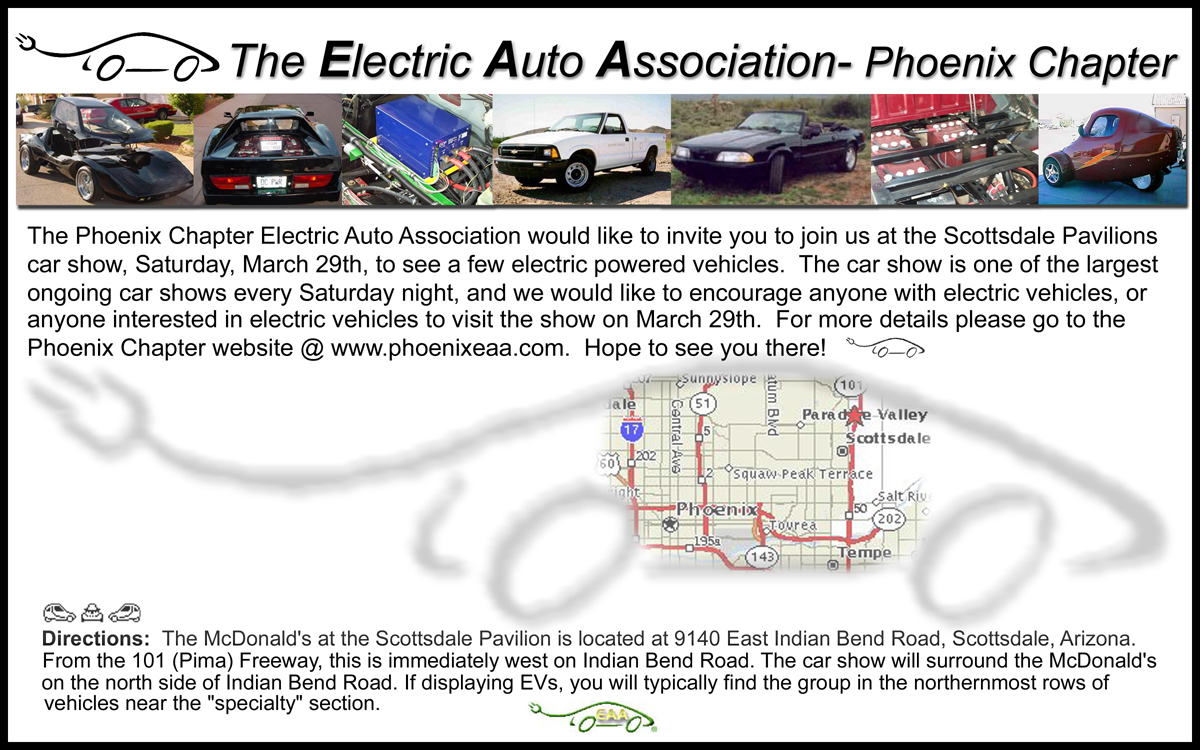
The Phoenix chapter of the EAA will be getting together at the Pavillions
auto show, this Saturday March 29th.  This is a free and informal car show
every Sat. in the parking lot behind the McDonalds.  If any one in the area
wants to stop by with or without your EV we hope to have 10 - 12 of our EV's
there starting at 2:00PM.  You can get more specific info on our website at
the link below.

http://phoenixeaa.com/documents/pavilion_flyer.jpg

Mike Pengelly
Phoenix, AZ
'90 Mustang EV
[EMAIL PROTECTED]
--- End Message ---
--- Begin Message ---
Hi Lawrence,

Are you saying that they have upped the motor voltage from 36 volts to 72
volts in this golf cart mod ?

Garry Stanley

Cable.net.nz
--- End Message ---
--- Begin Message ---
I have updated the think_ev web site
http://geocities.com/think_ev/

It has a link to rent or lease an older euro model
from Hertz (a Ford company) in the SF area.

The Think EV discussion group
http://autos.groups.yahoo.com/group/think_ev/
is waiting for Th!nk Nordic to produce their next
City EV model. They hope that is will be at the end
of 2003.


=====
' ____
~/__|o\__
'@----- @'---(=
. http://geocities.com/brucedp/
. EV List Editor & RE newswires
. (originator of the above ASCII art)
=====

__________________________________________________
Do you Yahoo!?
Yahoo! Platinum - Watch CBS' NCAA March Madness, live on your desktop!
http://platinum.yahoo.com
--- End Message ---
--- Begin Message ---
Hi Steve,

Looks like its not quite as illegal as I first thought it was.

I spoke to a "friendly" certifier last night and even though I haven't seen
him in 10 years we are still both doing the same sort of things :)

Garry Stanley

Cable.net.nz
--- End Message ---
--- Begin Message ---
I'm needing to sell my escort EV to make room (and $) for a new conversion
project.  Unfortunately, my efforts to sell it before the rebuild with an ad
on the tradin' post which lingered a few months, and a few leads I've had
since ti was rebuilt, have all proved fruitless.  I've been asking $6000.
It's at www.evalbum.com/221.html.  I'd like to ask the list if I'm asking
too much.

I calculated that $6000 would just about cover the cost of the electric
components.

Oh, it has new batteries (less than 75 cycles), a battery heater system, and
is located in the middle of the country, in Oklahoma.

Just looking for advice, to see if I should bother listing it like this
again.  Thanks.

IMPORTANT - THIS MESSAGE (INCLUDING ANY ATTACHMENTS) IS INTENDED ONLY FOR
THE USE OF THE INDIVIDUAL OR ENTITY TO WHICH IT IS ADDRESSED, AND MAY
CONTAIN INFORMATION THAT IS PRIVILEGED, CONFIDENTIAL AND EXEMPT FROM
DISCLOSURE UNDER APPLICABLE LAW. IF YOU ARE NOT THE INTENDED RECIPIENT, YOU
SHOULD DELETE THIS MESSAGE IMMEDIATELY AND YOU ARE HEREBY NOTIFIED THAT ANY
READING, DISSEMINATION, DISTRIBUTION OR COPYING OF THIS MESSAGE, OR THE
TAKING OF ANY ACTION BASED ON IT IS STRICTLY PROHIBITED. THANK YOU.
--- End Message ---
--- Begin Message ---
Lee Hart wrote:
>> The first problem is that you are not loading the batteries equally.

Mark Thomasson replied:
> In actual city traffic conditions, all the batteries get used almost
> equally.

That has not been my experience. For many years I drove a ComutaVan,
which has a 3-step 3-contactor controller (36v with resistor, 36v
direct, and 72v direct). Its top speed was 55 mph (at 72v), but my daily
commute was on streets with a maximum 40 mph speed limit (which only
needed 36v). Thus, I only used 72v while accellerating or on hills. Most
of the time was spent cruising at 36v.

With your arrangement, I would have had half the range. I'd arrive at
work with the lower 36v half of the pack dead, but plenty of charge
still left in the upper 36v half.

>> Next problem; you still have a lot of contactors. The way they are
>> arranged, if one fails shorted, it could be disastrous to close the
>> next one.

> Good point. Each battery bank should be fused.

Note that a fuse is a resistor. It will have more voltage drop than a
contactor. They are also amazingly expensive for ones that is guaranteed
to work at high DC voltages and currents. You always need at least some
fuses, but want to minimize the number of them.

I think a better solution is not to use SPST contactors; use SPDT
contactors, built so it is physically impossible to close both contacts
at once even in the event of a welded contact. This is always done in
commercial contactor controllers.

>> This problem has been studied for a very long time by some great
>> minds. You might want to look at some of their solutions.

> Exactly, that's why I'm asking you guys for input!

Most of the "guys" today have never even seen a contactor controller.
:-) So, you'll have to study old equipment, books, articles, patents,
etc. to see how they were done in their "golden age". Nowdays, most of
the engineers who knew how to design them are dead. So, the ones you see
today are often naive designs by people who lack the knowledge and
experience to do it right.

Thus, it's easy to find a high-mileage 1920 Detroit Electric with its
original contactor controller that still works. And, it's easy to find a
low-mileage CitiCar or golf cart with a contactor controller that's
destroyed.

>> For example, the batteries can be switched in series-parallel
>> combinations so the load is always divided equally between them.
>> Twelve 6v batteries can be wired for... 6v, 12v, 18v, 24v, 36v, 72v

> This arrangement would take 33 contacts and gives only 6 steps.

Correct; though that's 11 series/parallel contactors.

> If you are willing to give up on the symmetry, you could get all
> 12 evenly spaced steps.

If you are using a PM motor, then you need more steps because its speed
is directly proportional to voltage. With a series motor (much more
common in EVs), you need fewer steps because motor speed is a function
of both voltage and load. With a series motor, roughly 2:1 voltage steps
turns out to be adequate (6v, 12v, 24v, 48v, 96v, ...)

> The new method would give 15 steps with 15 6v batteries, but only
> use 9 relays. Balancing of battery discharge would depend on the
> natural variability of driving speed.

There was a streetcar controller similar to what you describe. However,
they had a scheme to balance the discharge. All the batteries were in
series. There were two *big* rotary switches, that could select any tap
from 0v to full pack voltage in 1-battery steps. One wire of each rotary
switch went to each side of the motor.

Start with both rotary switches fully counterclockwise, so both motor
leads were at the 0 volt tap. To accellerate, turn ONE of the rotary
switches up. 6v, 12v, 18v, 24v... the farther you advance it, the faster
you go.

But, this would discharge the batteries at the lower end faster, because
they are used less. So, to slow down, leave the first switch where it
was, and move the SECOND switch up to meet it. This brings the motor
voltage back down. 24v, 18v, 12v, 6v, and 0v when both switches are on
the same tap. This discharges the batteries at the higher end of the
pack faster, thus compensating so all batteries average out to the same
discharge rate.

There was a voltmeter between the two taps, so the operator could see
the battery voltage. It was a manual process; he looked at the voltages
to see where his weakest battery was, and avoided using that one.

The rotary switches were big slate panels, with coin-sized contacts
arranged in a circle. The two switch arms were concentric cranks that
the operator controlled manually.

>> The classic series-parallel switch is a single contactor with 3
>> contacts:
>>              ______________________
>>         + __|__       K1b          |
>> battery 1  ___   normally closed    / K1c
>>             |__________/___________|   normally open
>>             |  K1a               __|__+
>>              / normally open      ___   battery 2
>>             |______________________|  -
>>
>> If you don't need to do regen (carry current in both directions),
>> then K1a and K1c can be replaced by a big diode. Then series-
>> parallel switching is done with a single SPST contactor.

> The new method also lets you reduce relay count by using diodes,
> but diodes always have a forward biase voltage drop (~.7 v for
> silicon) and therefore energy loss

Contactors have a voltage drop too, especially as they age.

For low voltage systems you wouldn't use silicon diodes; you'd use
Schottky diodes (0.5v drop), germanium diodes (0.25v drop), or MOSFETs
(even less).

Diodes have other big advantages. They provide a path for the inductive
motor current during switching, which greatly reduces contact arcing to
extend life. They also eliminate the timing problem between opening one
contact and closing another "simultaneously".

Peukert effects

There's another factor you may not be aware of. The amphour capacity of
a lead-acid battery depends on the load current. The higher the current,
the lower the capacity. It's called the "Peukert effect".

Suppose you have golf cart batteries rated at 6v 225ah (at the 20-hour
rate). If you load them at 75 amps, they only deliver 144 amphours. If
you load them at 150 amps, they only deliver 122 amphours.

Now suppose you have twelve of these batteries (a 72v pack). You want to
cruise at a speed that requires 36v at 150 amps. With your controller,
only half the batteries are supplying this current. Each has to provide
150 amps, so you can only drive for 122ah / 150a = 49 minutes.

With a series/parallel controller, the two halves of the pack would be
in parallel, so each battery delivers half the current or 75 amps. Now
you can drive for 144ah / 75a = 115 minutes. That's a big difference --
more than 2:1!

With an electronic PWM controller, it would leave the pack wired for
72v. It would draw 72v at 75 amps from the pack, but deliver 36v at 150
amps to the motor. As for the series-parallel case, you could drive for
115 minutes.

For your scheme to be viable in any but very small vehicles that run at
full speed almost all the time, I think you really must have some way to
equalize the loading on all the batteries.
--
Lee A. Hart                Ring the bells that still can ring
814 8th Ave. N.            Forget your perfect offering
Sartell, MN 56377 USA      There is a crack in everything
leeahart_at_earthlink.net  That's how the light gets in - Leonard Cohen
--- End Message ---
--- Begin Message ---
On Thursday, November 21, 2002, at 03:19 PM, VanDerWal, Peter MSgt
wrote:
Ignore those infidels, they don't know what they are talking about. ;)
The 2hp motors that ASAS has should work ok and are a far cheaper
option
than the skill saws. The Leeson motors are rated for 14 amps whereas
skill
saws are only rated for 10-12 amps.
Things are starting to shape up for my go-kart, so I thought I'd revive
this thread to ask a few more questions of the local experts.
I've decided that I want to go super cheap, just to get it rolling,
then maybe I'll start changing things later. Once I've figured out
what I'm doing I'm going to polish it all off and dress it up nice and
purdy.
I picked up one of the Leeson motors that we discussed, hooked it up to
a 12V SLI that I've got laying around just to verify that it wasn't
damaged or non-functional and was pleased to find that it spins in
either direction easily.
I'm not going to play around with my 144V Insight battery pack, its
really heavy and bulky anyway. So I want to string together a simple
contactor control system for the YTs with forward and reverse. I've
got the wiring diagram figured out but I'm not having much luck finding
appropriate relays. I guess I need one 20A 24VDC SPST and one 20A
24VDC DPDT (or two SPDTs). Nothing I've found so far really fits the
bill, everything is either too big and expensive or too little and
cheap. Any ideas?
The relay idea is workable with cheap relays (like 70amp 24V truck
relays)
Where can I find these? And how cheap are they?
Another question, how big should my wires be? 12GA? 10GA? 8GA?
The good news is that the long forgotten go-kart is still in good
shape. I'm pretty sure the YTs will fit nicely behind the seat in
place of the gas tank. The engine's mounting bracket should do nicely
for securing the new motor. If only the motor had some kind of
mounting holes in it. There's no obvious mode of attachment on the
motor, which will probably be one of my biggest obstacles. Another one
will be to figure out how to get a sprocket on the motor's keyed shaft.
I found some keyed sprockets at Cloud EV, but having never done this
kind of thing before I'm really not sure what I'm looking for.
So, again, advice/experience and any leads on parts/info will be
greatly appreciated!
Thanks,
Matt
--
Honda Insight '01 Monte Carlo Blue
Honda Valkyrie Interstate '99 Forest Green
Honda CR-V '98 Jet Black
Apple Dual 1GHz PowerMac G4
Apple iBook 12.1" 800MHz
Kyocera 7135 Smartphone on Verizon
        Custom Audio Adapters!  Use standard stereo headphones on your 7135!
        <http://www.geocities.com/nokmout/adapter.html>
--- End Message ---
--- Begin Message ---
Does that $ 280 per 12.8 v battery include an individual charger ?
9 x 691 whr = 6.219 kwhrs,  9 x 36 lbs = 324 pounds.
18 T145s for 18 kwrs, 18 x 72 = 1296 pounds.
So, for the same 18 kwrs, 18/6.219 x 324 = 3 x 324 = 972 pounds
saving 324 pounds.
What's wrong with my math ?
NiZn does better in cold weather than Lead-Acid, but what about normal 70
F weather ?    Isn't NiZn only about twice the energy density as
Lead-Acid
(30 whrs/pound verse 15 whrs/pound) in 70 F weather ?
$ 280 per 691 whrs = 40.5 cents/whr for NiZn verse, Cycle Life 500,
But need total distance traveled to get cost per mile.
$ 110 per 1000 whrs = 11 cents/whr for Lead Acid, Cycle Life 500
But need total distance traveled to get cost per mile.

On Mon, 24 Mar 2003 05:09:28 -0400 "Shelton, John D. AW2"
<[EMAIL PROTECTED]> writes:
> All,
>       The 691wh listed for the NiZn is more than double that of
> the yellow
> top's rating of 312wh. So does this mean that if I have a string of
> twelve
> MB80s, I'll have at least as much total energy as two strings of 12
> yellow
> tops run in parralel? Are these the Evercell NiZn? Where are they
> selling
> for only $280? How many T-145s is this equivalent to? Any update on
> the
> cycle tests being conducted by one of the listers? Thanks guys.
>
> John Shelton
>
>
>
> Current pricing, based on recent information, small quantities.
> Shows that
> NiZn and LiIon are competative for inital cost and have longer life
> that
> PbA. Comparison based on YT size form.:
>
> PbA - Optima YT
> price         $120
> weight        45lb
> voltage       12v nominal (13.2v rest, charges up to 14.9v)
> capacity      55ah (C/20; 25ah at C/1 usable max)
> storage       12v*26ah=312wh
> price/wh      $0.385
> cyles         300 (spec)
>
> NiZn - MB80-12-8
> price         $280
> weight        36lb
> voltage       12.8v (charges up to 16.0v)
> capacity      68ah (0.8*68ah=54ah usable max)
> storage       12.8v*54ah=691wh
> price/wh      $0.405
> cyles         500 (spec)
>
> LiIon - TS-LP8581A (4 cells)
> price         $520 (=4*130)
> weight        27lb
> voltage       14.8v nominal (=4*3.7v, charges up to 4*4.3=17.2v)
> capacity      100ah (0.8*100ah=80ah usable max)
> storage       14.8v*80ah=1184wh
> price/wh      $0.439
> cyles         500 (spec)
>
> LiIon - TS-LP90A (4 cells)
> price         $460 (=4*115)
> weight        21lb
> voltage       14.8v nominal (=4*3.7v)
> capacity      90ah (0.8*100ah=72ah usable max)
> storage       14.8v*72ah=1066wh
> price/wh      $0.432
> cyles         500 (spec)
>
>


________________________________________________________________
Sign Up for Juno Platinum Internet Access Today
Only $9.95 per month!
Visit www.juno.com
--- End Message ---
--- Begin Message ---
Greetings all,

With the beginning of spring, now has come the time for that time honored (but
rarely enjoyed) task of mowing the lawn.

Last year my mower died, and my father gave me an old 3.25 hp Lowes (briggs) mower.

It only barely runs and the smell... well you know.

I have talked the wife into letting me replace it with an electric.

We have a 1.75 acre yard.  About 1/2 of it is open field, the rest has lots of
obsticles like bushes, trees and the like.

Some years ago, I mowed the yard with a rechargable ryobi, but it took me three
days to do it, and that was if I never let the grass get too high.  My wife
never could push the ryobi.  It was too heavy.

So, what I need is an easy to push (cause with my allergies, the wife and I have
to share mowing duties) electric with fairly good range.

OR an elec-trak or other electric riding.

So...

Anyone got any suggestions or a good mower for sale?

Thanks.

James
--- End Message ---
--- Begin Message ---
Lawrence Rhodes wrote:
Could the DCP run at 240v?
The T-Rex made by DCP can run 240V just fine (96-336 volts nominal). But
the Raptor made by DCP originally mentioned can only go up to 156V. Note
that the Raptors can do more current multiplying than the T-Rex's; the
big T-Rex is 1000 Amps in both battery and motor loops while the big
Raptor is (I think) 1200 Amps on the battery side and up towards 1800
Amps peak on the motor side.
Otmar's Zilla's (1000A or 2000A versions) are also good on a 240V system.
_________
Jim Coate
1992 Chevy S10
1970's Elec-Trak
http://www.eeevee.com
--- End Message ---
--- Begin Message ---
The one in my work truck is an early zapi (somthing like hmf ,came before
the h2) with regen .  120v 400 amps , it has pulled my lawn trailer for 50 k
and is now working on it's second truck body, It came with regen which has
been burned out for a few years now. When the regen went the controller
would come on  one time then as soon as the micro switch is togoloed it
shuts off. So I re wired the micro swithch which was on the pot box to a
switch in the truck . Trun it on once and leave it and the controller will
stay on and work. The micro switch was what worked the regen . There is some
falt somwhere that won't let the regen stay on and when the micro switch is
hit the regen trys to come on but dosen't and than it shuts the controller
off. other that that it works very well pulling 5280 lbs. with no clutch and
me often taking off in 2 nd gear . What could I get for  somthing like that?
:-(   I wouldn't feel right selling it with all the problems .

Steve Clunn


 ----- Original Message -----
From: "Lawrence Rhodes" <[EMAIL PROTECTED]>
To: <[EMAIL PROTECTED]>
Sent: Monday, March 24, 2003 9:47 AM
Subject: Re: Sob... I think if fried my motor.


> Don't blow that controller.  Sell it to me and get your zilla..uuhhhh what
> kind of controller are you running?? Lawrence Rhodes.......
> ----- Original Message -----
> From: "1sclunn" <[EMAIL PROTECTED]>
> To: <[EMAIL PROTECTED]>
> Sent: Monday, March 24, 2003 3:04 AM
> Subject: Re: Sob... I think if fried my motor.
>
>
> >
> >
> > >
> > > Lawrence Rhodes wrote:
> > > > By revving the motor and popping the clutch I probably caused a a
big
> > spike
> > > > and fried the controller
> >
> > slipping not popping :-)  That is a nice EV , dosn't look like room for
> big
> > ass controller although the new Zilla is small.  Who will be first .
Man
> do
> > i want one . I am pine ing for two 9" and a big one , Just so I can get
to
> > work on time. wish my old controller would blow.
> >
>
>
--- End Message ---
--- Begin Message ---
Steve Clunn wrote:
--------------------------------------
The one in my work truck is an early zapi (somthing like hmf ,came before
the h2) with regen . 120v 400 amps , it has pulled my lawn trailer for 50 k
and is now working on it's second truck body, It came with regen which has
been burned out for a few years now. When the regen went the controller
would come on one time then as soon as the micro switch is togoloed it
shuts off. So I re wired the micro swithch which was on the pot box to a
switch in the truck . Trun it on once and leave it and the controller will
stay on and work. The micro switch was what worked the regen . There is some
falt somwhere that won't let the regen stay on and when the micro switch is
hit the regen trys to come on but dosen't and than it shuts the controller
off. other that that it works very well pulling 5280 lbs. with no clutch and
me often taking off in 2 nd gear . What could I get for somthing like that?
:-( I wouldn't feel right selling it with all the problems .
Steve Clunn
-----------------------------------------
Hi Steve
My first experiences with EVs are with this controller, can you read
Italian? :^0
The Zapi HFM 400 controller has been an orphan for quite a while now, was
originally intended for vehicles lighter than the common auto conversion.
Pulled my hair out trying to remedy fault codes. (I am far from being an EE)
I managed to keep these two vehicles operational (with regen, at 144V)
thanks to some extra boards and parts (and help):
http://www.austinev.org/evalbum/218.html
http://www.austinev.org/evalbum/219.html
Was real easy to pop a mosfet (or two) with these things.
In some ways they worked great, but had many reliability problems.
Anyone else on the list familiar with these?
Sorry, don't have any paperwork or info on diagnostics.
Roy LeMeur Seattle WA
My Electric Vehicle Pages:
http://www.angelfire.com/ca4/renewables/evpage.html
Informative Electric Vehicle Links:
http://www.angelfire.com/ca4/renewables/evlinks.html
_________________________________________________________________
The new MSN 8: advanced junk mail protection and 2 months FREE*
http://join.msn.com/?page=features/junkmail
--- End Message ---
--- Begin Message ---
Jim Coate wrote:
>
> Lawrence Rhodes wrote:
> > Could the DCP run at 240v?
>
> The T-Rex made by DCP can run 240V just fine (96-336 volts nominal). But
> the Raptor made by DCP originally mentioned can only go up to 156V. Note
> that the Raptors can do more current multiplying than the T-Rex's; the
> big T-Rex is 1000 Amps in both battery and motor loops while the big
> Raptor is (I think) 1200 Amps on the battery side and up towards 1800
> Amps peak on the motor side.
>
> Otmar's Zilla's (1000A or 2000A versions) are also good on a 240V system.
>
> _________
> Jim Coate
> 1992 Chevy S10
> 1970's Elec-Trak
> http://www.eeevee.com

Also keep in mind that DCP is NOT selling T-Rexs or Raptors right now,
and won't be for 6-18 months.
So your above 144 volt options are Ot's Z1K and Z2K controllers.
        This market is VERY ripe for a affordable 400 to 800 amp 120 to 480 VDC
Dc controller.
I have my plate full... but the dream still lives.


--
Rich Rudman
Manzanita Micro
www.manzanitamicro.com
1-360-297-7383,Cell 1-360-620-6266
--- End Message ---
--- Begin Message ---
Hi David,
 Remember, these are just observations from experience
selling a VoltsRabbit, not a slight against you, nor
your conversion; you asked for advice... (;-p

1)  Nobody gives a darn about the price of parts.  $6K
buys a 96' Honda Civic with reasonable miles.
2)  Most EVs for sale sell between 3-5K.  Ask Mike
Chancey if he can verify this.
3)  Have you considered stripping it, and lowering the
price? Basically, if you can get the price of the
adapter plate for the glider, you'll be coming out
ahead, since the depreciation on selling EVs is so
high.  Someone might appreciate that, and the battery
racks being already there!
4)  How are gas prices in your area?  Lots of
refineries?  Ethanol mixed?
5)  Sorry, but Escorts aren't sexy.
My suggestion is to lower it $1500, wait 6 months, and
I really think you'll be sold, depending how much
Iraqi oil is on the market then...
Best to you,

--- David Brandt <[EMAIL PROTECTED]> wrote:
> I'm needing to sell my escort EV to make room (and
> $) for a new conversion
> project.  Unfortunately, my efforts to sell it
> before the rebuild with an ad
> on the tradin' post which lingered a few months, and
> a few leads I've had
> since ti was rebuilt, have all proved fruitless.
> I've been asking $6000.
> It's at www.evalbum.com/221.html.  I'd like to ask
> the list if I'm asking
> too much.
>
> I calculated that $6000 would just about cover the
> cost of the electric
> components.
>
> Oh, it has new batteries (less than 75 cycles), a
> battery heater system, and
> is located in the middle of the country, in
> Oklahoma.
>
> Just looking for advice, to see if I should bother
> listing it like this
> again.  Thanks.
>
> IMPORTANT - THIS MESSAGE (INCLUDING ANY ATTACHMENTS)
> IS INTENDED ONLY FOR
> THE USE OF THE INDIVIDUAL OR ENTITY TO WHICH IT IS
> ADDRESSED, AND MAY
> CONTAIN INFORMATION THAT IS PRIVILEGED, CONFIDENTIAL
> AND EXEMPT FROM
> DISCLOSURE UNDER APPLICABLE LAW. IF YOU ARE NOT THE
> INTENDED RECIPIENT, YOU
> SHOULD DELETE THIS MESSAGE IMMEDIATELY AND YOU ARE
> HEREBY NOTIFIED THAT ANY
> READING, DISSEMINATION, DISTRIBUTION OR COPYING OF
> THIS MESSAGE, OR THE
> TAKING OF ANY ACTION BASED ON IT IS STRICTLY
> PROHIBITED. THANK YOU.
>


__________________________________________________
Do you Yahoo!?
Yahoo! Platinum - Watch CBS' NCAA March Madness, live on your desktop!
http://platinum.yahoo.com
--- End Message ---
--- Begin Message ---
My 2nd conversion was a Mercury Lynx which is almost the same as yours. I
realy liked that car
remarks added


From: "David Brandt" <[EMAIL PROTECTED]>


> I'm needing to sell my escort EV to make room (and $) for a new conversion
> project.

Which is going to be   ?


> Unfortunately, my efforts to sell it before the rebuild with an ad
> on the tradin' post which lingered a few months,
> and a few leads I've had
> since ti was rebuilt, have all proved fruitless.

I'm sure not fruitless . The people who came and looked at your EV may never
have seen one before. Now they know
there's another way.


> I've been asking $6000.
> It's at www.evalbum.com/221.html.  I'd like to ask the list if I'm asking
> too much.

When you were rebuilding this car  were you still thinking of selling it . ?
you spent a lot of time getting things just right , why is that not worth
something.


> I calculated that $6000 would just about cover the cost of the electric
> components.

and nothing for your labor?
On the parts and ware , To me it seems that most (not all) EV parts  meters,
motors, dc/dc convetters and controllers don't really ware out but meet with
some user abuse and then die quickly.  I think if the car has been on the
road 20 k that thats a good sighn.  how many EV miles dose it have.  ?


> Oh, it has new batteries (less than 75 cycles), a battery heater system,
and
> is located in the middle of the country, in Oklahoma.

This is another plus as sombody just getting into EV's may not brake in
there pack right.

> Just looking for advice, to see if I should bother listing it like this
> again.  Thanks.
>
how many hours do you have into it ?
Steve Clunn
--- End Message ---
--- Begin Message ---
I would say it's a pretty strict requirement, at least with the Evercels
that I have.

The problem is that the Evercels build up a fair amount of pressure
internally as they charge, and if they aren't upright, that pressure
combined with the weight of the electrolyte can open the relief valve,
resulting in a loss of electrolyte (and other bad things).

S.

----- Original Message -----
From: "Chris Weaver" <[EMAIL PROTECTED]>
To: <[EMAIL PROTECTED]>
Sent: Saturday, March 22, 2003 9:44 PM
Subject: Evercel question


> I saw on the Evercel site that they say the battery should be upright
> during charging.  Anyone have any info about whether that is a strict
> requirement or just safe guidance?  Also, anyone been able to get and use
> the SAFT NiMH watercooled batteries?
>
> Thanks,
> Chris
>
--- End Message ---
--- Begin Message ---
[Contact Elaine directly]


-
Date:  Tue, 25 Mar 2003 05:33:56 -0000
From: "webelaine" <[EMAIL PROTECTED]>
Subject: Sacramento CARB meeting on Thursday: need ride

I hope lots of you are planning to head up to Sacramento for
the California Air Resources Board meeting this coming
Thursday!

It seems like time to speak now or forever hold our peace.

I drive a Ford Th!nk City and was thinking of taking it up
there, but I just made that drive, and people do 75 in the
slow lane-- no thanks!  My Th!nk has a maximum speed of 55.

So I'd love to carpool with a RAV4 owner, since it should
be within RAVing range.

A Production Electric Vehicles Coalition member in Vacaville
is arranging a dinner the night before and motel rooms for
those who are driving up.

Should be good camraderie, and we'll get to hear talking
points for Thursday's meeting.

You can sign up to speak for 3-5 minutes, and it's important
for the CARB to hear that electric cars are a reality--
otherwise, this meeting may be the beginning of the end for
electric cars in California.

For more information about the meeting, go to
 http://www.arb.ca.gov

Elaine L.
Green Th!nk City driver
Web4Elaine at aol dot com

===
====
======
=======
=========
==
-


__________________________________________________
Do you Yahoo!?
Yahoo! Platinum - Watch CBS' NCAA March Madness, live on your desktop!
http://platinum.yahoo.com
--- End Message ---
--- Begin Message ---
Some advertisements for vehicles like you seem to be discussing:

http://adcache.collectorcartraderonline.com/10/2/0/40164820.htm
http://adcache.collectorcartraderonline.com/10/6/0/39890460.htm
http://adcache.collectorcartraderonline.com/10/2/4/42853424.htm
http://adcache.atvtraderonline.com/16/4/0/43287040.htm

These are not body transplants. I don't know what they are called. The key
word seems to be 'monster'.

Joe Smalley
Rural Kitsap County WA
Fiesta 48 volts
NEDRA 48 volt street conversion record holder
[EMAIL PROTECTED]


----- Original Message -----
From: "John Lussmyer" <[EMAIL PROTECTED]>
To: <[EMAIL PROTECTED]>
Sent: Monday, March 24, 2003 9:34 AM
Subject: Re: Better range from less weight


> At 11:23 AM 3/24/2003 -0800, Lee Hart stated:
> >There's bound to be a name for them, but I don't know what it is. This
> >is a small town, and there are at least 2-3 of them around. Anyone else
> >know?
>
> Not a clue, the ones I've usually seen were Camaro bodies on a 4x4 truck
> chassis.
> REALLY stupid looking.
>
> --
> John G. Lussmyer      mailto:[EMAIL PROTECTED]
> Dragons soar and Tigers prowl while I dream....
> http://www.CasaDelGato.Com
>
--- End Message ---