EV Digest 2824

Topics covered in this issue include:
  1) Speed Controller
        by "David B" <[EMAIL PROTECTED]>
  2) EBAY: ComutaCar in Fort Myers, FL
        by Lonnie Borntreger <[EMAIL PROTECTED]>
  3) RE: EV A/C Compressor
        by "Bryan Avery" <[EMAIL PROTECTED]>
  4) Re: Supercaps
        by Seth <[EMAIL PROTECTED]>
  5) Re: Batteries
        by "Mark Hanson" <[EMAIL PROTECTED]>
  6) OT email test
        by Sherri J Hower <[EMAIL PROTECTED]>
  7) Charging efficiency
        by "Christopher Zach" <[EMAIL PROTECTED]>
  8) RE: Better efficiency numbers.
        by "James Jarrett" <[EMAIL PROTECTED]>
  9) RE: Better efficiency numbers.
        by "Eric Penne" <[EMAIL PROTECTED]>
 10) Re: Charging efficiency
        by Peter VanDerWal <[EMAIL PROTECTED]>
 11) Spreadsheet - electic costs
        by "John G. Lussmyer" <[EMAIL PROTECTED]>
 12) RE: Spreadsheet - electic costs
        by "James Jarrett" <[EMAIL PROTECTED]>
 13) Free Tech Paper "Do It Right the First Time"
        by [EMAIL PROTECTED]
 14) RE: Supercaps vs AGM for drag racing?
        by "Jorg Brown" <[EMAIL PROTECTED]>
 15) RE: Spreadsheet - electic costs
        by "John G. Lussmyer" <[EMAIL PROTECTED]>
 16) Re: Todd DC/DC/ converter question
        by Lee Hart <[EMAIL PROTECTED]>
 17) Re: Todd DC/DC/ converter question
        by Lee Hart <[EMAIL PROTECTED]>
 18) Re: Todd DC/DC/ converter question
        by Lee Hart <[EMAIL PROTECTED]>
 19) Re: EV digest 2823
        by Rick Woodbury <[EMAIL PROTECTED]>
 20) Re: Batteries
        by "Philippe Borges" <[EMAIL PROTECTED]>
 21) Re: Battery behavior
        by Paul G <[EMAIL PROTECTED]>
 22) RE: Spreadsheet - electic costs
        by "Bryan Avery" <[EMAIL PROTECTED]>
 23) Re: Free Tech Paper "Do It Right the First Time"
        by Bill Palter <[EMAIL PROTECTED]>
 24) RE: Spreadsheet - electic costs
        by "James Jarrett" <[EMAIL PROTECTED]>
 25) Semiconductors wear (was: Efficiency numbers)
        by Victor Tikhonov <[EMAIL PROTECTED]>
 26) Re: Supercaps vs AGM for drag racing?
        by [EMAIL PROTECTED]
 27) Re: EV A/C Compressor
        by Victor Tikhonov <[EMAIL PROTECTED]>
 28) Re: Saft ni-cad charge profil (was Battery pack sizing questions)
        by "Philippe Borges" <[EMAIL PROTECTED]>
--- Begin Message ---
* LP8.2: HTML/Attachments detected, removed from message *
--- End Message ---
--- Begin Message ---
1977 Sebring Electric Comuta Car in Fort Myers, FL.
http://cgi.ebay.com/ebaymotors/ws/eBayISAPI.dll?ViewItem&category=6472&item=2417187786
--- End Message ---
--- Begin Message ---
I would go in on a group purchase if it meant getting this kind of
pricing.  My only concern is the control electronics & the issue I
mentioned earlier regarding proper system sizing to match the
compressor.  I don't know how critical this really is, but the result if
something goes wrong is not very pretty.  Apparently if the compressor
locks up, then it's pretty much garbage since the unit is hermetically
sealed and can't be repaired.

Rick, Do you know if the development kit includes any additional
components that aren't included with the standard compressor package?

-Bryan Avery

>
> Rick (or anyone else): How about organizing a quantity purchase of
(say)
> 10 systems? That should get the price down, and some knowledgeable
> person could pick the rest of the parts to build workable system.
> --
> Lee A. Hart                Ring the bells that still can ring
> 814 8th Ave. N.            Forget your perfect offering
> Sartell, MN 56377 USA      There is a crack in everything
> leeahart_at_earthlink.net  That's how the light gets in - Leonard
Cohen
--- End Message ---
--- Begin Message ---
Yep, and supercaps like the PC2500 are worse than you think. If you want
to drag race then you probably want 600A out of a string. You will lose
0.6V on a 1 milliohm ESR cap at that current. A 2.5volt cap. Which means
5 caps, at 12.5V full, will immediately sag to 10.5 at 600A, and
continue to drop. At the end of the run you would have ~(1/2*2.5) -(I*R)
volts per cell. Or 0.65V at 600A. You originally had 100 caps to power
your motor at 250V peak, at launch they are 190V (actually more becasue
you are probably in motor loop current limit, not a 600A battery limit)
and they sag to 65V at the end of the run. You lift off the gas and they
are 125V, no load. Sound like fun?

You do that with a cap with an ESR that is half that resistance, and you
can drop your battery current limit to (let's say)500A becasue you are
now bucking the same power but from a higher voltage source So you go
through the lights at ~100V or higher becasue you didn't waste quite as
much energy in the cap and the sag under load is less than half as much.
Really 500 * 0.0005 x 100caps or 25V.


Now if you want to do intermediate power for many, many "micro-cycles"
then even the higher ESR, less expensive caps can make sense. Stick to
low ESR caps for the drags, so that the series string resistance is less
than  or equal to a good AGM string of the same voltage. Or at least
that's my opinion...


Seth

Peter VanDerWal wrote:
>
> FWIW Optima YTs are not the best AGM battery for drag racing, far from it in fact.
>
> For much less than the price of super caps you could buy Bolder TMF
> cells (they still make those don't they?)
> Bill Dube' was sponsored by them for a while (Killacycle 9.4 second 1/4
> mile).  Tiny PbA battery about the same diameter as a "C" cell and
> perhaps 1.5 times as long.  Put out about 300 watts for 10-15 seconds as
> I recall.
>
> The new SVR battery that EV parts is carrying is also better than YTs
> (power to weight) 12V tested to 1500 peak amps,  900 amps for 10
> seconds, weighs 11lbs 8oz and only costs $57.50
> http://www.evparts.com/shopping/product_details.php?code=bt9520
> These will give you roughly the same performance as YTs, weight 1/4 as
> much and cost 1/2 as much (you might even be able to get a bulk
> discount)
>
> There are others out there.
>
> > For my purposes as a drag racer, I'd probably go with the cheapy PC2500s
> > or the Yellow Tops.  That means either $3,080 for the YTs or $11,700 for
> > the PC2500s.  Either would be capable of delivering the power I want for
> > about 10 seconds.  28 Yellow Tops would weigh about 1200 pounds, and the
> > supercaps would weigh only 274 pounds.  If I got the newer model
> > supercap, they would weigh only 198 pounds, but that's not worth
> > doubling their price.
> >
> > So, for the same peak power, cheap supercaps are 1/4 the weight, maybe
> > less, and 4 times as expensive, as high-power lead acid.  (newer
> > supercaps are 1/6 the weight, and 8 times as expensive.)

--
[EMAIL PROTECTED]
--- End Message ---
--- Begin Message ---
Do you have a recommended charging algorithm for Ni-Cads? Is it like an IEI
dv/dt=0 like leadeds? Which model are you using/ how many?
----- Original Message -----
From: "Philippe Borges" <[EMAIL PROTECTED]>
To: <[EMAIL PROTECTED]>
Sent: Thursday, May 29, 2003 3:34 PM
Subject: Re: Batteries


> Saft NiCads are quasi indestructible, we use a bunch of them on our
Scooler
> and go-kart since 5 years now, 0% failure and still strong at full amps.
> Note: we have seen all mistakes a customer can do:
> forget to fill the water in time, short them, wiring not perfectly tight,
no
> connector cleaning...
>
> For the full amps, Saft data i have is near 700A during 10sec max if
> conditions are bad = when they pass 25�C and/or under 5V/module BUT until
> this limits you can stay at full amps !!! so on motor side you have plenty
> of power to burn rubber !
> What a pity cadmium is so crapy, Saft EV ni-cad are really (imho) the best
> batteries we can count on for a moment.
> though waiting for lithium or Ni-zinc...
> The next Scooler would be French Ni-zinc powered.
>
> Philippe
>
> Et si le pot d'�chappement sortait au centre du volant ?
> quel carburant choisiriez-vous ?
> http://vehiculeselectriques.free.fr
>
> ----- Original Message -----
> From: "Jim Coate" <[EMAIL PROTECTED]>
> To: <[EMAIL PROTECTED]>
> Sent: Thursday, May 29, 2003 4:29 AM
> Subject: Re: Batteries
>
>
> > And NiCads are happy in the cold winters so range consistent throughout
> > the year.
> >
> > If anyone has an in with SAFT to find out how often the 680 amps for 10
> > seconds can be repeated, it would be most useful information.
> >
> >
> > Philippe Borges wrote:
> > > Why not a 120V 140A/h Saft ni-cad pack ?
> > > Though, it would be 800 pound for complete (nickel plated connection,
> > > central watering system+box)
> > > 20 X 6V modules.
> > > You will have largely the range you need, good life cycle and Saft
> > > guarantied 270A constant/
> > > 680A (10sec) current for fun driving.
> > >
> > > Philippe
> > >
> > > Et si le pot d'�chappement sortait au centre du volant ?
> > > quel carburant choisiriez-vous ?
> > > http://vehiculeselectriques.free.fr
> >
> >
> >
> > _________
> > Jim Coate
> > 1992 Chevy S10
> > 1970's Elec-Trak
> > http://www.eeevee.com
> >
>
--- End Message ---
--- Begin Message ---
I just switched to web baised mail with my DSL
company.

Wanted to make sure it works
--- End Message ---
--- Begin Message ---
Question:

Back before the Magnecharger and the new pack, when the pack was about 15
amps down (dead) I would put it on the charger and let it go using the
onboard Dolphin charger (2.5 amps/hr). In the morning it would be full, with
a net positive of about an amp on the E-meter.

Since I have the new pack in, charging up to full using the MagneCharger
(from say 30-35 amps down) will leave the E-meter reading -.3 amps at end of
charge.

I know the E-meter uses a charger co-efficiency of 90% or so, but would the
final numbers have really changed based on using a fast charge vs. a slow
one? Or is it the fact the pack is new? Or am I not fully charging my pack.

Chris
--- End Message ---
--- Begin Message ---
Ok,

I re-worked the spreadsheet to include efficencies of the charger and the
batteries.  It gives a detailed cost analysis comparing your electric to
your gasser with everything up to 7 years of life on the batteries.  I realy
don't have an appropriate place to post it right now, so if someone has a
good place to post it I can e-mail it to you.  Otherwise, I can e-mail it to
individual listers who want a copy.

I think now that the math is done, I'll turn this into a dynamic web page.
Someday....


James

James F. Jarrett
Information Systems Associate
Charlotte Country Day School
(704)943-4562


-----Original Message-----
From: [EMAIL PROTECTED] [mailto:[EMAIL PROTECTED]
Behalf Of Lonnie Borntreger
Sent: Thursday, May 29, 2003 6:58 PM
To: Evlist
Subject: Re: Better efficiency numbers.


On Thu, 2003-05-29 at 16:29, James Jarrett wrote:
> Ok, I had to guess at and round off some of my numbers here, so it is not
> the gospel, but I'ts pretty good.  It looks like that IN MY CASE as long
as
> my batteries last more than about 18 months, I come out ahead of a gasser
> financially.  This is based on my electric, and the milage of my current
> gasser.  These are straight out of my Excel spreadsheet.

Could you post that spreadsheet?

Lonnie
--- End Message ---
--- Begin Message ---
I can post it!  Send it to me.

> Ok,
>
> I re-worked the spreadsheet to include efficencies of the charger and
> the batteries.  It gives a detailed cost analysis comparing your
> electric to your gasser with everything up to 7 years of life on the
> batteries.  I realy don't have an appropriate place to post it right
> now, so if someone has a good place to post it I can e-mail it to you.
> Otherwise, I can e-mail it to individual listers who want a copy.
>
> I think now that the math is done, I'll turn this into a dynamic web
> page. Someday....
>
>
> James
>
> James F. Jarrett
> Information Systems Associate
> Charlotte Country Day School
> (704)943-4562
>
>
> -----Original Message-----
> From: [EMAIL PROTECTED] [mailto:[EMAIL PROTECTED]
> Behalf Of Lonnie Borntreger
> Sent: Thursday, May 29, 2003 6:58 PM
> To: Evlist
> Subject: Re: Better efficiency numbers.
>
>
> On Thu, 2003-05-29 at 16:29, James Jarrett wrote:
>> Ok, I had to guess at and round off some of my numbers here, so it is
>> not the gospel, but I'ts pretty good.  It looks like that IN MY CASE
>> as long
> as
>> my batteries last more than about 18 months, I come out ahead of a
>> gasser financially.  This is based on my electric, and the milage of
>> my current gasser.  These are straight out of my Excel spreadsheet.
>
> Could you post that spreadsheet?
>
> Lonnie
--- End Message ---
--- Begin Message ---
You should really reset your E-meter when you change packs.

The charge co-efficiency number is a moving target.  The E-meter
recalculates it based on the packs charging history.  New packs are
definitely more efficient than old packs, but your E-meter probably
still has the old packs history which it's using to calculate charge
co-efficiency.

Reset the E-meter and let it start fresh.  If you have already reset it,
then give it a while and it will sync it's internal calculations with
real world data.

(the 90% is just a ballpark figure where it starts out with an unknown
pack)


On Fri, 2003-05-30 at 06:35, Christopher Zach wrote:
> Question:
>
> Back before the Magnecharger and the new pack, when the pack was about 15
> amps down (dead) I would put it on the charger and let it go using the
> onboard Dolphin charger (2.5 amps/hr). In the morning it would be full, with
> a net positive of about an amp on the E-meter.
>
> Since I have the new pack in, charging up to full using the MagneCharger
> (from say 30-35 amps down) will leave the E-meter reading -.3 amps at end of
> charge.
>
> I know the E-meter uses a charger co-efficiency of 90% or so, but would the
> final numbers have really changed based on using a fast charge vs. a slow
> one? Or is it the fact the pack is new? Or am I not fully charging my pack.
>
> Chris
>
--
EVDL
--- End Message ---
--- Begin Message ---
From: "James Jarrett" <[EMAIL PROTECTED]>
I'ts not the prettiest thing in the world, but it works. The numbers in
Blue are where you type in the data, all the other numbers are calculated
by
the computer.
James F. Jarrett
The file is now available at
http://www.CasaDelGato.Com/EV/electric-costs.xls
--
John G. Lussmyer      mailto:[EMAIL PROTECTED]
Dragons soar and Tigers prowl while I dream....         http://www.CasaDelGato.com
--- End Message ---
--- Begin Message ---
There is a bug.

I accidentally formatted the miles per gallon field as money. Can you change
that or do I need to re-send?

James F. Jarrett
Information Systems Associate
Charlotte Country Day School
(704)943-4562

Sorry no quote today. Visit QLiner.com.


-----Original Message-----
From: [EMAIL PROTECTED] [mailto:[EMAIL PROTECTED]
Behalf Of John G. Lussmyer
Sent: Friday, May 30, 2003 11:36 AM
To: [EMAIL PROTECTED]
Subject: Spreadsheet - electic costs


>From: "James Jarrett" <[EMAIL PROTECTED]>
>
>I'ts not the prettiest thing in the world, but it works.  The numbers in
>Blue are where you type in the data, all the other numbers are calculated
>by
>the computer.
>
>James F. Jarrett

The file is now available at
http://www.CasaDelGato.Com/EV/electric-costs.xls

--
John G. Lussmyer      mailto:[EMAIL PROTECTED]
Dragons soar and Tigers prowl while I dream....         http://www.CasaDelGato.com
--- End Message ---
--- Begin Message ---
* LP8.2: HTML/Attachments detected, removed from message *
--- End Message ---
--- Begin Message ---
I learn so much from this list....  Thanks Peter...

I thought Bolder TMF wasn't around anymore. www.boldertech.com doesn't
seem to work, and the killacycle page
(http://www.killacycle.com/page1.html) says the batteries "are no longer
available".

The SVR battery is impressive, at 900A from 11.5 pounds, but the specs I
find say 300CCA.  I guess the question is, at 900A load, how much does
the output voltage from an SVR-14 sag?  When I built my electric bicycle
for drag racing, the 10.5 pound Hawkers would put out about 450A but
they were sagging to about 9V when they did that.  (Rough numbers)

jorg

-----Original Message-----
From: Peter VanDerWal [mailto:[EMAIL PROTECTED]
Sent: Thursday, May 29, 2003 10:50 PM
To: EV
Subject: RE: Supercaps

FWIW Optima YTs are not the best AGM battery for drag racing, far from
it in fact.

For much less than the price of super caps you could buy Bolder TMF
cells (they still make those don't they?)
Bill Dube' was sponsored by them for a while (Killacycle 9.4 second 1/4
mile).  Tiny PbA battery about the same diameter as a "C" cell and
perhaps 1.5 times as long.  Put out about 300 watts for 10-15 seconds as
I recall.

The new SVR battery that EV parts is carrying is also better than YTs
(power to weight) 12V tested to 1500 peak amps,  900 amps for 10
seconds, weighs 11lbs 8oz and only costs $57.50
http://www.evparts.com/shopping/product_details.php?code=bt9520
These will give you roughly the same performance as YTs, weight 1/4 as
much and cost 1/2 as much (you might even be able to get a bulk
discount)

There are others out there.

> For my purposes as a drag racer, I'd probably go with the cheapy
PC2500s
> or the Yellow Tops.  That means either $3,080 for the YTs or $11,700
for
> the PC2500s.  Either would be capable of delivering the power I want
for
> about 10 seconds.  28 Yellow Tops would weigh about 1200 pounds, and
the
> supercaps would weigh only 274 pounds.  If I got the newer model
> supercap, they would weigh only 198 pounds, but that's not worth
> doubling their price.
>
> So, for the same peak power, cheap supercaps are 1/4 the weight, maybe
> less, and 4 times as expensive, as high-power lead acid.  (newer
> supercaps are 1/6 the weight, and 8 times as expensive.)
--- End Message ---
--- Begin Message ---
At 12:07 PM 5/30/2003 -0400, James Jarrett wrote:
There is a bug.
I accidentally formatted the miles per gallon field as money. Can you
change
that or do I need to re-send?
Fixed.
--
John G. Lussmyer      mailto:[EMAIL PROTECTED]
Dragons soar and Tigers prowl while I dream....         http://www.CasaDelGato.com
--- End Message ---
--- Begin Message ---
Peter VanDerWal wrote:
> Here is the auction page:
> http://cgi.ebay.com/ws/eBayISAPI.dll?ViewItem&item=3023392534

That's it! I have a Todd PC75, and it works on AC or DC input. It looks
exactly like that photo. It measures 14.75" long x 4" high x 7.25" wide
(at the mounting flanges). The one in the photo may be a shorter, lower
power version. My old PC30 (30 amp) was about half the length.
--
Lee A. Hart                Ring the bells that still can ring
814 8th Ave. N.            Forget your perfect offering
Sartell, MN 56377 USA      There is a crack in everything
leeahart_at_earthlink.net  That's how the light gets in - Leonard Cohen
--- End Message ---
--- Begin Message ---
Joe Smalley wrote:
>
> Why did they change the design and then go out of business?

I think the design was junky and crude. It used multiple flyback
converters in parallel to get the desired output, with only one control
circuit so they didn't share power well.

It is actually more efficient and cheaper to build one large DC/DC
converter than multiple parallel ones. And, the voltage doubler input
topology costs less and has better efficiency and power factor.

So, I think they were run out of the market by better units.
--
Lee A. Hart                Ring the bells that still can ring
814 8th Ave. N.            Forget your perfect offering
Sartell, MN 56377 USA      There is a crack in everything
leeahart_at_earthlink.net  That's how the light gets in - Leonard Cohen
--- End Message ---
--- Begin Message ---
Peter VanDerWal wrote:
>
> Next question, they made some low voltage units designed for EVs.  Are
> these required for 120V EVs (that sag to say 95V)?
>
> If so is it possible to modify one for low voltage?

Remember that these old Todds were designed for 120v *AC* input. They
had a bridge rectifier and filter capacitors that used this to produce
~160 volts DC. Thus, the DC/DCs were really designed for 170vdc
operation.

As you lower the input voltage, a switcher draws more input current in
an effort to keep the output voltage the same. So if you ran a Todd with
120vdc input, it ran hotter and less efficiently. They didn't have any
protection circuitry, so if input voltage went too low, they just burned
up!

95vdc operation is very risky. Unless you seriously limited the output
current, the Todd would be very likely to burn itself up.

Since they are basically a very simple circuit, you can modify them for
different voltages. I have the circuit diagrams. First, there are
trimpots inside to adjust the current limit for the primary side
MOSFETs. You would need to adjust them for a survivable current limit
with your lower input voltage. This will let it work and survive at
lower input voltages, but you will get less power output.

Second you may want to change the transformer turns ratio to get back
the full power output even with the reduced input voltage. You can
either remove turns from the primary, or add turns to the secondary.
This is a nasty job, as there are several transformers and they are
glued together. To do it right, you would replace the primary with fewer
turns of heavier wire.

Finally, depending on how low you go, you may need to replace the
MOSFETs with lower on-resistance parts.
--
Lee A. Hart                Ring the bells that still can ring
814 8th Ave. N.            Forget your perfect offering
Sartell, MN 56377 USA      There is a crack in everything
leeahart_at_earthlink.net  That's how the light gets in - Leonard Cohen
--- End Message ---
--- Begin Message ---
> I like
> the sound of that $700-800 price a lot better.  Rick, is this price only
> for volume purchases as an OEM?

Sorry for the misinformation. I didn't know you had to be an OEM. The quote
we got was for about $2,000 for the first one (a development kit) and then
$850 each in low quantities.

I suggest that you go to Vintage Air for putting a system together. They
have the knowledge of doing custom A/C installations in cars like no other.
I'm pretty sure they'll work with you on an electric compressor. They also
may have a better source for the Sanden compressors as they buy about 10,000
per year of the standard automotive compressors from them.

Vintage air will also know how to size a system for a vehicle. We decided
that 12,000 BTUs would be plenty for the Tango.

I tried an experiment on a 100 deg. + day in Montreal. We put a 5,000 BTU
household A/C in the window of a Corolla that we were renting and found that
it didn't do much. If the air is blowing right on you it certainly helps,
but it took forever to lower the inside temperature below 90 deg.

Hope this helps.

Rick Woodbury                                     Phone: (509) 624-0762
President, Commuter Cars Corporation          Toll-free: (800) 468-0944
Doubling the capacity of freeways                   Fax: (509) 624-1466
Quadrupling the capacity of parking            Cellular: (509) 979-1815
Zero to 60 in under 4 seconds
715 E. Sprague Ave., Suite 114             Email: [EMAIL PROTECTED]
Spokane, WA 99202                      Web: http://www.commutercars.com
--- End Message ---
--- Begin Message ---
Yes I'm talking about STMR5-140.
we have few complete (ready to connect to your application) genuine 36 and
72V pack available here   ;^)
For Saft ni-cad, you have to really worry near 48�C, sensor against the case
(50�C expected inside), at this level the on-board computer of the French EV
log the time they support such danger zone treatment.
In Fench EV charger don't stop at 35�C because they use STM RE(liquid
cooled)
The water cooling pomp goes on at 30�C and stop at 25�C.
But sincerely without talking about racing, 280A continuous on Ni-cad side
is not bad at all !
My 120V100A/h Saxo is limited at 250 motor Amps and still 100km/h 80km range
for 1100 kgs...and i like it !

Philippe

Et si le pot d'�chappement sortait au centre du volant ?
quel carburant choisiriez-vous ?
http://vehiculeselectriques.free.fr

----- Original Message -----
From: "David Roden (Akron OH USA)" <[EMAIL PROTECTED]>
To: <[EMAIL PROTECTED]>
Sent: Friday, May 30, 2003 2:10 AM
Subject: Re: Batteries


> On 29 May 2003 at 21:34, Philippe Borges wrote:
>
> > Saft data i have is near 700A during 10sec max if
> > conditions are bad = when they pass 25�C and/or under 5V/module ...
>
> That would be for STM5-140s.  The limit is 5C, or 136 * 5 = 680 amps.
>
> For the STM5-100s that Ralph had, the limit is 500 amps.  Each 5C "hit"
> raises the internal temperature a little more; at some point you're going
to
> hit the ceiling.  But when you have a moderately heavy vehicle and 600 amp
> controller, and you have to climb some hills, what are you supposed to do
if
> it takes longer than 10 seconds -- get out and push?
>
> I think heat is the problem here.  Nicads ^love^ cold weather, but if you
> see ambient over 35 deg C very often (95 deg F), and you expect to
routinely
> request more than 2C amps, you have to be more careful. I suspect that you
> really should have aggressive cooling, and temperature management that
> starts backing off the controller current limit when internal cell
> temperature exceeds 40 deg C, maybe 50 at the most.  Without automated
> temp
> management, you'll just have to watch the temperature carefully and
> discipline your right foot.
>
> Saft says in the manual that if internal temperature hits 60 deg C (140
deg
> F), STOP NOW.  And that's internal temperature; most means of measuring
> the
> temp will be external and will lag significantly.
>
> Saft also suggest that, after use, you hold off charging until temperature
> falls below 35 deg C.  So when you come home and plug in the car, your
> battery box fans need to start up right away, and your charger should
> probably watch the temperature too.
>
> The STM5-140s, or even better the STM5-180s, if you can find any, are
> probably on safer ground. They're bigger and can sink more heat.  But the
> STM5-100s are definitely best suited to light vehicles.  They are fine for
> Solectria Forces and similar cars, which weigh under 2500lb and have 250
> amp
> max inverters.  For larger or faster vehicles, using 2 parallel strings
> might be an option, if you can find the space.
>
> I suspect, but don't know for sure, that some of this sensitivity to heat
is
> an unintended consequence of the reduced-maintenence design in the newer
> 100s and 140s.
>
> BTW, the heat issue isn't exclusive to Saft nicads.  The Ovonics NiMH that
> were fitted to the NiMH EV1s had even worse problems.  GM actually used
> the
> car's aircon to cool the battery tunnel, and wouldn't lease the NiMH cars
in
> the hottest regions of the US.  (Well, OK, they wouldn't lease them in
> ^most^ of the US, but you know what I mean.)
>
> I believe I've heard something like this for the Nickel Zinc Evercells.
And
> I wouldn't be at all surprised if it turns out that the Thundersky Lithium
> Ion blocks need careful thermal management for long life, too.  Perhaps
it's
> unavoidable with batteries that have relatively high energy densities.
>
> David Roden
> Akron OH USA
>
--- End Message ---
--- Begin Message ---
Lawrence wrote:
When a battery comes up to target voltage and then drops in voltage below
all the other charging batteries what does this indicate?  Battery feels
cool.  Resting voltage is about .1 volt lower than other batteries.   This
is a sealed battery.  Lawrence Rhodes......
I have a more drastic example; one that drops to about 13.6v while
the rest are finish charging at 15v (plus or minus 0.2v). That
battery was baked hard in its first year--it was vented so much I
just am happy it still works.
I would bet your voltage dropper has been vented a few times. My
recommended test is to check the voltage ever 5 minutes during
charge, starting at least one half hour before you expect any battery
to pop up in voltage. There you should see the time where its voltage
rises over 15v - and at amp levels high enuf to vent it.
Don't worry about this to much though, just make sure the charger is
no longer repeating the abuse. My well vented Optima has put in 3
more years of service this way. Only last year did it start to show
lowered capacity. Its still not the smallest battery in the pack, but
has dropped from number 1 to number 8 (out of 10).
Neon
P.S. - that is 4 years without any regulators or a decent charger!
--- End Message ---
--- Begin Message ---
I would suggest adding a field to enter the projected life of the pack
as well so that the cost of replacing a new pack every 2, 3, 4 years,
etc. is calculated into the annual cost and cost per mile of operating
the electric vehicle.  This will make it easier to compare the cost
effectiveness of batteries such as Ni-Zn or Li-Ion. Of course, we don't
really know how long these batteries will last but using a conservative
estimate would at least give some idea of the cost over the life of the
battery pack.

-Bryan Avery

> -----Original Message-----
> From: [EMAIL PROTECTED] [mailto:[EMAIL PROTECTED]
On
> Behalf Of John G. Lussmyer
> Sent: Friday, May 30, 2003 10:13 AM
> To: [EMAIL PROTECTED]
> Subject: RE: Spreadsheet - electic costs
>
> At 12:07 PM 5/30/2003 -0400, James Jarrett wrote:
> >There is a bug.
> >
> >I accidentally formatted the miles per gallon field as money. Can you
> >change
> >that or do I need to re-send?
>
> Fixed.
>
> --
> John G. Lussmyer      mailto:[EMAIL PROTECTED]
> Dragons soar and Tigers prowl while I dream....
>       http://www.CasaDelGato.com
--- End Message ---
--- Begin Message ---
Please send me a copy of this paper.

> A free copy of "Do It Right the First Time" is available from
> [EMAIL PROTECTED]

Thanks,
Bill Palter


>
> --part1_bd.32c468fd.2c08daf4_boundary
> Content-Type: text/plain; charset="US-ASCII"
> Content-Transfer-Encoding: 7bit
>
>
> This paper details the 4 major steps from deciding to build an EV to
> installation and testing.   It was presented with Seth Murray, a high school
> student,
> at NESEA's Energy in Schools Conference on November 14-15, 2002.  Seth
> converted an S10 and entered the ATdS winning a number of awards.  The email paper
> has links to Seth's pictures showing S10 construction, the ATdS race, and how
> he survived a major accident.
>
> A free copy of "Do It Right the First Time" is available from
> [EMAIL PROTECTED]
>
> Electric Vehicles of America, Inc. (EVA) is the leader in EV Safety with the
> use of Anderson SBX connectors, the First Inertia switch, dual contactors, and
> more.  A paper describing safety is available also free.  Its title is
> "Safety First".
>
> Just email your request to  --------    [EMAIL PROTECTED]
>
> Please do not send your request to the EV Digest.
>
> We send our catalog with all technical paper requests.
>
>
> "Anyone can build an EV - but building great EVs
> requires experience and engineering."
>
>
> Bob Batson P.E.
> [EMAIL PROTECTED]
> Free Offers at Home Page
> www.EV-America.com
>
> Electric Vehicles of America, Inc. (EVA)
> Tel# 603-569-2100
> Fax# 603-569-2900
> 11 Eagle Trace
> P.O Box 2037
> Wolfeboro, NH 03894
> ***********************************
> Authorized Distributor for Advanced DC Motors,
> Curtis; DC Power System Controllers,
> Albright Contactors, and other EV component manufacturers.
> Free catalog. Largest EV Component supplier in the East
> Electric cars, trucks, motorcycles, boats, ski-dos, and more.
> *******************************************
>
>
>
>
> --part1_bd.32c468fd.2c08daf4_boundary
> Content-Type: text/plain; charset=us-ascii
> Content-Transfer-Encoding: 7bit
>
> * LP8.2: HTML/Attachments detected, removed from message  *
>
> --part1_bd.32c468fd.2c08daf4_boundary--
--
Bill Palter ([EMAIL PROTECTED])
--- End Message ---
--- Begin Message ---
IT is there at the bottom it shows you the cost per year and yearly savings
(if any) based on a pack lasting 1-7 years.

James

James F. Jarrett
Information Systems Associate
Charlotte Country Day School
(704)943-4562

Sorry no quote today. Visit QLiner.com.


-----Original Message-----
From: [EMAIL PROTECTED] [mailto:[EMAIL PROTECTED]
Behalf Of Bryan Avery
Sent: Friday, May 30, 2003 2:37 PM
To: [EMAIL PROTECTED]
Subject: RE: Spreadsheet - electic costs


I would suggest adding a field to enter the projected life of the pack
as well so that the cost of replacing a new pack every 2, 3, 4 years,
etc. is calculated into the annual cost and cost per mile of operating
the electric vehicle.  This will make it easier to compare the cost
effectiveness of batteries such as Ni-Zn or Li-Ion. Of course, we don't
really know how long these batteries will last but using a conservative
estimate would at least give some idea of the cost over the life of the
battery pack.

-Bryan Avery

> -----Original Message-----
> From: [EMAIL PROTECTED] [mailto:[EMAIL PROTECTED]
On
> Behalf Of John G. Lussmyer
> Sent: Friday, May 30, 2003 10:13 AM
> To: [EMAIL PROTECTED]
> Subject: RE: Spreadsheet - electic costs
>
> At 12:07 PM 5/30/2003 -0400, James Jarrett wrote:
> >There is a bug.
> >
> >I accidentally formatted the miles per gallon field as money. Can you
> >change
> >that or do I need to re-send?
>
> Fixed.
>
> --
> John G. Lussmyer      mailto:[EMAIL PROTECTED]
> Dragons soar and Tigers prowl while I dream....
>       http://www.CasaDelGato.com
--- End Message ---
--- Begin Message ---
Lee Hart wrote:
>
> Electronic controllers don't wear out; they just work until
> you exceed some rating and they "snap" (over-voltage, over-current,
> over-temperature, or some other rating exceeded).

Lee, I wish this was true, but this is wrong statement.

Electronic components do wear out and have predictable life time.
Mechanisms are well known and the life of the semiconductor
parts even within specifications cannot be expected indefinite.
They can be built for long life (like satellite parts), but makes
no sense to built a 100 year lasting part for a gadget no one wants
10 years later. We're talking computers, cell phones, CD players
and things like that.

Industrial grate parts are better, but still fixed life time.

Minimum 10-30 years though for typical parts you get from digikey
or mouser, far longer than mechanical wear of ICE.

I do life tests and failure analysis of ICs for living.

Victor
--- End Message ---
--- Begin Message ---
I still have over110 new svr14s batteries for sale,but this model does not
put out 1500amps like the svr14s on Rod Wildes web page.The ones I have are $15
ea + shipping. I also have super power17ah marathorn nicads 4 sale.
                                         Dennis Kilowatt Berube
--- End Message ---
--- Begin Message ---
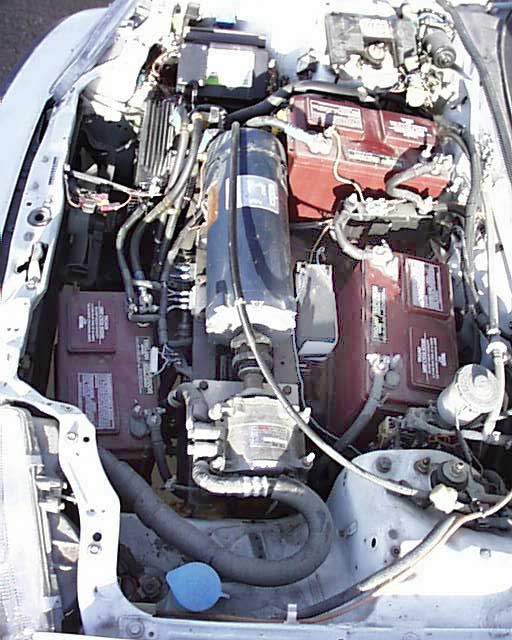
FWIW, In my old life I used stock A/C from my Honda driven by Leeson
PM DC motor:

http://metricmind.com/dc_honda/hood2.jpg
http://metricmind.com/dc_honda/ac1.jpg

The 1.5 hp motor (160V 6.7A working directly off of 120V pack)
was overkill: when A/C was on it didn't even slow down the motor a
bit. Cooling was excellent, and lock up was prevented by
simple 10A fuse - when the pressure builds up too much, so does
the motor current and the fuse blows before pressure reach dangerous
level.

I plan to re-use it again with smaller motor (AC or DC brushless)
unless there is good deal with potential group buy and worthwhile
benefits.

Victor

Bryan Avery wrote:
>
> I would go in on a group purchase if it meant getting this kind of
> pricing.  My only concern is the control electronics & the issue I
> mentioned earlier regarding proper system sizing to match the
> compressor.  I don't know how critical this really is, but the result if
> something goes wrong is not very pretty.  Apparently if the compressor
> locks up, then it's pretty much garbage since the unit is hermetically
> sealed and can't be repaired.
>
> Rick, Do you know if the development kit includes any additional
> components that aren't included with the standard compressor package?
>
> -Bryan Avery
>
> >
> > Rick (or anyone else): How about organizing a quantity purchase of
> (say)
> > 10 systems? That should get the price down, and some knowledgeable
> > person could pick the rest of the parts to build workable system.
> > --
> > Lee A. Hart                Ring the bells that still can ring
> > 814 8th Ave. N.            Forget your perfect offering
> > Sartell, MN 56377 USA      There is a crack in everything
> > leeahart_at_earthlink.net  That's how the light gets in - Leonard
> Cohen
--- End Message ---
--- Begin Message ---
it seems you are making a commissioning charge...not good at all if the
voltage is low:

Commissioning cycle of STM monoblocks
STM 5-100 STM 5-100 STM 5-140
MR MRE MR
Current (I) 7 A      10 A    9 A
Time (t)      21 h    15 h     22 h
Voltage (V) no limit *
* Voltage can reach 9 V per monoblock.
Maximum temperature at the beginning of the charge: + 35�C
Maximum temperature during the charge: + 50�C

extract of Technical manual installation, operation and maintenance for
Ni-Cd STM MR-MRE monoblocks type
you can find here:
http://www.ziggr.com/ftp/evl/stmuk.pdf
and more charge details here
http://www.aracnet.com/~rmerwin/prizm/SAFT_Stm5-100mre.ChargeMode.pdf

My Saxo documentation indicate this charge procedure to wake up modules :
*between 0 to 4V/module   ... 10V to 80V for 120V pack
"preliminary charge" = low amps depend on voltage
*between 4 to 5,25V/module ... 105V to 80V
"first" charge  = 10A during 12minutes and normal charge

In our usage, taking care of them is 80% electronics brain (amps/temp
monitoring, charge profiles...) and 20% user (not to often 100% DOD, good
watering , connection control and cleaning) and...nickel plated connector
;^)

Philippe

Et si le pot d'�chappement sortait au centre du volant ?
quel carburant choisiriez-vous ?
http://vehiculeselectriques.free.fr

----- Original Message -----
From: "Ralph Merwin" <[EMAIL PROTECTED]>
To: <[EMAIL PROTECTED]>
Sent: Thursday, May 29, 2003 11:10 PM
Subject: Re: Battery pack sizing questions


> Victor Tikhonov writes:
> >
> > Why not buy few same NiCds just to replace damaged ones? THis is the
> > only
> > expense then, no rebuilds needed. May be you can find used ones of
> > the same type.
>
> I did buy used replacements.  I changed out the first three modules
> that died and tried to reinitialize the pack.  Two more modules died
> in the process (9 amps for 15 hours).  This led me to believe that
> the whole pack was soon going to die, module by module.
>
> Then I learned that my car's configuration was drawing too much current
> for too long a time for the SAFTs, which, according to a Brusa engineer,
> leads to "dramatically reduced lifetimes".
>
> If I want to continue to use NiCads, I would need to change to larger
> modules and add more of them to keep my peak current draw below the
> SAFT 'continuous' rating.
>
> Many other people report that NiCads are almost indestructible, which
> is why I used them.  I assume something about my configuration or use
> patterns is wrong, and the theory of damaging them with excessive
> currents is certainly a plausible explanation.
>
> It would be interesting to hear others.  I do have the option of
> replacing the entire pack with another used pack, but unless I know why
> my old pack died and can change something to fix the problem, it would
> be pointless.
>
> Ralph
>
--- End Message ---