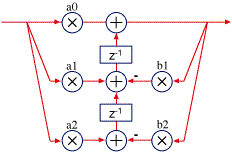
These are good questions!  Since there must be a delay associated with each
feedback path, I don't see any way to avoid pushing the delays around to
get a unit delay at each feedback "throw point" in the Faust specification.
 This increases the number of delays but it should not change the
computation (e.g., (x+y)' versus x'+y'). Extra delays can definitely be
eliminated by optimization, but I don't know how feasible it would be to do
carry out such transformations on the internal "block diagram normal form"
used by the Faust compiler. - Julius
On Thu, Apr 24, 2014 at 4:17 AM, D <[email protected]> wrote:

> D <dddd@...> writes:
>
> >
> > Julius Smith <jos <at> ...> writes:
> >
> > >
> > >
> > > Ok, all four direct-form biquads are now in filter.lib
> > > (after you pull the latest master):
> > > tf21(b0,b1,b2,a1,a2) = // tf2, direct-form 1:
> > >     _ <:(mem<:((mem:*(b2)),*(b1))),*(b0) :>_
> > >     : ((_,_,_:>_) ~(_<:*(-a1),(mem:*(-a2))));
> > > tf22(b0,b1,b2,a1,a2) = // tf2, direct-form 2:
> > >     _ : (((_,_,_:>_)~*(-a1)<:mem,*(b0))~*(-a2))
> > >       : (_<:mem,*(b1)),_ : *(b2),_,_ :>
> > > _;
> > > tf22t(b0,b1,b2,a1,a2) = // tf2, direct-form 2 transposed:
> > >     _ : (_,_,(_ <: *(b2)',*(b1)',*(b0))
> > >       : _,+',_,_ :> _)~*(-a1)~*(-a2) :
> >
> > I've just recently started looking at Faust, so I'm still working to
> > properly parse it.  Is there 5 unit delays in tf22t (three explicit
> > and two implicit from recursion)?  How does this compare with
> > a biquad direct form II with 2 unit delays?
>
> Just to follow on, I wanted to understand what the Faust compiler
> would be doing in this situation.  Is it the case that you input the
> system with a description involving 5 unit delays, but it still
> generates a system with 2?  (In which case my previous question
> could be changed to, is it possible to describe the system in the
> Faust language using 2 unit delays, so that the Faust description
> more closely parallels the direct form II transposed network?).
>
> This is the C++ code generated from tf22t.  It ends up keeping
> 4 pieces of state:
>
> - Last sample input, x*z-1, as fVec0
> - Last sample output, y*z-1, as fRec0
> - Last sample output again, fRec1 == fRec0
> - Delay of the b2 / a2 branch, as Vec1
>
> Maybe a really smart C++ compiler could get rid of the double
> output state (but semantically I don't think you could do that
> optimization), but that still leaves the system with 3 vs 2 states.
>
> fVec0[0] = fTemp0;  // input
>
> // b2 * (x*z-1) - a2 * (y*z-1)
> fVec1[0] = ((b2 * fVec0[1]) - (a2 * fRec0[1]));
>
> // ((b2 * (x*z-1) - a2 * (y*z-1)) * z-1) +
> //   b1 * (x*z-1) + b0 * x - a1 * (y*z-1)
> fRec1[0] = ((fVec1[1] + ((b1 * fVec0[1]) + (b0 * fVec0[0]))) - fRec1[1]);
> fRec0[0] = fRec1[0];
> output0[i] = (FAUSTFLOAT)fRec0[0];
>
> // post processing
> fRec0[1] = fRec0[0];
> fRec1[1] = fRec1[0];
> fVec1[1] = fVec1[0];
> fVec0[1] = fVec0[0];
>
> Just wanted to check that I got all of that right.  Is there a way to get
> Faust to generate C++ code that would be closer to the two state
> form?  And is there a way to describe the network in the Faust language
> in a manner that is more similar to the 2 delay network?
>
> Thanks again
>
> >
> > I read the difference as the fact that it sums the output of
> > individual delays instead of delaying the sums?  For example
> > instead of delaying b1 - a1, b1 and a1 are each individually
> > delayed and then summed.
> >
> > Besides using twice (well 2.5x) the memory I guess this shouldn't
> > have an effect on the system?
> >
> > When you flatten out the system like this, is it still really
> > considered direct-form 2 transposed?  To me while the algebra
> > is of course identical I am not sure if I would see it as the same
> > form, since of course the signal network is quite different, and
> > also the states are different.
> >
> > Is it not possible to implement the 2 unit delay signal network
> > directly in Faust? IE:
> >
> > http://www.earlevel.com/DigitalAudio/images/BiquadTDFII.gif
> >
> > Thanks
> >
> > > _;
> > > tf21t(b0,b1,b2,a1,a2) = // tf2, direct-form 1 transposed:
> > >     tf22t(1,0,0,a1,a2) : tf22t(b0,b1,b2,0,0); // or write
> > > it out if you want
> > > I have a little resonator filter-bank project that may be able to see
> > > some differences in numerical behavior, and I'll report any
> > > findings.
> > > - Julius
> >
> >
> ------------------------------------------------------------------------------
> > Start Your Social Network Today - Download eXo Platform
> > Build your Enterprise Intranet with eXo Platform Software
> > Java Based Open Source Intranet - Social, Extensible, Cloud Ready
> > Get Started Now And Turn Your Intranet Into A Collaboration Platform
> > http://p.sf.net/sfu/ExoPlatform
> > _______________________________________________
> > Faudiostream-users mailing list
> > Faudiostream-users <at> lists.sourceforge.net
> > https://lists.sourceforge.net/lists/listinfo/faudiostream-users
> >
>
>
>
>
>
>
> ------------------------------------------------------------------------------
> Start Your Social Network Today - Download eXo Platform
> Build your Enterprise Intranet with eXo Platform Software
> Java Based Open Source Intranet - Social, Extensible, Cloud Ready
> Get Started Now And Turn Your Intranet Into A Collaboration Platform
> http://p.sf.net/sfu/ExoPlatform
> _______________________________________________
> Faudiostream-users mailing list
> [email protected]
> https://lists.sourceforge.net/lists/listinfo/faudiostream-users
>


--
"Anybody who knows all about nothing knows everything" -- Leonard Susskind
------------------------------------------------------------------------------
Start Your Social Network Today - Download eXo Platform
Build your Enterprise Intranet with eXo Platform Software
Java Based Open Source Intranet - Social, Extensible, Cloud Ready
Get Started Now And Turn Your Intranet Into A Collaboration Platform
http://p.sf.net/sfu/ExoPlatform
_______________________________________________
Faudiostream-users mailing list
[email protected]
https://lists.sourceforge.net/lists/listinfo/faudiostream-users