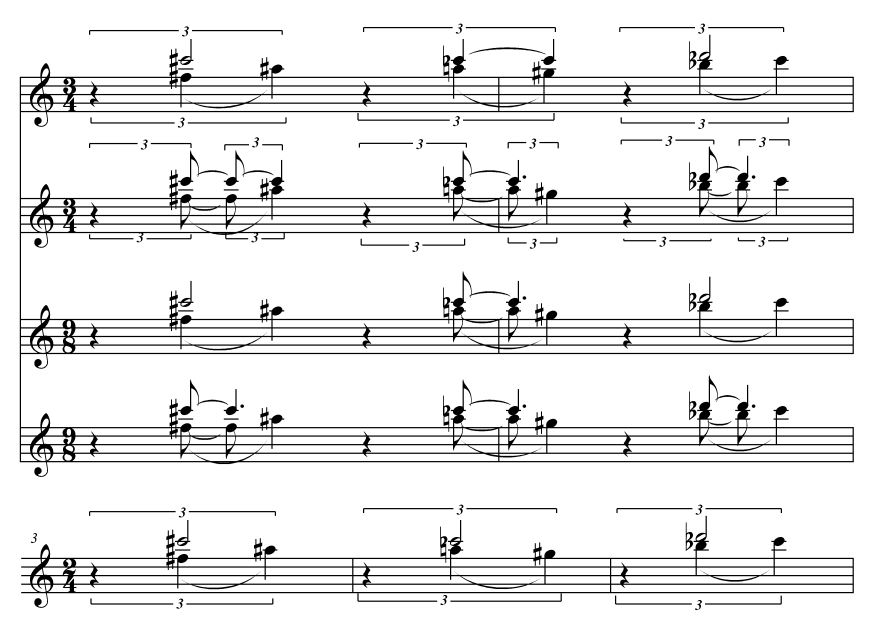
On 6 Sep 2010 at 17:59, Darcy James Argue wrote:

> On 6 Sep 2010, at 5:35 PM, David W. Fenton wrote:
>
> > I find it hard to believe:
> >
> > a. that the MS we are looking at is Williams's hand, OR
>
> Why? It's certainly not a professionally recopied score. It's either
> Williams's manuscript, or it's his orchestrator's. (Not sure if he had
> starting delegating stuff to orchestrators at that point in his
> career.)
We were told it's a film cue from a movie. I assumed it was
transcribed by ear.

> > b. that a copyist faced with the notation you suggest would
> > transform it into quarter-note triplets.
>
> I was actually suggesting the opposite -- that the notation in the
> manuscript is shorthand.

Because it actually captures what is going on musically better than
your version? I'd certainly agree with that.

> > Assuming this isn't Williams's own hand, it would mean that your
> > assumption about copyist intervention is not correct.
>
> Film composers and orchestrators use quite a bit of shorthand in their
> scores. This could easily be shorthand.
>
> The thing to do would be to check the parts, obviously.

I think it very unlikely original materials for film scores from the
1980s would be widely available to just anybody.

> >> More broadly, you'll find over-the-barline triplets split by a tie
> >> at the barline in everything from Stevie Wonder songbooks to Steve
> >> Reich scores.
> >
> > Being able to find the notation you're advocating does *not* mean
> > each instance of it is an easier-to-read substitute for quarter-note
> > triplets.
>
> You are moving the goalposts -- I was merely supporting my position
> that the tied-over-the-barline notation is more standard than the
> alternative.

But it depends on the repertory. I wouldn't attempt to dispute you
that it's more common in your repertory. But I didn't fully
appreciate the level of complexity of what you were proposing until I
tried to notate it myself -- to me, it's only going to be easier to
perform for people who are used to triplet subdivisions as a norm,
and are accustomed to seeing ties within triplet notation.

> > I returned to the original and it does seem to me that the
> > syncopated performance might not be too much of a problem, given
> > that it's offbeats within the triplet, but I can't really agree that
> > Darcy's approach is clearer. I tried it out (assuming I've
> > understood it), and here is what I came up with (I have no idea if
> > I'm interpreting the accidentals correctly, and didn't bother to
> > adjust collisions, etc.):
> >
> >  http://dfenton.com/images/Triplets.png
>
> This is helpful, actually! However, you've slightly misinterpreted the
> notation I would suggest.
>
> Beats one and two of the first measure and beats two and three of the
> second measure I would leave untouched -- i.e., same as in the top
> line of your example.

Do you mean you'd notate it like my first 9/8 example, but in 3/4
with triplets for the quarters and 8ths? That is, the top line,
except for the middle figure, which would be like the second line?

To me, that's really confusing, as it makes the second figure look
like it's a completely different rhythm from the other two, whereas
it's quite clear that they are all precisely the same rhythm in the
2/4 version (which is ultimately what's really going on here, i.e., 3
measures of 2/4 superimposed on two measures of 3/4; put another way,
3 measures of 3/4 in the time of 2 measures of 3/4; but that's what
the tuplets indicate quite clearly!).

> I also suggested that it might be a good idea to extend the triplet
> bracket from beat 3 of the first measure to the end of the triplet in
> the second measure. I don't think that's strictly necessary but it
> could be helpful in this case.

I don't really know what standard practice for tuplet brackets is.

> My point in bringing up the 9/8 alternative is that I doubt anyone
> would ever seriously suggest that the final eighth note of that
> measure be written as a quarter note, and the first eighth note of the
> following measure be left empty. The 9/8 version requires a tie over
> the barline to be comprehensible.

But it's not in 9/8, not at any level. The only reason to choose 9/8
is to make a rhythmic pattern's exact relationship to the beat clear,
but doing so entirely misrepresents the musical content, in my
opinion.

--
David W. Fenton                    http://dfenton.com
David Fenton Associates       http://dfenton.com/DFA/

_______________________________________________
Finale mailing list
[email protected]
http://lists.shsu.edu/mailman/listinfo/finale