https://www.frontiersin.org/journals/science/articles/10.3389/fsci.2025.1657323/full
*Authors*: John C. Moore, Marc Macias-Fauria, Michael Wolovick

*09 September 2025*

*A Viewpoint on the Frontiers in Science Lead Article*
*Safeguarding the polar regions from dangerous geoengineering: a critical
assessment of proposed concepts and future prospects*
<https://doi.org/10.3389/fsci.2025.1527393>


*Key points*
-Academics, activists, and Arctic inhabitants are deeply concerned about
cryosphere systems at imminent risk of collapse, and yet decades of
“consequences-based” lobbying have failed to produce sufficient political
will for deep decarbonization.

-There are moral imperatives to search for tools that may help stabilize
polar Earth systems and to explore knowledge co-production and co-design
with Arctic peoples to ensure both local and global benefits.

-We propose a “compassionate harm reduction” paradigm, whereby climate
scientists prioritize the well-being of humanity and take responsibility to
thoroughly understand any potential interventions that might minimize the
harm from the consequences of climate change.

A new paradigm

The prevailing “consequences-based paradigm” defines the role of climate
scientists as informing the public about the negative effects of climate
change, assuming this will mobilize political action to reduce emissions.
Under this paradigm, research into strategies other than decarbonization is
often seen as counterproductive, an argument advanced by Siegert et al. (1
<https://www.frontiersin.org/journals/science/articles/10.3389/fsci.2025.1657323/full#B1>)
in their Frontiers in Science lead article, “Safeguarding the polar regions
from dangerous geoengineering.” Yet after half a century of alarm-raising,
this paradigm has failed to generate the political will needed for deep
decarbonization.

This article uses insights from 27 academics, activists, and Arctic
inhabitants to propose an alternative: a “harm-reduction paradigm.” We
maintain that climate interventions research and decarbonization are not
mutually exclusive. Instead of focusing solely on the problems, climate
scientists should also explore all potential solutions to reduce harm to
humanity. The effectiveness and risks of interventions remain uncertain,
and only further research can address these questions; research that some,
including Siegert et al. (1
<https://www.frontiersin.org/journals/science/articles/10.3389/fsci.2025.1657323/full#B1>)
seek to halt. This perspective also carries implications for governance.
Stewards of the Arctic

Unlike Antarctica, the Arctic is more accessible, making it a more likely
starting point for intervention field trials. It is not a global commons,
and Arctic peoples must be central to any decision-making. Preference from
those in the mid-latitudes are secondary. The key question is: how should
decisions be made— through evidence or guesswork? Evidence includes both
traditional knowledge and the scientific method, each of which has long
produced valuable insights. Whether climate interventions make sense, pose
risks, or are preferable to inaction remains unknown and cannot be
determined without comprehensive research across legal, scientific, and
technical domains.

Pirita Näkkäläjärvi, President of the Saami Parliament in Finland, states:
“It is my personal opinion that we need to keep all options open and
research climate interventions because of the risk of exceeding the goal of
limiting global temperature rise to 1.5 degrees and the risk of crossing
multiple climate tipping points” (2
<https://www.frontiersin.org/journals/science/articles/10.3389/fsci.2025.1657323/full#B2>).
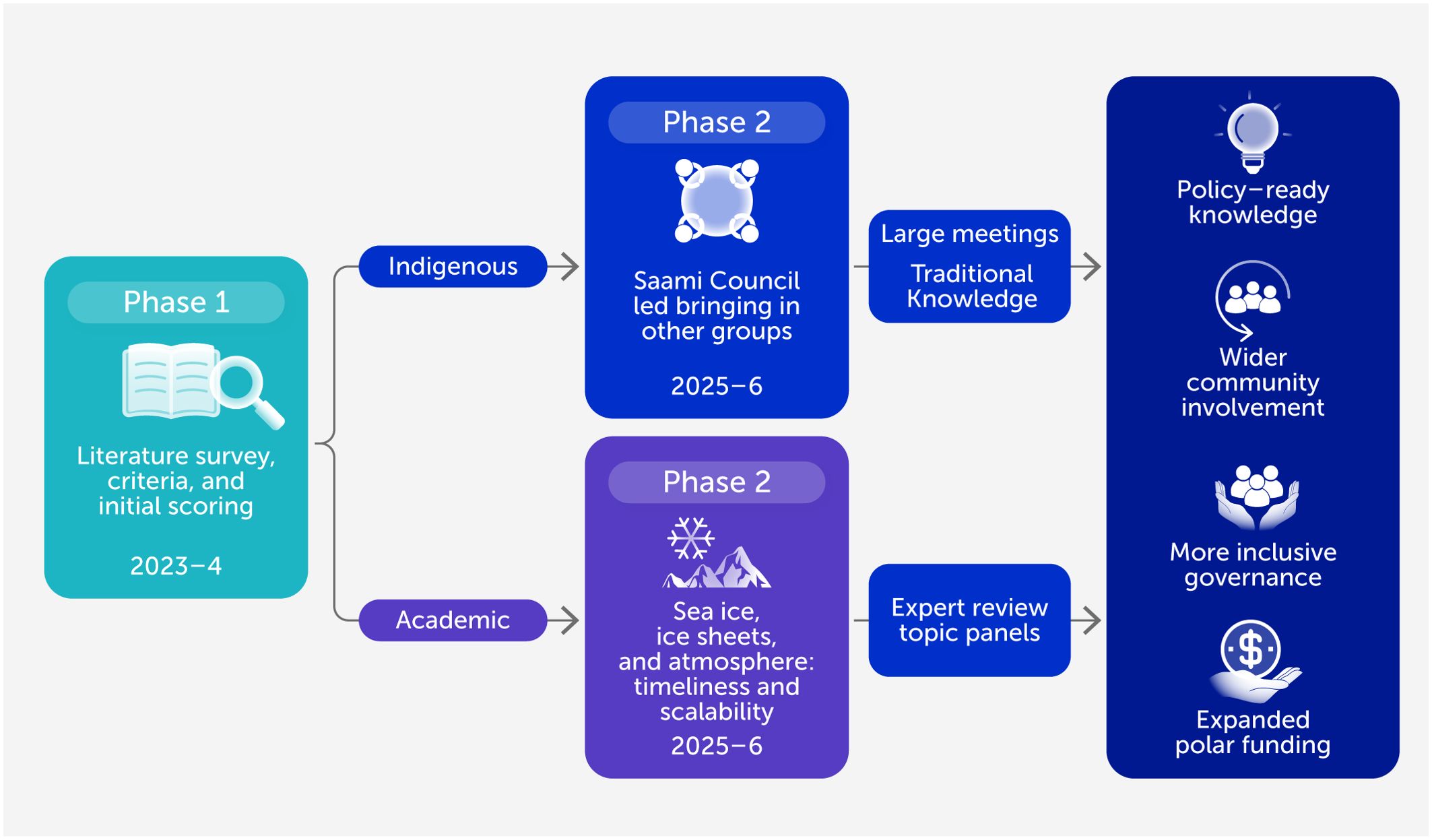
Motivated by these concerns, the University of the Arctic has set up a
review process for high-latitude interventions (
https://climateinterventions.org/), led by the Saami Council and
incorporating both academic and traditional knowledge perspectives (Figure 1
<https://www.frontiersin.org/journals/science/articles/10.3389/fsci.2025.1657323/full#f1>).
Gunn-Britt Retter, Head of the Arctic and Environmental Unit of the Saami
Council, explains: “The Saami Council acknowledges the need to face
suggested intervention ideas and initiatives that are developed or are
being developed. (…) It is our position that a rights-based perspective
must be the foundation in any evaluation of intervention suggestions in
relation to strengths and weaknesses and benefits and co-benefits. (…)
Saami Council’s participation in this project should not be interpreted as
Saami Council’s endorsement or support of the intervention suggestions
assessed” (private communication). Another core group interested in the
future Arctic are the youth. Anni Pokela, strategic planner with Operaatio
Arktis and a Gender Studies student at Helsinki University, asks: “Are we
truly ready to accept the damage, the suffering that’s unavoidable without
climate intervention? Or are we going to give climate repair a chance?”
(private communication).
Figure 1
[image: Flowchart depicting a two-phase process. Phase 1 (2023-2024)
involves a literature survey and initial scoring. Phase 2 (2025-2026)
splits into two paths: Indigenous, led by the Saami Council, and Academic,
focusing on sea ice, ice sheets and atmopshere. Both paths engage in large
meetings and expert panels, leading to policy-ready knowledge, community
involvement, inclusive governance, and expanded polar funding.]
<https://www.frontiersin.org/files/Articles/1657323/fsci-03-1657323-HTML-r1/image_m/fsci-03-1657323-g001.jpg>

*Figure 1*. The methodology adopted by the University of the Arctic for an
evaluation of intervention ideas. The Saami Council leads the indigenous
knowledge stream but engages with other indigenous groups in the Arctic
Council. Meetings include three distinct groups: traditional knowledge
holders, indigenous politicians, and indigenous experts. The meetings take
various formats, including formal workshops, town halls
and council meetings, in addition to awareness campaigns and general
capacity-building activities.
In their lead article, Siegert et al. ask: “Why would a nation such as
Greenland embrace a geoengineering solution to sea level rise?”—since sea
levels around Greenland’s coasts are falling as the ice disappears. A good
way to find out is to ask Greenlanders. Those of us that have done so
readily identified several reasons for pursuing interventions research. For
example, many Greenlanders have empathy and feel a sense of solidarity with
low-income communities around the world who are already experiencing the
impacts of sea level rise. Furthermore, the ice itself is a global good
which, if valued appropriately (3
<https://www.frontiersin.org/journals/science/articles/10.3389/fsci.2025.1657323/full#B3>),
would be highly rewarding for Greenland. Finally, declining sea levels
impact Greenlanders directly, for instance through boat collisions with
unmapped islets previously submerged (4
<https://www.frontiersin.org/journals/science/articles/10.3389/fsci.2025.1657323/full#B4>
).
*Challenges of decarbonization* There is near-universal agreement among
scientists and policymakers that decarbonization is essential. The Earth is
already at 1.5°C above pre-industrial levels, and no climate intervention
can work sustainably without rapid emissions cuts. Yet, glossing over the
serious challenges involved is, at best, naïve.  Siegert et al. (1
<https://www.frontiersin.org/journals/science/articles/10.3389/fsci.2025.1657323/full#B1>)
describe a scenario in which global temperature is stabilized at 0.9°C
above preindustrial levels; a target long since past. While we agree that
this “simple vision for Antarctica is appealing,” it is also practically
impossible. Even in 2020, achieving net zero required global investments in
clean-energy and carbon-removal infrastructure exceeding US$ 4 trillion
annually by 2030 (5
<https://www.frontiersin.org/journals/science/articles/10.3389/fsci.2025.1657323/full#B5>).
With President Trump now actively reversing United States commitments to
renewable energy, despite the United States being the world’s largest
historical emitter of greenhouse gasses, the likelihood of achieving rapid
global decarbonization in time to meet climate goals is becoming
increasingly remote. Meanwhile, human activities continue to drive
planetary warming: the most effective large-scale geoengineering experiment
to date.
*Governance: Moral hazard *A widely touted argument against research into
climate interventions, and used by Siegert et al. (1
<https://www.frontiersin.org/journals/science/articles/10.3389/fsci.2025.1657323/full#B1>),
is that such research may reduce the likelihood of decarbonization. This is
known as the “mitigation deterrence” or “moral hazard” argument. However,
evidence is mixed: public attitudes show weak and variable support for this
hazard, and there is equally strong evidence of the opposite effect (6
<https://www.frontiersin.org/journals/science/articles/10.3389/fsci.2025.1657323/full#B6>):
that is, the idea of interventions can motivate people to take
decarbonization more seriously. Furthermore, anticipating moral hazard may
limit policymakers’ options (7
<https://www.frontiersin.org/journals/science/articles/10.3389/fsci.2025.1657323/full#B7>).
Support for intervention research is strongest among those suffering the
worst climate impacts, especially in the Global South and among Indigenous
peoples (8
<https://www.frontiersin.org/journals/science/articles/10.3389/fsci.2025.1657323/full#B8>
).
*Motives and vested interests: *Opinions on geoengineering are often
influenced by who funds the research and their motives. Who gains from
Arctic intervention research? The fossil fuel and mineral extraction
industries have clear interests in the Arctic, which holds an estimated 25%
of untapped global gas reserves, 13% of oil, and large amounts of rare
earth elements, such as 40% of global palladium (9
<https://www.frontiersin.org/journals/science/articles/10.3389/fsci.2025.1657323/full#B9>).
These resources become more accessible with reduced snow and ice cover or
minimal sea ice, which also facilitates safer transport. Thus, resource
extraction industries are unlikely to fund efforts to preserve the Arctic
cryosphere intact; unless they are cynically assuming interventions will
fail. Many institutions active in Arctic research, including the University
of the Arctic and the University of Cambridge, have published strong
ethical statements rejecting support from such sources (10
<https://www.frontiersin.org/journals/science/articles/10.3389/fsci.2025.1657323/full#B10>
).
*The precautionary principle: *Environmental risks are often cited to
oppose geoengineering research [e.g., (1
<https://www.frontiersin.org/journals/science/articles/10.3389/fsci.2025.1657323/full#B1>)].
The precautionary approach has framed most environmental legislation over
the last 30 years. Davis and Vinders (11
<https://www.frontiersin.org/journals/science/articles/10.3389/fsci.2025.1657323/full#B11>)
examine how it might apply to geoengineering. In the case of intervention
field trials, environmental risks are generally very small. However,
perceived risk often includes concern over a “slippery slope” toward
broader deployment. Davis and Vinders (11
<https://www.frontiersin.org/journals/science/articles/10.3389/fsci.2025.1657323/full#B11>)
argue that political risk should be included when evaluating harms, but
this assessment must consider both the risk of using an intervention and
the risk of not using one; the “moral hazard of non-research”. This latter
risk is missing in Siegert et al.’s lead article, and more broadly, for
example in the European Union advisory report (12
<https://www.frontiersin.org/journals/science/articles/10.3389/fsci.2025.1657323/full#B12>).
Risks of inaction include the socio-economic damages from crossing climate
tipping points, which are concentrated in the polar regions (13
<https://www.frontiersin.org/journals/science/articles/10.3389/fsci.2025.1657323/full#B13>
).
*Sticky slopes, not slippery ones: *Does research inevitably lead to
deployment—the so-called slippery slope? Not if research is ethically
guided [e.g., (14
<https://www.frontiersin.org/journals/science/articles/10.3389/fsci.2025.1657323/full#B14>)].
There is a duty to report all findings, positive and negative, often
required by funders. A roadmap to potential deployment involves many
checkpoints along the way [e.g., (15
<https://www.frontiersin.org/journals/science/articles/10.3389/fsci.2025.1657323/full#B15>)].
So far, the slope has proven “sticky,” not slippery. For example, the
Arctic Ice Project ceased sea ice albedo modification research due to
toxicity concerns about hollow glass microspheres that they proposed for
use (https://srm360.org/news-reaction/arctic-ice-project-shuts-down/).
Similarly, simulations suggest that the retreat of the Sermeq Kujalleq
(Jakobshavn Isbræ) glacier is unstoppable (16
<https://www.frontiersin.org/journals/science/articles/10.3389/fsci.2025.1657323/full#B16>
).
*The induction fallacy: *Both decarbonization and climate interventions are
extraordinarily challenging. Many intervention proposals will prove
unworkable due to feasibility, cost, timing, or risk. Whether this has
already been demonstrated, as Siegert et al. claim, is debatable given how
little research exists on most options (Figure 1
<https://www.frontiersin.org/journals/science/articles/10.3389/fsci.2025.1657323/full#f1>).
Dismissing all climate interventions because some face serious challenges
is a logical error, known as the induction fallacy. Siegert et al. examine
only 5 of the 61 intervention ideas identified so far for the Arctic (
https://climateinterventions.org), with more likely to emerge in the
future. Conversely, advocating a sole focus on carbon emissions reduction
risks falling into “single action bias”—the tendency to favor one familiar
solution while neglecting others that may also be necessary.
*Risk-risk assessment: *Any analysis of climate interventions must be
framed as a risk–risk assessment; that is, comparing the risks and benefits
of doing something versus doing nothing. Neither the present nor a past
climate state can serve as a viable baseline. We must compare against
plausible future scenarios. While research is still at an early stage for
many intervention ideas, the literature on stratospheric aerosol injection
(SAI) is relatively mature. It generally finds that projected impacts under
SAI are less severe, and crucially more equitable, than those under future
greenhouse gas climate scenarios. Supporting references (see the Supplementary
Material
<https://www.frontiersin.org/journals/science/articles/10.3389/fsci.2025.1657323/full#hsm>)
point to economic benefits, an overwhelmingly positive cryospheric
response, and net human health gains from reduced temperatures that
outweigh risks from air pollution and from ozone depletion by a factor of
13 (17
<https://www.frontiersin.org/journals/science/articles/10.3389/fsci.2025.1657323/full#B17>
).
*Conclusions: *While scientific and public support for climate action is
strong (18
<https://www.frontiersin.org/journals/science/articles/10.3389/fsci.2025.1657323/full#B18>),
the political will for large-scale emissions reductions remains
insufficient. Siegert et al. frequently cite fossil fuel-funded opposition
as a key barrier. While such interests have obstructed other major societal
and economic changes in the past (e.g., workers’ rights, environmental
regulations), those changes still occurred. Hence, lack of climate action
is likely not solely due to fossil fuel-funded opposition but to fossil
fuels being integral to modern lifestyles [e.g., (19
<https://www.frontiersin.org/journals/science/articles/10.3389/fsci.2025.1657323/full#B19>
)]. We argue that the “consequences-based paradigm,” the belief that
warning the public will generate political action, has failed. After
decades of warnings, emissions remain high. Worse, fear-based messaging may
even boost support for right-wing parties [e.g., (20
<https://www.frontiersin.org/journals/science/articles/10.3389/fsci.2025.1657323/full#B20>)],
which typically oppose climate action. By contrast, research into climate
interventions could offer much-needed optimism and agency. Our
“harm-reduction paradigm” suggests that such research may strengthen public
confidence in our ability to meet climate challenges, thereby fostering
solidarity, expanding empathy, and ultimately increasing political support
for decarbonization. Of course, we could be wrong, and even if we are right
that climate interventions research boosts support for decarbonization,
that does not necessarily mean interventions themselves are good ideas.
Only more research can answer that. Yet, Siegert et al. claim that “further
research into these techniques would not be an effective use of limited
time and resources” (1
<https://www.frontiersin.org/journals/science/articles/10.3389/fsci.2025.1657323/full#B1>).
Arguing to shut down an entire field of scientific research is an
extraordinary claim and requires extraordinary proof. Pointing to specific
problems in individual techniques, as the authors do, is not sufficient.
Further research may resolve those problems. The only potentially valid
argument against all interventions research is political: that it might
reduce motivation to decarbonize. But even setting aside the ethical
concern of suppressing science for political reasons, this argument is
unproven. It rests entirely on the same “consequences-based paradigm” of
climate outreach. It is fair to say that the “consequences-based paradigm”
has, after half a century, failed to deliver. Perhaps, it is time that we
try compassionate harm reduction instead.
*Source: Frontiers*

--
You received this message because you are subscribed to the Google Groups
"geoengineering" group.
To unsubscribe from this group and stop receiving emails from it, send an email
to [email protected].
To view this discussion visit
https://groups.google.com/d/msgid/geoengineering/CAHJsh9-RB%2B1whrGqQsz6buKW28Q2YhP_fsj4rDkJ4sCbyNkuyQ%40mail.gmail.com.