https://plus.thebulwark.com/p/literature-in-a-time-of-conglomeration
-----

Literature in a Time of ConglomerationA new book about the publishing
industry offers surprising new perspectives on American literary history.
<https://substack.com/profile/1046539-adam-fleming-petty>
ADAM FLEMING PETTY <https://substack.com/@verydistantlands>
JAN 5, 2024
15
Share
<https://substackcdn.com/image/fetch/f_auto,q_auto:good,fl_progressive:steep/https%3A%2F%2Fsubstack-post-media.s3.amazonaws.com%2Fpublic%2Fimages%2Fa35129de-2a8e-44c8-8033-63e1d77e2a73_2100x1500.jpeg>


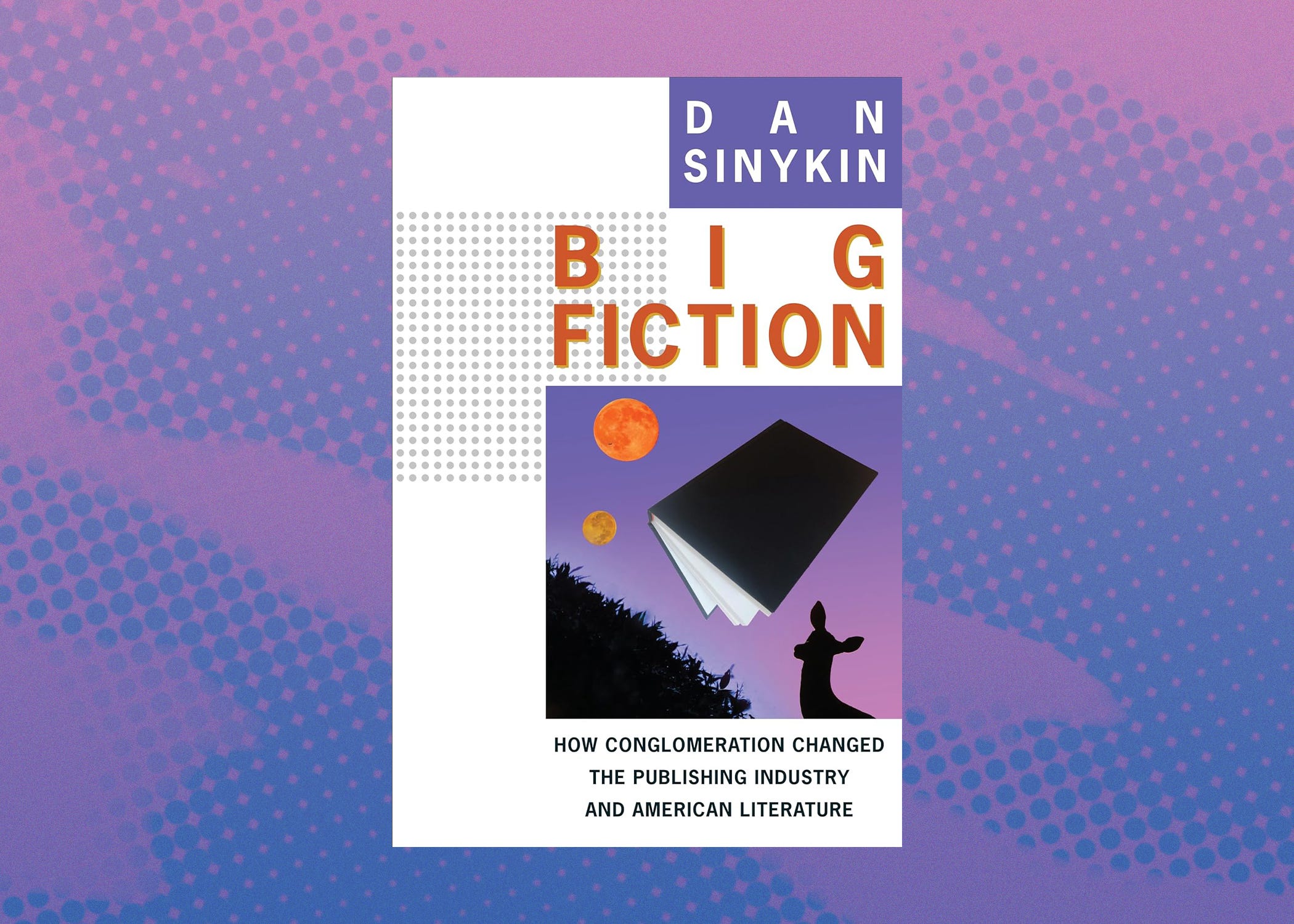
*Big Fiction
<https://www.amazon.com/Big-Fiction-Conglomeration-Publishing-Literature/dp/0231192959/?tag=bulwark08-20>**How
Conglomeration Changed the Publishing Industry and American Literature
<https://www.amazon.com/Big-Fiction-Conglomeration-Publishing-Literature/dp/0231192959/?tag=bulwark08-20>*
by Dan Sinykin
Columbia, 328 pp., $30

A COLOPHON IS THE DESIGN OR SYMBOL publishers place on the spines of their
books. Glance at your bookshelves, at the bottom edge of each volume, and
you might see the Knopf borzoi, the three fish of FSG, the interlocking
geometric shapes of Graywolf. They are designed to be clean and distinctive
but unobtrusive
<https://brianlarossa.medium.com/the-tales-behind-the-branding-of-32-storied-book-publishers-f14679107742>.
The colophon is not what sells the book, after all. The author does. One
doesn’t buy *A Dance with Dragons *because it’s published by Bantam. One
buys it because it’s written by George R.R. Martin.

Yet Dan Sinykin, a scholar and critic, has made the colophon and the
commercial realities it represents his primary field of inquiry. His new
book, *Big Fiction: How Conglomeration Changed the Publishing Industry and
American Literature*, tracks the progress of U.S. fiction from the postwar
era to the present from the perspective of the colophon. Harcourt, Brace;
Pantheon; New American Library: these and countless other publishers
provide the institutional setting of Sinykin’s account. His cast of
characters includes editors, agents, publicists, fundraisers, accountants,
and others who belong to the ranks of literature’s wage laborers, toiling
away behind the veil of the colophon. Though often unknown, they take
center stage here, their talents, idiosyncrasies, and shortcomings on full
display.

But why does Sinykin tell this story in this way? Is it just an exercise in
nostalgia, a chance to swoon over the glamour of midcentury New York
publishing, with its three-martini lunches and rampant sexism? Hardly. For
all the office gossip, Sinykin’s focus ultimately remains on the books
themselves and on their authors, seen through the lens of the industry that
shaped their careers and enabled some of them in turn to alchemize their
commercial dealings into their art.

This is an angle both promising and obvious enough that it’s a surprise to
learn that others have not already worked this ground over many times. Its
unexpected novelty is what gives Sinykin’s project its unique insights,
making it a real contribution to our understanding of recent American
literary history. Comparisons to Mark McGurl’s landmark *The Program Era*,
a study of the influence of the writing workshop on American letters, are
not inapt. By slightly modifying his viewfinder, Sinykin perceives new
meanings and details in the literary history’s equivalents of the most
photographed barn in America
<https://www.atlasobscura.com/places/t-a-moulton-barn>.

Take David Foster Wallace. *Infinite Jest* is a vast novel concerning,
among many other things, a fictional film called *Infinite Jest, *said to
be so entertaining that viewers become enraptured while they watch it,
neglecting to eat or move until eventually dying as they sit on the couch,
amused to death. Yet the intentions of the filmmaker, James O. Incandenza,
were noble. He sought to create a film that would bring his son, Hal, out
of his emotionless, irony-soaked cocoon. But his artistic powers were so
great he inadvertently created a weapon, one sought after by government
agencies and Québécois separatist terrorists. Critics and readers have
interpreted *Infinite Jest *as an exploration of a generational malaise.
But in Sinykin’s telling, the story mirrors Wallace’s engagement with the
publishing industry.

Support our independent coverage of books, the arts, and ideas by signing
up for a free or paid *Bulwark* subscription.
Join

Wallace, like Incandenza, held high hopes for his work. He believed *Infinite
Jest*—originally titled “A Failed Entertainment”—could lead readers out of
ironical disaffection and into genuine engagement with others. To do that,
he believed the book itself needed to fail, at a fundamental level, as that
would compel the reader to look for true fulfillment not in the book, but
in life. But Michael Pietsch, Wallace’s editor at Little, Brown, took a
more, well, *commercial* approach to the book’s publication. He cut
hundreds of pages from the manuscript, rearranging chapters and events in a
way that arguably made the book stronger. He made the book’s heft a selling
point, sending out postcards to booksellers promising the book would offer
“infinite pleasure.” And it worked. The book became a hit, and Wallace a
star. Yet Wallace was dismayed. The book he hoped would act as a clarion
call for authenticity became yet another product. Sinykin writes:

The example of *Infinite Jest* demonstrates the limits of authorial agency
in the conglomerate era. Wallace’s error was to put too much faith in the
ability of his writing to transcend its conditions of production. He
overestimated the power of his message and underestimated that of his
medium.

“The conglomerate era” is Sinykin’s term of art for the present state of
publishing, wherein independent publishers are absorbed by ever-larger
media companies in an ascending spiral of consolidation. Up to the
immediate post-WWII period, publishing was a fairly local, personal
business, with houses founded by whiskered men shipping out books to stores
on an irregular basis. Today we have the Big Five—HarperCollins, Simon &
Schuster, Macmillan, Hachette, and Penguin Random House—whose countless
imprints <https://almossawi.com/big-five-publishers/> account for the rough
majority of books published in the marketplace. (The Big Five nearly became
the Big Four when Penguin Random House attempted to purchase Simon &
Schuster, but the sale was blocked
<https://www.nytimes.com/2022/10/31/books/penguin-random-house-simon-schuster.html>
by
the Biden Justice Department on the basis that such a massive company would
constitute an uncompetitive monopoly. Simon & Schuster was then purchased
<https://apnews.com/article/simon-schuster-kkr-book-publishing-penguin-random-house-797c3f383bfc1e60ea9a9bd48c6abfab>
by
private equity firm KKR to the tune of $1.62 billion. Its fate remains
uncertain.)

Taking the business of publishing out of the hands of the whiskered
eccentrics and putting it into those of the men in the gray flannel suits
didn’t happen overnight, but it didn’t take long.

After WWII, hundreds of thousands of veterans attended college on the GI
Bill. This transformed education—and publishing. Those veterans were eager
readers, and publishing obliged their tastes with cheap mass-market books
that could fit into the back pocket of a pair of Levi’s. A wide variety of
titles was available, spanning everything from the classics to the
hard-boiled pulp of Mickey Spillane. One such publisher was New American
Library, where a young E.L. Doctorow worked during the 1960s. He soon tried
his hand at writing fiction himself, eventually producing *Ragtime *in 1975.

*Ragtime *was popular to a degree that’s difficult to imagine now. It was a
hit with critics, winning the National Book Critics Circle award. It was
also a hit with readers. The mass-market rights were sold for $1.85 million
(the equivalent of about $10.9 million today). It looked like a bright new
future was in store, one where serious-yet-entertaining novels would be
both well remunerated and showered with hosannas. But *Ragtime*’s success
actually marked the end of the party. After seeing steady growth throughout
the ’50s and ’60s, book sales began to taper off during the late ’70s, part
of a larger cultural and economic slump. Yet publishing had grown far
bigger. Many imprints had been bought by larger companies like Gulf +
Western, which demanded returns on their investments. During the
cocaine-fueled ’80s, publishers would post huge profits, but the authors
producing the fastest-selling goods plied their talents in genre, as
Danielle Steel did in romance and Stephen King in horror. Literary authors
like Doctorow were increasingly forced to trade in sales for prestige.
Indeed, the term “literary fiction” was coined during this era as a
marketing device for appealing to that segment of readers. A new wall
between art and commerce had been erected, and authors of literary fiction
are still working in its shadow.

Share
<https://plus.thebulwark.com/p/literature-in-a-time-of-conglomeration?utm_source=substack&utm_medium=email&utm_content=share&action=share>

It might be tempting to turn one’s nose up at the commercial side of that
wall, but one of the illuminating aspects of *Big Fiction *is the attention
it gives to romance luminaries like Steel, Judith Krantz, and others. As
big names who must produce new books regularly to satisfy readers and
shareholders alike, they are truly “industrial” writers. (Steel, who has
written over 200 books
<https://www.panmacmillan.com/blogs/fiction/danielle-steel-books-bestsellers-latest-books>,
claims to regularly work around 20 hours a day
<https://www.glamour.com/story/danielle-steel-books-interview>.) They
responded to the conditions of conglomeration, accepting the commercial
roles developed for them and incorporating those roles into their work. For
example, Steel became the legendarily prolific writer she is thanks to a
gamble on the part of an executive making a big bet on her. His goal was to
turn her into “a brand, a writer readers could trust to be as reliable as
Coca-Cola” amid the romance boom. To do this, his company spent an enormous
amount of money producing over a million copies of a book she was adapting
from a popular screenplay, and then spent even more money “on every
promotion gimmick known to the book trade” to “make every American woman
aware of Danielle Steel.” Predictably, it worked, but more interesting than
that is the way Steel turned her experience of a publisher forging her
literary persona into an allegorical subplot of the book she ended up
writing, as Sinykin shows in a convincing gloss.

But perhaps no other author better conveys the breadth of conglomeration,
and the scope of the changes conglomeration has brought about in
publishing, than Cormac McCarthy. McCarthy had an incredibly long career.
His first novel, *The Orchard Keeper, *came out in 1965; *The
Passenger *and* Stella
Maris, *his final books, came out in 2022, the year before he died at the
age of 89. For the first thirty years of his career, he was a commercial
failure. None of his books sold more than a couple thousand copies, and he
never earned royalties. But in the age before conglomeration fully took
place, a few sympathetic editors helped him out with money and
opportunities. Albert Erskine of Random House sent him checks when he
could. By the early ’90s, McCarthy was ready to play ball. After Erskine,
his long-suffering advocate, retired, McCarthy signed with an up-and-coming
agent, Amanda “Binky” Urban. He streamlined his demanding, Faulknerian
prose style and wrote a classic, crowd-pleasing western, *All the Pretty
Horses*, which outdid his best previous sales record by a factor of forty
and won the National Book Award. And he gained an even bigger, even more
devoted readership in 2006 with *The Road*, a bleak postapocalyptic story
with a moving father-son relationship at its heart. McCarthy has a
reputation as an uncompromising *artiste*, all work shirts and modernism,
but it’s worth pointing out how deliberately he courted mainstream success
when he was induced to do so by the “extraordinary” team at Random House
that set their hopes on him. Even geniuses like McCarthy comport themselves
to the needs of conglomeration when the time comes. Perhaps the ability of
an artist to cash in while retaining what makes him or her distinctive is a
form of genius in its own right.

Talk of publishing mergers is always in the air these days; conglomeration
remains a core dynamic within the industry. That alone makes *Big
Fiction *valuable.
Yet I can’t help but wonder if the book’s totalizing vision doesn’t miss
something. Great effort is expended to find authors, to produce books, to
market them to different demographics and target audiences. Yet once those
books reach readers’ hands, and they read the words printed there, what
happens? What is the nature of the exchange taking place there? After all
the conglomerating, can a genuine encounter with literature still take
place?

I have to believe so. I, like so many other readers selecting books from
small-town libraries, found myself changed by books, no matter who
published them. And I believe they’ll always retain that power, even if
authors have to print copies of their own books out of their garages. That
colophon will endure.

Share this review with your book club.

--
*** Please be polite and on-topic in your posts. ***
---
You received this message because you are subscribed to the Google Groups "The
Goa Book Club" group.
To unsubscribe from this group and stop receiving emails from it, send an email
to [email protected].
To view this discussion on the web, visit
https://groups.google.com/d/msgid/goa-book-club/CAN41tof16nRTfzh3RG_RprvFpgoGvN%3DGPFhvcjWVtuJ2w_duow%40mail.gmail.com.