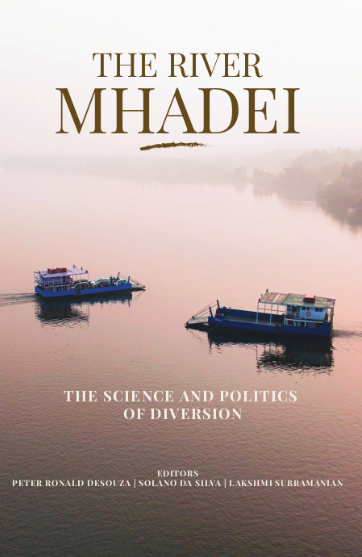
Release at the Goa University on Tuesday, Sep 16, 2025.The River Mhadei:
The Science and Politics of Diversion
<https://www.goa1556.in/book/the-river-mhadei/>
*Editors:* Peter Ronald deSouza, Solano Da Silva, Lakshmi Subramanian
*Genre:* ecology <https://www.goa1556.in/book-genre/ecology/>, Environment
<https://www.goa1556.in/book-genre/environment/>, goa rivers
<https://www.goa1556.in/book-genre/goa-rivers/>, Green Campaigns
<https://www.goa1556.in/book-genre/green-campaigns/>, Law
<https://www.goa1556.in/book-genre/law/>, Local Studies
<https://www.goa1556.in/book-genre/local-studies/>, river diversion
<https://www.goa1556.in/book-genre/river-diversion/>, Sociology
<https://www.goa1556.in/book-genre/sociology/>, Water
<https://www.goa1556.in/book-genre/water/>
*ISBN: *978-93-95795-68-5 *Price (PB) : *Rs. 900 Mail Enquiry
<[email protected]?subject=Enquiry/Buy%20Book%20-%20The River Mhadei: The
Science and Politics of
Diversion/978-93-95795-68-5&body=Hi,%0AI%20am%20interested%20in%20the%20book%20mentioned%20in%20the%20subject%20of%20this%20email%20above.%0APlease%20contact%20me%20back.%0AAnything
else..%0AAdd%20Your%20Name/Contact/Email/Phone%20here%0A>
Pp 450. Colour printing.
<https://www.goa1556.in/wp-content/uploads/2025/09/trm.png>
*It is rare to find a work as readable and educative on an issue with
resonances for this country and the world at large. River Mhadei has
friends as thoughtful as they are articulate.--MAHESH RANGARAJAN,
Professor, Ashoka University*

*A rich, lucidly written collection of articles that captures the Mhadei
river’s ecological, cultural, and political significance. From its origins
to ongoing legal battles and living traditions, this book demonstrates that
the Mhadei is not just Goa’s lifeline—it is its soul. Essential reading for
every Goan. Every river lover.—NORMA ALVARES, Senior Advocate, Bombay High
Court*

The River Mhadei: The Science and Politics of Diversion brings together a
wide range of experts—scientists, ecologists, legal scholars, historians,
planners, journalists, activists, and community practitioners—to explore a
pressing environmental dispute. Centered on the waters of the Mhadei, which
are contested by the states of Goa, Karnataka, and Maharashtra, the volume
moves beyond the narrow confines of technical and legal debates over water
diversion and allocation to present a richly layered portrait of the river
as a living presence. Its chapters flow across time and discipline, from
field-based ecological studies and hydrological analyses to the history of
Goan riverine infrastructure, cultural memory, participatory art, and a
critical perspective on the official adjudication of the dispute and the
political maneuverings it has engendered. Some essays foreground the
staggering—and fragile—biodiversity supported by the river; others explore
local festivals, agricultural infrastructure, and the experiences and lived
knowledge of riverside communities for whom the Mhadei is *Amchi Mai*—Our
Mother. At the heart of the volume is the pressing question: What does
justice mean in a time of ecological crisis? It warns against viewing the
Mhadei solely as a resource to be exploited and highlights its role as a
sustainer of ecosystems, a commons, and a memory archive.

   - Contents
   - Figures and Tables 7
   - Foreword: Keri Facer 11
   - Acknowledgements 16
   - Introduction (Peter Ronald deSouza, Solano Da Silva, Lakshmi
   Subramanian) 18
   - Conserving the Mahadayi: Biodiversity, Water, and Cultural Resources
   (Rajendra P. Kerkar) 31
   - The Many Pasts and Contested Present of the Mhadei (Lakshmi
   Subramanian) 50
   - Abundant Mother Goddess or Scarce, Contested Resource? The Life and
   Times of the River Mhadei (Parineeta Dandekar) 71
   - Saving the Mhadei: The Anatomy of a Movement (Meera Mohanty) 93
   - The Political Economy of the Mhadei Dispute: Intersecting the Domains
   of Politics, Institutions, and Interests (Rahul Tripathi) 120
   - The Unquiet Flow of the Mahadayi: A Logbook of Issues as Seen from the
   Eastern Face (Rishikesh Bahadur Desai) 135
   - The Working of the Inter-State Mahadayi Water Disputes Tribunal
   (Vaishali Kashyap) 157
   - Sifting through the Water Laws: Securing the Mandovi River for Future
   Generations (Vasudha Sawaiker) 176
   - Understanding Mhadei River Water Sharing (A. G. Chachadi) 201
   - Threats to the Lesser-Known Biodiversity of the Mhadei Bio-Region: A
   Spotlight (Nirmal Kulkarni) 225
   - Freshwater Fish Diversity in the Mhadei River in Goa (Vidyadhar Atkore
   and Nandini Velho) 247
   - From the River to the Sea: The Mhadei River Continuum and the Impact
   of Interventions (Helga do Rosario Gomes) 264
   - Valuing the River Mhadei: An Economic Exploration (Dhirendra
   Deshpande) 281
   - Understanding the Urban Estuarine Ecology of the Mhadei: The Role of
   Khazans in Panjim, Goa (Leon Morenas and Manisha Rodrigues) 301
   - The Privatization of Community Property and Gambling with the Future
   of Goa (Aurobindo Gomes Pereira) 325
   - Mhadei: ”May the Great Mother Live Long in Letters and Spirit”
   (Narayan B. Desai) 343
   - Participatory River Drawings and Political Capabilities through
   Library Practice (Sujata Noronha) 366
   - Managing the Commons in a Climate Emergency: An Experiment in Good
   Governance (Maya de Souza) 391\
   - Epilogue: The Currents of the River Mhadei (Peter Ronald deSouza) 419
   - Contributors 442

  *CONTRIBUTORS:* A. G. Chachadi | Aurobindo Gomes Pereira | Dhirendra
Deshpande | Helga do Rosario Gomes | Lakshmi Subramanian | Leon Morenas |
Manisha Rodrigues | Maya de Souza | Meera Mohanty | Nandini Velho | Narayan
B. Desai | Nirmal Kulkarni | Parineeta Dandekar | Peter Ronald deSouza |
Rahul Tripathi | Rajendra P. Kerkar | Rishikesh Bahadur Desai | Solano Da
Silva| Sujata Noronha | Vaishali Kashyap | Vasudha Sawaiker | Vidyadhar
Atkore *450 pp. Printed in colour.* *VISIT  http://www.mhadeicollective.com
<http://www.mhadeicollective.com>* Contributors
*Peter Ronald deSouza* was the Director of the Indian Institute of Advanced
Study (IIAS), Rashtrapati Nivas, Shimla, for two terms (2007-2013). Prior
to that he was a Senior Fellow at the Centre for the Study of Developing
Societies (CSDS), Delhi (2003-2007) and even earlier was Professor and
Head, Department of Political Science at Goa University (1996–2003). After
serving as Director at IIAS, he returned to CSDS as Professor in 2014. He
is a Senior Research Associate at the African Centre for Epistemology and
Philosophy of Science (ACEPS), University of Johannesburg. Professor
deSouza has served as a consultant to UNESCO, International IDEA,
Stockholm, UNDP, the World Bank, Inter-Parliamentary Union (IPU), Ford
Foundation, etc. His recent publications are with Mohd Sanjeer Alam and
Hilal Ahmed, Companion to Indian Democracy: Resilience, Fragility,
Ambivalence, Routledge, New Delhi, 2022; and with Rukmini Bhaya Nair,
Keywords for India: A Conceptual Lexicon for the 21st Century, Bloomsbury,
London, 2020.
*Solano Jose Savio Da Silva* is an Assistant Professor in the Department of
Hu- manities and Social Sciences at BITS Pilani, Goa, where he teaches
courses in development and political theory. His research has looked at
electoral poli- tics, urbanization, and land use planning with a special
focus on Goa. Before joining BITS, he worked at Goa University and at the
Centre for the Study of Developing Societies (CSDS), Delhi. He completed
his PhD on the dynamics of land-use planning in Goa in 2019. He has an
M.Phil. in Development Studies from the University of Oxford as well as a
Master’s in International Studies and a BA in Economics from Goa
University. Professor Da Silva is also deeply involved with Goan social
issues, occupying himself in particular  with overseeing, analysing, and
sometimes agitating against variants of the Goa Regional Plan—an attempt
to  develop a broad strategy for Goa’s development, which includes
preparing a land-use plan.
*Lakshmi Subramanian *is a retired Professor of History, Centre for Studies
in Social Sciences, Calcutta, and BITS Pilani, Goa. She has had a long and
distinguished research and teaching career and is credited with making
major contributions to the fields of Indian business history and music
history. She has many publications to her credit, the latest ones being
Singing Gandhi’s India: Music and Sonic Nationalism (2020) and India Before
the Ambanis: A History of Indian Business, Market and Economy (2024). She
has been the recipient of several international fellowships, including the
prestigious Mellon Fellowship and Adam Smith Fellowship.
*Rajendra P. Kerkar* has been involved in environmental education,
protection, and conservation in Goa for the last three decades. He has been
instrumental in initiating the movement for notifying the Mhadei and
Netravali Wildlife Sanctuaries. He serves as the General Secretary of the
Mhadei Bachao Abhiyan and as a member of the National Board of Wildlife,
the Goa State Biodiversity Board, and other organizations involved in
protecting the history, heritage, ecology, and wildlife of the Western
Ghats.
*Parineeta Dandekar* is an environmental advocate and Associate Coordinator
for the South Asia Network on Dams, Rivers, and People (SANDRP), where she
works to ensure that India’s last free-flowing rivers remain protected. Her
research uncovers the failures of large-scale water projects while
amplifying the voices of communities, cultures, and ecosystems that depend
on these rivers. She is pushing for policies that prioritize both people
and the planet, ensuring a future where rivers continue to sustain life.
*Meera Mohanty* is Editor at The Economic Times. A financial journalist
with twenty years of experience, she covers politics and business, and
closely covers the business of mining.
*Rahul Tripathi* is a Professor in Political Science at the D.D. Kosambi
School of Social Sciences and Behavioural Studies, Goa University. He
specialized in South Asian Studies at the School of International Studies,
Jawaharlal Nehru University, New Delhi. He teaches and researches in the
area of international relations, global political economy, and South Asia
and has published in International Studies, South Asian Survey, and the
Economic and Political Weekly. He is also the co-convenor of the
Multidisciplinary Cluster on Mhadei, a knowledge cluster at Goa University
that brings together diverse perspectives on the river. His popular
writings on Goa and Mhadei have appeared in national and local newspapers,
including The Indian Express, Times of India, Navhind Times and O Heraldo.
*Rishikesh Bahadur Desai* is an award-winning Senior Assistant Editor at
The Hindu, covering northwestern Karnataka. With experience at The Times of
India, Vijay Times, and The Asian Age, he reports on governance,
decentralization, agriculture, and social welfare. His 2024 Karnataka State
Media Academy award highlights the impact of his journalism. Some of his
best- regarded stories include a series on the Siddi African tribe getting
ST certification, an inquiry into the alleged sale of a poor widow, and the
restoration of the Surang Bavi Karez, an ancient heritage structure in
Bidar. He has extensively covered Hyderabad-Karnataka’s backwardness,
farmer distress, and infrastructure projects like Bidar’s multi-arch dams.
His reporting on the kidnapping of actor Rajkumar gained wide attention. As
India coordinator for BBC Radio, he worked on projects about the tobacco
industry, the Kaveri dispute, and the IT revolution. Fluent in English,
Kannada, and Hindi, he holds degrees in English Literature, Political
Science, and Law. He also edits and translates, organizing initiatives like
a Wikipedia edit-a-thon in Bidar.
*Vaishali Kashyap* is a doctoral research scholar at the Department of
Humanities and Social Sciences, BITS Pilani K.K. Birla Goa Campus. Her
on-going research explores factors behind livelihood change in a
traditional fishing community in Assam. She holds a postgraduate degree in
Water Policy and Governance from TISS, Mumbai. In the past, she has been a
part of organizations like Tata Trusts and INREM Foundation, engaging with
the development space with a particular focus on public health, nutrition,
and water quality.
*Vasudha Sawaiker* trained in law at V.M. Salgaoncar College of Law, Goa
University, and has a postgraduate degree in social work from the Tata
Institute of Social Sciences (TISS), Mumbai. At TISS, she was awarded the
prize and shield for being the best student in Dalit and Tribal Social
Work. As a lawyer, she represented clients in cases on social justice and
inclusion in public employment. Her legal research encompasses diverse
areas such as organ donation, forest rights, and construction workers. She
was awarded the UGC-JRF Fellowship in Social Work in 2016 and is presently
a research scholar at the School of Sanskrit, Philosophy and Indic Studies,
Goa University.
*A. G. Chachadi*, former Professor, Goa University, Goa, completed his
M.Tech. and PhD at IIT Roorkee. Before joining Goa University as teaching
faculty, he served as a scientist at the National Institute of Hydrology,
Government of India, for seven years. His research interests and works are
related to the fields of hydrogeology and water resources management,
environmental science and exploration geophysics. He has published several
research publications in national and international journals and has worked
as a consulting hydrogeologist for several mining companies.
*Nirmal U. Kulkarni* is a herpetologist and nature photographer with over
two decades of experience in conservation science and field herpetology in
tropical forests of the Western Ghats and North East India. He has served
as an Expert Member of the Goa State Biodiversity Board and Goa State
Wildlife Advisory Board for two terms, besides being part of various state
and national committees on wildlife and research. Nirmal is currently
Chairman of the Mhadei Research Centre, Goa, India, and is leading research
projects on the Leith’s soft shell turtle in Karnataka, a snake bite
awareness project in Goa, and a monitor lizard project investigating
illegal trade in India. As an ecologist, Nirmal is involved in long-term
monitoring of the Chorla Ghats forests and the adjoining Mhadei bio-region.
His research interests include field herpetology in tropical forests,
tackling the organized illegal wildlife trade and conservation education.
*Vidyadhar Atkore* is a freshwater ecologist by training, interested in
quantifying the anthropogenic and environmental factors on freshwater
biodiversity across different scales. Currently he is a faculty member at
the Salim Ali Centre for Ornithology and Natural History (SACON), South
India Centre, Wildlife Institute of India, Coimbatore. He teaches wetland
ecology and management, ichthyology, landscape ecology, GIS, human ecology
and eco-hydrology.
*Nandini Velho* is a wildlife biologist working on the human dimensions of
forest management. She has completed her PhD from James Cook University and
was an Earth Institute Fellow at Columbia University. She has worked as a
Policy Fellow with the Minister of Environment and Forests and with
multiple forest departments and communities across India. She is interested
in the intersection of art, science and action.
*Helga do Rosario Gomes* is a Research Scientist at Lamont-Doherty Earth
Observatory, Columbia Climate School. She graduated with a PhD in
Biological Oceanography from the University of Bombay and has held research
positions in Japan and Maine. Dr Gomes is interested in large-scale
climatic questions such as the impacts of the new and unusual planktonic
blooms in the Arabian Sea, the effect of Arctic warming and ice melt on the
American lobster, the impact of urbanization on wetland systems, and ocean
acidification and deoxygenation of waters from harmful algal blooms. With
her colleagues she has been developing ocean monitoring and decision
support systems tailored to meet needs for sustainable management of
coastal resources in tropical countries experiencing climate change. She
mentors postdoctoral, graduate, and undergraduate students, but her passion
lies in providing guidance and support to high school students, some of
whom have won national and international awards. She is a trustee and
Science Advisor for Goa Chitra, an anthropological museum in Benaulim, Goa,
that preserves and showcases the culture and lifestyle of the people of the
west coast of India.
*Dhirendra M. Deshpande* has nearly four decades of experience in Indian
higher education, starting as a Lecturer in a degree college in Goa,
working in various capacities in reputed institutions such as Symbiosis,
Pune, and KLE Society, Bengaluru, as Faculty, Principal, Director and
finally retiring as the Vice Chancellor of ISBM University in Chhattisgarh.
As a columnist for a leading daily newspaper in Goa, he has rich experience
in writing on a range of economic and policy issues such as budgets,
monetary policy, reforms and liberalization. As a faculty member at
Symbiosis, he was associated with guiding and evaluating various
finance-related projects that included building economic models for
producing hydroelectricity and long- range demand and sales forecasting.
* Leon Morenas* is the Principal of the Goa College of Architecture. He was
Associate Professor of Architecture at the School of Planning and
Architecture, Delhi. He was also a Fellow at the Indian Institute of
Advanced Study, Shimla, where he worked on a project entitled “Mohallas and
Smart Cities: Post-Colonial Development in Delhi.” He was a World Social
Sciences Fellow in Sustainable Urbanization (2014) and Programme
Coordinator of the Masters in Social Design at Ambedkar University, Delhi
(2013). He is an architect with a Master’s in Urban Design from the School
of Planning and Architecture, Delhi, and a PhD in Architectural
Sciences—with a specialization in Informatics—from Rensselaer Polytechnic
Institute, Troy, New York. Professor Morenas’s research uses the
disciplinary lens of Science and Technology Studies (STS) to understand the
relationship of technology with contemporary design, architecture and urban
planning. His most recent writings have focused on urban governance through
technology, with a focus on smart cities and their command centres. He is
also working on a set of essays that attempt to answer the question, “Is
there an Indian way of thinking about technology?” using the foils of
history, metaphysics and literature.
*Manisha Rodrigues* is an architect based in Goa. She holds a Bachelor’s
degree from the Goa College of Architecture and a Master’s in Architecture
with a specialization in architectural conservation from CEPT University,
Ahmedabad. With over a decade of experience in practice and more than three
years as an assistant professor at her alma mater, the Goa College of
Architecture, her work often explores the intersections of water, heritage,
and the built environment. She was part of projects like the Serampore
Initiative led by the National Museum of Denmark, which documented
Indo-Danish heritage along the Hooghly River. Her academic and professional
work reflects a deep connection to water and cultural landscapes—from the
Sabarmati and Hooghly to the Sal and Mandovi rivers in Goa. As a fellow of
the Goa Water Stories fellowship by the Living Waters Museum, she explored
“What is a river?” through the lens of the built environment of the
Mhadei–Mandovi–Mahadayi River. She currently leads her practice in Margao
and continues to engage with architectural education as visiting faculty at
the Goa College of Architecture.
*Aurobindo Gomes Pereira *is an Advocate, with an L.L.M. in Constitutional
and Administrative Law, and a resident of the city of Panjim, Goa. He can
be contacted at [email protected].
*Narayan Desai* is a teacher and translator, columnist in local
languages—Marathi and Konkani. His interest areas are language and culture.
He can be reached at [email protected]
*Sujata Noronha* is an educator specializing in early literacy and enjoys
working with children and books. She is deeply interested in the power of
the printed word and the pathways to access and growth emerging from it. In
Goa, she works out of her organization called Bookworm, which provides
resources and facilitates libraries and reading within the community of
Panjim and in schools around the state. She consults with the Tata Trusts
within the education portfolio.
*Maya de Souza* has an interdisciplinary background with over twenty years’
experience in public policy and the law. She graduated from Oxford
University in Philosophy, Politics and Economics before studying and
practising law. After an L.L.M. (London), graduating with distinction, she
joined the Department for the Environment, Food and Rural Affairs in the UK
Government Legal Services and later moved to policymaking. She headed
various teams on better institutional structures for flood risk and
integrated water management, where she led a project on holistic approaches
to water management in the climate risk context. She has also headed the
Business Environment Council Hong Kong’s Policy and Research Team, leading
projects on climate resilience, and served on the BITC–UK Circular Economy
team as Co-Director, Environment. Maya has been an elected Green Party
councillor in London, playing an active role in town and country planning
and scrutiny of the environment, among other policy areas. Currently, Maya
lives and works in Goa and is a co-director of Act for Goa and co-founder
of Materia Verde (a new biomaterials industry accelerator powered by
Quicksand). She was previously with the Bangalore-based think tank, CSTEP.
She also works with various consultancies on future-proofing and strategic
insight.

*Available via mail order from Goa,1556 WhatsApp +91-9822122436
[email protected] <[email protected]>*

https://www.goa1556.in/book/the-river-mhadei/

--
*** Please be polite and on-topic in your posts. ***
---
You received this message because you are subscribed to the Google Groups "The
Goa Book Club" group.
To unsubscribe from this group and stop receiving emails from it, send an email
to [email protected].
To view this discussion, visit
https://groups.google.com/d/msgid/goa-book-club/CA%2Bmqab9Xk4fLueswO_MXCCU1Kw9qHgTVOn4QjAw60BJ5u9%3DmXw%40mail.gmail.com.