Dear Olivier,

Thanks for looking into this. I'm not sure off hand whether there are other
missing ones, but these are the ones I've dealt with in my own
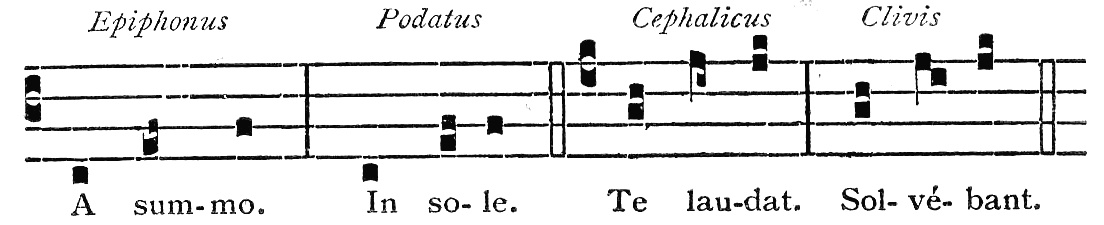
transcriptions of Dominican chant. I typically just make do with the g>
(etc.) for the plica/liquescent with the left bar, but it would be nice if
that variation in typography could be accommodated, as well as the
epiphonus (cf. http://pbillaud.fr/images/1908page2.portee1.jpg) also
in the *Salve
regina *chant you include. The meaning of these signs, I think, is somewhat
unclear. The main editor of the modern editions of Dominican chant
following the development of the Solesmes books (Fr Pie Bernard, op) was
fairly literal in trying to copy the neume shapes of the 13th century
manuscripts, even when the meaning wasn't entirely self-evident. To me, I
don't think it's absolutely necessary to have them from a musical point of
view, although I imagine it would be helpful in principle to expand
slightly the ability of Gregorio to reproduce these types of historical
scores.
The dotted tau is the Dominican version of the flex mark (†). That would be
very helpful to have within the Gregorio symbols.

Yours,

bro Innocent, op


On Sun, Jul 13, 2014 at 2:18 AM, Olivier Berten <[email protected]>
wrote:

> Hi!
>
> It recently came to my knowledge
> <http://gregobase.selapa.net/chant.php?id=4577> that Gregorio misses
> some dominican specific neumes
> <https://github.com/gregorio-project/gregorio/issues/1>.
>
> Could somebody tell wether there are other missing ones, and if
> possible give some explanation about their meaning?
>
> By the way, does anybody know what is that "dotted tau" after "Oremus"
> on that page?
>
> Yours,
>
> Olivier
>
> _______________________________________________
> Gregorio-users mailing list
> [email protected]
> https://mail.gna.org/listinfo/gregorio-users
>
_______________________________________________
Gregorio-users mailing list
[email protected]
https://mail.gna.org/listinfo/gregorio-users