On Fri, 2023-05-12 at 11:48 +0200, Joan grupoventus wrote:
> Hi Oleg,
>
> After changing this method from:
> private TlsStrategy getTLSStrategy() throws Exception {
>   return (DefaultClientTlsStrategy.getDefault());
> }
>
> To:
> private TlsStrategy getTLSStrategy() throws Exception {
>    return
> ClientTlsStrategyBuilder.create().setSslBufferMode(SSLBufferMode.DYNA
> MIC).build();
> }
>
> And set this strategy to the pool:
> this.phccm =
> PoolingAsyncClientConnectionManagerBuilder.create().setPoolConcurrenc
> yPolicy(PoolConcurrencyPolicy.LAX).setTlsStrategy(this.getTLSStrategy
> ()).build();
>
>
> The histogram shows the same:
> num     #instances         #bytes  class name
> ----------------------------------------------
>    1:        233151     3208489352  [B
>    2:        182882       52757328  <methodKlass>
>
>
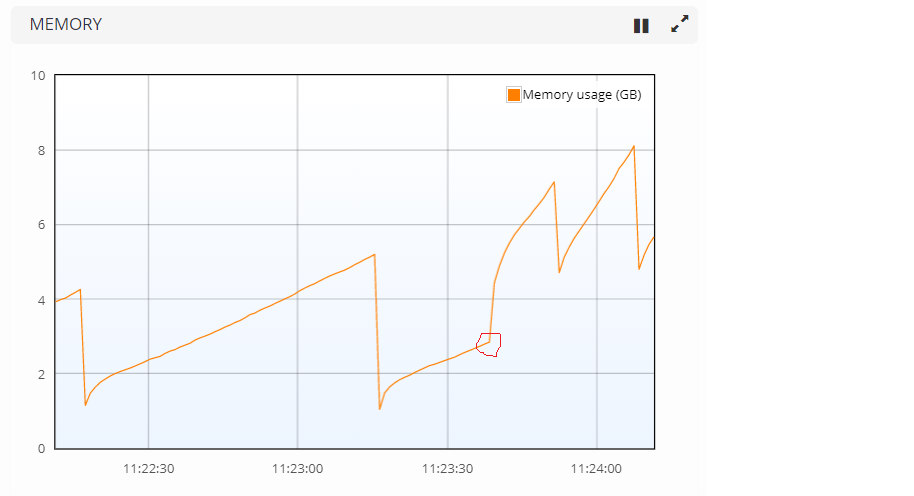
> This chart shows the execution under http and the change to https at
> 11:23:35:
> http://www.grupoventus.com/resources/spike.png
>
> With http, at the end of each GC cycle the amount of heap used is
> around 1,5GB.
> At the moment we dynamically change to https you can see a spike from
> 3GB to 7GB. Next GC cycles frees memory until around 5GB, and remains
> there.
>
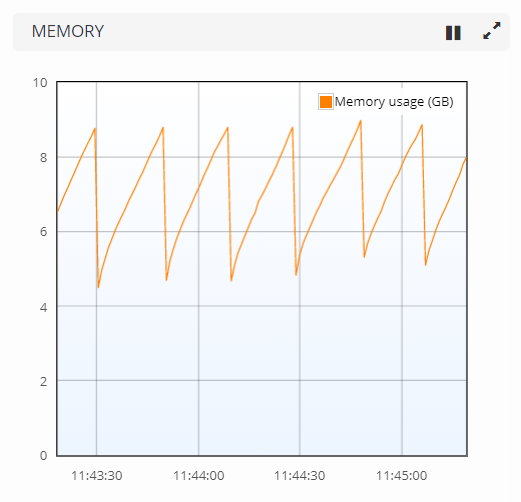
> Here the chart with the execution already with https during several
> minutes, never lows from the 5GB:
> http://www.grupoventus.com/resources/https.png
>
> The point is that here traffic is very low, in production this
> traffic is much higher so the spike is about 20GB and the heap
> becomes exhausted.
>
> Joan.
>
This unfortunately does not help. This is only so much I can do just by
looking at the charts.

There are two options going forward:

1. You manage to reproduce the issue in an isolated environment that I
can replicate locally (Docker image or a unit test).

2. You manage to find out the cause of FrameOutputBuffer growing past
the max frame length in your local environment and propose a fix, which
I can review and test locally.

Oleg


>
> -----Original Message-----
> From: Oleg Kalnichevski <[email protected]>
> Sent: Friday, May 12, 2023 9:47 AM
> To: HttpClient User Discussion <[email protected]>
> Subject: Re: Httpclient issue with https
> "org.apache.hc.core5.http2.impl.nio.ClientH2StreamMultiplexer"
>
> On Thu, 2023-05-11 at 19:17 +0200, Joan grupoventus wrote:
> > Hello Oleg,
> >
> > We are finding an issue in a new installation of our app that is
> > using
> > httpclient5-5.2.1 and httpcore5-5.2.
> >
> > Our app is a proxy that receives protobuf requests that are sent to
> > an
> > amazon endpoint that is responding with protobuf responses. We
> > started
> > this communication by using plain http, processing around
> > 4.000 req/s. Everything OK.
> >
> > But when we move to live https must be used to communicate with
> > this
> > endpoint, just changing the url from http:// to https://
> >
> > So we changed it and after 30 seconds testing we got an
> > OutOfMemoryException, the heap was exhausted.
> >
> > Below an histogram using http (just the first 2 items):
> > num     #instances         #bytes  class name
> > ----------------------------------------------
> >    1:        181753       52412760  <methodKlass>
> >    2:        218819       46398592  [B
> >
> >
> > And the histogram using https after 30s:
> > num     #instances         #bytes  class name
> > ----------------------------------------------
> >    1:        224873     3216328416  [B
> >    2:        182417       52604088  <methodKlass>
> >
> >
> > So the space occupied by byte arrays moves from 46Mb to 3GB. So we
> > decided to perform a heap dump and analyze it to find out where
> > these
> > 3GB byte arrays are coming from, and we have seen this:
> >
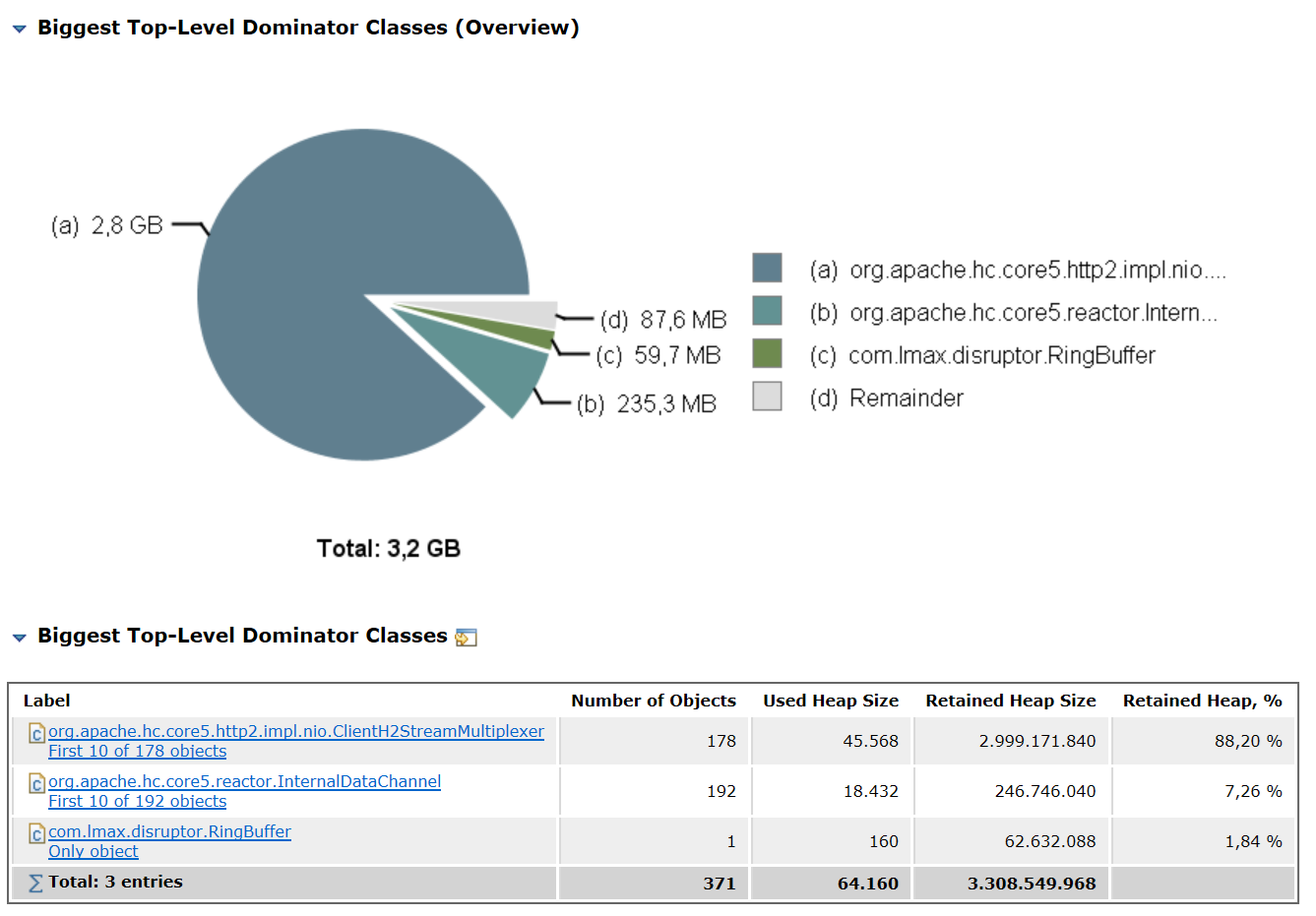
> > 178 instances of
> > "org.apache.hc.core5.http2.impl.nio.ClientH2StreamMultiplexer",
> > loaded by "org.apache.catalina.loader.ParallelWebappClassLoader @
> > 0x400768258e8" occupy 2.999.171.840 (88,20 %) bytes
> > http://www.grupoventus.com/resources/top_dominator_class.png
> >
> >
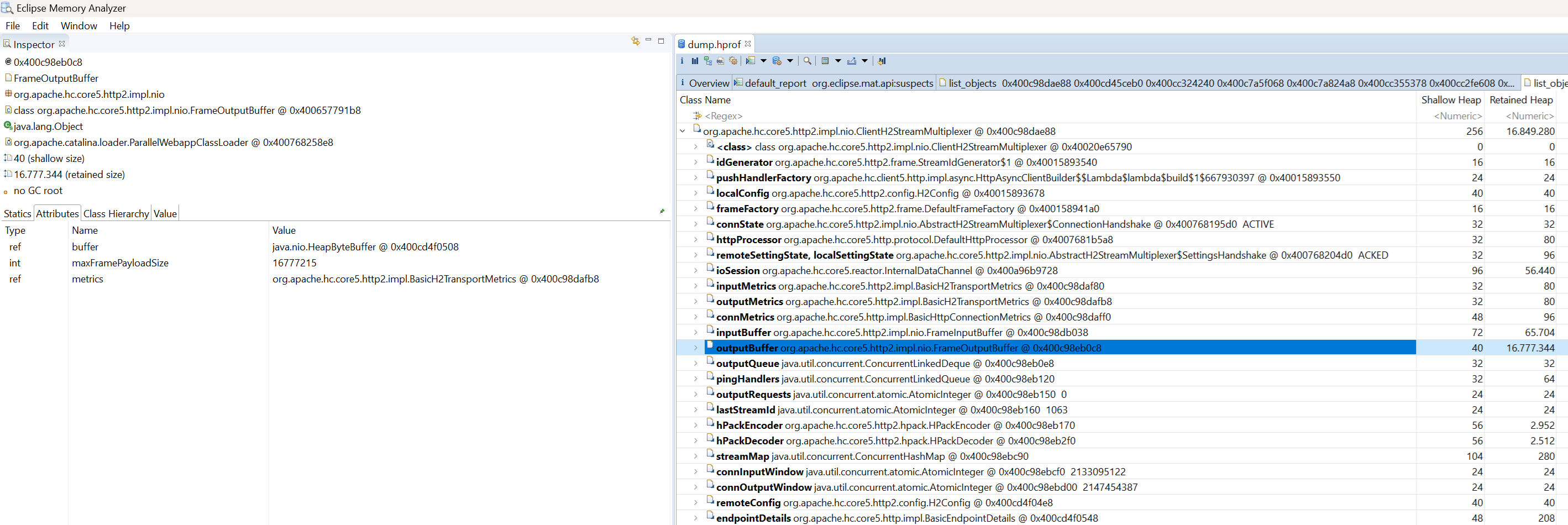
> > If we analyze each one of these 178 instances of
> > ClientH2StreamMultiplexer, it seems the OutputBuffer is holding
> > around
> > 16Mb for each instance, multiplied by 178 gives as a result these
> > 3GB:
> > http://www.grupoventus.com/resources/output_buffer.png
> >
> >
> > I’m not sure if this is a bug, we have been using https with these
> > same versions against other endpoints and we never had a problem.
> > Anyways it does not seem a memory leak, because if you keep the
> > traffic stable, the space occupied by these instances seems to not
> > be
> > growing.
> >
> > Let me know what you think, and if you need more information (logs
> > about http traffic, etc).
> >
> > Thanks,
> >
> > Joan.
> >
>
> Hi Joan
>
> This sounds odd. I see no reason why FrameOutputBuffer should ever
> grow beyond the size of the maximum frame size and do not see how
> this could be possibly be related to TLS. Nevertheless, this may well
> be a bug that gets triggered by the use of the transport encryption.
>
> Please do one thing, though, first. Please make sure you configure
> the I/O reactors to use a custom TLS strategy with SSLBufferMode set
> to DYNAMIC. This will make the I/O reactor release intermediate TLS
> buffers which should substantially decrease the total memory
> footprint of TLS connections at the cost of extra memory allocation /
> de- allocation.
>
> Oleg
>
>
> ---------------------------------------------------------------------
> To unsubscribe, e-mail: [email protected]
> For additional commands, e-mail: [email protected]
>
>
>
>
> ---------------------------------------------------------------------
> To unsubscribe, e-mail: [email protected]
> For additional commands, e-mail: [email protected]
>


---------------------------------------------------------------------
To unsubscribe, e-mail: [email protected]
For additional commands, e-mail: [email protected]