Thank you very much Mr. Garg. I started on an email on *P. pectinata* a
couple of weeks ago but while writing it had doubts again. I am still
working on it and hoping to understand it soon.
Regards,
Ashwini

On Wed, 2 Oct, 2019, 10:38 AM J.M. Garg, <[email protected]> wrote:

> Thanks, Ashwini ji, I agree with your id as P. hookeriana
>
> ---------- Forwarded message ---------
> From: mcleodwild <[email protected]>
> Date: Thu, 19 Sep 2019 at 13:26
> Subject: [efloraofindia:330408] Re: Yet another discussion on Pedicularis!
> ABAUG2017/12
> To: efloraofindia <[email protected]>
>
>
> I have again been looking at this species. Going through Yamazaki (*A
> Revision of the Genus Pedicularis in Nepal
> <http://umdb.um.u-tokyo.ac.jp/DKankoub/Bulletin/no31/no31012.html>*,
> 1988), Pennel (*The Scrophulariaceae of the Western Himalayas*, 1944) and
> Arti Garg (*Critical Taxonomic Appraisal of Some Taxa of Pedicularis from
> Indian Himalayas Belonging to Section Siphonanthae
> <https://www.researchgate.net/publication/290798065_Critical_Taxonomic_Appraisal_of_Some_Taxa_of_Pedicularis_from_Indian_Himalayas_Belonging_to_Section_Siphonanthae>*
>  ,
> 2009) I have reached the conclusion that the plant here is *Pedicularis
> hookeriana*.
>
> Here is why:
> 1. The corolla-tube is roughly three times the length of the calyx (
> *Pennell*: 'distinguished from *P. siphonantha *Don by the corolla-tube
> being hardly three, instead of four times the length of the calyx'). I am
> attaching a new photo to show that.
> 2. Lower leaves long with more than 6 lobes (*Yamazaki*: leaves 1.5-7cm
> for *hookeriana* vs. 1-4cm for *P. siphonantha*; *Pennell*: Pinnae of
> leaf blades 6-12 pairs). The earlier photo of me holding a basal leaf shows
> the size and number of pinnae corresponding clearly to *hookeriana*)
> 3. Toothed galea (*Pennell*: 'anterior lobe acutely triangular-toothed on
> the anterior margins). See the attached photo.
>
> Also the filaments are hairy on one pair of stamens on the upper parts
> only (*Arti Garg*: 'anterior pair hairy, hairs confined to upper half,
> posterior pair glabrous').
>
> Apart from this, the size of the lower lip (with three lobes), presence of
> hair on the tube, lower lip and on the galea (upper lip) all point to *P.
> hookeriana*. The geographical distribution is also correct with the
> altitude (our plants are found around 3100m and slightly above).
>
> Some studies have shown that both *P. hookeriana* and *P. punctata*
> belong to the *P. siphonantha clade* and experts may not consider these
> two as separate species in the future. But till then I am filing this under
> *P.
> hookeriana*.
>
> My earlier email under Pedicularis sp. ABSEP2016/21
> <https://groups.google.com/forum/?utm_medium=email&utm_source=footer#!searchin/indiantreepix/Pedicularis$20sp.$20ABSEP2016$2F21%7Csort:date/indiantreepix/K74yH8VLpiA/0W0SbkHUCwAJ>
>  is
> also the same.
>
> Thanks.
> Ashwini
>
>
> On Monday, 7 August 2017 10:18:27 UTC+5:30, ashwini wrote:
>>
>> The long-tube pedicularis species, which is very common here above 3000m,
>> has confused me. I have followed the excellent discussion between Dr Singh,
>> Tabish ji and other senior members and have at times concluded that the
>> plants here are *P. siphonantha* but another doubt nags me and I start
>> looking at the characteristics again.
>>
>> Looking at the sketch uploaded by Tabish ji here
>> <https://08511630493324166816.googlegroups.com/attach/e36d7a85e0216671/Pedicularis.jpg?part=0.1&view=1&vt=ANaJVrEtAptdaht5u2Pj-lcsDLZouMjVcxlJXpSBVs1GmC-hjQBpsFN3snYDVjCrDzlVfJDAcNq5AQ68UVg36SH3zpKVYbfLC8ls6wH-4nBhb2NUrJKOn0g>,
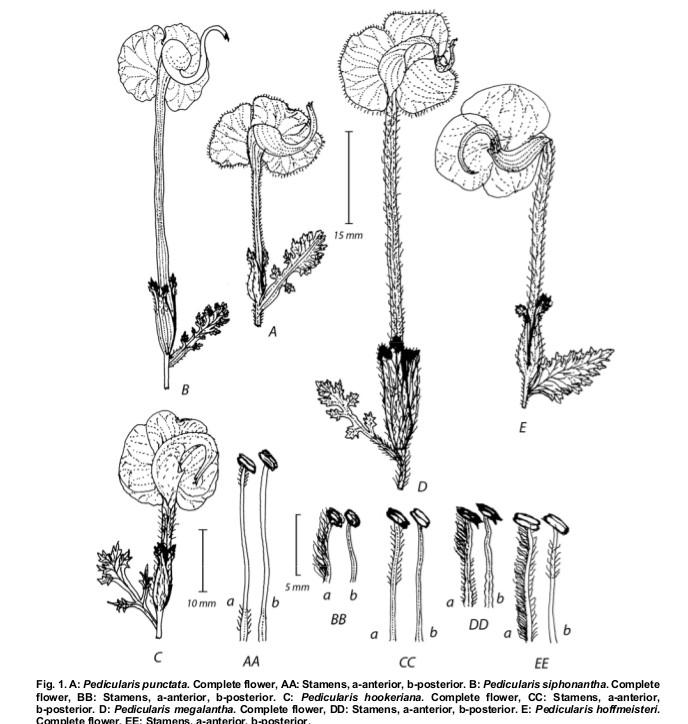
>> I would say that flowers of our plants are closer to *P. punctata* than *P.
>> siphonantha* (tube length and its ratio with the calyx). I have included
>> a photo of our flower (without calyx) on a ruler for comparison below.
>> Accounting for the absence of calyx in the photograph, the tube length
>> matches with figure A and so does the shape of the galea.
>>
>> However, the lower lip on our flower is narrow (about 7-8mm) while *P.
>> punctata* should have a broader, 15mm, lower lip.
>>
>> The number of lobes on the lower leaves is higher than 6 (see photo). The
>> petiole is long and not winged. This would suggest *not* *P. punctata*
>> again.
>>
>> Dr Singh had suggested *P. hookeriana* which was described briefly by
>> Kletter and Kriechbaum here
>> <https://books.google.co.in/books?id=ODrIXj-48RsC&pg=PA171&lpg=PA171&dq=pedicularis+hookeriana&source=bl&ots=gUvRh-j7Jt&sig=vv_ReidCDSUxF3FLKEUVghwAg9g&hl=en&sa=X&ved=0ahUKEwjZ5tP1nsTVAhUEuI8KHRLiB5UQ6AEITzAN#v=onepage&q=pedicularis%20hookeriana&f=false>
>> in their 2001 discussion of *P. punctata *but it was concluded that
>> since the drawing in the 2009 paper shows shorter tube length, *P.
>> hookeriana* was not a possibility. But the tube length of *P.
>> siphonantha* in the drawing does not match our sample either.
>>
>> Most of the images of *P. siphonantha* available online show a higher
>> ratio of tube-length to calyx than our flowers here.
>>
>> Our plant is gregarious at 3200m with many clumps of flowers. I have
>> tried to include photos to show that.
>>
>> I would request my seniors to look at this species again and advise. I am
>> at a loss as to which source takes precedence. I apologise for requesting
>> to open this discussion yet again and hope that you will find merit in
>> doing so.
>>
>> Thanks and regards,
>> Ashwini
>>
>> --
> You received this message because you are subscribed to the Google Groups
> "efloraofindia" group.
> To unsubscribe from this group and stop receiving emails from it, send an
> email to [email protected].
> To view this discussion on the web, visit
> https://groups.google.com/d/msgid/indiantreepix/e87d2d4f-b0e9-46a1-9c0a-bb161ab04cfc%40googlegroups.com
> <https://groups.google.com/d/msgid/indiantreepix/e87d2d4f-b0e9-46a1-9c0a-bb161ab04cfc%40googlegroups.com?utm_medium=email&utm_source=footer>
> .
>
>
> --
> With regards,
> J.M.Garg
>
> 'Creating awareness of Indian Flora & Fauna'
> <http://en.wikipedia.org/wiki/User:Jmgarg1>
>
> Winner of Wipro-NFS Sparrow Awards 2014 for efloraofindia
> <https://sites.google.com/site/efloraofindia/award-for-efloraofindia>.
>
> For identification, learning, discussion & documentation of Indian Flora,
> please visit/ join our Efloraofindia Google e-group
> <https://groups.google.com/forum/#!forum/indiantreepix> (largest in the
> world- more than 3,000 members & 3,00,000 messages on 23.8.18) or
> Efloraofindia
> website <https://sites.google.com/site/efloraofindia/> (with a species
> database of more than 13,000 species & 3,00,000 images of which more than
> 1,70,000 images are directly displayed).
>
> The whole world uses my Image Resource
> <http://commons.wikimedia.org/wiki/Category:J.M.Garg> of more than a
> thousand species & eight thousand images of Birds, Butterflies, Plants etc.
> (arranged alphabetically & place-wise). You can also use them for free as
> per Creative Commons license attached with each image.
>
> Also author of 'A Photoguide to the Birds of Kolkata & Common Birds of
> India'.
>

--
You received this message because you are subscribed to the Google Groups
"efloraofindia" group.
To unsubscribe from this group and stop receiving emails from it, send an email
to [email protected].
To view this discussion on the web, visit
https://groups.google.com/d/msgid/indiantreepix/CAAKUM9CO4o%3DVPObJbNfyVarc32fz4k%3DmW5qkHBUm8uTKVC6S%2Bg%40mail.gmail.com.