Date: 2005-03-07T15:29:49
   Editor: MichaelStover
   Wiki: Apache JMeter Wiki
   Page: UserManual/BuildAdvancedWeb
   URL: http://wiki.apache.org/jakarta-jmeter/UserManual/BuildAdvancedWeb
   no comment

New Page:

= Building an Advanced Web Test Plan =

In this section, you will learn how to create advanced Test Plans to test a Web
site. For an example of a basic Test Plan, see [:../BuildWebTest: Building a
Web Test Plan].
[[Anchor(urlrewriting)]]
== Handling User Sessions With URL Rewriting ==

If your web application uses URL rewriting rather than cookies to save session
information, then you'll need to do a bit of extra work to test your site.

To respond correctly to URL rewriting, JMeter needs to parse the HTML received
from the server and retrieve the unique session ID. Use the appropriate HTTP
URL Re-writing Modifier to accomplish this. Simply enter the name of your
session ID parameter into the modifier, and it will find it and add it to each
request. If the request already has a value, it will be replaced.

 '''URL Rewriting Example'''

    [http://jakarta.apache.org/jmeter/demos/URLRewritingExample.jmx Download]
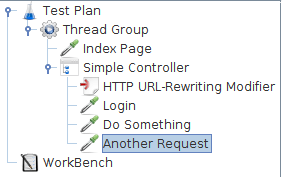
this example . In Figure 1 is shown a test plan using URL rewriting. Note that
the URL Re-writing modifier is attached to the ThreadGroup, thus assuring that
it will affect every request in that ThreadGroup.

 http://jakarta.apache.org/jmeter/images/screenshots/url_rewrite_example_a.png
[[BR]]
 ^Figure 1 - Test Tree^

In Figure 2, we see the URL Re-writing modifier GUI, which just has a field for
the user to specify the name of the session ID parameter. There is also a
checkbox for indicating that the session ID should be part of the path
(separated by a ";"), rather than a request parameter

 http://jakarta.apache.org/jmeter/images/screenshots/url_rewrite_example_b.gif
[[BR]]
 ^Figure 2 - Request parameters^
[[Anchor(headermanager)]]
== Using a Header Manager ==

The HTTP Header Manager lets you customize what information JMeter sends in the
HTTP request header. This header includes properties like "User-Agent",
"Pragma", "Referer", etc.

The HTTP Header Manager , like the HTTP Cookie Manager , should probably be
added at the Thread Group level, unless for some reason you wish to specify
different headers for the different HTTP Request objects in your test.

---------------------------------------------------------------------
To unsubscribe, e-mail: [EMAIL PROTECTED]
For additional commands, e-mail: [EMAIL PROTECTED]