*There have been reports of hundreds injured today and many killed on top of
the 300 already, some building are now on fire, Molotov cocktails being
throw by the government thugs at the peaceful protesters along with rocks
and tear gas in Alexandria and Cairo. Fighting still taking place after 5
hours of it.*
**
*Cort*
.
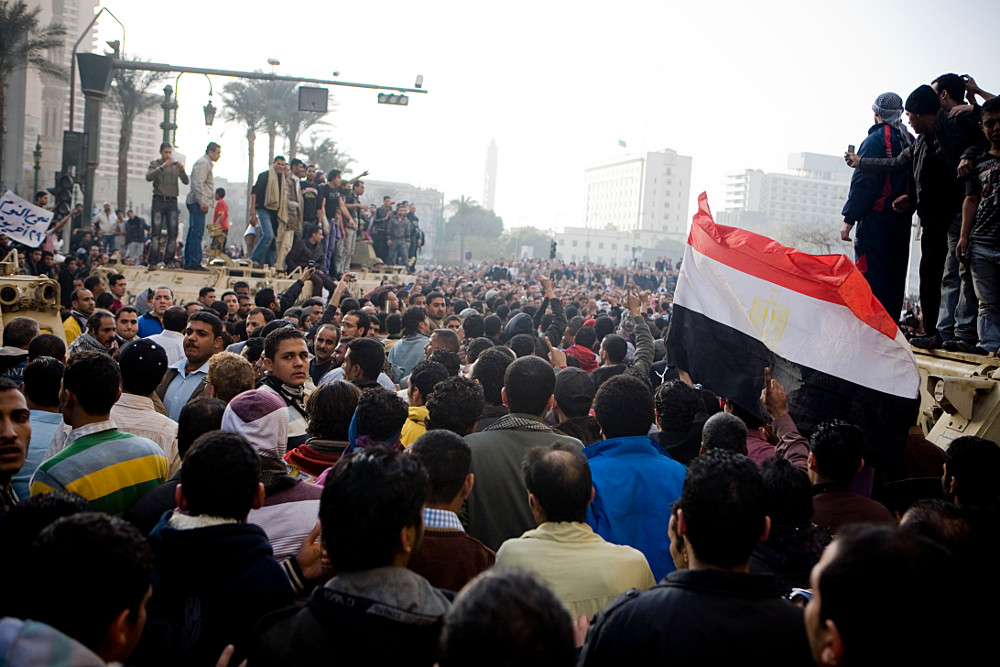
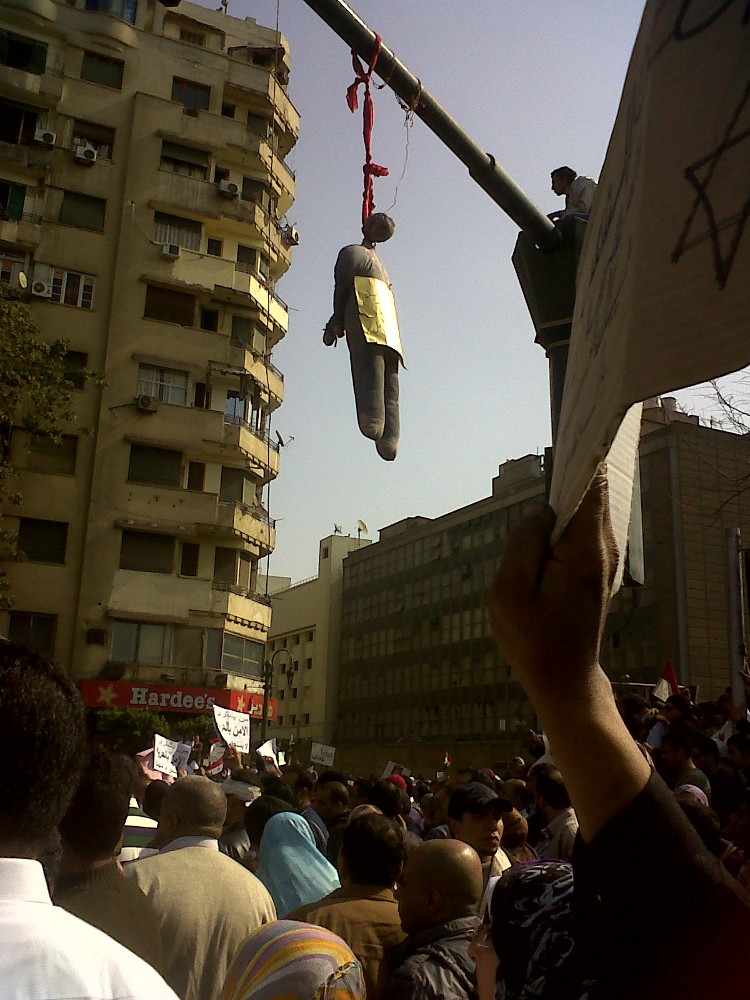
http://www.marxist.com/egypt-on-brink-of-civil-war.htm Egypt on the brink of civil war<http://www.marxist.com/egypt-on-brink-of-civil-war.htm> Written by Alan Woods Wednesday, 02 February 2011 [image: Print]<http://www.marxist.com/egypt-on-brink-of-civil-war/print.htm>[image: E-mail]<http://www.marxist.com/component/option,com_mailto/link,aHR0cDovL3d3dy5tYXJ4aXN0LmNvbS9lZ3lwdC1vbi1icmluay1vZi1jaXZpbC13YXIuaHRt/tmpl,component/> The revolution in Egypt is reaching a critical point. The old state power is collapsing under the hammer blows of the masses. But revolution is a struggle of living forces. The old regime does not intend to surrender without a fight. The counterrevolutionary forces are going onto the offensive. There is ferocious fighting on the streets of Cairo between pro- and anti-Mubarak elements. [image: Scene from 29 January. Photo: 3arabawy.]<http://www.marxist.com/images/stories/egypt/Jan_29_2-3arabawy.jpg>Scene from 29 January. Photo: 3arabawy.Yesterdays "protest of the millions" surpassed all expectations. More than a million people thronged Cairos Tahrir Square. There were 300,000 on the streets of Suez, 250,000 in Mahalla, 250,000 in Mansoura, and an impressive 500,000 in Alexandria. This mighty movement has no precedent in Egyptian history. Protesters took to the streets out in every single city and town. According to some estimates four million demonstrated all over Egypt. By contrast, the numbers who took to the streets to voice their support for the President yesterday were small and undoubtedly made up of members of the security forces, bureaucrats and their families, all those who have something to lose if Mubarak is overthrown. The Revolution has enormous reserves of support. However, there are weaknesses in the revolutionary camp. As we pointed out from the beginning, the spontaneous character of the movement was both its main strength and its principal weakness. The forces of the counterrevolution are numerically weaker (this was shown yesterday). But numbers are not everything in revolution as in war. Many times in history a large army composed of valiant soldiers has been defeated by a smaller professional army with good officers. The revolutionaries have determination, courage and morale. But the counterrevolutionaries have a lot to lose: their jobs, positions, power and privilege. Desperation will give them the courage to resist. And they are organized and well trained. There is not the slightest doubt that the shock troops of the mob that attacked the demonstrators in Tahrir Square today were policemen out of uniform. This was not a spontaneous demonstration of loyalty to the President but a carefully prepared action that corresponds to a worked out plan. Mubaraks strategy In Tunisia President Ben Ali decided relatively quickly that the game was up and took a plane to exile together with his wife and a large amount of loot. President Mubarak of Egypt is tougher and more stubborn. He has decided to ignore the millions of demonstrators shouting for his downfall in the streets. He does not care what happens to Egypt. Still less is he concerned with the preoccupations of his former friends and allies in Washington. His only programme is survival. His only perspective is the age-old slogan of despots: *Après moi le deluge* After me, the flood! Everyone must now realise that the only way of calming the country is for the president to go. The self-appointed leaders of the opposition have made it clear that they will not even talk unless Mubarak disappears. They have no choice, since the masses on the streets are vigilant and will not tolerate any compromise. The immediate removal of Mubarak was therefore the only hope to secure the "orderly transition of power" that the US so fervently desires. But John Simpson the editor of BBC News World Affairs, an intelligent bourgeois commentator correctly points out: The only trouble is no-one has told the crowds in Tahrir Square about this. Their slogan is Mubarak out now not Mubarak out with honour in a few months and the continuation of his system slightly improved. In last night's speech, Mr Mubarak promised to leave at the next polls, and promised constitutional reform, but he announced that he would like to stay on until September to oversee the change. In his address on Tuesday, Mr Mubarak said he would devote his remaining time in power to ensuring a peaceful transition of power to his successor (he did not mention his son Gamal). He criticised the protests and said his priority was to "restore peace and stability". "This is my country. This is where I lived, I fought and defended its land, sovereignty and interests, and I will die on its soil," he said. The speech was seen by the protestors as a provocation. Far from calming things down it again poured petrol on the flames. The reaction of the protesters to Mubaraks statement was first disbelief, and then indignation. "The speech is useless and only inflames our anger," one protester, Shadi Morkos, told Reuters. "We will continue to protest." This was a universal reaction. Last night the protesters remained camped out on Tahrir Square saying Mr Mubarak's promise was not enough, and chanting: "We will not leave! He will leave!" The masses do not want to give Mubarak time to manoeuvre. They want him overthrown and put on trial. On the demonstrations yesterday they hanged him in effigy. That shows the real frame of mind on the streets. Everyone knows it was he who gave the order to shoot down the demonstrators last Friday. The television showed the father of a young man killed on a demonstration weeping as he cried: They are killing our children. Now the regime is attacking unarmed people with murderous intent. Unarmed people are being beaten, stoned and gassed in Tahrir Square. With this regime there can be no truce, no peace and no forgiveness. An historical precedent Egypt is in the grip of a titanic battle between revolution and counterrevolution. Until this moment the demonstrations had been completely peaceful. This had lulled the masses into a false sense of security. Now all the illusions have been dissolved. The masses are receiving their baptism of fire. Mubaraks plan is to regain control of Tahrir Square and thus to seize the initiative, which has hitherto been in the hands of the revolutionaries. The struggle for power has begun in earnestness. [image: February 1, a dummy Mubarak is dangling from a lamp post. Photo: monasosh.]<http://www.marxist.com/images/stories/egypt/Feb_1_hanging_Mubarak-monasosh.jpg>February 1, a dummy Mubarak is dangling from a lamp post. Photo: monasosh.The whole thing has been carefully prepared in advance. The anti-government protestors are unarmed and were unprepared for the conflict. The pro-government forces are armed and have used tear gas, thrown into crowds including children. They have entered the Square mounted on horseback and camels. With the advantage of surprise and superior weapons and tactics, as I write these lines, the counterrevolutionaries are slowly forcing the revolutionaries back. They have arrested protestors who are then handed over to the army. Their fate is unknown. In the context of these actions it is clear that Mubaraks speech last night was an integral part of a plan to push the Revolution back step by step. By promising concessions and offering to stand down in September, he was hoping to win the support of the wavering elements: the middle classes who fear instability and long for order; the bourgeoisie who fear a revolution like the plague and would like business to return to normal; the backward, politically inert layers who understand nothing and gravitate to the big names, the strong men and whoever is in power; the depraved criminal classes and lumpenproletariat who sell their political allegiance to the highest bidder. These are the social reserves of the counterrevolution that are now being mobilized against the Revolution. There is a clear historic precedent. On 17 October 1905 (30 October in the new calendar) in response to the Russian Revolution of 1905, Tsar Nicholas II issued the October Manifesto. The regime was in what seemed to be an impossible position. It was confronted with a colossal revolutionary movement and a general strike. In many areas the revolutionary committees of workers were taking control of society. The Manifesto pledged to grant civil liberties to the people: including personal immunity, freedom of religion, freedom of speech, freedom of assembly, and freedom of association; and the convening of an elected parliament the Duma under universal male suffrage. On paper this was a major victory, but in practice the democratisation was insignificant. The Tsar remained in power and exercised a veto over the Duma, which he repeatedly dissolved. The Manifesto was a gigantic fraud, just as the promised reforms of Mubarak, but it was sufficient to buy off a layer that had previously supported the Revolution. The bourgeois Liberals immediately supported it, broke with the Revolution and made their peace with the Tsar. They desired stability, as did a large part of the middle classes. Their defection prepared the way for a counterrevolutionary backlash. At the same time as the Tsar announced his reforms, he unleashed the dark forces on the masses: the lumpenproletariat, the scum of the slums, the anti-Semitic pogroms, to drown the Revolution in blood. Mubarak is attempting to do the same. In Russia the pogroms were organized by the tsarist police. In Cairo the counterrevolutionary attacks are organized by plainclothes police posing as pro-Mubarak demonstrators. At the same time as his henchmen crack skulls in Tahrir Square, Mubarak has announced that the banks and shops will reopen on Sunday, the first working day after the Islamic weekend. The intention is to create an impression of a return to normality. But normality will not return to Egypt for a long time. Washington worried In Washington they are getting increasingly nervous. The longer Mubarak clings to power, the greater the risk of what they call chaos. The latest developments have confirmed their worst fears. Egypt may be sliding towards civil war. The Americans would not be too worried about that, but the problem is that it would destroy all their plans for a managed transition. In a statement after Mr Mubarak's address, Obama said the US would be happy to offer assistance to Egypt during the transition process. He modestly declared that it was *not his country's right* to dictate the path for Egypt, but that any transition must include opposition voices and lead to free and fair elections: "It is my belief that an orderly transition must be meaningful, it must be peaceful and it must begin now." Despite Mr. Obamas soothing words about having no right to choose the leaders of other nations, we seem to recall that Washington had something to do with the removal (and trial) of Slobodan Milosevic, and was somehow instrumental in the removal (and execution) of Saddam Hussein. We also recall the eagerness with which the USA proclaimed the policy of regime change as the best way to get rid of dictators and usher in democracy (under American control). Here the cynical reality of bourgeois democracy stands out in all its uncouthness. US imperialism always considers it to be their countrys right to remove leaders that are disobedient and replace them with more pliant leaders. To this end, democracy is as good an excuse as any other. But when it comes to those regimes that are friendly to US interests, all scruples about democracy and human rights instantly vanish. The worlds policeman is suddenly afflicted by an attack of scrupulous legality: it is *not our country's right* to dictate the path for Egypt or, of course, for Saudi Arabia, Jordan, Morocco, or any of the numerous unsavoury regimes that are Americas good friends in the world. Obama said he had told Mr Mubarak all this during a 30-minute phone call. It would be interesting to know the precise content of this telephone conversation, but we imagine it would not have been very cordial. When the present occupant of the White House says that an orderly transition "must begin now", this is as near as the Americans dare to come to saying to Mubarak: For Gods sake, go! There is very good reason why Obama cannot tell Mubarak to go, at least in public. The Americans have to choose their words very carefully because they are being carefully followed by the rulers of Jordan, Morocco and Saudi Arabia who feel the ground trembling underneath their feet. Simpson, again, explains: President Mubarak's offer to stand down will cause shock waves right across the Middle East. Until recently the regime in Egypt seemed pretty much rock solid. Now autocratic governments in North Africa right through to Yemen, Syria and maybe even Saudi Arabia will be looking for ways to buy off discontent at home. The shock waves from Egypt continue to shake all the neighbouring countries. Turkey's Prime Minister Erdogan is the latest to proffer friendly advice to the embattled Mubarak. In the kind of obscure utterance we associate with Ottoman diplomacy he advised his friend in Cairo to take a "different step". He omitted to add the small detail that it was a step over a very steep cliff. What now? John Simpson adds the following: In every revolution, popular or otherwise, there comes a critical moment a tipping point at which the future is decided. [...] The fact is we are still not at the tipping point quite yet. But we will know it when we see it. Suddenly there is an answer to the basic question: Are the protesters too strong for the power structure or can the country's leaders face them down? He continues: All popular revolutions share certain basic similarities. The vast crowds, often gathering for the first time, believe that they are bound to win because there are so many of them and their determination is so great. But if the political structure refuses to take the hint and keeps the support of the army and the secret police then it can survive. It all depends on how strong and resilient the structure of government is. Simpson compares the situation in Egypt with the overthrow of the Stalinist regimes in Eastern Europe two decades ago. I made the same comparison in an article last week. The parallels are instructive. On paper these regimes seemed solid and unchallengeable. They possessed powerful armies, police and secret police. But in the moment of truth, they were shown to be brittle and wafer-thin. The case of Russia in 1991 is even more striking. The demonstrators who brought down the old regime were few in number and nervous of the government reaction, but the government was even more feeble and collapsed without a fight. Now we see a similar phenomenon. In Eastern Europe the crowds kept on demonstrating until the old regime simply caved in. That is what we are seeing before our very eyes in Egypt. But there is a difference. Mubarak refuses to go. The masses are on the streets in large numbers, but Mubarak has unleashed the forces of the counterrevolution against them and the army looks on. What is to be done? The people have correctly concluded that if a week of demonstrations has pushed the president this far then there's every incentive to keep up the pressure on him. The next flashpoint will be on Friday, when another mass demonstration will take place after Friday prayers. The word is going round that the next step will be a march on the Presidents palace. The people demand justice and revenge. Those who are guilty of crimes against the people must be handed over to popular tribunals to answer for their crimes. That is applicable not only to the police who fire upon unarmed demonstrators but also to the man who issued the orders. Insurrection is in the only way out. In order for it to succeed, the workers' movement must play a key role. It was the long wave of workers strikes and protests that played a key role in weakening the regime and creating this movement. Workers are now setting up independent unions. They have the power to paralyse the country and also to organise the economy. There has been talk of railway workers refusing to transport troops and security forces to be used in repression. The calling of a nationwide general strike is the only fitting answer to the use of thug tactics against unarmed demonstrators. In order to prepare for this and keep order, action committees should be set up everywhere (workplaces, neighbourhoods and barracks) and linked up at local, regional and national level. This way the revolutionary people can take power and elect their own representatives, not those who are self-appointed leaders or people put in place by the US ambassador. What we are seeing is a desperate rearguard action of the old regime. The old order is like a wounded animal that refuses to die and is thrashing about. The new order is struggling to be born. The outcome of this life-and-death conflict will determine the immediate fate of the revolution. The Revolution must defend itself. It must arm itself to resist the attacks of the counterrevolutionaries. But the best form of defence is attack. It is time for the movement to go beyond mass rallies. The only way to kill a snake is to knock it on the head. Passivity is the death of the Revolution. Power will not fall into your hands like a rotten apple. Instead of remaining in Tahrir Square, the masses should go onto the offensive, march on the presidential palace and take power. The revolutionary masses should trust only their own forces. That is the only way to save the Revolution and win a decisive victory. *London 2 February 2011* Video of thugs and protesters clashing http://www.youtube.com/watch?v=mMbAx_fYVcs&feature=player_embedded [Non-text portions of this message have been removed] ------------------------------------ --------------------------------------------------------------------------- LAAMN: Los Angeles Alternative Media Network --------------------------------------------------------------------------- Unsubscribe: <mailto:[email protected]> --------------------------------------------------------------------------- Subscribe: <mailto:[email protected]> --------------------------------------------------------------------------- Digest: <mailto:[email protected]> --------------------------------------------------------------------------- Help: <mailto:[email protected]?subject=laamn> --------------------------------------------------------------------------- Post: <mailto:[email protected]> --------------------------------------------------------------------------- Archive1: <http://www.egroups.com/messages/laamn> --------------------------------------------------------------------------- Archive2: <http://www.mail-archive.com/[email protected]> --------------------------------------------------------------------------- Yahoo! Groups Links <*> To visit your group on the web, go to: http://groups.yahoo.com/group/laamn/ <*> Your email settings: Individual Email | Traditional <*> To change settings online go to: http://groups.yahoo.com/group/laamn/join (Yahoo! ID required) <*> To change settings via email: [email protected] [email protected] <*> To unsubscribe from this group, send an email to: [email protected] <*> Your use of Yahoo! Groups is subject to: http://docs.yahoo.com/info/terms/