http://www.marxist.com/repression-in-bahrain-reactionary-monarchies-unmasked.htm
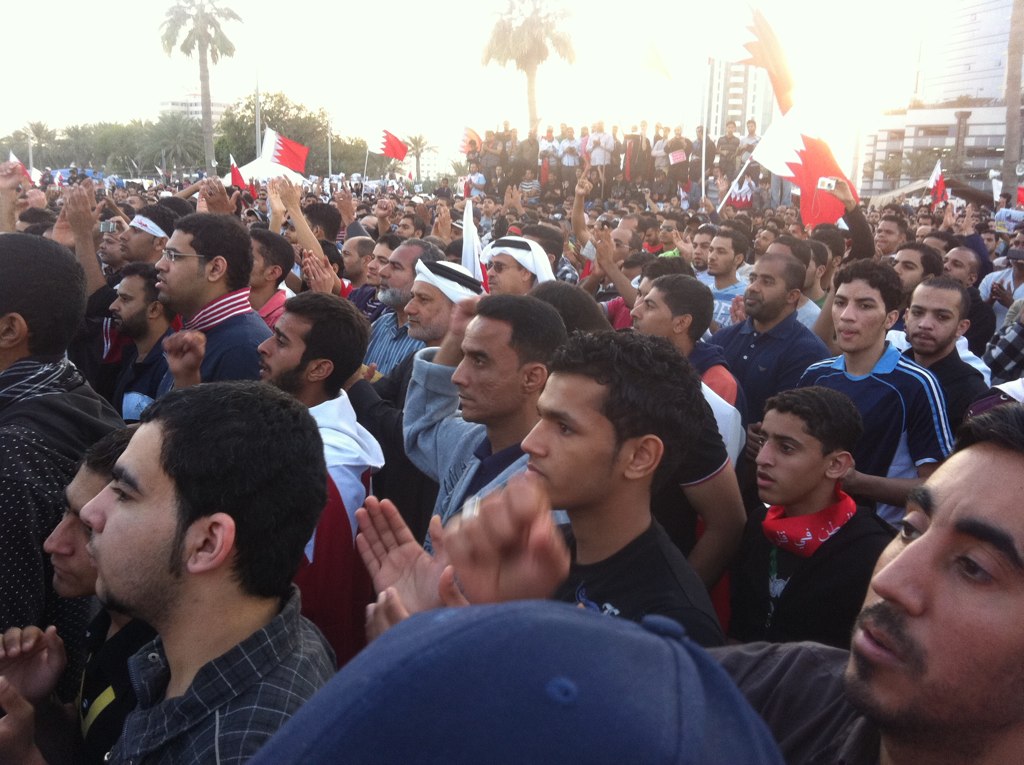
Repression in Bahrain reactionary monarchies of the Gulf unmasked<http://www.marxist.com/repression-in-bahrain-reactionary-monarchies-unmasked.htm> Written by Francesco Merli Wednesday, 23 March 2011 [image: Print]<http://www.marxist.com/repression-in-bahrain-reactionary-monarchies-unmasked/print.htm#> *The wave of mass protests that have swept Bahrain since February 14 and culminated in huge demonstrations that brought onto the streets more than 100,000 people in the capital Manama (in a country with an estimated population of 1.2 million, half of which are immigrants with no legal citizenship) have been the biggest ever in Bahrain's history.* [image: Pearl Roundabout, February 21. Photo: Mahmood Al-Yousif] <http://www.marxist.com/images/stories/middleeast/Feb_21_Bahrain-Mahmood_Al-Yousif.jpg>One month has passed since the initial demands for political reform, equal rights for the Shia majority of the population and the resignation of the unpopular prime minister were first put forward. During this past month we have witnessed schizophrenic violent zig-zags on the part of the regime, swinging from conciliation and promises of reforms to repression by brute force. Now the Al Khalifa monarchy and its allied autocrats from the other Gulf States are showing their real face. Protests are being crushed in blood by a coordinated military effort by the Saudi Arabian army and the six Gulf Cooperation Council (GCC) states and the Bahraini security forces, under the umbrella of their joint peninsula military shield pact. It is not the first time that a Saudi Arabian military intervention has been used to smash a mass movement in the neighbouring kingdom. In 1994 the death toll as they reinstated order was over 40 victims. Reforms promised at that time, whose purpose was to bring the situation back under control, were subsequently forgotten as order was reinstated. Similar to today, among the main demands in 1994 were the reinstating of the 1973 constitution, the release of political prisoners, the granting of political rights to women, and the institution of economic reforms to raise the standard of living of the majority Shia population. The reaction of the government has not changed significantly. The protests were portrayed as a purely sectarian Shia rebellion in order to prepare the ground for repression. It is worth noting that the government of Bahrain is almost one with the monarchy as 80% of the cabinet is composed of members of the Al Khalifa royal family and the prime minister is the king's uncle. Khalifa ibn Salman Al Khalifa is the longest serving unelected premier in the world, having held office since 1971, and perhaps also the wealthiest man in the country. He is regarded as a symbol of extreme corruption and the demand for his resignation represents the immediate focal point of the mass opposition movement. The former Emir and self-proclaimed king, in 2002 announced the introduction of a constitutional monarchy, but these reforms did not alter in the slightest the absolute control of the monarchy, nor did it improve in any way the conditions for the vast majority of the population. Abruptly ending any previous offers of negotiating with the opposition, on Wednesday March 16 the government declared a state of emergency with a 12-hour curfew from 4pm to 4am and a ban on demonstrations for three months. The enforcement of this decision is being imposed by the security forces, with the support of 1,000 Saudi and 500 UAE officers who entered the country on March 14. The military intervention, supported by all the Gulf monarchies after a call issued by the Bahraini government, is an attempt to clamp down on the mounting mass uprising before it gets out of control and to scare into passivity the population of all the surrounding countries who have been encouraged by the movement in Bahrain and were beginning to put forward their own demands in the recent weeks. Saudi Arabia and their allies are strobngly denying that their troops have been used to confront the demonstrators, but several eye-witness accounts contradict the official version and report that at least on two occasions in the last few days Saudi troops have opened fire on protesters. The main point, however, is that through the deployment of GCC troops they have allowed the Bahraini government to use the full weight of its security forces against the mass movement. Naked repression The Pearl roundabout in the capital Manama has been the focal point of peaceful protests for over one month. After the first attempt to remove them on February 17, the protesters had forced their way through and regained control over what had become for them the equivalent of Tahrir Square in Cairo. A second brutal attack by security forces in the early morning of March 16 succeeded in removing the protesters from the roundabout with the use of tanks, helicopters and live ammunition. At least five people were killed and hundreds were seriously injured by gunfire. In what seems to be a consolidated tactic of the security forces like and even worse than on February 17 they made no distinction between the elderly, children or women and attacked even nurses and doctors who had intervened to provide first aid to the injured. As a result, the first aid and emergency care units of hospitals in the capital have been stretched to their limit by an influx of large numbers of patients injured by gunshots. As on previous occasions, the attack by the police, aided by government thugs in plain clothes, was not confined to the mere taking over of the Pearl roundabout but was transformed into a vicious man-hunt. In one of the many incidents reported, medical staff witnessed security forces at Salmaniya Hospital taking 20 injured protesters to an undisclosed location. Those attempting to resist were abused. Security forces blocked access to the hospital and prevented the hospital staff from moving leaving. A taste of the brutality of the repression is given by the *New York Times*correspondent, Nicholas Kristof on March 16: (New York Times <http://www.nytimes.com/2011/03/17/opinion/17kristof.html?_r=4>) In Bahrain in recent weeks, Ive seen corpses of protesters who were shot at close range, seen a teenage girl writhing in pain after being clubbed, seen ambulance workers beaten for trying to rescue protesters and in the last few days it has gotten much worse. Saudi Arabia, in a slap at American efforts to defuse the crisis, dispatched troops to Bahrain to help crush the protesters. The result is five more deaths, by the count of The Associated Press. And again: My *New York Times* colleague Michael Slackman was caught by Bahrain security forces a few weeks ago. He said that they pointed shotguns at him and that he was afraid they were about to shoot when he pulled out his passport and shouted that he was an American journalist. Then, he says, the mood changed abruptly and the leader of the group came over and took Mr. Slackmans hand, saying warmly: 'Dont worry! We love Americans!' 'Were not after you. Were after Shia,' the policeman added. Mr. Slackman recalls: 'It sounded like they were hunting rats'. The unleashing of these thugs with the full backing of the regime is what is happening right now in Bahrain. No doubt they will be fully rewarded for their services by their wealthy masters. US diplomacy breaking down in the Gulf? Just a few days before the clampdown on the opposition, US Defence Secretary Bob Gates, declared during a visit to Bahrain that its baby steps toward reform werent enough and that the kingdom should step up its negotiations with the opposition. The very next day the decision of the GCC military intervention was made public. It is frankly unlikely that the US were unaware of the Bahraini king's plans to smash the internal opposition by brute force, but if we were to take at face value the claims by US diplomats that they did not give the green light for repression, the picture would be all the more embarrassing for the US imperialists. The *Washington Post *of March 15 gives some insights on what the points of friction are between the US imperialists and their allies and also the real aims of the GCC military intervention: 'We dont want Iran 14 miles off our coast, and thats not going to happen,' said the Saudi official. U.S. officials counter that Iran, so far, has been only a minor player in the Bahrain protests and that Saudi military intervention could backfire by strengthening Irans hand. 'There is a serious breach' between the Gulf countries and Washington over the issue, warned a second Saudi official. 'Were not going in [to Bahrain] to shoot people, were going in to keep a system in place,' he said. And further on: The crack-up [in US relations with the Gulf States] was predicted by a top UAE sheik in a February meeting with two visiting former U.S. officials. According to notes made during the conversation, the UAE official said: 'We and the Saudis will not accept a Shiite government in Bahrain. And if your president says to the Khalifas what he said to Mubarak [to leave office], it will cause a break in our relationship with the U.S.' In other words, the military intervention of the GCC countries is not considered interference in internal matters concerning the Bahraini people... *as long as the system is kept in place and majority rule is ruled out*! Thus, what had been originally presented as a defensive military pact to guarantee mutual support in case of a foreign threat in the moment of truth has been shown to be the fig leaf of a conspiracy by the autocratic regimes in the region to guarantee stability and the continuation of their rule against the will and legitimate grievances of their own people and, of course, to deal with the threat of revolution. The reactionary monarchies of Kuwait, Oman, Qatar, Saudi Arabia and the United Arab Emirates have everything to lose if the Bahraini dynasty falls and the revolutionary contagion spreads further. Already signs of social unrest that could develop into a real crisis have emerged particularly among the Saudi Shia minority (which lives in the area where there are important oil fields) and the industrial heart and second most important city of Oman. In both cases the demonstrations have been met with a combination of bloody repression and concessions. Arab revolution: a test for the US's acrobatic skills The US imperialists have obviously a lot at stake in Bahrain. For the last 20 years, after the first Gulf war against Iraq, Bahrain has been the base of the US Fifth Fleet, which monitors and guarantees US interests in in the whole area and in this key gateway for oil supplies, the Persian Gulf and the Red Sea. This alone would be a good reason, but there is another one that is at least as important. The initial reluctance of the Obama Administration to abandon their former friends Ben Ali and Mubarak was because they correctly feared that if the two dictators fell, the aftershocks of the Arab revolution would not stop at the artificial borders established by the imperialist powers after the First World War. The key country for the USA is Saudi Arabia, an ally sitting on the biggest oil reserves in the world. The Saudi monarchy was the staunchest campaigner for Mubarak to hold on to power, to the extent that they even offered to pay the Egyptian army whatever subsidy the USA may have withdrawn. This was not small change, but billions of dollars. US diplomacy was caught by surprise by the development of the revolutions in Tunisia and Egypt, first denying the reality of the facts and constantly having to run after events. However, when the Libyan revolution began, they found in it the opportunity to try to regain credibility for their long worn-out claim that they stood for democracy, that they are a force for good, and decided to throw all their weight against the Gaddafi regime advocating regime change. The US imperialists' propaganda in relation to Libya has further entangled US diplomacy in contradictions, as most of the things that have been invoked to justify military intervention in Libya would be also true of Bahrain. But in the case of Bahrain the loud US rhetoric about Libya becomes just a series of mild understatements. Once the revolutionary unrest hit Bahrain on February 14, and further radicalised after the repression of February 17, the US government sharply changed its tune. The *Wall Street Journal* of March 5 reports the words of a US official: "'Starting with Bahrain, the administration has moved a few notches toward emphasizing stability over majority rule,' said a U.S. official. 'Everybody realized that Bahrain was just too important to fail. (U.S. Wavers on 'Regime Change'<http://online.wsj.com/article/SB10001424052748703580004576180522653787198.html>, March 5, 2011) The *Washington Post* of March 16 picks up on the contradictions facing US diplomacy: Such a contrast manifested itself Wednesday in the secretary of states reaction to the events in two different Arab public squares, each a revolutionary icon. On a visit to Tahrir Square in Cairo, the epicenter of protests that ultimately deposed President Hosni Mubarak, Clinton strode through the plaza and glad-handed Egyptian passersby, whom she praised for risking their lives. 'Its just a great reminder of the power of the human spirit and universal desire for freedom and human rights and democracy,' Clinton said. 'Its just thrilling to see where this happened. It is worth remembering, however, what the same Hillary Clinton said roughly one month earlier about the same events in Egypt: President Mubarak has announced he will not stand for re-election nor will his son He has given a clear message to his government to lead and support this process of transition. That is what the government has said it is trying to do, that is what we are supporting, and hope to see it move as orderly but as expeditiously as possible under the circumstances. (February 5, 2011) So, while the heroes of Tahrir square were exercising the power of the human spirit and universal desire for freedom and human rights and democracy, Clinton and Co. were squarely behind the last defence line of the dictator, Mubarak. What a contradiction between the praise for Tahrir (after the dictator has fallen) and the US vocal condemnation of Gaddafi's violence, on the one hand, and the cautious words in relation to the Gulf States on the other hand. Again, the *Washington Post* comments: Meantime, in Manamas Pearl Square, Bahraini security forces fired tear gas and assaulted an encampment of demonstrators, whom officials derided as 'saboteurs' and 'outlaws.' Five people were reported killed and more than 100 injured. Clinton said that U.S. officials have 'deplored' the violence in conversations with Bahraini officials. But unlike her endorsement of the Egyptian revolution she did not take sides in the conflict in Bahrain. 'We believe that a long-term solution is only possible through a political process,' she said. The common thread that ties together these twists and turns is the interests of US imperialism. The US administration will stand up for democracy as long as it can be used as a propaganda weapon in their hands and as a stick to beat their enemies with. And in order for this to be more effective, the allies of the US are advised to pursue stability and strangle any revolutionary threat, but they should do so not in front of the TV cameras and possibly without leaving any evidence behind. Saudi Arabia While much of the world has been preoccupied with questions about a no-fly zone over Libya, Arab Gulf states have been busy establishing what might be called a 'no-protest zone' in the Arabian peninsula. (*The Guardian*, March 17) Previous divisions within the Saudi royal family on whether to tighten up their grip over society or start a process of reforms to prevent revolution from below seem to have been overcome for the time being. The Gulf monarchs, with their actions, are attempting to boost confidence in the idea that the wave of the repression they have unleashed will protect them from the danger of revolution. But it isnt that simple and straightforward. Already unrest amongst the Shia minority (who are concentrated in the strategically important oil-rich Eastern provinces) has been harshly repressed in the past weeks. The Saudi king is trying to hold onto power through the combined action of repression and economic concessions, the same card already played by all the regimes under threat of revolution in the region over the last few months. On March 18, the Saudi King Abdullah announced billions of dollars in handouts (a staggering $66.7 billion) to his people in a TV address to the nation. The decrees provide a boost in welfare benefits, bonuses for public sector workers, including the army, and a drive to build new housing. The king also ordered the creation of 60,000 security jobs within the interior ministry. The speech was also, however, punctuated with threats of further repression. A couple of weeks before, Saudi Arabian scholar *Mai Yamani commented on a previous similar announcement:* No kingdom is an island, particularly when it sits in a sea of revolution. King Abdullah of Saudi Arabia, watching the assault on Libya's strong man Muammar Gaddafi with his monarchy's usual complacency, thinks he can buy off protests with the promise of gifts. Of course, the scale of the bribes the king offered last week to his country's alienated young generation £22bn is something only an oil-rich monarch could deliver. The Saudi king speaks as a father to the youthful population after all, this is the only royal family to give its name to its people and he expects them to obey the name al-Saud as they would their own father. But the king has compromised his authority by combining it with the role of 'sugar daddy'. Nowhere else are subjects promised such largesse to not rock the boat. (*The Guardian, **February 27)* Two weeks have passed by and the size of the bribe has grown threefold. This is a graphic indication of how big the concerns of the Saudi monarchy are. How much time the Saudi king will be able to buy with these policies is hard to tell. *In the same article Mai Yamani reminds us of the other side of the coin:* In 1979, indeed, the kingdom's ground and air forces shot at protesting Shia in the eastern province, killing dozens and wounding hundreds. Denial remains the dominant state of mind of the Saudi rulers. The royals believe that they have a special status in the Arab world and that no revolution can touch them. And if one tries, they will follow the words of Prince Naif: 'what we took by the sword we will hold by the sword'. Undoubtedly, the Saudi Arabian youth and workers who are not prepared to sell away their aspirations for radical change, real democracy and dignity will have to be prepared to stand up to this challenge. The Al Khalifa play game of divide and rule In an attempt to twist reality and justify the decision to clamp down on unarmed demonstrators, the Bahraini rulers are conducting a hysterical campaign to portray the protesters as hired thugs of the great felon Iran in a move engineered to expand its influence over the Gulf, hub of 40% of the worlds oil supplies. While one doesn't need much imagination to see why the Iranian regime would be delighted to exert its influence over the Gulf kingdom (historically claimed by Iran as a part of its territory), it is also certain that the overwhelming majority of the February 14 revolutionary youth who represent the most resilient and determined part of the movement in Bahrain would most likely embrace the struggle of their brothers and sisters in Iran against the regime of the mullahs, rather than acting in solidarity with Ahmadinejad. About 70% of Bahrain's population is Shia, while the state security forces and the monarchy belong to a Sunni clique. It is not surprising therefore that the protests have solid support among the Shia population (in fact, a mass movement in Bahrain could never develop as such without involving the Shia population). However, the movement is also clearly affecting a considerable layer of the Sunni youth, women, workers and intellectuals, who would not join it if the government's claims had any real base in truth. It is nothing but a desperate attempt to play the card of the sectarian division in order to turn one part of the population against the other and so preserve the power and privilege of the ruling clique. In fact, one of the six political leaders of the opposition parties that were jailed a few days ago for their support for the movement is the leader of a Sunni-based party. It is striking to see how the ruling cliques throughout the Arab world are showing no restraint whatsoever in evoking and provoking the most dangerous sectarian divisions in a desperate attempt to cling on to power. Once again it is an elementary divide and rule tactic, the oldest trick in the book to guarantee the rule of a minority over the majority. Strong evidence, for example, has been unveiled in the past weeks of the role played by security forces in engineering the attacks against Coptic Christians in Egypt in a failed attempt to put a wedge between Christians and Muslims and turn one against the other. The Egyptian masses have demonstrated in action how unity against the common oppressor is the key to achieve revolutionary change and with their actions have swept to one side this miserable manoeuvre. In Bahrain the government has been forcefully attempting to rally the Sunni minority and use them as shock troops of the counter-revolution to attack the protesters, alongside with the security forces. For example, on March 3 Sheik Abdel Aziz Mahmood addressed a crowd of thousands of Sunnis gathered at the al Fatah Mosque to support the monarchy, inciting them to sweeo away the mob at the Pearl roundabout. To what extent they will be successful, albeit temporarily, is to be seen. Immigrant workers Bahrains economy as it is the case for all the Gulf States relies heavily on a cheap immigrant workforce mainly from Middle Eastern and Asian countries, which constitutes half of the population. These immigrant workers have no citizen status, no right to organise or strike, and are subject to extremely harsh conditions of exploitation, in some cases bordering on slavery (this is particularly true for the legion of house carers, mainly women, who work for wealthy households). Their presence in the country has been used by the ruling clique and the Bahraini capitalists as a means of constant pressure against the Shia majority, thus fomenting tensions between the immigrant workers and the poorest sections of Bahraini society. It has to be noted also that an important part of the kingdoms security forces are recruited among foreigners. The role played by these mercenaries in the repression is particularly vicious and has provoked a clear rejection amongst the masses. *Jadaliyya* reports: As part of its campaign against the opposition, Bahrain TV has been rising to the defense of poor Asians, a number of whom have come under attack by civilians in the past week. Migrant workers are easily the most vulnerable segment of Bahraini society. They are afforded minimal legal protections due to a deeply flawed and protracted legal system and a generally weak application of the law. They bear the brunt of the Bahraini economy and most of its citizens in ordinary times, and are now being singled out and targeted in these chaotic times. Ostensibly, the withdrawal of police forces from ordinary policing and security duties has led to a combination of mob rule: On the one hand, there are roaming gangs of armed instigators, the '*baltajiyya*;' and on the other, there are those Bahrainis who are indiscriminately lashing out at foreigners, mostly Pakistanis, because they have witnessed or have been directly affected by the violence of the (mostly Pakistani) security personnel. A Pakistani commentator has spoken out on the issue, urging Pakistanis not to lend an iron hand to despots of the Middle East." The Bahraini media have skilfully exploited situations where unidentified mobs have attacked and severely injured or killed some immigrant workers, blaming the Shia masses for attacks on them. This is far from the truth and it wouldn't be surprising if these provocations were organised by thugs connected to the security services, following a tactic that has been constantly used in the last months by all reactionary Arab regimes. However the question of involving in the revolutionary movement the immigrant workers is clearly one of the issues that could decide the fate of the revolutionary upsurge, especially in the Gulf States. The revolutionary youth and workers of Bahrain should appeal to their brothers and sisters, regardless of their nationality and religion, to stand up against the common oppressors and demand equal rights, wages and working conditions for the immigrant workers. If this unity is forged, the days of the al Khalifa royal family and of capitalist rule in Bahrain would be numbered. Reform or revolution? The aims of the movement initially could not be characterised as particularly revolutionary. In fact what the movement was demanding was simply a series of reforms and a new constitution within the framework of the monarchy. Only in the last two weeks has a section of the movement decided to move forward and call for the end of the monarchy. The first declaration of the newly formed Coalition for a Bahraini Republic on March 7 stated: In the name of our glorious religion and international conventions on human rights and on the principle of the right of nations to decide their destiny, and based on our long struggle and sacrifices against the oppressive and corrupt Al-Khalifa regime, we hereby declare a tripartite coalition between the Wafaa, Haqq and Bahrain Freedom Movements that has chosen to fight for a complete downfall of the regime, and the establishment of a democratic republic in Bahrain. We have named this the Coalition for a Bahraini Republic. We will work with the free people of this country, and the 14th February Youth and all others who believe in this legitimate and rightful choice through all means of civil and peaceful resistance. (Bahraini "Coalition for a Republic" Issues First Statement<http://www.jadaliyya.com/pages/index/839/bahraini-coalition-for-a-republic-issues-first-statement>, 3 March, 2011) It is clear that cosmetic changes would not be enough to recover the authority of the monarchy, especially after the openly repressive turn. But why is it that significant reforms cannot be granted without undermining the power of the monarchy? In spite of being a particularly wealthy country in the context of the Middle East thanks to oil and finance sector revenues, any serious concession that involves a significant shift in political and even economic power, from the Sunni minority to the Shia majority would seriously threaten the stability of the whole state, which has been based on the marginalisation and discrimination of the majority Shia population for decades. The problem facing the revolutionary forces in Bahrain is the same as that faced by the revolution in other countries. The simple forceful proclamation of a demand, even when supported by the overwhelming majority of society, * poses* but does not *solve* the problem of which social forces will carry it out and how. Who will realise the aspirations of the masses? How could the obstacle of the repressive forces, that is the state, be overcome? Protesters in Egypt and Tunisia were right to think that young Egyptian and Tunisian conscripts would not shoot against them even if ordered to. In Bahrain, however, the security and armed forces are almost entirely made up of mercenaries who sometimes do not even speak the same language as ordinary Bahrainis. To put it in the words of Professor Mark LeVine's contribution on *Al Jazeera*: Pakistanis (particularly Baluchis), Yemenis, Jordanians, Syrians and now Saudis and GCC troops seconded to the kingdom Bahrain's geography of repressive power is a confusing maze of nationalities, tribes and ethnic groups. What unites them is the fact that they are entirely Sunni and have no compunction about harming and even killing Bahraini protesters at the command of their Bahraini paymasters (indeed, many receive Bahraini citizenship as a reward for their services). (Full house: Playing Bahrain's sectarian card <http://english.aljazeera.net/indepth/opinion/2011/03/20113179218339808.html> ) In Egypt or Tunisia, because of the social composition of the army, the ranks and lower-ranking officers were affected by the contagion of revolution. At a later stage, even sections of the police were rebelling against their commands and joined the revolution. That was not the result of a peaceful process as hundreds of people died, however, the regimes could not deploy the full force of repression and as soon as they attempted to use the army against the masses, the army started to break up along class lines. In spite of that, particularly in Egypt, the regime had a momentary window of opportunity to fight back the revolutionary upsurge and it was only the heroic resistance of the revolutionary youth and, above all, the working class entering the revolutionary stage, that overcame and routed the reactionary forces, pushing sections of the regime to abandon the dictators and thus bring about their downfall as an extreme measure in an attempt to preserve their power and privilege. This process is less likely to happen in countries like Bahrain. The spontaneous character of the movement and its mass nature obviously have had an impact on all layers within society, but the lack of a revolutionary strategy on the part of the leadership has exposed the weaknesses of the movement and has given the counter-revolution the opportunity to hit back with its full force to disperse the movement. Now, after the demonstrations have been temporarily dispersed and the roads and junctions are under the control of armed men, tanks and military vehicles, this inability to lead the revolution is turning into demoralisation, as the recent appeal from the 18 opposition legislators to the UN and USA to intervene in Bahrain to stop the violence against protesters, has shown. It is difficult to imagine a more disastrous course of action that could possibly be taken by the movement. It would mean total capitulation to the same forces that have been the historical pillars of the reactionary rule of the al Khalifa. If this idea gains ground, it would mean making passive the living social forces that gave the movement such explosive strength. All the sacrifices will have been in vain. The working class has clearly participated in the revolutionary wave, and particularly in the wake of repression there have been strikes in the strategic gas and oil industry which provides 60% of government revenues. The leaders of the opposition have wavered throughout the duration of the movement, on the one hand feeling the pressure of the revolutionary forces and particularly the youth who every time the leaders hesitated tended to bypass them and take the lead and on the other the pressure of the ruling class, in a constant attempt to negotiate their way out of the inevitable showdown, instead of preparing and steeling the forces of the revolution for the decisive struggle. This attitude of the leaders has undermined the movement instead of strengthening it and has contributed to actually making more likely the outcome they feared. The whole experience of the revolution in Bahrain so far has shown that negotiation is not possible and the only possible alternative is between revolution the overthrow of the monarchy and of the capitalist system it is based upon or a bloody counter-revolution. The king's triumphant speech while rallying his troops on Sunday night (March 20) reveals to what degree reaction feels confident now. "An external plot has been fomented for 20 to 30 years until the ground was ripe for subversive designs... I here announce the failure of the fomented plot," king Hamad said, according to a report by the state Bahrain News Agency (BNA). It goes without saying that the only foreign plot in full swing is the one conspired by the reactionary Gulf monarchies to preserve their power and wealth against the will of their own people. The blow suffered by the revolutionary forces has been serious, but nothing has been solved by the repression. Once the troops are removed from the ground, the regime will be naked and exposed to new revolutionary waves. The Arab revolution is just at the beginning. It is the duty of all revolutionaries to prepare for this perspective. The revolutionaries in Bahrain and in the whole of the Middle East should take stock of the lessons of the uprising in Bahrain, reorganise and base themselves on the youth and the working class, regardless of religion and nationalities, and restart the struggle on an higher level for the revolutionary overthrow of all these reactionary regimes. [Non-text portions of this message have been removed] ------------------------------------ --------------------------------------------------------------------------- LAAMN: Los Angeles Alternative Media Network --------------------------------------------------------------------------- Unsubscribe: <mailto:[email protected]> --------------------------------------------------------------------------- Subscribe: <mailto:[email protected]> --------------------------------------------------------------------------- Digest: <mailto:[email protected]> --------------------------------------------------------------------------- Help: <mailto:[email protected]?subject=laamn> --------------------------------------------------------------------------- Post: <mailto:[email protected]> --------------------------------------------------------------------------- Archive1: <http://www.egroups.com/messages/laamn> --------------------------------------------------------------------------- Archive2: <http://www.mail-archive.com/[email protected]> --------------------------------------------------------------------------- Yahoo! Groups Links <*> To visit your group on the web, go to: http://groups.yahoo.com/group/laamn/ <*> Your email settings: Individual Email | Traditional <*> To change settings online go to: http://groups.yahoo.com/group/laamn/join (Yahoo! ID required) <*> To change settings via email: [email protected] [email protected] <*> To unsubscribe from this group, send an email to: [email protected] <*> Your use of Yahoo! Groups is subject to: http://docs.yahoo.com/info/terms/