http://www.marxist.com/arab-revolt-history-of-struggle.htm
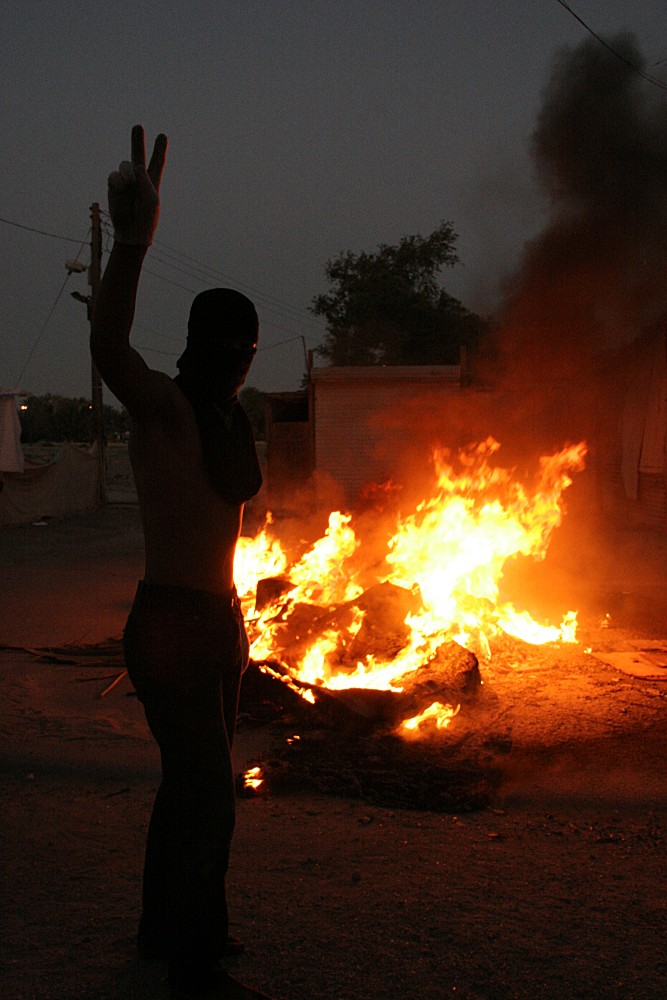
The Arab revolt: A history of struggle <http://www.marxist.com/arab-revolt-history-of-struggle.htm> Written by John Pickard Thursday, 24 March 2011 [image: Print]<http://www.marxist.com/arab-revolt-history-of-struggle/print.htm#> *The Arab world, from the Atlantic to the Persian Gulf and from North Africa to the heart of Sudan, is in flames as one revolutionary movement after another unfolds. Tunisia, Egypt, Yemen, Jordan, Libya, Algeria, Sudan, Bahrain, Kuwait and Morocco have all seen demonstrations for democracy and social reforms.* [image: Bahraini youth. Photo: Sara Hassan] <http://www.marxist.com/images/stories/middleeast/youth_with_fire-Sara_Hassan.jpg>The revolutionary wave has spread across the Arab world because of the common traditions and culture that pervade all these states. They are really nations within one greater nation and a feature of the struggle of the Arab workers is always the historic aspiration for Arab unity. The Arab nation is united by a common language, culture and tradition and the boundaries that exist between separate states are relics of the colonial past rather than natural divisions between peoples. In modern times, all the Arab states have suffered from the legacy of imperialist domination when they were ruled either as direct colonies, as in the case of French rule of Tunisia and Algeria or as protectorates as in the case of Britains governance of Palestine, Iraq and Egypt. Independence After the Second World War, the colonial masses, including those in the Arab states, were struggling for independence and national self-determination. The Marxists warned at the time that if independence meant that the local capitalists and landlords were in power, there would be no possibility of a resolution to the economic and social problems faced by the mass of the workers and peasants. There is no better confirmation of that general position than in the list of rotten kingdoms and dictatorships littering the Arab world today. Egyptian president Hosni Mubarak was in power nearly 30 years before he was overthrown. Ben Ali was in power in Tunisia for 32 years before he was forced out. Ali Abdullah Saleh has governed Yemen since 1978. Muammar Gadaffi has been in power for over 42 years in Libya. In these supposed peoples states and republics, as often as not the leaders have groomed their sons to take over after them, like dynastic monarchies. Thus Bashar Assad successfully took over from his father Hafez as president of Syria; in like manner Mubarak, Ben Ali and Gadaffi groomed their sons to inherit their crowns. Whether or not the mass of the populations of these countries will let them, is another matter. In almost every case, these rulers presided over economic policies that favoured the so-called free market which meant that a handful of favoured capitalists, bureaucrats and family members were able to grossly enrich themselves, while the mass of the population existed on a permanent treadmill of price increases, rising unemployment, low pay and hopelessness. Nearly half the population of Egypt has existed on no more than $2 a day. The average rate of unemployment in the Arab countries has been around 9-10 per cent but that masks a far higher rate among young people and newly-qualified graduates. The safety valve of emigration that skilled graduates could use to seek work in Europe is now cut off in the face of a world recession and young people, who make up nearly half the total population, are becoming ever more desperate. Rulers The dictators, kings, sheikhs and emirs that rule the Arab world constitute a massive international kleptocracy, soaking the wealth from the state, feathering their own nests with secret bank accounts and assets. One of the most significant features of the current revolutionary movements around the Arab world is the repeated demand by workers and youth in the streets for the confiscation of the multi-billion dollar assets of their present and former leaders, assets obtained by decades of plundering of the state coffers. Whatever radical sounding phraseology they have used against the West and the USA in particular, most of them have acted as the willing lapdogs of the great capitalist powers, by providing strategic military bases, access to the all-important oil and the necessary political stability. The ongoing revolution in Egypt is particularly significant today because of the great political weight of that country within the Arab world. It is one of the three giants of the African continent and by far the largest Arab state, as big as the next four or five put together. Asked on Al Jazeera TV if they were copying the lead of Egypt, a demonstrating Yemeni worker replied, Of course. Egypt is the mother of the Arab people. On the last occasion that revolutionary upheavals took place in Egypt, it gave a huge impetus to struggles in all parts of the Arab world. In 1952 the Free Officers movement of Colonel Nasser overthrew King Farouk and ushered in a period of unprecedented social upheaval in the region. This eventually culminated in Nasser nationalising the Suez Canal and the invasion of Egypt by British and French forces, acting in collaboration with Israel which invaded Sinai. The nationalisation of the Canal at that time and further nationalisations of banks, land and industry, gave momentum to later revolutionary movements in Iraq, Syria, Algeria and other Arab states. Nassers methods were extremely autocratic he banned strikes and arrested leaders of the Egyptian Communist Party but his policy of challenging the interests of the imperialist powers is still remembered today. Israel The establishment of the state of Israel in 1948 has also been a key factor in the politics of the Arab world and an important driver of pan-Arab struggles. The state was established with the support of all the great powers after the war, including the USSR, as a haven for the Jewish survivors of the Nazi Holocaust. But the state was established at the expense of the local Palestinian population, most of whom were forced to flee. The half a million or so Palestinian refugees who found themselves outside the 1948 boundaries of Israel, eventually found their way to Gaza, Jordan and Lebanon and now, generations later, many of them are still living in the same camps on UN charity. During the 1967 war, Israel captured more Palestinian territory, on the West Bank of the Jordan and the Gaza Strip, governed respectively by Jordan and Egypt since 1948. Israel has since withdrawn from Gaza, but maintains it as an open prison blockaded on all sides by the Egyptian and Israeli military, preventing the access of goods and necessities so there is no possibility of any normal economic or social development. Little wonder that more than half the population of Gaza is unemployed. On the West Bank, the tame Palestinian Authority has been given control of the heavily-populated Palestinian cities while Israel has carried on a creeping annexation of large parts of the rural areas for Jewish settlements. The Palestinian Authority is in effect a client of Israel, which is still in total control, militarily and economically, of the West Bank. Israel is today a Middle East superpower, thanks above all to the massive military and economic aid given by the United States non-stop for decades. In return, Israel has supported the strategic interests of imperialism, likened once to a massive land-based US aircraft carrier. Yet for the Jewish people who migrated, Israel has been anything but a safe haven. The Arab states have fought wars with Israel in 1948, 1956, 1967 and 1973 and there is still no guarantee of peace. Taking the Arab population of the Israeli state together with the population governed by the Palestinian Authority, the total population of Israel/Palestine is roughly divided equally between Israeli Jews and Arabs. But as long as one half of the total population has second-class rights, or no rights at all, there will be constant struggle and upheaval. The Israelis have benefitted for 30 years from a peace treaty with Egypt and Mubaraks regime has been complicit in the blockade of Gaza, even during the murderous bombings of two years ago. The revolution in Egypt and the wider Arab revolution have now put this apparent stability in the melting pot. Faced with a new war with a radicalised Egypt, there is no doubt that Israel would win on the battlefield. But, as the Economist asked, *could it win against masses of protesters in town squares across the West Bank, Gaza and Israel too, demanding political rights for Palestinians? It is a question that makes many Israelis queasy! (Feb 5 2011)* Palestine The support of Arab workers around the whole Middle East for their Palestinian cousins has been a key unifying element in Arab politics. One Arab dictator or sheikh after another has given lip-service to the cause of the Palestinian people. But whilst they have plied the PLO leadership with millions of dollars and their unwavering diplomatic support they have repeatedly betrayed concrete Palestinian interests. In fact for many years while Ben Ali was plundering the Tunisian state of billions of dollars, he was at the same time kindly providing a home for the PLO. The Tunisian and Egyptian revolutions have thrown the carefully nurtured stability of the Middle East into complete turmoil. The history of the Arab world is a history of imperialist domination, wars by proxy, greed and treachery. The 20th Century was marked by the defeat of the already decaying Ottoman empire and the struggle to take its place on the part of the British, French and - last of all, thanks to the growing lure of oil - the Americans. Stooge regimes were established and replaced at the whim of the imperialist powers and corruption became the norm. It is a rotten history in which one thing has remained constant - the suffering of the masses. Each dawn of hope has proven to be a false one. This time the Arab revolution must succeed. Source: *Socialist Appeal*<http://www.marxist.com/weblinks/europe/socialist-appeal-britain.htm>(Britain) [Non-text portions of this message have been removed] ------------------------------------ --------------------------------------------------------------------------- LAAMN: Los Angeles Alternative Media Network --------------------------------------------------------------------------- Unsubscribe: <mailto:[email protected]> --------------------------------------------------------------------------- Subscribe: <mailto:[email protected]> --------------------------------------------------------------------------- Digest: <mailto:[email protected]> --------------------------------------------------------------------------- Help: <mailto:[email protected]?subject=laamn> --------------------------------------------------------------------------- Post: <mailto:[email protected]> --------------------------------------------------------------------------- Archive1: <http://www.egroups.com/messages/laamn> --------------------------------------------------------------------------- Archive2: <http://www.mail-archive.com/[email protected]> --------------------------------------------------------------------------- Yahoo! Groups Links <*> To visit your group on the web, go to: http://groups.yahoo.com/group/laamn/ <*> Your email settings: Individual Email | Traditional <*> To change settings online go to: http://groups.yahoo.com/group/laamn/join (Yahoo! ID required) <*> To change settings via email: [email protected] [email protected] <*> To unsubscribe from this group, send an email to: [email protected] <*> Your use of Yahoo! Groups is subject to: http://docs.yahoo.com/info/terms/