http://www.marxist.com/greece-critical-moment-in-the-struggle.htm
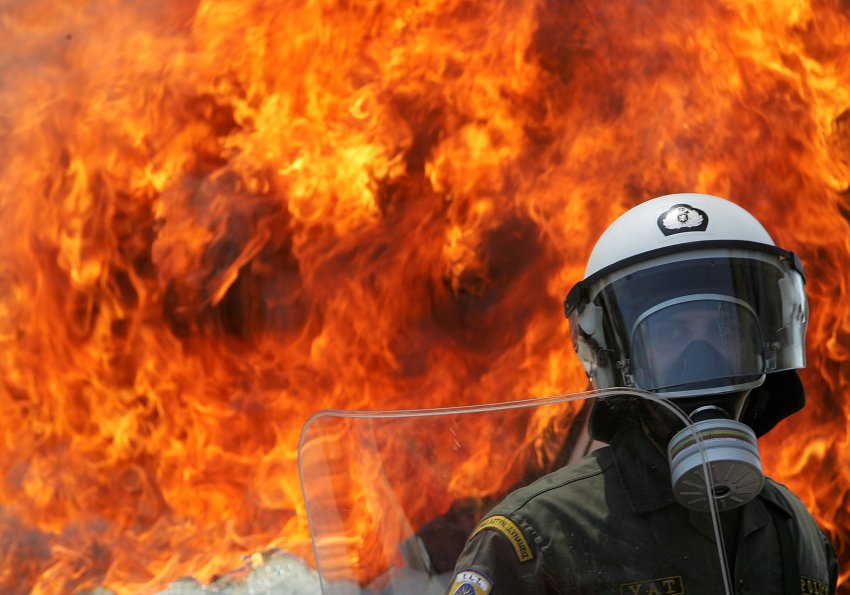
Greece: A critical moment in the struggle<http://www.marxist.com/greece-critical-moment-in-the-struggle.htm> Written by Fred Weston Thursday, 30 June 2011 [image: Print]<http://www.marxist.com/greece-critical-moment-in-the-struggle/print.htm#> *Yesterday the Greek parliament approved the austerity measures required to get further lending from the European Union. The PASOK government is determined to force through its austerity measures, even though 75% of the population is totally opposed to any further austerity being imposed on them. [Note: this article was written on the basis of discussions with the Greek comrades of the IMT, of Marxistiki Foni, presently intervening in Syntagma Square].* [image: Greece in flames - Photo: PIAZZA del POPOLO] <http://www.marxist.com/images/stories/greece/greece-in-flames.jpg>A total of 155 MPs voted in favour and 138 voted against. One* *PASOK MP, Yannis Kourouplis voted against the austerity measures and Papandreou immediately expelled him from the party. So much for the right to express ones opinion freely! Also, one New Democracy MP, Elsa Papadimitriou, voted for the measures and Samaras reacted in the same manner expelling her. The result of this is that the PASOK governments majority has been slowly whittled down. Since last year its parliamentary group has gone from 160 to 154, out of a total of 300 that make up the parliament. The new bail-out from the European Union and the IMF involves raising taxes to the tune of 14bn euros cutting spending by 14.3bn euros and selling off state assets over the next five years. VAT is to be increased, while lower income earners who previously were exempted from tax will now have to pay. Whereas in the past wages would be frozen while inflation ate into their real value, now Greek workers are facing real direct cuts in their nominal wages. Public sector workers wages will be cut by 15%. Workers in state-owned enterprises will see their wages cut by 30%. All public sector workers on temporary contracts will be sacked, and for every ten public sector workers that retire in the coming period only one will be taken on to replace them. This programme in fact meets the demands of international capital that has stated quite bluntly that Greece must slash unit labour costs by at least a third. And the only way they propose doing so is through wage cuts. What they ignore is that real wages in Greece are already abysmally low, among the lowest in Europe, and that explains the angry militant mood on the streets. Drastic cuts are also being imposed on healthcare, local government subsidies and education. Close to 1.5 billion will be cut from healthcare alone, while close to 2000 schools will either be closed or merged. Many social security benefits will also be eliminated, and the age of retirement is going to be raised to 65. In order to get a full pension one will have had to pay forty years of contributions, something which is impossible, given how long it takes for many young people to find a stable job. Also, many workers have had to work in the black as many bosses have evaded paying contributions. But it is the workers who will have to pay for this, not the bosses! Over the next few years the government also hopes to raise around 50 billion from privatizations. Parts of the utilities, such as water and electricity companies, refineries, airports, telecommunications, motorways, port operators and state owned banks, are to be sold off. Today the Greek parliament was voting on the details of the overall package approved yesterday. The PASOK government is under immense pressure from the European Central Bank, the IMF and the World Bank to deliver unprecedented levels of cuts in public spending. The PASOK was elected by the Greek workers in reaction to the measures of the previous New Democracy government, but now the party has lost the support of many of those same workers. Opinion polls show that the PASOK would only get 27% of the votes in new elections, while the New Democracy would muster only 31%. That means neither of the two major parties could govern alone should early elections be called. That explains why for now the Greek bourgeois is pushing for the PASOK to do the dirty work for them. There is no room for manoeuvre any more, as was the case in the past. As things stand now, Greece will have to pay 10% of its GDP just to cover the interest on its debt. And to achieve the 3% deficit limit established by the Maastricht Treaty (yes, does anyone remember that nowadays?), excluding interest payments, Greece would have to move from a deficit of around 5% last year to a surplus of anything between 7 and 10% of GDP. So if one adds the 10% to be put aside on interest and the shift from -5% to +10% in the balance of state finances, that means that what is required is a total of cuts, taxes and sell-offs to the tune of around 25% of Greek GDP. Dilemma of Greek and international bourgeoisie These figures show the dilemma the Greek and international bourgeoisie are facing. It is clear that it is not a question of *if* Greece will default but of *when*. The choices everyone is discussing are either a massive uncontrolled default in the immediate future or a managed default involving cancelling some of Greeks debt and delaying some of the repayments. There is no such thing as a best case scenario now. What all the bourgeois economic experts are talking about is the least bad scenario. Should Greece default then it would set in panic internationally and trigger a much wider European and world financial crisis. International banks are exposed to the Greek public sector and Greek banks by billions of dollars. The French banking sector is exposed to Greeces $485 billion debt to the tune of $42 billion, while the French government is exposed by close to $15 billion. The figures for Germany are $11 billion and $24 billion respectively. The combined overall exposure of France and Germany to Greek debt has reached over $90 billion. Britain and the US are the next in line after the French and German banks. Serious analysts have calculated that Greece can only realistically pay half what it owes, which would put international banks exposed to Greece in severe difficulties, having to write off a large part of what is owed to them, some $33 billion immediately after any default on the part of Greece and up to $100 billion in the long run. All this would come on top of the massive crisis of the banks in 2008. All this explains why France and Germany appear to be so keen to secure Greece's financial future. If they dont come up with some package to save Greece it is their own banks that would have the most to lose. Furthermore, a Greek default would spark off defaults in Ireland and Portugal that would in turn spark of a financial crisis in Spain, then Italy and then the whole of Europe would be dragged down, pulling down the United States as well. As one commentator recently described this scenario, it would be Armageddon. All this explains why the governments of France and Germany, and behind them Britain and the United States, are so keen to come up with some form of new bail out for Greece. They are in a Catch-22 situation. If they dont come up with the money their own banks face collapse; if they do, their own deficits mount up, forcing them to adopt more austerity measures at home as their own debts increase. French President Nicolas Sarkozy recently announced that French banks would be prepared to give Greece 30 years to repay its debts to them, a so-called roll-over. The German government has also been putting pressure on the private banks and other lenders to contribute to the latest Greek bail out. But all this will end up doing is further exposing the banks to the risks of a Greek default. In fact the credit rating agencies have already stated quite clearly that they would consider any such roll-over as a technical default, i.e. bankruptcy. Mass protests While Greek parliament today was holding a second vote on the austerity programme, on how to put into practice the measures listed above, the masses have been involved in the 48-hour general strike organised by the trade unions. Participation in the strike this time round has been rock solid as on June 15, but with a far lower turn out at yesterdays gathering of the GSEE and ADEDY organised away from Syntagma Square in "Pedion Areos", one of the largest public parks in Athens. There were in fact 40,000 people demonstrating in front of the Parliament building in Syntagma Square, many of whom had not gone to the trade union rally. There is a mistrust of the trade union leaders which is palpable on the streets. This is perfectly understandable, as the trade union leaders rather than leading, are being pushed. The trade union leaders are being forced to call strikes that they would rather not have to call. That is the fact of the matter. For example, yesterday the GSSE leadership refused to organise a central strike rally, so the only rally that was organised was by the Syntagma Coordination Committee. We also see the behaviour of the leadership of the electricity workers union, GENOP DEI, who yesterday, after 10 days, announced a suspension of the electricity workers strike. This is the result of the pressures from the government on these trade union leaders, who as a result have broken the strike front of the public sector workers. In spite of all this, the general strike has been a powerful one. Hundreds of ordinary people, workers, unemployed and young people, fought the fully armed riot police with their bare hands. This comes after millions of workers and young people have been participating in rallies and supporting the movement. Meanwhile anger against state terrorism has been growing. Police brutality The response of the government and police authorities has been brutal. In the past two days the government has implemented its plan to crush the mass movement and to get the police to occupy Syntagma Square. Once having secured the passage of the austerity measures in parliament, the government wants to make sure that the movement, which has terrified the ruling class and its international patrons, will "die out" under a barrage of teargas and truncheons. Yesterday we witnessed unprecedented police brutality against thousands of demonstrators who from the morning flocked en masse to protest outside Parliament. The police were determined to remove thousands of fighters from Syntagma Square. Hundreds were trapped in the metro in a cloud of chemicals. Countless rounds of asphyxiating teargas and other chemicals were fired into the crowd. According to the volunteer doctors on the scene over 500 demonstrators were injured. Among those who were brutally attacked by the police was the vice-president of the POE-OTA (municipal workers Union), Dimitris Harissis. The police were also firing stun grenades and marbles. With this level of state terror, it is purely a matter of luck that so far there has been no fatality. However, yesterdays police violence was not limited just to Syntagma Square. In the late evening the police turned their attention to the Popular Committees in the working class neighbourhoods close to the centre of Athens. They clearly aim to destroy these expressions of popular power. And as on other occasions, they used the old and tested technique of planting among the demonstrators agents provocateurs, protected by the police. Some private TV channels have actually broadcast footage of such provocateurs at work. None of this, however, has dampened the militant mood of the masses. Today in Syntagma Square, another mass rally against the government and its state terror is being organised. Ordinary working people are very angry and especially the youth and the unemployed want to continue the struggle. The same mood exists among the public sector workers. In the working class neighbourhoods people continue to organise committees and rallies. That is why ADEDY [public sector trade union confederation] organised a new rally in Syntagma Square for 7pm (Greek time) today. The workers in the private sector are also very angry but due to the lack of clear leadership on the part of the trade unions are confused about how to continue the struggle. Tonights turnout will be a way of measuring at what stage the movement has reached. Critical point At a critical point like this the lack of a fighting leadership is the key element that determines which way events will turn. The masses have been struggling now for over one and a half months. They have had to face an incredibly brutal police response. In spite of this they have kept going and have stepped up the struggle. The masses have done everything they could do. Had the leadership been up to the task the government could have been brought down. The overwhelming majority of the population rejects the austerity measures. They have made it abundantly clear that they do not consider Greeces debt something of their making. It is not the workers and youth who are responsible for this mess, but the Greek and international bankers and capitalists. And yet in spite of all their efforts the Greek workers and youth can see the situation slipping out of their hands. The government has steamrollered through its hated austerity measures and the masses are not being offered a way out. In a situation like this, what is required of the leadership of the labour movement, of its trade unions and parties, is a revolutionary determination to go to the end. The Greek Marxists of *Marxistiki Foni* issued a statement yesterday, in which they explained what was required to push the movement to a higher level and go forward and win. We quote from their statement: It is necessary to continue and escalate the movement until the government of speculators is brought down and police brutality is stopped. The steps that the movement needs to take are the following: - Meetings directly in all the neighbourhoods and workplaces to discuss and arrange the next steps to continue and escalate the struggle. - Organise new mass protests tomorrow [June 30] in Syntagma Square and all the squares of the major cities, with defence squads organised by the trade unions to combat police violence and the activities of agents provocateurs to maintain control in the squares. - The recent 24 hour and 48-hour general strikes, mass popular assemblies and mass concentrations in the squares have proven not to be enough to win. What is required is that the struggle be escalated into an extended political general strike. - Strike committees should be elected in all workplaces, large and small, to coordinate strike action together with committees of struggle elected by the local assemblies. - To set up a Centralised National Action Committee to coordinate a nationwide movement, to set up strike funds and soup kitchens for the strikers, to organise picket lines and to establish workers defence squads, adequately equipped to protect the mass demonstrations and rallies against the violent actions of disguised police agents provocateurs. - The Centralised National Action Committee should also organise a campaign of solidarity with the Greek workers within the European and world labour movement. The Action Committee should be based on and legitimised by the popular and working-class assemblies and be prepared to replace the government of the "troika" and the banks and take over the concentrated wealth of the country and place it under the control of the masses. - On the basis of such a plan of action and demands, the Left parties [KKE and Synaspismos] and the trade unions should form a united front to fight for the leadership in each neighbourhood and workplace. Down with the government's oppression and exploitation of the people - fight until victory! This expresses succinctly what is required. Unfortunately, this is not what is being offered to the Greek workers and youth by the present leaders of the labour movement. And it is precisely this lack of fighting leadership that has allowed the government to manoeuvre in spite of the immense will to struggle on the part of the masses. This could lead to a temporary pause in the movement. As we explained above the events tonight will be an indicator of where the movement will go in the immediate future. But whatever happens, the anger of the Greek workers and youth will not go away. The movement may subside for a while, but as the austerity measures outlined earlier in this article begin to be implemented real pain and suffering will be inflicted on the Greek masses. It will be an ongoing, relentless onslaught against the Greek workers. Life has already become difficult enough. Now it will become intolerable. What we are witnessing is only the first act in a much longer drama. In the coming period the workers will begin drawing the lessons of what has happened. It is clear to millions of Greeks that the economic measures being imposed on them are in the interests of the rich. It is also clear to them that the will to struggle is there. What has become abundantly clear is the lack of a real fighting leadership. This means that a period opens in which the struggle will be concentrated on changing the leadership and replacing it with one that is prepared to struggle to the end. Within this struggle the Marxists will play their part in patiently explaining what is required. There is no short-cut to this. But in the long run a mass revolutionary tendency will emerge within the workers organisations. Once this is achieved no one will be able to stop the Greek workers from fighting for the revolutionary socialist transformation of society, for this is the only answer to the present crisis of Greek capitalism. [Non-text portions of this message have been removed] ------------------------------------ --------------------------------------------------------------------------- LAAMN: Los Angeles Alternative Media Network --------------------------------------------------------------------------- Unsubscribe: <mailto:[email protected]> --------------------------------------------------------------------------- Subscribe: <mailto:[email protected]> --------------------------------------------------------------------------- Digest: <mailto:[email protected]> --------------------------------------------------------------------------- Help: <mailto:[email protected]?subject=laamn> --------------------------------------------------------------------------- Post: <mailto:[email protected]> --------------------------------------------------------------------------- Archive1: <http://www.egroups.com/messages/laamn> --------------------------------------------------------------------------- Archive2: <http://www.mail-archive.com/[email protected]> --------------------------------------------------------------------------- Yahoo! Groups Links <*> To visit your group on the web, go to: http://groups.yahoo.com/group/laamn/ <*> Your email settings: Individual Email | Traditional <*> To change settings online go to: http://groups.yahoo.com/group/laamn/join (Yahoo! ID required) <*> To change settings via email: [email protected] [email protected] <*> To unsubscribe from this group, send an email to: [email protected] <*> Your use of Yahoo! Groups is subject to: http://docs.yahoo.com/info/terms/