http://www.marxist.com/israeli-workers-and-youth-join-revolutionary-wave.htm
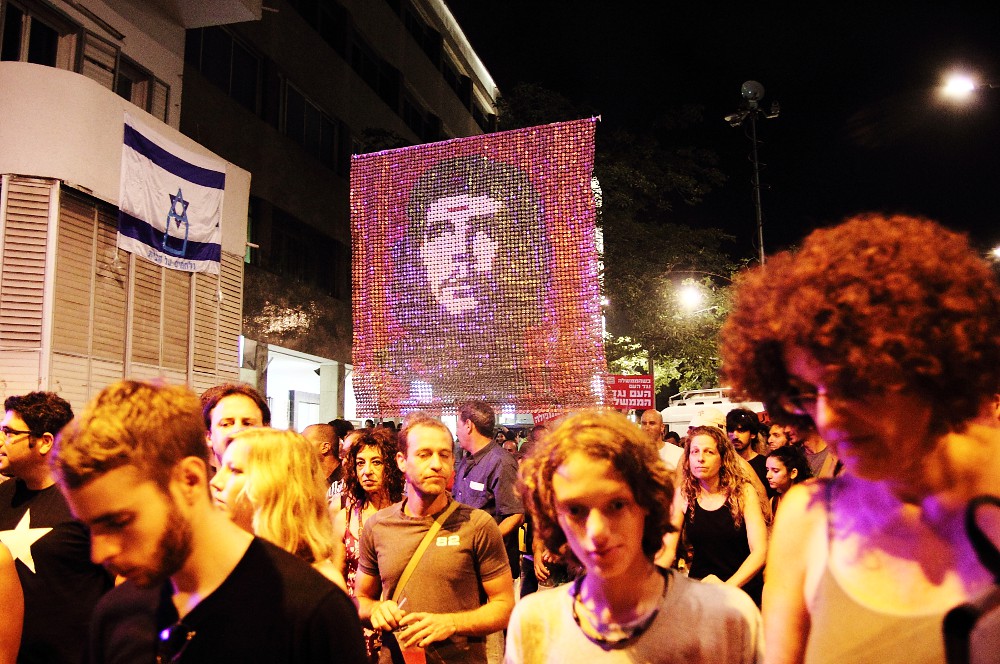
Israeli workers and youth join the revolutionary wave<http://www.marxist.com/israeli-workers-and-youth-join-revolutionary-wave.htm> Written by Walter Leon and Daniel Morley Monday, 01 August 2011 [image: Print]<http://www.marxist.com/israeli-workers-and-youth-join-revolutionary-wave/print.htm#> *The latest news coming out of Israel is that municipal workers across the country have declared a one-day general strike in support of the wave of protests sweeping Israel, taking place today [Monday, August 1]. This is a hugely significant step, as it begins to link Israels powerful industriallabour movement with the political demands of the wider youth and working-class, something which has not happened on a large scale for decades*. [image: Tel Aviv, July 30. Photo: Yossi Gurvitz] <http://www.marxist.com/images/stories/israel/Jul_30_Che_resurrected-Yossi_Gurvitz.jpg>World events are moving at lightening speed and are leaving no stone unturned as the revolutionary mood spreads across the world. The latest country to bear witness to mass anger at the turmoil of capitalism is one that may surprise many of our readers: Israel. We have been writing articles for years pointing out the deteriorating social and economic situation for Israeli workers. As we said, sooner or later this would lead to a social explosion, dividing Israel not on national but on class lines. No country can escape the crisis of capitalism. Most importantly, the mass movement developing in Israel shows not only the possibility but also the necessity for a class based solution to the problems of both Arab and Jewish Israelis and Palestinians. We stand for the unity of the Jewish and Arab workers against the Zionist state. Revolutionary developments in Israel The mass movement of workers and youth is evidently directly inspired by both the Arab revolution and the waves of protest and militancy in Europe. Banners were seen on protests with the slogan, Moubarak, Assad, Netanyahu. Workers over the world are learning that their interests are fundamentally the same. Tents have sprung up in major cities, particularly Tel Aviv, in protest at the Netanyahu governments extreme indifference to the worsening conditions of the Israeli people. The movement has spread with dramatic speed and has already lead to protests, coming apparently from nowhere, numbering 150,000 people (in a country of 7-8 million). The demands of the movement are so popular and deeply rooted in the problems of the masses that the protesters enjoy 87% support. According to the Israeli website Globes, the scale and depth of the movement has shocked even its organisers: Demonstrations had been called for in five cities but in the end protesters marched through the streets in ten cities: Jerusalem, Tel Aviv, Haifa, Beersheva, Ashdod, Ashkelon, Kiryat Shmona, Modiin, Ra'anana, and Nazareth. In Tel Aviv, more than 50,000 people marched from Habimah Square to Tel Aviv Museum, just as some 20,000-30,000 demonstrators had done the previous week. Typical slogans were, The people want social justice, Bibi go home, and We want justice not charity. According to the popular view of Israeli society in the West, including, shamefully, amongst many in the left, Israelis all enjoy a high standard of living and all benefit equally and enthusiastically from the oppression of the Palestinian people. If that were so, one would then expect that any protest movement enjoying such popularity must be aimed against the Palestinian people. Not so. These protests are calling for the downfall of the extreme right-wing Zionist government of Netanyahu. The concrete demands of the movement are as follows: - That something be done to lower the astronomical housing prices (real estate rates have been increasing in the centre of Israel by up to 20% annually for several years); - That public education be offered for free from age 0 (most Israeli mothers are forced to work, but have to spend the bulk of their salary on expensive day care); - That the prices of basic foods be kept under control, and that the cost of gasoline be slashed (Israelis currently pay about $8 a gallon); and - That social workers, police officers, firefighters, doctors, nurses and other public servants be paid better salaries (many currently earn just above the minimum wage). Dafni Leif, one of those who lead the call for these protests, hinted at the revolutionary implications of the movements demands in an interview with Globes: Greed and egoism have become the outstanding characteristics of Israeli society. But in the past two weeks, we have discovered that there are other Israeli characteristics... Our revolution is a revolution of awareness, to stand on the rights we are entitled to. We don't want to change the government but the rules of the game. A bolt from a clear blue sky? The tumultuous events now taking place in Israel appear to some as a bolt from a clear blue sky. The same capitalist commentators that utterly failed to predict the coming of the revolution sweeping the Arab world are equally baffled by the entry onto the scene of Israels workers and youth. This was not supposed to happen in stable, prosperous, educated Israel. Israel was supposed to be a reliable ally of US imperialism. Israeli workers were supposed, for their part, to support their state, to unite in the face of the Arab common enemy. They were not supposed to mobilise on the streets in their tens of thousands, and they certainly were not supposed to demand the fall of their government and its prime minister, Binyamin Netanyahu. So what is happening? Well, our analysis of the revolution in the Arab world was predicated on the understanding that, beneath the seemingly-placid surface, pressures had been building up within Arab society; these pressures eventually reached a critical point and blew the lid off the pressure-cooker. Israel is no different. In fact, as a country, it has been heading toward this point for the past forty years; the revolution across North Africa and the Middle East has seeded fertile soil in Israel. The struggles of workers and young people in Israel are rarely reported in the capitalist media. As such, one might be forgiven for thinking that there *were* no class struggle in this tiny country; but one would be wrong. In fact, this year alone, a number of struggles have broken out. As in Britain, the US and many other countries, the absence of a fighting leadership of the labour movement had given this process a sporadic, patchy nature. But it was there. January saw a three day strike of 2,500 dock workers in the ports of Haifa, Ashdod and Eilat, which concluded with a small wage increase of 3%. Later that month, nurses struck, not for wage increases, but to reduce overcrowding in hospital wards, which had reached dire levels. (According to Haaretz, the country's 28 general hospitals had an average occupancy rate of 105% last week, with the rate rising to 108% in internal medicine and paediatric wards; this lead to many patients being housed in hospital corridors.) The strike was resolved with an agreement by the Ministry of Health to provide more beds. This busy month saw the return to work of staff at the foreign ministry, who had been out since December fighting for better pay and conditions. This strike of workers *in a key part of the state machine* threatened severe consequences for Israels ruling class, potentially endangering the state visit of German chancellor Angela Merkel, and paralysing Israeli capitalisms dealings with the outside world. In the end, the workers achieved some, but not all, of their demands. This pattern of events is not restricted to January. February saw strikes of social workers, demanding better wages and conditions, and the Histadrut threatening a general strike demanding a cut in fuel taxes, water and bread prices, an increase in the minimum wage for public sector workers, and a reduction in the cost of housing. Histadrut Chairman Ofer Eini threatened that it could disable Israels economy, and Shlomo Bohbot of the Centre for Local Government demanded the re-nationalisation of Israels water companies. Of course, the Histadrut called off the general strike in return for minor concessions trade union bureaucracies have always been the faithful servants of the capitalist class, smothering class struggle to protect the status quo. But the fact that they were forced to threaten a strike in the first place shows the pressure they were coming under due to the unfolding events in the whole region. More recently, May saw militant wildcat strikes by railway workers, defying a court order demanding their return to work. The strikes followed the arrest of union leader Gila Ederi at a protest near the house of Israeli Railways chairman Uri Yogev; the workers had been protesting against privatisation of the countrys railway network. Following the illegal strike, Ederi and nine others were released, though the fight against privatisation goes on. These strikes, some of which have had an extremely political character, reflect a pattern of sporadic, intermittent outbreaks of class struggle over the past few years. And these developments have not been limited to the industrial sphere. As we reported<http://www.marxist.com/israel-tel-aviv-municipal-elections-2008.htm>, the 2008 municipal elections in Tel Aviv saw Communist Party candidate Dov Hanin finish second, with over 34% of the vote. Hanin, who argues for equal rights for Israels Arabs and supports draft-dodging, won this support against the backdrop of campaigns by Tel Avivs workers fighting for decent housing. The absence of the necessary national leadership to bring these struggles together has obviously weakened their ability to challenge the attacks of the capitalists, but pressure has been building up, pressure which must eventually lead to a critical point. That critical point has been reached, and the events in the region have pushed Israel into a new period. Crisis of Israeli capitalism [image: Jul 28, "The economy is free the people enslaved. Photo: Yossi Gurvitz] <http://www.marxist.com/images/stories/israel/Jul_28_The_economy_is_free_the_people_enslaved-Yossi_Gurvitz.jpg>All of this points to a general crisis of capitalism in Israel, in concert with the world crisis. The truth is that Israeli living conditions have been worsening for years. Unemployment has been increasing for some time. It is the need to distract from these problems that is precisely the reason for the governments imperialist policy. They hope that they can mask the class divisions by creating a fiction of the unity of all Jews against the Arabs. But these problems cannot be indefinitely hidden from those who suffer from them. They have now found an expression. This is very bad news for the Israeli ruling class! Indeed the demands are so popular precisely because of their clear class content. *Israel Today* points out that while the overall cost of living in Israel is on par with America and most of Europe, Israelis in general earn only half of what Americans and Europeans earn, and sometimes much less. The demonstrators are demanding what they call social justice. A third of young Israeli children live under the poverty line, almost half of them Arab Israelis. That fact underlines the basis for the unity of the class struggle of Arab and Jewish Israelis against the ruling class. Bernard Avishai for *Al Arabiya *has drawn attention to some of the glaring economic contradictions in Israeli society that have sparked the protests: - One sixth of the government budget goes to defence and is creeping up to incorporate new weapons systems. Social services are constantly being trimmed back. The ratio of national debt to GDP is stuck around 80 percent, not unmanageable as long as interest rates remain low and growth rates remain high, say, 4-5 percent year; but if Israel were to enter periods of lower growth, as now seems inevitable with global recession and political isolation, it will be impossible to outpace the social tensions we now see, or hold back the discontent in the Israeli Arab community. - The healthcare system is in crisis because government subsidized hospitals and health maintenance organizations cannot pay doctors a living wage. The latter have been on strike for two months. When you figure hours worked, young doctors make less on average than babysitters. - The wealthiest 16 families own 20 percent of the top 500 companies: Ofer, Dankner, Arison, Tshuva. Some family-based conglomerates have been taking super-profits from, in effect, monopolies in banking, telecom, food retailing, media, and so forth. But they are also over-leveraged, and highly invested in real estate. Burst the housing bubbleby releasing a great deal more ILA land, for exampleand some will be under water. The impact on Israel could be something like the collapse of Lehman Brothers in the US. These dire conditions have lead to concerns by the more serious bourgeois analysts, who see the contradictions emerging. The Facebook-organised consumer boycott of cottage cheese, a staple in Israel, prompted some concerned words by David Horovitz in the conservative *Jerusalem** Post:* [T]he revolt illuminates the forgotten side of the Israeli economy the sectors that are being left ever further behind: The Israelis who cant get close to the bottom rung of the real-estate ladder. The Israelis who are watching the demise of our remarkable health service, knowing they could never afford private care if the system fails them. The Israelis who worry that their children arent getting a good enough education, but lack the means to supplement it with private tuition. The Israelis who, even if they work their hearts out and come from families with more than one breadwinner, still dont earn enough to pay the months bills. The Israelis who, doing their ordinary weekly shopping, realize that, somewhere along the line, cottage cheese turned into a luxury item they could no longer afford Clearly, the more serious of the capitalists realise that the crushing economic conditions in Israel could lead to serious instability. Horovitz continues: Many political and business leaders here are so far out of touch with the day to day challenges faced by ordinary Israelis that, at first, they truly did not understand what all the fuss was about. They certainly didnt know the price of a tub of cottage cheese The concern here is obvious: Israels political leaders are so out of touch, they are incapable of carrying out what is required by Israeli capitalism. But again, cottage cheese is not the issue here. Where our dairy revolt though thoroughly peaceable, democratic, and limited in its goals invites consideration in the context of the Arab spring is in its symbolization of widespread popular discontent over a lack of fairness in the oversight of the economy in general a lack of fairness that extends to an absence of equal educational and by extension employment opportunity. The unfairness exposed in the rampant rise of the price of cottage cheese, and the indifference or sheer ignorance of those at the helm as to the consequences for ordinary people, emblemize the countrys dizzying shift through recent decades from an exaggeratedly socialist economy to one that embraced capitalism at its most ruthless, without many of the safeguards that prevail elsewhere in the West Here, his barely-concealed concern is that the Arab revolution could spill over into Israel a not-unfounded concern. Itzik Elrov has done Israel a great favor in channeling popular discontent into an uprising over cottage cheese prices. He has helped sound a socioeconomic alarm The capitalist class often benefits from allowing a degree of political freedom - protests such as this can serve to warn the capitalists that tensions are arising, and that it needs to take action. But in this case, there is little they can do Israeli capitalisms crisis is too severe, and, like in Britain, the US, Greece and elsewhere, they must cut, cut and cut. Labour Zionism and the growth of the Israeli state Whilst the crisis is global, there are local conditions peculiar to the historical development of the Israeli state. When Israel was founded, the dominant ideology was Labour Zionism, which was a reflection of a cross-class alliance between Israeli trade-unions, agricultural co-operatives, the state and the capitalists. This particular form of bourgeois-nationalism existed as an agreement to provide work and good conditions for Jewish workers, at the expense of their Arab brethren. The material basis of this ideology was the post-war economic boom, the highly-educated nature of the Israeli workforce, and the national sentiment created by the horrors of the holocaust; these factors allowed for the phenomenal development of Israels productive forces, meaning Israeli capitalism could afford a relatively prosperous Jewish workforce. This state of affairs for a whole period was able to serve the workers with good conditions, and the bourgeoisie with profits and the building of a state. However, it all came to an end with the slump in the 1970s, when capitalism in this small country simply couldnt afford to maintain the living standards of Israels Jewish workers. In 1977, Israels ruling (Labour-Zionist) coalition was voted out of power for the first time, and Likud formed a government with a more classical conservative bourgeois programme. Nationalised companies were privatised, collective bargaining agreements were torn up, and unionised workers were replaced with (mostly Palestinian) agency workers. Labour Zionism was dead. The past forty years have seen a catastrophic fall in living standards in Israel. In the past period, the only recourse of the Israeli ruling class to hold the nation together has been the external threat. This explains why, over the past fifteen years, Israeli governments have passed up opportunity after opportunity to normalise relations with Arab regimes that no longer have any interest in military conflict. Rejection of the Saudi Plan, rebuffal of Syrian overtures and the outright provocation of Turkey with the attack on the flotilla all fit a pattern of a society which needs war to hold itself together in its current form. Zionism today has taken on Lenins description of capitalism: horror without end. But, of course, this has its limits. The Arab revolution is having a serious effect in Israel, and the relentless state propaganda depicting Arabs as murderous lunatics bent on Israels destruction are being blown away by events. Our perspectives have been utterly born out Israelis are following in the footsteps of their Arab brethren and beginning to fight a system which means horror and misery for the vast majority. How long before the Palestinian masses rise up as well? We would suggest one will not have to wait long. Perspectives for the struggle [image: Jul 29. "Talkin bout a revolution". Photo: Galit] <http://www.marxist.com/images/stories/israel/Jul_29_Talkin_bout_a_revolution-Galit.jpg>Trotsky said that the formation of a capitalist Jewish state in the Middle East would become a trap for the Jews. This hypothesis is rapidly being realised now. British, American and French imperialism disgracefully carved up the whole Middle East in a crude attempt at divide and rule. The truth is that the countries of the Middle East are artificial creations with the purpose of weakening and confusing the revolutionary anti-imperialist movements in that region. The world historical significance of the Arab revolution is that the Arab masses are finally rising up against this crime. But the imperialist powers fear nothing in the Middle East more than the Jewish workers uniting with their Arab brothers and sisters against capitalism. A movement of this scale and organised along class lines cannot help but pull in the Arabs who live in Israel and are amongst its poorest inhabitants. Indeed many of those in the protests for cheaper housing have been Arabs or more recent, poorer Jewish immigrants from Morocco, Russia etc. According to *Haaretz*, a protest involving Jews and Arabs has also taken place in central Nazareth. It is significant that the demands for cheaper housing are not linked to building more settlements but more social housing in the cities. The movement is openly calling for wildcat strikes and now has the support of Histadrut, which says it will use all the measures at its disposal. This shows that the mass organisations of the working class will be shaken from top to bottom by the mass movements sweeping Europe and the world, and that they are the indispensable organisations with which the working class can change society. This also answers all the rubbish on the left about the need to boycott the Israeli trade unions, which in truth means boycotting the Israeli working class. When the Israeli working class moves, its trade unions will also be affected as the workers show their true revolutionary face and not that of Zionism, either in its original or its current form. Those who have bought into the so called clash of civilisations were left with their mouths open when the Coptic Christians consciously fought side-by-side with their Muslim brothers and sisters during the Egyptian revolution. Revolution, and this is a revolutionary epoch, turns everything on its head. Society is shaken from top to bottom. All the old certainties disappear. Earth-shattering events such as the Arab revolution dramatically transform consciousness, which can be extremely elastic. This is precisely what is happening in Israel now. One Israeli paper, *Maariv*, has mocked Netanyahus utter dependence on stoking the Israeli populations fear of the Arab world. Without such fear both he and the Israeli ruling class could no longer govern and continue to reap profits from exploiting the Israeli people. The problem is that the development of revolutions in the Arab world has massively undermined this strategy. Arabs can no longer be portrayed as a mass of people exclusively interested in destroying Israel. Suddenly they appear to have similar problems and similar needs to the mass of Israelis. Meanwhile, the crisis, which threatens to topple the Netanyahu regime, has now claimed the head of Finance Ministry Director General Haim Shani. Whilst Netanyahu scrambles to convene a committee of economic concentration and regain some control of the situation, he is coming under severe pressure from the treasury, As *Haaretz* explains: Despite [Netanyahus promise of limited reforms], mutual recriminations have persisted between the Prime Minister's Office and the treasury. The treasury continues to oppose Netanyahu's steps from last week on housing, among them incentives to contractors to build in the center of the country based on the cheapest price to the end user and incentives to convert offices in apartment houses back into residences. *The treasury says such measures merely fan the flames of protest*, while the Prime Minister's Office says the treasury has not studied the issue properly. (Our emphasis.) Splits and paralysis at the top are one of the four conditions Lenin outlined for the development of a successful revolution. The working-class prepared to fight and sacrifice the second condition is beginning to develop as well. Lenins third condition is that the middle-class wavering between revolutionary forces and the state. Unemployment and rising prices afflict Israels middle-class professionals as well as its working class. Many are deeply dissatisfied; the role of the students in the movement is symptomatic of this. Increasingly unpopular is the amount of money spent on the settlers, who more and more are seen as a burdensome, extremist fringe. As Israeli society enters into crisis as part of the global crisis of capitalism, so too does Zionism, which is being questioned more and more. *Of course, Lenins fourth condition is key the existence of a revolutionary party and leadership capable of uniting the movement and defeating capitalism. The historical development of the Israeli state we outlined in the previous section has tied the Histadrut to the state by a thousand threads, and its leadership has often played a treacherous role in diverting struggles down narrow economic lines, away from political demands. However, even the most bureaucratic unions can be shaken by great events, as is happening in Israel today. Ergo we utterly reject sectarian calls to boycott Israels mass organisations, or misguided attempts by sincere militants to set up red unions inside Israel. Workers will fight to transform the Histadrut, as they always fight to transform their organisations. As a first step, the Histadrut should call a general strike, with the explicit aim of bringing down Netanyahus hated government. This would really bring the might of the organised working class into this struggle against capitalism.* *Ultimately the problems of the Israeli and Palestinian masses have the same solution a socialist federation of the Middle East.* [Non-text portions of this message have been removed] ------------------------------------ --------------------------------------------------------------------------- LAAMN: Los Angeles Alternative Media Network --------------------------------------------------------------------------- Unsubscribe: <mailto:[email protected]> --------------------------------------------------------------------------- Subscribe: <mailto:[email protected]> --------------------------------------------------------------------------- Digest: <mailto:[email protected]> --------------------------------------------------------------------------- Help: <mailto:[email protected]?subject=laamn> --------------------------------------------------------------------------- Post: <mailto:[email protected]> --------------------------------------------------------------------------- Archive1: <http://www.egroups.com/messages/laamn> --------------------------------------------------------------------------- Archive2: <http://www.mail-archive.com/[email protected]> --------------------------------------------------------------------------- Yahoo! Groups Links <*> To visit your group on the web, go to: http://groups.yahoo.com/group/laamn/ <*> Your email settings: Individual Email | Traditional <*> To change settings online go to: http://groups.yahoo.com/group/laamn/join (Yahoo! ID required) <*> To change settings via email: [email protected] [email protected] <*> To unsubscribe from this group, send an email to: [email protected] <*> Your use of Yahoo! Groups is subject to: http://docs.yahoo.com/info/terms/