http://www.marxist.com/capitalist-crisis-deepens-no-recovery-in-sight.htm Capitalist crisis deepens no recovery in sight as economy heads for depression<http://www.marxist.com/capitalist-crisis-deepens-no-recovery-in-sight.htm> Written by Rob Sewell Thursday, 08 September 2011 [image: Print]<http://www.marxist.com/capitalist-crisis-deepens-no-recovery-in-sight/print.htm>[image: E-mail]<http://www.marxist.com/component/option,com_mailto/link,61e65423ec712a0fd474611be0137112cfb4ad23/tmpl,component/> Share17<http://www.facebook.com/sharer.php?u=http%3A%2F%2Fwww.marxist.com%2Fcapitalist-crisis-deepens-no-recovery-in-sight.htm&t=Capitalist%20crisis%20deepens%20%E2%80%93%20no%20recovery%20in%20sight%20as%20economy%20heads%20for%20depression%20%7C%20In%20Defence%20of%20Marxism&src=sp>
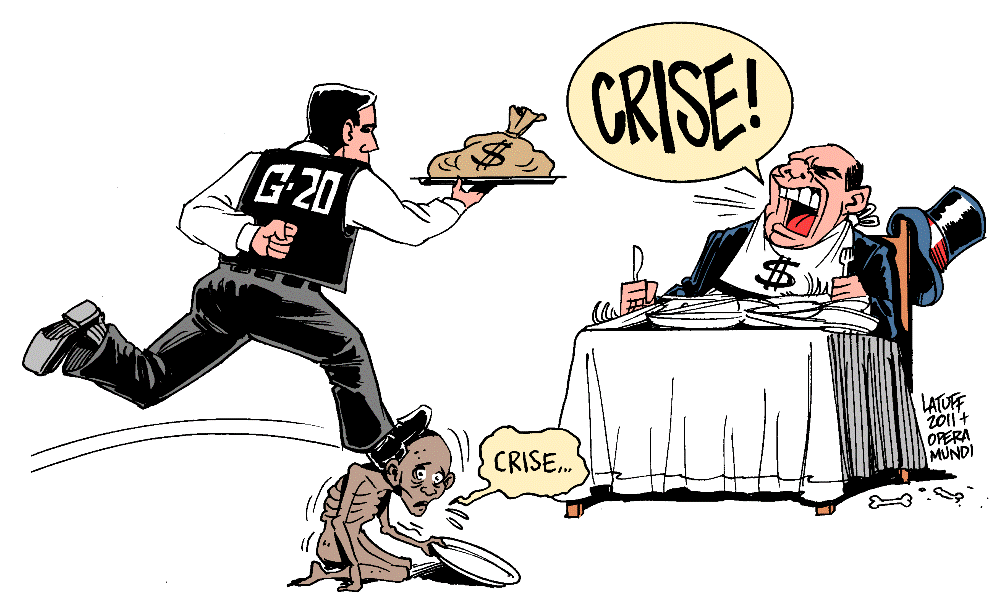
*The world crisis of capitalism has entered a new stage. Rather than recover, several countries are showing features of a depression. This is an unprecedented situation and shows the deep malaise affecting the capitalist system, still reeling from the slump of 2008-9.* [image: Which deserves priority? Financial or humanitarian crisis? Illustration: Carlos Latuff]<http://www.marxist.com/images/stories/economy/Finance_crisis_or_humanitarian_crisis-latuff.gif>Which deserves priority? Financial or humanitarian crisis? Illustration: Carlos LatuffWorld stock markets continue to plunge as August witnessed the worst sell-off since the collapse of Lehman Brothers. Many are asking themselves whether the recent anaemic recovery is at all durable given the massive global slowdown. Debt markets are in chaos as the cost of borrowing in a number of eurozone countries continues to escalate. Italy and Spain are being placed under intolerable pressure as bond yields jump. And all this despite the intervention of the European Central Bank in buying Italian and Spanish bonds in a desperate attempt to prevent the crisis from spreading. In addition, Greek officials failed to reach an agreement with the IMF and European Union over austerity measures linked to the second Greek bailout, adding a further twist to the turmoil. RBS now believes that Greece will default in December, as the cost of debt has soared to record levels. When this happens, be it in December or whenever, all bets are off. This turmoil is taking place in face of fears that the global economic slowdown will turn into a new slump. The scramble for safe havens, such as gold and the Swiss franc, has created renewed fears of a currency war as governments take unilateral measures to safeguard their economies. The Swiss central bank, in a shock announcement, said it was pegging its burgeoning currency to the euro in an attempt to prevent its rise, and give its hard-pressed exporters a breathing space. The bank was prepared to buy foreign currencies in unlimited quantities, but reigniting fears of currency war style reprisals by other central banks in the process. However, this is only the tip of the iceberg. The rest of the world is slowing down dramatically at a time it should normally be expanding. Many fear a Japanisation of the situation, with the United States already trapped in a lost decade of low growth. The global economic slowdown is hammering factories throughout most major western economies, explains the business paper *CityAM*. Manufacturing survey scores declined in all but one of the G7 countries last month, with factory sectors actually contracting in the UK and the eurozone. Manufacturing growth in the UK plummeted to a 26-month low in August, according to the latest purchasing managers index (PMI). New export orders suffered the most devastating collapse since May 2009, with companies reporting weaker demand from the US and the rest of Europe The British sector had been expanding healthily until early this year, with analysts hoping it could drive the recovery forwards. Yet since January the index has shed 12 points. The only steeper drop in its 20-year history was in the aftermath of the Lehman Brothers collapse. (2/9/11) Recent months have witnessed a steep deterioration in growth of key overseas markets, especially in Europe and America. Manufacturing declined to a PMI score of 49, down from 49.4 in July. All scores under 50 signal economic decline. Manufacturing also contracted in France (49.1) and Italy (47), their lowest reading for over two years, while the shrinkage was even more severe in Spain (45.3) and Greece (43.3). In the US and Germany, manufacturing ground to a halt, slipping to 50.6 and 50.9 respectively. The speed with which the growth has slowed since the start of the year is really quite alarming, said Chris Williamson, chief economist at Markit, which gathers the PMI data. With the fall in demand, over-production has reappeared in manufacturing, which reported a rise in stocks of finished goods. This was the first rise in more than three years, at the height of the slump. In August, the rise in stocks combined with the fall in orders suggests manufacturers will need to cut production further in the coming months, stated the *Financial Times *. [image: Photo: Melingo Wagamama]<http://www.marxist.com/images/stories/economy/RIP_economy-melingo_wagamama.jpg>Photo: Melingo WagamamaNew export orders from the eurozone plummeted at their sharpest rate since January 2009, while new orders have shrunk for two straight months in the US, boding ill for the worlds largest economy. The weakness of the US economy was further illustrated by the slump in sales at Walmart, the worlds biggest retailer, which posted nine consecutive quarters of falling sales. In the eurozone, consumer confidence plummeted last month at the fastest rate for 20 years, to minus 16.6%. This was a larger monthly fall than was seen in October 2008 after the collapse of Lehman Brothers. Meanwhile, unemployment in the eurozone has also risen and stands at officially at 15.7m or 10% of the workforce. Growth has practically vanished across the developed world. Annualised growth rates for gross domestic product, based on the second quarter, were 1.3% for the US, 0.8% for the eurozone and Britain, 0.5% for Germany, zero for France, and minus 1.2% for Japan. This stagnation looks worse in historical context, explains the *Financial Times*. A deep recession should be followed by a strong recovery as the labour and capital that lay fallow during the bad years are put to work. That is not happening. Four years without economic growth qualify as a sort of Lesser Depression. (FT, 17/8/11) In Britain, August was the worst month for spending in the High Street in more than two years. Total sales fell back by 2.2% compared to the same month a year ago, the worst year-on-year fall since 2009, according to the BDO High Street Sales Tracker. Orders in construction are at the lowest levels for 30 years. Orders for public housing and other public sector projects fell by one third between the first and second quarters of 2011. As a consequence of the crisis, the Office of Budgetary Responsibility warns of decades of austerity in Britain. The problem will take, I think, a number of years before we will find our way through it, states Mervyn King, governor of the Bank of England. This highlights the real picture of economic crisis affecting capitalism. All talk of green shoots has completely withered away. Confidence has crashed and is being replaced by fears of a new slump. Every day seems to herald a new stage in the European crisis, with European and American capitalism falling further into the doldrums. The economic crisis has produced political crisis as governments attempt to grapple with the decline. In the United States, the sharp disagreements over the debt-ceiling have produced a deal requiring escalating budget cuts. This climate means that further stimulus spending is becoming inconceivable. This in turn raises the spectre of 1937, when the rush to tackle the budget deficits plunged the economy back into recession. History is tending to repeat itself but on a higher level. Sometimes, the conclusions of the serious strategists of capital coincide with those of the Marxists, but from opposite class point of view. We have warned that capitalism has entered an insoluble crisis following the slump of 2008-9. Now the apologists of capitalism have woken up to this fact. Recently, Joseph Stiglitz, the Nobel Prize winner for economics, stated that A long malaise now seems like the optimistic scenario. More significantly were the comments of Martin Wolf, chief economic strategist at the *Financial Times*, who doesnt mince his words about the crisis. In reply to the question as to whether there is going to be a double dip recession, he answers no because the first one did not end. He continues, The question is, rather, how much deeper and longer this recession or contraction might become. The point is that, by the second quarter of 2011, none of the six largest high-income economies had surpassed output levels reached before the crisis hit in 2008. The US and Germany, are close to their starting points, with France a little way behind. The UK, Italy and Japan are languishing far behind. Wolf goes on to explain that, this recession is not normal. When economies suffer such steep collapses, as they did during the worst of the crisis (the peak to trough fall on gross domestic product having varied between 3.9% in France and 9.9% in Japan), an expansion that fails to return output to the starting point will not feel like a recovery. This is especially true if unemployment remains high, employment low and spare capacity elevated. In the US, unemployment is still double its pre-crisis rates. He concludes, given that the central banks have used up their ammunition, Another downturn now would surely be a disaster. (FT, 31/8/11) A few days later, he concentrates his analysis on the British economy. Again, he makes no bones about the depth of the crisis: we are in a depression. We quote it at length to give our readers an accurate picture of what this bourgeois strategist says. The current UK depression will be the longest since at least the first world war. Without a dramatic surge in growth, it is also quite likely to generate a bigger cumulative loss of output than the great depression. All this is disturbing enough. What is even more disturbing is the near universal view that almost nothing can be done to change the prognosis. A recession is a period of economic decline (from the Latin word for retreat). A depression may be defined as the period while output is below its initial level. Recently, three researchers have analysed such UK depressions, using a constructed set of monthly estimates of gross domestic product. This allows the authors, among them Martin Weale, now on the Bank of Englands monetary policy committee, to analyse the size and duration of UK depressions, starting with the one of 1920-24 and ending with todays. Hitherto, the longest depressions of the past century were those from June 1979 to June 1983 (under Margaret Thatcher) and from January 1930 to December 1933 (the great depression). For the present depression to be shorter than its longest predecessor, it must end not later than April 2012. But output is close to 4 per cent below its starting point, with eight months to go. Even if growth now jumped to a 4 per cent annual rate, it would take another year for it to end. If growth were to be 1.5 per cent a year, the depression would last 72 months, making it some 50 per cent longer than its longest predecessor in a century. One can assess the depth of a depression by the steepness of the decline or by the cumulative losses, relative to the starting point. The depression of 1920-24 was the steepest, followed by the great depression, whose largest reduction in GDP was 7.1 per cent. But the present depression is only a little behind, with a fall of 6.5 per cent. The cumulative loss of GDP is likely to be worse this time even than in the 1930s. It was 17.7 per cent of GDP back then, against 14.5 per cent, this time, so far. But this depression is not over. If growth were to be 2 per cent a year, the cumulative loss would be over 18 per cent of GDP. This then is a huge depression by UK standards. In his conclusion, Martin Wolf states: The UK is in the midst of what is set to be the longest and among the most costly of its depressions in over a century. The characteristic of this depression, compared with its predecessors, is the frightening weakness of the recovery phase. It is far more plausible that this is due to weakness in demand than a collapse in potential supply. Yet the conventional view is that nothing much can be done. Beware such prophecies of doom. They can so easily become self-fulfilling. (FT, 2/9/11) This is an unprecedented situation for Britain and the world. The crisis of capitalism has in many ways deepened and become intractable. The description of Wolf is not of a cyclical crisis, but a structural crisis of capitalism. While there can be partial recoveries, as in the 1930s, there is an overall decline. The productive forces, the key to the development of society, were in an impasse in the 1930s. The same is true today. They are hemmed in by private ownership and the nation state. Whatever the capitalists do they will be wrong. If they cut state spending, they will simply cut into the market and make the crisis even worse. Whereas if they increase state spending they will make the budget deficits even bigger and provoke a deeper sovereign debt crisis. They are in a catch-22 situation. That is why we are not in a normal recovery. The endless turmoil on a world scale provides a disturbing background to the attacks upon the working class in all countries. Capitalism can no longer afford lasting reforms. Those days have long gone. On the contrary, this is the era of counter-reforms and vicious austerity. For working people, capitalism means decades of austerity. Tinkering with the system provides no solution. Only with the overthrow of capitalism and the establishment of a socialist planned economy can we put an end to this nightmare once and for all. Home <http://www.marxist.com/> » Topics <http://www.marxist.com/world/> » Economy <http://www.marxist.com/economy/> [Non-text portions of this message have been removed] ------------------------------------ --------------------------------------------------------------------------- LAAMN: Los Angeles Alternative Media Network --------------------------------------------------------------------------- Unsubscribe: <mailto:[email protected]> --------------------------------------------------------------------------- Subscribe: <mailto:[email protected]> --------------------------------------------------------------------------- Digest: <mailto:[email protected]> --------------------------------------------------------------------------- Help: <mailto:[email protected]?subject=laamn> --------------------------------------------------------------------------- Post: <mailto:[email protected]> --------------------------------------------------------------------------- Archive1: <http://www.egroups.com/messages/laamn> --------------------------------------------------------------------------- Archive2: <http://www.mail-archive.com/[email protected]> --------------------------------------------------------------------------- Yahoo! Groups Links <*> To visit your group on the web, go to: http://groups.yahoo.com/group/laamn/ <*> Your email settings: Individual Email | Traditional <*> To change settings online go to: http://groups.yahoo.com/group/laamn/join (Yahoo! ID required) <*> To change settings via email: [email protected] [email protected] <*> To unsubscribe from this group, send an email to: [email protected] <*> Your use of Yahoo! Groups is subject to: http://docs.yahoo.com/info/terms/