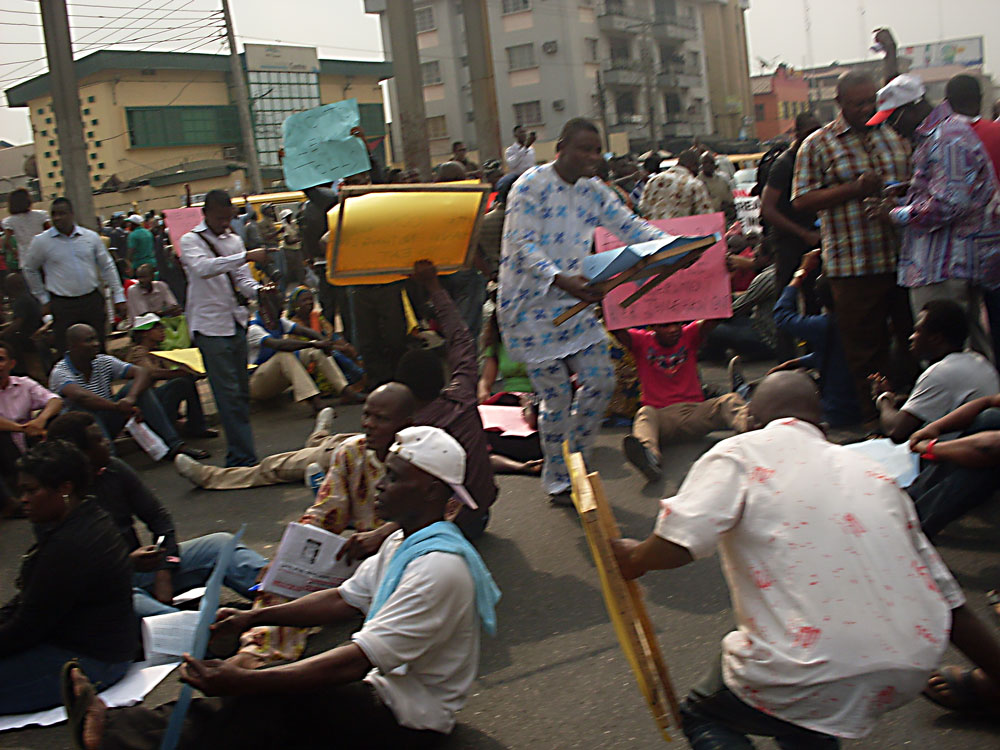
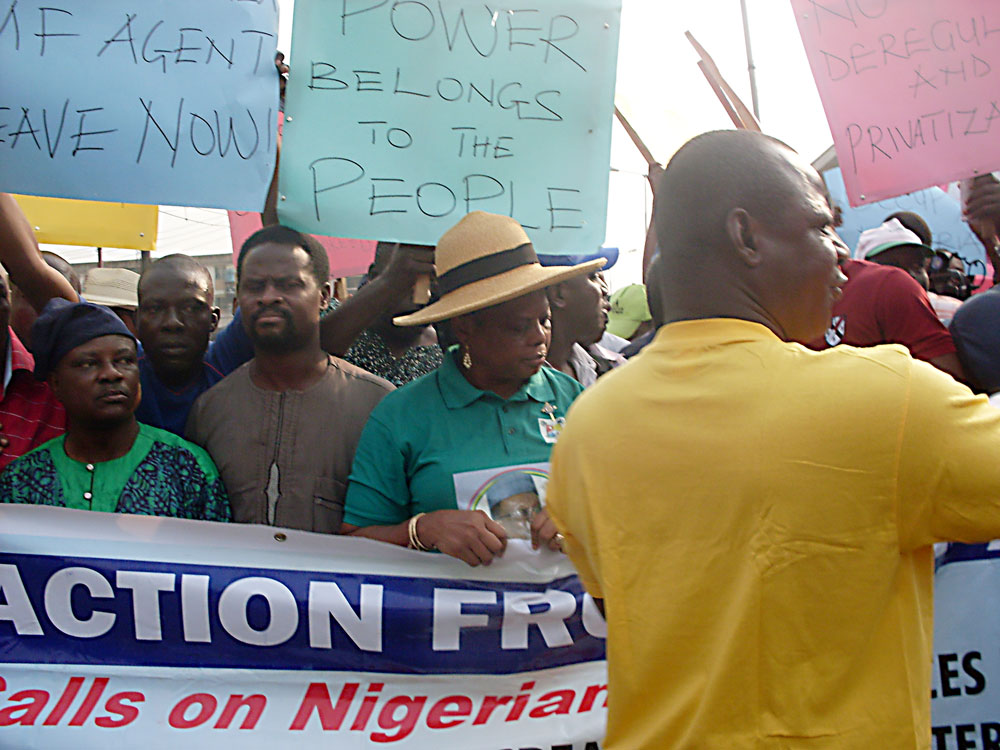
There are many  strikes and rallies against the government today (Monday)
in many towns.
Cort ------------- Nigeria: new issue of Workers' Alternative<http://www.marxist.com/nigeria-workers-alternative-15-1.htm> Written by Workers Alternative Friday, 06 January 2012 [image: Nigeria: new issue of Workers' Alternative]Just in time for the general strike, the Nigerian Marxists have published the latest issue of *Workers' Alternative*<http://www.marxist.com/weblinks/africa/workers-alternative-nigeria.htm>. Download it here ([image: pdf]pdf506.26 KB<http://www.marxist.com/images/stories/nigeria/Workers_Alternative_15-1.pdf> ). ------------- http://www.marxist.com/nigeria-not-a-kobo-increase-in-fuel-price.htm Nigeria: Not a Kobo increase in Fuel Price!<http://www.marxist.com/nigeria-not-a-kobo-increase-in-fuel-price.htm> Written by Workers Alternative Editorial Board, Lagos, Nigeria Friday, 06 January 2012 [image: Print]<http://www.marxist.com/nigeria-not-a-kobo-increase-in-fuel-price/print.htm#> Police has fired tear gas at protestors in Nigeria angry at the latest increase in the price of fuel. In the northern town of Kano around 300 people were wounded in the attack and 19 were arrested. Tension has been mounting as protesters have clashed with riot police in different parts of Nigeria for the past three days and the trade unions have called for a nationwide indefinite strike to start Monday. More protests are expected across the country in the coming days. Here we provide the Editorial statement of the *Workers Alternative <http://www.workersalternative.com/>*on this key issue affecting the Nigerian masses. [image: Protest, 3 January]<http://www.marxist.com/images/stories/nigeria/20110103_JAF_protest-2.jpg>Protest, 3 JanuaryNothing can testify to mans bestiality towards fellow man as the current attempt by the Goodluck Jonathans regime attempt to further increase the price of petrol. Nothing is as wicked as this program and it has fully exposed the true face of the regime to the overwhelming majority. Coming at a time when the overwhelming majority are living in abject poverty with no hope in sight, with large numbers living on less than $2 a day, this will no doubt be a death blow to many in Nigeria. Unemployment has reached record levels, factories are closing down by the day, mass migration is taking place from the rural areas, that are now poverty centres, to the cities, all infrastructure is collapsing roads, schools, etc. A regime of poverty wages and terrible working conditions now reigns in the factories and workplaces round the country. The gap between the rich and the poor is now so huge to the extent that it was recently confirmed that less than 6 % of bank depositors own 88% of all bank deposits in Nigeria. The remaining 94% of depositors, mainly the working people and poor, own about 12% of bank deposits in Nigeria. Why would this not be when senators, governors, reps, etc., in Nigeria are earning much more than the president of the USA; when so-called elected men in Nigeria consume a large and growing part of the overall income of the country. Despite the poverty in the land, Nigeria is said to have recorded over $247 billion in GDP, with over $36 billion in foreign reserves, and an estimated $180 billion expected from total sale of oil this year. In essence, there is poverty in the midst of abundance. This reflects the extreme callousness of the ruling class. We have witnessed over 18 fuel price increases in Nigeria and the arguments of the proponents have remained the same since the 1970s. This confirms the extreme shallowness of the various regimes representing the interests of the Nigerian elites and their imperialist masters. No subsidy on fuel! The claim of subsidy is topmost on the lips of the agents of government calling for an increment in fuel prices. They claim that an unnamed cabal is milking the country via the subsidy. They come up with all sorts of figures to justify their claims. However, in their desperation, they put forward arguments that are totally illogical; they lie with ease and put forward figures that never add up whenever they are subjected to independent investigation. They raise the alarm that if the subsidy is not withdrawn the country will collapse. However, there are so many facts available to debunk all these shallow and illogical arguments. In 1978, they claimed there was a subsidy when petrol was sold at 15 kobo; today, in 2011, they still claim there is a subsidy after an over 4,300 % increment; how come? When will there be no subsidy? By how many times have the wages of Nigerian workers been increased since then? How can there be a subsidy when the funds used to pay for the fuel is coming from the sale of fuel both locally and internationally? One of the most guarded secrets in Nigeria today is the actual price of fuel from the foreign refineries it is acquired from and the internal workings of the entire oil sector, both upstream and downstream. The reason for this is that if the truth were known there would be a revolt. The government agents have been giving conflicting figures of the cost of the subsidy, varying between N1 trillion to N3 trillion for last year. However, the National Assembly declared that it was actually to the tune of N450 billion for last year. The question is what was the source of that fund? The N450 billion came from oil sales, so how can that be a subsidy? In spite of the conscious attempt to cover up the workings of the entire oil sector and confuse the public, we can still see the realities of the situation. These realities further confirm that the various regimes are out to milk the masses to their bones for profit. They continue to tax fuel in order to make money. Nigeria produces oil via the oil multinationals for both internal and external consumption. 445,000 barrels per day are allocated to internal consumption and it is to be forwarded to the domestic refineries. This is not part of the countrys OPEC oil quota of over 2.5 million barrels per day. However, the national refineries have all been sabotaged. Since 2003, this quota is being sold on the international market with the initial understanding that its proceeds will be used to pay for the countrys fuel importation. Prior to 2003, the 445,000 barrels per day was sold to the NNPC at near production price and if the Nigerian refineries were down it was exported to foreign refineries and the country just paid for the cost of refining. The refined products are thus brought back. However, in order to make much more money this method was abandoned in the interests of the multinationals and the very rich in Nigeria. All the Nigerian refineries have since been grounded and the government is planning on selling them off cheaply. The total sale of the 445,000 barrels per day for this year alone amounts to about $14 billion at $90 per barrel. This is more than enough to pay for the importation of all the countrys fuel. Petrol is currently sold at N65 per litre and this price actually covers the cost of importation and still gives a profit to both the government and the oil giants doing the importation. The claims of the government agents, PPPRA, that the landing cost of petrol is N128 per litre is extremely fraudulent. As at October 2011, when the figures they put on their web site were added, the result was less than N15 per litre. They have recently edited the web site. However, just recently, another government agency, the DPR, made a slip by revealing that the landing cost of petrol is actually N48 per litre. A lot of fraudulent figures and processes are added in order to inflate figures to give the impression that there is a subsidy. For instance, fuel ship tankers are always to berth in Nigerian ports for two weeks after arrival at the port in order to increase the demurrage charge. This is in spite of the fact that demurrage charges for tankers of fuel in Nigeria start from the day the ship is loaded with fuel in the foreign refinery. Fuel importers (the fuel cabal) pay these dubious and inflated government charges per importation. These funds are then refunded back to them after the entire importation process, all this to give the impression that there is a fuel subsidy. Hells of a lot of corrupt practices go on within this highly fraudulent process. For instance, the fuel importers do a lot of over-invoicing. They inflate the volume of fuel they plan to import; pay the charges for that volume of fuel but import less than what they declared. They paid back the funds for the government charges for the inflated volume. They make money from both ends, from the government and from selling the fuel to Nigerians. This is an open secret which the PPPRA also acknowledges but refused to act on in spite of the fact that it is supposed to have power to bring the crooks to book. Any way we consider the issue, there are no subsidies on fuel in Nigeria; fuel is paid for from the sale of the 445,000 barrels per day domestic allocation to the international market and the direct sale of fuel to the public at a direct price currently higher than its actual cost. Workers Wages, Devaluation and Fuel prices The whole essence of the fuel price increment is to shift the burden of the crisis created by the elites onto the heads of the working people. It is to suck more blood from the veins of the working masses and has nothing to do with subsidies. The Nigerian government has been taxing fuel over the years as a means of making money. They do not call it a tax in public; that is why they prefer the term subsidy in order to deceive the working people. The government over the years has imposed a series of IMF/World Bank economic policies, part of which is the fuel price increment. They devalue the naira as a means of cutting the actual wages of workers. Devaluation is usually followed by increases in the prices of goods and services above their corresponding value. This is why in spite of the higher quantity of naira notes that workers earn today, Nigerian workers in the 70s and 80s actually earned more than the workers of today. The current attempt to increase fuel prices is coming some few months after the increase in the national minimum wage to N18,000 and 140% across the board. This is yet to be implemented nationally; many state governments, government corporations and private companies are still resisting its implementation. However, the naira has been devalued and they are already increasing the prices of various commodities and services. That is giving with the right hand and taking it back with the left. Devaluation of the Naira increases the rate of inflation and therefore increases the rate of exploitation because the actual wages of the workers have been cut due to devaluation. What has been changing since the late 70s till date has been the value of the naira. The value of the naira has massively depreciated since the mid 80s till date. As at 2007, when the last increment in petrol prices took place the value of the naira was about N118 to the dollar; it is now at about N160 at the official market rate and much more on the black market. It is said that it could go to as low as N200 to the dollar. As at the time the minimum wage was approved the naira exchanged for about N150 to a dollar; N18, 000 was equivalent to about $120. At N200 to the dollar, the current minimum wage would be equivalent to $90. In essence, wages of the Nigerian workers have been reduced by 30%. The workers minimum wage in the early 80s was N125, which was equivalent to $250 then, as the naira was exchanged at N5 to the dollar. This implies that the wages then were actually equivalent to more than N31,000 today. $250 in the 80s is equivalent to more than $560.00 today. As at the time the minimum wage was N125 in the 80s, the price of a brand new Volkswagen car was about N5,000. All this changed in 1986 when the IBB regime started the implementation of structural adjustment policies, SAPs. The government devalues the naira and increased the prices of goods and services and held down the wages of workers. The prices were actually increased to the level above the corresponding prices before the devaluation. The same applied to fuel prices. The money they made from this crime was then used to pay fictitious local and foreign debts, and went into private pockets of the elites. If they are really concerned about the subsidy why cant they increase the value of the naira to the level it was before devaluation? They would not do so because that would mean more money for the workers. They actually want to pay workers less in order to make more profit. Today, over N3 trillion has been used to bail out Nigerian distressed private banks and more billions are still expected to go to the banks. These banks mismanaged trillions of naira but they were rescued with public funds. Of course, they dont call this a subsidy; they call it a bail out. Throughout the period of the global oil boom, the Nigerian masses did not see any improvement in their lives; they only saw pain and more poverty. The enormous wealth was shared by the Nigerian ruling elites and their imperialist masters who own the oil multinationals. As the global economy is now stagnating, it will have a negative effect on countries like Nigeria as the price of oil is bound to fall. In the face of any shortfall, the elites are bound to try to shift the burden on to the heads of the masses. They are never ready to pay for the crisis they have created. They always push it onto the heads of the masses. Corruption and Failed Promises To say the government and the Nigerian elites are corrupt is to say the most obvious fact. The fact that the so-called cabal profiting from the subsidy cannot be named today reflects this reality. Since 1999, when the civilian regime started increasing fuel prices, an estimated over N30 trillion had been made and there is nothing to show for it. The roads are bad, there are no hospitals, no power, etc. The country has been moving more backwards. The Nigerian masses have lived through years of failed promises. This is why the promises being made by Goodluck have no hearing whatsoever among the masses. In the past the NNPC was solely responsible for the importation of fuel. Today, it is big multinationals, associates of top government officials, etc. Billions of dollars are involved. These are the reasons why the refineries are not working. Deregulation a Failure! The price of kerosene and diesel has been deregulated since 2007 and today diesel in Nigeria ranks among one of the most expensive in Africa. The same goes for kerosene which has currently disappeared from the pumps. The real intention of the government is to totally deregulate the price of petrol too. Therefore, its price can change without notice. This is the land of paradise the exploiters are hoping for. Only the multinationals and big time dealers benefit from this process. The masses are the big time losers. Today, most of the fuel related infrastructures built in the past have collapsed pipelines, storage depots, refineries, etc. The country is now totally dependent on fuel importation. Since the deregulation of diesel no investor has deemed it fit to build a refinery. It is on record that over 18 refinery licenses have been issued but none have been built since 1999. The contrary is the situation when compared with Venezuela. Further deregulation would spell more disaster. Fight Back! No fuel price increase was implemented in the past without resistance from the working class; close to nine general strikes have been called on this issue since 1999. It is, however, unfortunate that the leadership of labour undermined these strikes. These strikes were the result of pressure from the rank and file workers in Nigeria. There have been several protest marches round the country against fuel price increases and currently it is clear that the mass majority are opposed to further increments. It may be the straw that breaks the camels back. The past strikes were usually called off by top labour leaders undemocratically without serious concessions granted by the regimes; however, the next fight back may not be that easy to call off undemocratically by the top union leaders. This is why many are quite critical of the leadership of the trade unions, both the NLC and TUC. Independent protest groups are already being set up across the country. The global protest movements and revolutions will also have an influence in the impending movement in Nigeria. Top labour leaders will definitely be under much more pressure this time around. More unions are bound to experience internal conflicts as workers are bound to make attempts to remove corrupt and compromised union leaders. The government and bosses over the years have invested heavily in corrupting labour leaders. However, in spite of this, the workers have embarked on struggles for a better life and on many occasions they have forced the leaders to act. Labour leaders in the past refused to involve the rank and file workers fully in decision-making; they did not set up committees of action around the country with powers to coordinate the strikes. These are tasks that must be taken up in the coming movement. Workers Party and Socialism the way forward The bulk of the problems facing Nigerian workers are political. But unfortunately the Nigerian workers do not yet have their own serious political party that can take power and start addressing all these problems. This lack of a political alternative will make the fight back fruitless as those responsible for the crisis will remain in power and they will continue to impose their extremely exploitative policies on the masses. These are programs designed to make the poor pay for the crimes of the rich minority and multinationals. The NLC set up a Labour Party that it abandoned in the hands of corrupt politicians who have converted the party into a platform for all forms of opportunism. The party excludes workers and it has totally been taken over by bourgeois politicians of various extractions. The party went so far as to declare support for Goodluck Jonathan at the last elections. A workers political party still needs to be built. Labour must reclaim its political platform from the hands of the opportunists and open it to workers, youth and other poor strata of society. The crisis facing society today can only be solved by the class responsible for the production of the wealth of society, the working class. Without the working people taking political power in Nigeria, the problems will continue and get much worse. The crisis in the oil sector can only be solved by the nationalization of the sector and putting it under the democratic management of the workers. This is the very opposite to deregulation. In essence, socialism is the only way forward. Source: *Workers' Alternative<http://www.marxist.com/weblinks/africa/workers-alternative-nigeria.htm> * (Nigeria) - Nigeria: Masses back on the move<http://www.marxist.com/nigeria-masses-back-on-the-move.htm> Written by Rashy in Lagos Friday, 06 January 2012 [image: Print]<http://www.marxist.com/nigeria-masses-back-on-the-move/print.htm#> Human consciousness is naturally conservative. People naturally stick to the old ways of doing things, but when a great event occurs, consciousness becomes transformed in a matter of seconds and people begin to question what they have not been questioning before. This perfectly confirms the present Nigerian situation. (3 January 2012) [image: Protest, 3 January]<http://www.marxist.com/images/stories/nigeria/20110103_JAF_protest-1.jpg>Protest, 3 JanuaryFor decades, many had written Nigerians off; they said they are docile people who cannot stand up for their rights; they even went further to say that the Arab Spring could not happen in Nigeria because Nigerians are too religious, cowardly and extremely tribalistic. However, what has been happening since Monday, January 2nd 2012, after the announcement on Jan 1st, by the Nigerian government of the increase in the pump price of petroleum from N65 to N141 despite overwhelming opposition to it by Nigerians, confirmed the opposite of these assertions. Immediately after the announcement, the consciousness of the Nigerian masses became transformed and they started questioning their old believe, even people that voted for this regime nine months ago started clamouring for its immediate removal. On Monday, Jan 2nd 2012, Nigerians came out en masse, irrespective of their religion and tribal orientation in Abuja, Kano, Zamfara, Sokoto & Port Harcourt to express a clear NO to the hike in the price of fuel, among other demands. Some people were arrested in Abuja and they were later released. On Tuesday, Jan 3rd, 2012, a date chose by the Joint Action Front(JAF), there were protests in Lagos, Ibadan, Abeokuta, Ilorin, Abuja, Kano and Port Harcourt. In Lagos, where we participated, the protest started as early as 8am in the morning from the NLC secretariat in Yaba. Over 5,000 people marched from Yaba through Ojuelegba, Lawanson, Ikorodu Road and terminated at Ojota. Ikorodu Road was paralyzed for many hours. People left Ojota with the resolution that they will continue the protest in their various neighbourhoods tomorrow. In Ilorin, one protester was killed and many injured. The two main labour centres will also be meeting tomorrow and there is a very likelihood that a general strike will be called soon. It is very difficult for the union leaders to remain silent in the face of all this independent action because they know their credibility is also on line. What is clear is that Occupy Nigeria has fully commenced, Nigerians are beginning to take their destiny into their own hands and they are saying enough is enough. At the end of the Lagos protest we sold 200 copies of the [image: pdf]Workers Alternative paper<http://www.marxist.com/images/stories/nigeria/Workers_Alternative_15-1.pdf> . Source: *Workers' Alternative<http://www.marxist.com/weblinks/africa/workers-alternative-nigeria.htm> * (Nigeria) [Non-text portions of this message have been removed] ------------------------------------ --------------------------------------------------------------------------- LAAMN: Los Angeles Alternative Media Network --------------------------------------------------------------------------- Unsubscribe: <mailto:[email protected]> --------------------------------------------------------------------------- Subscribe: <mailto:[email protected]> --------------------------------------------------------------------------- Digest: <mailto:[email protected]> --------------------------------------------------------------------------- Help: <mailto:[email protected]?subject=laamn> --------------------------------------------------------------------------- Post: <mailto:[email protected]> --------------------------------------------------------------------------- Archive1: <http://www.egroups.com/messages/laamn> --------------------------------------------------------------------------- Archive2: <http://www.mail-archive.com/[email protected]> --------------------------------------------------------------------------- Yahoo! Groups Links <*> To visit your group on the web, go to: http://groups.yahoo.com/group/laamn/ <*> Your email settings: Individual Email | Traditional <*> To change settings online go to: http://groups.yahoo.com/group/laamn/join (Yahoo! ID required) <*> To change settings via email: [email protected] [email protected] <*> To unsubscribe from this group, send an email to: [email protected] <*> Your use of Yahoo! Groups is subject to: http://docs.yahoo.com/info/terms/