http://www.marxist.com/prerevolutionary-situation-in-greece.htm
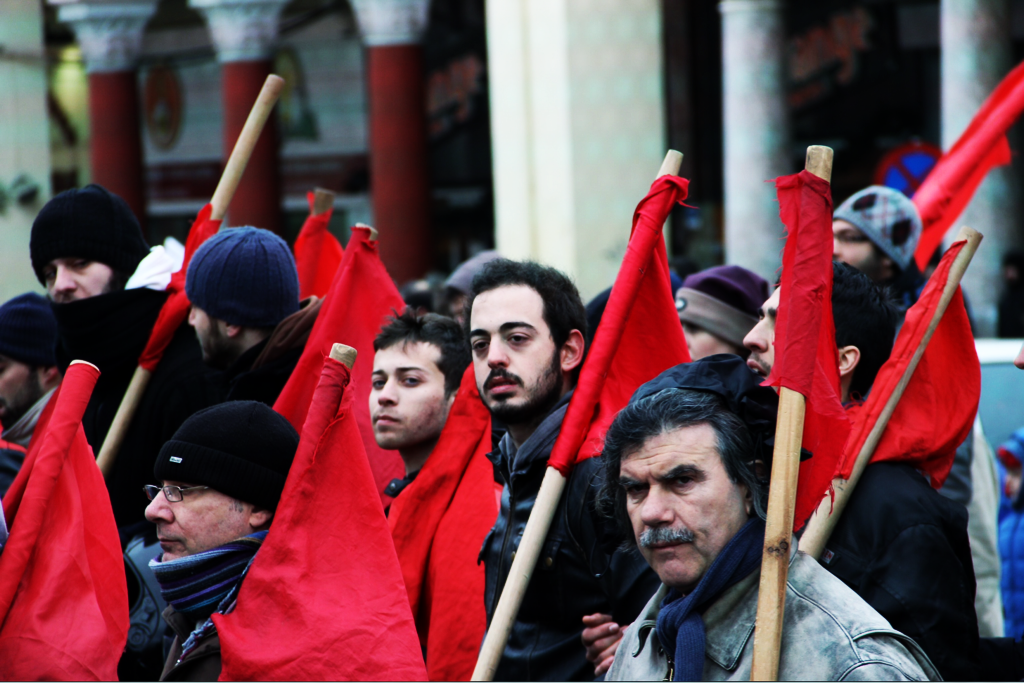
Pre-revolutionary situation in Greece<http://www.marxist.com/prerevolutionary-situation-in-greece.htm> Written by Alan Woods Tuesday, 14 February 2012 17:41 <http://www.marxist.com/prerevolutionary-situation-in-greece/print.htm><http://www.marxist.com/component/option,com_mailto/link,aHR0cDovL3d3dy5tYXJ4aXN0LmNvbS9wcmVyZXZvbHV0aW9uYXJ5LXNpdHVhdGlvbi1pbi1ncmVlY2UuaHRt/tmpl,component/> [image: Greece facing a pre-revolutionary situaiton - Photo: Nick Papakyriazis]*The Greek crisis has now reached the point of a pre-revolutionary situation. On Sunday we saw the biggest demonstration in the history of Greece. Hundreds of thousands of people gathered to protest the reactionary deal before the Athens parliament. Here was the real face of the Greek people: workers and students, pensioners and shopkeepers, young and old, came onto the streets to express their rage.* [image: Greece facing a pre-revolutionary situaiton - Photo: Nick Papakyriazis]<http://www.marxist.com/images/stories/greece/2012-02-09_greece_general_strike_and_semiuprising_photo_Nick_Papakyriazis.png>Greece facing a pre-revolutionary situaiton - Photo: Nick Papakyriazis<http://www.flickr.com/photos/mlrs193/>Emotions are running high over the price the country is being forced to pay for its second bail out, a 130bn euro loan from the EU and the International Monetary Fund, intended to avoid the threat of bankruptcy and withdrawal from the euro. However, the so-called loan and austerity package included a further 3.3bn in wage, pension and job cuts for this year alone, adding to the pain of four years of recession, lower wages and high unemployment. The merciless pressure exerted by the EU has already cut living standards to the bone, plunging the country into a deep slump. Unemployment has soared to over a million. The official figure of 21% underestimates the extent of the problem. It does not take into account the large number of Greek workers who are theoretically employed but have not been paid for weeks or even months. Pension cuts totalling 300bn, a 22% reduction in the minimum wage (32% for those under 25) and the loss of 150,000 public sector jobs by 2015 will hit almost every Greek household. Hospitals are running out of drugs. Wages and pensions have been slashed. The mood of the people is becoming desperate. Naturally, the austerity measures do not affect the rich. They have offshore accounts and have sent their money out of the country. The entire burden of the tax increases falls on the shoulders of the poor, the pensioners, the workers and the small shopkeepers. The Greek people are facing even steeper cuts in pensions, wages and a bigger fall in living standards, and their patience is exhausted. The mood of burning anger finally boiled over on Sunday when the latest and most vicious austerity measures were put to the Greek parliament for approval. The vote was passed 199-74 amid some of the most serious violence seen on the streets of Athens. Tens of thousands besieged the Greek Parliament in militant demonstrations. The sacrifices involved in meeting the terms of the latest austerity package have infuriated unions and workers while German demands for even tougher measures as a condition of continued Greek membership of the eurozone have caused widespread public anger. State repression The street protests started in Athens but immediately spread to other Greek towns and cities, including Salonika, Patras, Rhodes, Corfu and Crete. In Crete ten thousand people marched to the centre of Iraklion, where they occupied the television studios, chanting slogans. The government and state forces reacted with unprecedented violence, attacking demonstrators with baton charges, stunt grenades and choking tear gas. The demonstrators fought back bravely, throwing tear gas canisters back at the police and hurling stones and improvised Molotov cocktails. These were not all anarchists, as the media asserted. Many were ordinary youngsters, infuriated by the provocative conduct of the police who even rode motorbikes into the crowd The mood was one of fury. Demonstrations and protests were held in many different cities and towns, accompanied by the occupation of town halls and regional government buildings. The situation on the streets was insurrectionary. On Monday night, the day after the big demonstrations, the people attacked the offices of a PASOK deputy minister in Patras, and a LAOS (the right wing party) office in Agrinio. The 4,000 riot police brutally assaulted the demonstrators in Athens on Sunday. By the end of the day, the centre was like a war zone. The streets were strewn with glass and stones. Around 45 people were injured and buildings in central Athens, including cafes and cinemas, were set on fire by petrol bombs hurled by masked protesters. This has been seized upon by the government, which is attempting to justify its support for the austerity plan by alleging that the alternative is chaos. Lucas Papademos, the unelected Prime Minister, told Parliament: "Vandalism and destruction have no place in a democracy and will not be tolerated. I call on the public to show calm. At these crucial times, we do not have the luxury of this type of protest. I think everyone is aware of how serious the situation is." These declarations reek of hypocrisy. It is self-evident that that the violence on the streets has been deliberately provoked by the repressive forces of the state, precisely in order to create a climate of fear and instability. The government itself is responsible for this. Finance minister Evangelos Venizelos issued a desperate appeal for support before the midnight vote: "We must show that Greeks, when they are called on to choose between the bad and the worst, choose the bad to avoid the worst." But none of the so-called solutions of the bourgeois can halt the decline. Greece cannot pay its debts. It is now paying 33% interest on foreign loans. This means that it has entered into a downward spiral, an unstoppable process in which cause becomes effect and effect cause: more cuts will mean a deeper crisis, more unemployment and lower living standards. This, in turn, will mean less taxes and a higher public deficit, which can only be plugged by new bailouts, which will lead to new demands for cuts, and so on. It is like falling into a Black Hole, from which nothing can escape not even rays of light. Political crisis In a television address to the nation late on Saturday Prime Minister Papademos, spelled out the cost of rejecting the package. He said it would "set the country on a disastrous adventure" and "create conditions of uncontrolled economic chaos and social explosion." He added: "The country would be drawn into a vortex of recession, instability, unemployment and protracted misery and this would sooner or later lead the country out of the euro." All this is probably true, but it did nothing to persuade the Greek people to cut their own throat in order to stop others from carrying out that painful operation. There is massive opposition to the austerity plan. According to the opinion polls, 90% of the people are opposed to it. Despite this, the Greek cabinet approved the package on Friday, but only after six members had resigned. Laos, the small right wing nationalist party headed by Giorgios Karatzaferis withdrew support but with the two main parties continuing to back the draconian measures Prime Minister Lucas Papademos was anticipating winning parliamentary approval. In the event, every one of the parties in the coalition has split and is in crisis. 22 MPs were expelled from PASOK for voting against the plan, and a further nine who abstained have been disciplined. 21 MPs were expelled from the Conservative ND Party. The second largest group in parliament is now the "independent expelled 64 MPs. What does all this show? Only this: this discredited parliament does not represent the people. The polls show sharp falls in the support for both Pasok and the New Democracy. Support for Pasok even before Sundays vote was only 8-9%. Now it will have fallen still further. Nothing has been resolved by this vote. The Government still has to meet the harsh terms and conditions tied to the loan and must meet a deadline by this Friday to accommodate a deal with bondholders and repay an outstanding 14.4bn bond by the March 20 cut off date. Every serious commentator now assumes that in the end Greece will be forced to leave the eurozone and probably the EU. Contingency plans for a return to the Drachma have already been drawn up in Athens, Berlin and Brussels. It is only a matter of time. Revised figures for 2011 show the economy contracted by 6.8%, more than originally thought, 7% in the last quarter of 2011 in annualised terms. Even if all the provisions of the latest austerity plan are implemented, they will not solve the deficit. The original estimates were that these measures would reduce the deficit from 160% of GDP (the present level) to (a still very high) 120%. But the latest estimates indicate that, even if the plan is carried out (which is unlikely), the deficit would still stand at 136% in the year 2020. Despite this, the EU paymasters, led by Angela Merkel, remain implacable. Even the deep cuts agreed to by the Athens government do not satisfy them. German finance minister Wolfgang Schaeuble, declared in an interview with the Welt am Sonntag newspaper: "The promises from Greece aren't enough for us anymore." He added: "Greece needs to do its own homework to become competitive whether that happens in conjunction with a new rescue programme or by another route that we actually don't want to take." The leaders of Germany do not accept the latest measures as good coin. They want a signed agreement by government parties that these measures will be implemented regardless of the results of elections being called in April. They also want bail out money to be put in a special fund outside of the control of Greece, so that creditors are repaid first and only if there is money left then state expenditure can be made. They also demand that the Greeks must come up with an additional 325 million euros worth of cuts. Berlin is also demanding further clarification on how Greece will cut its labour costs by 15%. In other words, they want to squeeze blood from a stone. These friendly German interventions did nothing to help Mr Papademos, whose government is now like a ship foundering on the rocks in a high sea. The infamous Troika wanted his government to last till the end of this year. Instead, it is already coming apart at the seams. Like all the plans of the EU leaders, the coalition of national unity is unravelling fast. The bourgeois are no longer in control of events. Rather, events are controlling them. New elections will have to be called in April. We do not know who will win, but we can say who will lose. There is a mood of anger directed against all the parties in the present coalition. All the parties are in crisis. The elections will at best produce yet another weak pro-austerity coalition government, probably headed by the Conservative ND. This will solve nothing and will lead to further upheavals. One unstable coalition will fall after another. A prerevolutionary situation Lenin pointed out long ago that there are four conditions for a revolutionary situation: 1) the ruling class should be split and in crisis, 2) the middle class should be vacillating between the bourgeoisie and the working class, 3) the masses should be prepared to fight and make the greatest sacrifices to take power and 4) a revolutionary party and leadership that is prepared to lead the working class to the conquest of power. In Greece at the present time all these factors are in existence except the last. The Greek ruling class is in crisis. It has no solutions to the present impasse. Its leading figures are a picture of impotence and indecision. They are being ground between the two gigantic millstones: on the one hand the merciless pressure of international Capital, on the other, the ferocious resistance of the masses. The crisis of the ruling class is reflected in the crises and splits in every one of the governmental parties. Already forty parliamentarians have been expelled for not voting for the austerity plan. But disciplinary measures will solve nothing. It is like papering over the cracks in a wall caused by a massive seismic movement of the tectonic plates. The present government lacks all legitimacy in the eyes of the masses. It is a bankers government that was never elected by anybody. The hatred of the bankers and the rich in general is universal. The general mood of revolt has spread to the middle classes who have seen their living standards driven down: the small business people who have been pushed into bankruptcy; the civil servants who have lost their jobs; the taxi drivers who face ruin. It is not true that the middle class is vacillating between the bourgeoisie and the proletariat. The Greek middle class has been forced by cruel necessity to take the road of revolution. What about the working class? For the last two years, the proletariat of Greece has displayed enormous militancy and determination. There have been 17 general strikes, and numerous demonstrations and mass protests of all kinds. One must ask oneself: what more can we demand of the working class? What more do we expect? It is true that the 48 hour general strike called by the union leaders last week was not a great success. Does this indicate that the mood of the working class is cooling off? Does it signify that the masses have become reconciled to the inevitable, and that the bourgeoisie has succeeded in re-establishing the necessary equilibrium? On the contrary, the old social and political equilibrium has been completely destroyed in Greece. It will not be restored easily or quickly. How does one explain the reduced response to the call for a 48-hour general strike? The answer is very simple: the Greek workers have understood that strikes of one or two days solve nothing. There are certain situations in which mass strikes and demonstrations can force a government to change its policies. But this is not one of them. The crisis is too deep to allow the bourgeois any room for manoeuvre. They will not abandon the course of action which, in any case, is being dictated to them from Berlin and Brussels. The trade union leaders in Greece like their counterparts in other countries do not understand the seriousness of the situation. Though they regard themselves as supreme realists, they are in reality the blindest of the blind. They are living in a past that has already receded into the mists of history. The union leaders imagined that with a little show of opposition, they could persuade the bourgeoisie to make some compromises with them. After all, we are moderates, not revolutionaries. But instead of compromises all they receive is a kick in the teeth. The truth is that the union leaders used the tactic of one-day general strikes as a convenient way of allowing the masses to blow off steam. A one-day general strike is really only a demonstration. It can be useful in mobilizing the class, drawing in even the most backward and inert layers. On the streets, the workers feel their collective power and their confidence grows. That is the positive side of a one-day general strike. But if the same thing is repeated endlessly, without showing any concrete results, the workers get tired of it. They can see that all these strikes have lost them a lot of money, but have not succeeded in their objective. They conclude that some stronger form of action is required. But what kind of action is that? Here the question of leadership acquires a burning importance. Purely trade union methods cannot solve the problem, because the nature of the problem is not trade union but political. It is a question of class against class, of workers against bosses, rich against poor: ultimately, it is a question of state power. The tactic of general strikes of one or two days has completely exhausted itself. The only possibility now is for an all-out general strike to bring down the government. But an all-out general strike is no longer a demonstration. It poses the question point blank: who is the master of the house? Who rules: you or us? In other words, it poses the question of power. This is a question that none of the present leaders of the Left are prepared to pose. They are afraid to explain to the people of Greece what they need to know: that no solution to the problems of Greece is possible as long as the power is in the hands of a handful of wealthy parasites: bankers, capitalists, landlords and shipping magnates. It is impossible to cure cancer with an aspirin. What is necessary is a genuine Left government a workers government that is prepared to expropriate the bankers and big capitalists both Greek and foreign and introduce a nationalised planned economy, under the democratic control and administration of the working class. In order to free the Greek economy from the stranglehold of foreign Capital, all debts must be repudiated and there should be a state monopoly of foreign trade. Drastic revolutionary measures should be taken against speculators and people who send their wealth abroad. These are the prior conditions, without which no solution is possible. However, even these steps will not be enough. Under modern conditions, no country can save itself on purely national lines. Socialism in one country is a reactionary utopia, as the experience of the USSR and China clearly show. A socialist Greece should make an appeal to the workers of Europe to follow its example: throw off the yoke of Capital and unite in a European Socialist Federation, built on the solid foundations of equality and solidarity. Let our banner be that of socialism and proletarian internationalism. This is the only way forward for the workers of Greece, Europe and the whole world. London, 14 February 2012 Home <http://www.marxist.com/> » Europe <http://www.marxist.com/europe/> » Greece <http://www.marxist.com/greece/> [Non-text portions of this message have been removed] ------------------------------------ --------------------------------------------------------------------------- LAAMN: Los Angeles Alternative Media Network --------------------------------------------------------------------------- Unsubscribe: <mailto:[email protected]> --------------------------------------------------------------------------- Subscribe: <mailto:[email protected]> --------------------------------------------------------------------------- Digest: <mailto:[email protected]> --------------------------------------------------------------------------- Help: <mailto:[email protected]?subject=laamn> --------------------------------------------------------------------------- Post: <mailto:[email protected]> --------------------------------------------------------------------------- Archive1: <http://www.egroups.com/messages/laamn> --------------------------------------------------------------------------- Archive2: <http://www.mail-archive.com/[email protected]> --------------------------------------------------------------------------- Yahoo! Groups Links <*> To visit your group on the web, go to: http://groups.yahoo.com/group/laamn/ <*> Your email settings: Individual Email | Traditional <*> To change settings online go to: http://groups.yahoo.com/group/laamn/join (Yahoo! ID required) <*> To change settings via email: [email protected] [email protected] <*> To unsubscribe from this group, send an email to: [email protected] <*> Your use of Yahoo! Groups is subject to: http://docs.yahoo.com/info/terms/