http://www.marxist.com/60-years-bolivian-revolution-lessons.htm Sixty years of the Bolivian revolution what lessons can be learned?<http://www.marxist.com/60-years-bolivian-revolution-lessons.htm> Written by Jorge Martín Thursday, 12 April 2012 [image: Print]<http://www.marxist.com/60-years-bolivian-revolution-lessons/print.htm#>
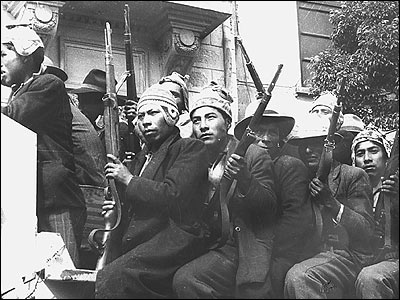
On April 9, 1952 Bolivia witnessed one of the deepest and most proletarian revolutions in the history of the American continent. In the space of a few hours, factory workers, the population of the cities and armed miners, defeated and humiliated the bourgeois state apparatus and physically destroyed the army of the ruling class, which would take years to be re-established. [image: Militia]<http://www.marxist.com/images/stories/bolivia/1952_revolutionaries.jpg>However, the revolutionary cycle that began with the revolution of April 9 ended twelve years later in the 1964 military coup and the establishment of the dictatorship of Ovando and Barrientos. Now that Bolivia is undergoing a new revolutionary cycle, it is important for more advanced activists of the working class and youth to absorb the lessons of history in order to never repeat the same mistakes. Bolivia, in the early twentieth century, was an extremely backward country from an economic point of view, whose economy depended mainly on mining and agriculture. The backwardness and poverty of Bolivia (which before World War II had the second lowest income per capita in the continent after Haiti), in a contradictory manner, was also the result of the enormous mineral wealth of the country. In the countryside, agricultural landowners, *gamonales,* owned hundreds of thousands of hectares of land, cultivated using the semi-feudal methods of * pongueaje*, an institution inherited from the kingdom of the Incas, which the Spanish colonists had adapted to their needs.8% of the landowners held more than 95% of arable land. Among them, 615 landowners with holdings greater than 10,000 hectares owned half of all arable land in the country. Hundreds of thousands of peasants were forced to serve the gamonales, in most cases for free, while two million farmers survived outside the cash economy on subsistence agriculture. The vast majority of the population was indigenous, and 80% of them did not speak a language other than their own (thus being outside of any official public activity which took place only in Spanish), and 90% were illiterate. At the same time, the combined and uneven character of the development of Bolivia had created a powerful capitalist export sector. Mining, which employed 3.2% of the population, produced 25% of GDP. Three families (Patiño, Aramayo and Hochschild) controlled 80% of this industry which represented 80% of national exports. During the Second World War, Bolivian tin came to represent 50% of world production. The tin barons, popularly known as *la rosca,* controlled all aspects of social, economic and political affairs in an alliance with the gamonales: they owned the main banks, published the most important newspapers, installed and removed governments and bought politicians and presidents. This ruling class had no interest in developing a domestic market, through the improvement of the living conditions of the masses. The landowners needed the continuation of the regime of semi-feudal exploitation in the countryside, while the mining barons exported their products to the world market. Thus, the economic structure of Bolivia produced in an extremely acute manner a series of contradictions that could only be resolved with the coming to power of the workers at the head of the oppressed nation, solving the problems of natural resources and agrarian redistribution by revolutionary means. The mining proletariat, which totalled 53,000 in the war years, lived and worked in horrible conditions of exploitation. Mining areas were usually in remote and poorly connected parts of the country, and miners were completely dependent on the mining companies for housing and the purchase of food from the company shops (pulperías). The conditions in the mines were of extreme humidity, some of them flooded to the waist, and with unbearable heat. Most of the miners suffered from silicosis and their life expectancy was still lower than the country's average which at that time was barely 50 years of age. These conditions had strengthened the ties of solidarity and militancy of the mining proletariat during the first decades of the 20th century. Mining fields were usually guarded by army barracks and the army did not hesitate to massacre workers to impose the most brutal discipline of capitalist exploitation. The 1932-35 Chaco War was, perhaps, the event that brought out all the accumulated contradictions in Bolivian society and especially the decay of its ruling class. The war between Bolivia and Paraguay, instigated by the interests of oil companies (Standard Oil on the Bolivian side and Shell on the Paraguayan side), was an unmitigated disaster for Bolivia. Tens of thousands of men (a total of 250,000 out of a population of less than three million) were transferred thousands of kilometres from their homes, to an inhospitable environment with a climate they did not know, to fight for a country (their own) that they had barely heard of! For tens of thousands of indigenous peasants, this was their first experience outside of their local communities. More Bolivian soldiers died from disease, from not being able to endure the climate of the Chaco and as a result of the ineptitude of the generals, than were killed by enemy bullets. The humiliating defeat of the Chaco War marked the consciousness of a whole generation of Bolivians from all walks of life. The radicalisation following the Chaco War, led to the governments of so-called military socialism of Toro and Busch, which despite the nationalization of oil were unable to solve any of the problems facing the masses. The bourgeois or petty-bourgeois nationalist governments which tried to confront the interests of imperialism and the rosca on behalf of the nation, were unable to bring that conflict to its conclusion, as this would have meant the expropriation of the tin barons and the gamonales and they would be left at the mercy of the revolutionary pressure of the masses, without their own independent base of support. This impotence led to the suicide of Busch in August 1939. In 1940 the Revolutionary Left Party (PIR) was founded, under the influence of the Stalinised Communist International. Already in 1941, the PIR adopted a policy of democracy vs. Fascism, i.e. support for the Allied capitalist powers in the Second World War, which at that time were in the same camp as the Soviet Union. In practice, in Bolivia, this political line pushed the PIR to the same side, and even to government collaboration with, the rosca oligarchy and the U.S. Embassy. This criminal policy, in line with that of the Communist Parties in Argentina and Cuba, to mention only the two most striking examples, undermined the working class base which the PIR had conquered, leaving the field open for the Nationalist Revolutionary Movement (MNR) to win a basis of support amongst the workers. The MNR, founded in 1941, was a classic petit bourgeois nationalist party with a radical anti-imperialist language, patriotic and even socialist in words. Its main slogan was that of the National Revolution, i.e. national as opposed to socialist or proletarian. The MNR, because of its confused ideology contained within it, from extreme right-wing elements to those that, under the pressure of the masses, were forced to use extremely radical language. But within the revolutionary movement in Bolivia there was another political position, which rejected both collaboration with democratic imperialism and the idea that all classes of the nation, united, could solve the problems it faced. This was the position of the Trotskyist Revolutionary Workers' Party (POR), founded in 1935, but which had been more or less lethargic during the first years of its life. Trotsky's position, explained masterfully in his book Permanent Revolution in which he drew the theoretical conclusions of the Russian Revolution, was clear: With regard to countries with a belated bourgeois development, especially the colonial and semi-colonial countries, the theory of the permanent revolution signifies that the complete and genuine solution of their tasks of achieving democracy and national emancipation is conceivable only through the dictatorship of the proletariat as the leader of the subjugated nation, above all of its peasant masses. In 1946, the positions of the POR were adopted by the congress of the Union Federation of Mine Workers of Bolivia, at its Pulacayo Congress. The Pulacayo Theses, despite their limitations, are essentially the application of Trotsky's Transitional Programme to the Bolivian reality. The Pulacayo Theses, whose main ideas are still valid today, start out by establishing clearly Bolivias character as a capitalist country and part of the world capitalist system in which there are still pending bourgeois democratic tasks: Bolivia is a backward capitalist country: within its economy different stages of development and different modes of production coexist, but the capitalist mode is qualitatively dominant... Bolivia, even though a backward country, is only one link in the world capitalist chain. National peculiarities are themselves, a combination of the essential features of the world economy. Hence, the Theses point to the leading role of the proletariat in the revolution: What characterises the proletariat is that it is the only class possessing sufficient strength to achieve not only its own aims but also those of other classes. Its enormous specific weight in political life is determined by the position it occupies in the production process and not by its numerical weakness. And finally they explain that the revolution cannot be stopped at its bourgeois democratic stage: The proletariat of the backward countries is obliged to combine the struggle for bourgeois democratic tasks with the struggle for socialist demands. These two stages democratic and socialist are not separated in struggle by historical stages; they flow immediately from one another. One cannot underestimate the importance of the fact that the key sector of the Bolivian working class, already in 1946, based itself firmly on the view that only the seizure of power by the workers could solve the pending tasks of the democratic revolution (agrarian revolution and national independence), and that these tasks were inextricably linked to the struggle for socialism. Thus, with these actors, we come to the April 1952 revolution. The immediate origin of the events can be found in the attempt of the leaders of the MNR to carry out a coup in combination with elements of the army and police against the military regime which had annulled the 1951 elections which the MNR had won. Due to the improvisation of the conspirators, the attempted coup was defeated and its leaders were forced to flee. However, in those moments of confusion, the masses entered the scene. Across the country, workers armed themselves and fought the army. In Cochabamba, Oruro, Potosí, workers took up arms and marched to the capital La Paz. Milluni miners occupied the railway station, seized a military supply train and marched on La Paz. Their arrival in the capital (as the arrival of the miners during the Red October in 2003) decided the outcome of the struggle. The army was completely defeated, the prisoners captured by the workers were humiliated and forced to march through the centre of the capital in their underwear. On April 11 there was no longer a bourgeois army in Bolivia. The only armed force in the country was between 50 and 100,000 men organized into armed militias by the unions. Real power was in the hands of workers. On April 15, MNR leader Paz Estenssoro returned to the country to be become the new president. A massive crowd of armed workers received him with cheers and shouts of nationalization of the mines and Land Reform. For the masses, Paz Estenssoro was the man who would deal a death blow to the landlords, imperialism and mining capitalists. Nothing, however, was further from his intentions. On 17 April, the Bolivian Workers Union (COB) was formed on the initiative of POR militant Miguel Alandia. Born amid the revolutionary fervour, the COB acquired since the very beginning features akin to a Soviet, and it had elements of real power. Liborio Justo describes it in this way in his book on the Bolivian revolution: From the outset, the COB... presented itself as the legitimate representative of the workers organized into *armed militias that controlled the country and were the only effective existing power in Bolivia. *Comrade President... was a virtual prisoner of the proletariat and its militias, guarded and monitored at the Palacio Quemado. And most importantly: He had no basis of support to resist any imposition by the workers, since the main base he could have counted on, the bourgeois army, had been destroyed in the days between April 9 to 11, 1952, by the armed proletariat and this was the only effective authority. In a short space of time the movement spread to the peasantry, which occupied the landed estates, created its own unions (which also joined the COB) and its own armed militias. Guillermo Lora, the historic leader of the POR, describes how the unions took power into their hands: As of April 9, the most important unions simply took the solution of vital issues into their hands, and the authorities, if they had not been removed, had no choice but to submit to their decisions... Becoming directors of the daily life of the masses, they surrounded themselves with legislative and executive powers (they had the power to enforce decisions) and even began to administer justice. The trade union meeting became the supreme law, the supreme authority. The same was true in the countryside, and in some cases even more so, as Lora explains: The peasant unions called unions only because they did not find a better name to describe themselves in the revolutionary turmoil always had in the early days of the revolution the essential characteristics of a council and acted as the sole authority (legislative, executive and judicial) in their counties. Armed peasant militias simply enforced the decisions the union took, which regulated even the daily lives of the inhabitants. Clearly what we had in Bolivia in April 1952 was a situation of dual power: real power was in the hands of workers and peasants through their organizations, coordinated through the COB and based on their armed militias, and on the other hand the official power of the government that had no real force in society. This situation was very similar to what occurred in Russia after the February Revolution of 1917 or in Spain after the workers defeated the fascist uprising in July 1936. In both cases, workers had the power (in the form of *soviets* in Russia, and Anti-Fascist Militia Committees in Spain), but there was still beside this an official power (the provisional government in Russia and the republican government in Spain).In Russia the situation was resolved in favour of workers in less than nine months, with the seizure of power by the *Soviets* in October 1917. In Spain the situation was resolved in favour of the government of the Republic, which gradually recovered real power, disarming the workers militias and disarticulating any element of workers' power by May of 1937, which led directly to the triumph of fascism in the civil war. In Bolivia the events followed a course similar to that of the Spanish Revolution and also ended with the crushing of the workers by the military. To achieve this, the MNR government used a clever tactic of delaying the implementation of the main demands of the masses, watering them down and emptying them of real content, and gradually re-creating a bourgeois army which would allow him to deal with the workers' and peasants militia. Thus, while the COB demanded the immediate nationalization of the mines, without compensation and under workers control, Paz Estenssoro created, on May 13, 1952, a commission of inquiry into the nationalization, which had to give a report within... four months! When the nationalization of the mines was finally decreed, on 31 October 1952, this was a bourgeois nationalization, in reality on very favourable terms for the interests of the tin barons, with compensation and concessions to US companies. But by that time the revolutionary fervour of the early days had begun to decline. Something similar happened with land reform. Radicalisation in the countryside, as we have seen, had reached, with some delay, a level even higher than the radicalisation of the workers in the cities and mines. Particularly after 1953, peasants took the initiative and occupied the landed estates of the gamonales. An American author, quoted in the book of Liborio Justo, describes it this way: The peasantry had no involvement in the April 1952 revolution, but once the MNR was in power, it conducted its own revolution. Its members seized the landed estates and distributed them among themselves. To achieve this, they had to embark on a real war against the owners... In 1953, rural areas of the great valleys of Cochabamba, densely populated by Quechua Indians, were a region completely sealed off to the former owners, to all persons suspected of belonging to the rosca and to foreigners. The agrarian reform law of August 1953 (after another four months commission of inquiry) simply legalized what the masses had already done and made every effort to provide compensation to former owners and also to give legal guarantees to any remaining latifundia. For example it did not consider as a *latifundo* any landed estates in which the owner had made investments and fixed the maximum amount of land a single owner could hold in tropical and subtropical areas to 50,000 ha. However, the achievements in the field of land reform (the result of direct action by the peasants), were more durable than in other areas and allowed the MNR to consolidate a base of support in the countryside. Yet, without access to credit, machinery and other tools, many of these small landowners created by the agrarian reform were forced, over a period of decades, to sell or abandon their lands, resulting in a new cycle of concentration of land ownership in few hands. This process of emptying the revolution of its real content, for which the masses had fought in April 1952, led to a growing disillusionment, the bureaucratization of the revolutionary institutions (starting with the COB itself) and finally the Barrientos coup in 1964.In all this, the MNR had the invaluable help of Lechin, the leader of the COB and the MNR, a very clever union bureaucrat who knew when to radicalise the content of his speeches to be in tune with the mood of the masses. We cannot fail to mention the role played in this process by the POR, the only political force that had a clear idea of the tasks and strategy for revolution in a backward country like Bolivia, but which, at the moment of truth, applied a conciliatory policy towards the MNR leadership. The POR had a decisive influence on the proletariat, particularly among the miners, but also within the leadership of the COB. What policy should it have adopted in a situation of dual power like the one that opened up in April 1952? The policy of the Bolsheviks in Russia, which allowed them to solve the question of dual power in favour of the workers, was clear, All Power to the Soviets, and this policy enabled them to win a majority in these organisations as the masses realised that the provisional government could not solve their most pressing needs (peace, bread and land). The correct policy in Bolivia would have been to advocate All Power to the COB as the only way to achieve the most pressing demands of the masses (the mines to the state, the land to the Indians). Unfortunately, the POR never raised this slogan, and in practice became just a left advisor to the left wing of the MNR represented by Lechin. Thus, the main limitation of the Bolivian revolution of 1952 was the absence of a revolutionary leadership which could implement a consistent revolutionary policy. *Most of the tasks faced in 1952 remain unresolved today.* To ensure they are solved, it is necessary to create a strong Marxist tendency, with roots in the mass organisations of the Bolivian proletariat and a clear perspective: capitalism has been unable to solve any of the problems of backwardness, underdevelopment and imperialist domination which Bolivia faces and only the expropriation of the oligarchy, the capitalists, landlords and imperialists by the working class can open the way to address them. [Non-text portions of this message have been removed] ------------------------------------ --------------------------------------------------------------------------- LAAMN: Los Angeles Alternative Media Network --------------------------------------------------------------------------- Unsubscribe: <mailto:[email protected]> --------------------------------------------------------------------------- Subscribe: <mailto:[email protected]> --------------------------------------------------------------------------- Digest: <mailto:[email protected]> --------------------------------------------------------------------------- Help: <mailto:[email protected]?subject=laamn> --------------------------------------------------------------------------- Post: <mailto:[email protected]> --------------------------------------------------------------------------- Archive1: <http://www.egroups.com/messages/laamn> --------------------------------------------------------------------------- Archive2: <http://www.mail-archive.com/[email protected]> --------------------------------------------------------------------------- Yahoo! Groups Links <*> To visit your group on the web, go to: http://groups.yahoo.com/group/laamn/ <*> Your email settings: Individual Email | Traditional <*> To change settings online go to: http://groups.yahoo.com/group/laamn/join (Yahoo! ID required) <*> To change settings via email: [email protected] [email protected] <*> To unsubscribe from this group, send an email to: [email protected] <*> Your use of Yahoo! Groups is subject to: http://docs.yahoo.com/info/terms/