http://www.marxist.com/egyptian-revolution-enters-new-stage.htm
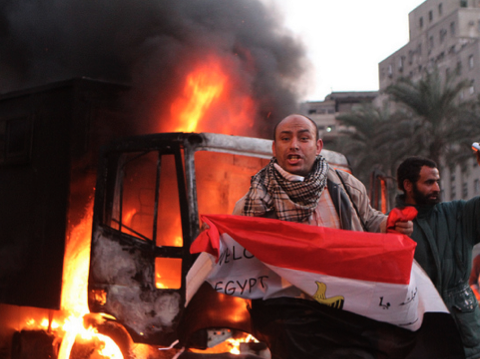
Egyptian Revolution enters new stage<http://www.marxist.com/egyptian-revolution-enters-new-stage.htm> Written by Alan Woods Monday, 04 June 2012 [image: Print]<http://www.marxist.com/egyptian-revolution-enters-new-stage/print.htm#> *One of the main features of a revolutionary situation is the suddenness with which the mood of the masses can change. The workers learn quickly on the basis of events. And the events of the last 24 hours show that the workers and youth of Egypt are learning fast.* [image: 21-11-2011 tahrir square egypt]<http://www.marxist.com/images/stories/egypt/21-11-2011_tahrir_square_egypt.png>The Egyptian Revolution is now entering into a new stage. The discontent that has been accumulating for months in the depths of the masses finally erupted in mass protests, which have continued overnight in Cairo's Tahrir Square. This feels like January 2011. It seems that the Revolution is back in a big way. These words by a BBC correspondent accurately convey the essence of the situation, which is characterised by a rapid change in the consciousness of the masses. The spark that detonated the explosion was the result of the trial of ex-President Hosni Mubarak, accused of complicity in the killing of about 850 protesters during the revolutionary uprising of 2011. But in reality it has far deeper causes, which are rooted in the development of the Revolution itself. We see a similar process in every revolution, not only in the Russian Revolution but also in the French Revolution of 1789-93. A revolution is not a one-act drama. Neither is it a simple, forward-moving process. The overthrows of Ben Ali and Mubarak were great victories, but they were only the first act of the revolutionary drama. Marx pointed out that the revolution needs the whip of the counter-revolution to advance. Over a year since the start of the Egyptian Revolution, the masses are stirring once more. In my article two days ago I pointed out the following: We know from history that every revolution passes through an initial phase of democratic illusions. The masses on the streets seem to be advancing constantly, pushing aside all obstacles. It is like a procession that can only go one way upwards. The masses feel their strength and believe themselves to be invincible. In this stage of the revolution, the main idea is unity: the people are united in struggle against a common enemy. Then comes the second stage. Beginning with the most advanced and politically conscious elements, the masses begin to understand that they have been deceived, that none of their main objectives has been achieved, and that, in essence, nothing has changed. This stage, which is accompanied by a sense of frustration and all kinds of convulsive uprisings, is the beginning of an inner differentiation in the revolutionary camp. Gradually, the more revolutionary and proletarian elements separate themselves from the vacillating elements, the careerists and bourgeois politicians who have hijacked the Revolution for their own ends. This is an unavoidable stage. It is the stage through which the Egyptian Revolution is now passing. The events that are now unfolding have confirmed this hypothesis. When Egyptians joined the revolt last year, they were demanding not only a change of regime but a fundamental economic change. The Revolution heightened expectations of improvements in living standards. But these hopes were soon dashed. Millions of Egyptians are suffering from high unemployment and prices, low wages, widespread poverty and all-pervasive corruption. The Revolution was about bread, work and housing. But over the last 15 months nothing has changed and most people have even seen their financial position worsen. Many graduates cannot find work. The poor become ever poorer. Unable to find proper work, many Egyptians from poorer neighbourhoods have been forced into casual jobs or selling cigarettes or fruit on the streets. For these people, the presidential candidates have little meaning. Whichever contender wins will be unable to deal with Egypt's deep economic crisis, or provide jobs and houses. Tourism, which used to bring $1bn a month, has collapsed. Egypt is a net importer of energy and has few natural resources. The price of energy is rising, putting a heavy burden on the poor. Domestic production has halted in parts of Egypt as hundreds of factories have closed down. Exports are also lower compared to pre-revolution levels. Foreign investment has dried up, frightened by the political upheaval. The idea has taken root in the minds of the masses that nothing has changed. Some of the names have changed, but the system remains the same. The same bosses run the factories. The same corrupt officials pocket the wealth of the nation. The same police chiefs are in charge of the organs of state repression. The same generals pull the strings from behind the scenes. Now all the accumulated discontent and frustration have found a focal point in the trial of Mubarak. It served to concentrate the attention of the people. The trial of Mubarak The 84-year-old former president was the first former leader to be tried in person since the start of the Arab Spring in early 2011. Announcing the verdicts, Judge Ahmed Refaat said Mubarak and former Interior Minister Habib al-Adly had failed to stop security forces using deadly force against unarmed demonstrators. In the end the two men were found guilty and sentenced to life imprisonment. The judge, obviously fearing the popular reaction, insisted that the 10-month trial had been fair. He said the Mubarak era had been "30 years of darkness" and praised what he called "the sons of the nation who rose up peacefully for freedom and justice". But these words sound like a cruel mockery of the aspirations of millions of ordinary Egyptians who risked their lives to defy the dictatorship on the streets last year. According to Egyptian law, the maximum penalty for these crimes is death. Many Egyptians were killed during the uprising, and their families and comrades expected that the man who was responsible for these murders should pay the ultimate price for his crimes. Instead, Hosni Mubarak can expect to spend a few years in a comfortable prison cell, where all the luxuries will be provided until he is released on grounds of ill heath. The preparations for this trick are already being made. State television reported that as he was being transferred to jail, Mubarak at first refused to leave the helicopter and then suffered from severe health problems. He has reportedly been admitted to the prison hospital. To add insult to injury, Mubarak and his two sons, Alaa and Gamal, were acquitted on separate charges of corruption, although his sons will remain in detention as they are to be charged with stock-market manipulation. Evidently, Plan A was to throw Mubarak like a bone to a dog, in order to preserve the rest of the old regime. But if that did not work, they would throw out his two sons as well. But things did not go according to plan. Immediately after the verdict, scuffles erupted in court. Outside, sentencing was initially greeted by celebrations, but anger soon took over when news of the acquittals spread. What made the crowds even more furious was the acquittal of key security officials who were on trial alongside Mubarak. Four interior ministry officials and two local security chiefs were cleared of complicity in protesters' killings. Every single one of the police officers who ordered their men to fire on unarmed demonstrators has been released without charge. This sends a direct and very clear message to the organs of state repression: you can carry on killing and torturing demonstrators with complete impunity. It is this that has provoked the fury of the masses, expressed in demonstrations all over Egypt. The protests in Cairo were seconded by rallies against the verdict in Alexandria, Suez and Mansoura. A verdict that was meant to bring closure and terminate the Egyptian Revolution has had the opposite effect. It has opened wounds that are too recent and too deep to heal. It has forcefully reminded people that none of the aims of the Revolution has been achieved. Above all, it has exposed the fact that the old state apparatus remains virtually unchanged. The slogan from last year's uprising: "Down with the military rule" is being chanted in the square and many have vociferously condemned Saturday's verdict. Eighteen months after the start of the Revolution that was fought under the banner of democracy, there is no democracy in Egypt. The trial of Mubarak shows that all talk of law and justice is meaningless. There is no independent judiciary: the judge in Mubaraks trial was clearly not impartial but a puppet of the regime. The Prosecutor General was appointed by Mubarak himself. Protesters at Tahrir Square, the focal point of last year's uprising, say they are determined to begin a sit-in. They have been joined by prominent public figures and football fans known as Ultras, who have been implicated in a number of political confrontations. The BBC's Yolande Knell, reporting from Tahrir Square, says there is particular anger at the acquittals of the officials, which many take as a sign that the talk of reform is hollow and nothing has changed. "The Mubarak verdict mocks us. He and [former Interior Minister Habib] Adly got a sentence and their aides got nothing," protester Sharif Ali told the BBC. "When they return to court on appeal, they will be freed too." But, the BBC correspondent adds, others have poured on to the streets out of disillusionment at the current political situation. Rigged elections The recent presidential elections were organized by the same state that was handed down from the Mubarak period intact, with all the old bureaucrats, generals and assorted gangsters in charge. To expect fair elections from this gang would be like asking pears from an elm tree. The first round of recent presidential elections has left Egyptians with a choice between an Islamist candidate and an ex-prime minister from the Mubarak era, that is to say, no choice at all. The candidate of the Left, Hamdeen Sabahi, the real candidate of the Revolution, was pushed into third place behind the counter-revolutionary Ahmed Shafiq, Mubaraks last prime minister. The presidential elections will solve nothing. The Egyptians people anticipated dramatic economic improvements after last year's uprising but they did not materialise. They will demand that the new government deliver on the promises of the revolution. But whether the Muslim Brotherhood or Ahmad Shafiq forms the next government, nothing will be solved. The crisis of capitalism rules out any improvement. The budget deficit is close to 10% of GDP. The bourgeoisie is demanding serious reforms (that is, deep cuts) in the subsidy system, which takes up 30% of the national budget. But how can this be done while protecting the poor? That is to say, how can one square the circle? As long as the capitalist system continues to exist in Egypt, the only future that awaits the workers and peasants is one of poverty, falling living standards, poverty and hunger. But this is not what the Revolution was supposed to stand for! Already the workers are striking for higher wages. Impatience and the desire to find short cuts always lead to disaster. It is a mistake to attach too much importance to ephemeral developments, such as a (rigged) election. It is an even bigger mistake to pay too much attention to the political struggle between different factions of the bourgeoisie at the top, and insufficient attention to the revolutionary trends that are developing at the bottom. The former are related to the latter as the foam on the waves is related to the currents in the depths of the ocean. That is to say, they are ephemeral phenomena. The Egyptian revolution will unfold over a period of years, with ebbs and flows. There will be advances but also defeats and setbacks. But through all this, the workers and youth will learn. This learning process will be far shorter if the Egyptian Marxists do not make serious mistakes, like the mistake of calling for a vote for the Muslim Brotherhood. We must at all costs maintain absolute independence from all factions of the bourgeoisie. Combining political firmness with the necessary tactical flexibility, the small forces of Marxism can begin to get an echo, beginning with the most advanced workers and youth. The experience of a government of the Muslim Brothers will open the eyes of the millions as to the real class nature of this movement, exposing the gulf that separates words and deeds, and preparing for a sharp turn to the Left at a later date. The rigging of the elections has given a powerful impulse to the mass movement. This underlines the incorrectness of the attempts to block the advance of the counter-revolution by calling for a vote for the Muslim Brotherhood as the lesser evil. *In order to defeat the counter-revolution what is needed is not electoral pacts and combinations at the top, but the direct action of the masses*. The most advanced elements in Egypt have understood this. In a protest against the rigging of the elections, protesters stormed the campaign headquarters of Shafiq in the Fayoum area south of Cairo. This and, above all, the mass protests on the streets of Cairo and other cities, show that the Revolution is not defeated, that it still has considerable reserves of energy, and that it will not surrender without a fight. That and that alone, is what we must base ourselves on. The Marxists must have faith in themselves, in their programme and ideas. Above all, they must have faith in the revolutionary masses and the working class. Let us remind ourselves that the decisive element in the revolutionary equation, that eventually forced Mubarak out, was the intervention of the working class, and the working class remains the key to the whole situation. The Egyptian Revolution was prepared by the biggest strike movement Egypt has witnessed in more than half a century. From 2004 to 2008 over 1.7 million workers participated in more than 1,900 strikes and other forms of protest. In the recent period there have been 3,000 strikes, including all sectors, both government and private. Many of them were successful, leading to wage increases. But the economic struggle is no longer enough. Even when strikes are successful and wages are increased, the effects are soon cancelled out by inflation. The Egyptian Revolution has begun but it has not finished. In order to solve the problems of Egyptian society, it is necessary to break with capitalism, expropriate the capitalists and imperialists and carry out the socialist transformation of society. This is both possible and necessary. Let our slogan be: *"Thawra hatta'l nasr" (Revolution until Victory)* London, 3rd June, 2012 [Non-text portions of this message have been removed] ------------------------------------ --------------------------------------------------------------------------- LAAMN: Los Angeles Alternative Media Network --------------------------------------------------------------------------- Unsubscribe: <mailto:[email protected]> --------------------------------------------------------------------------- Subscribe: <mailto:[email protected]> --------------------------------------------------------------------------- Digest: <mailto:[email protected]> --------------------------------------------------------------------------- Help: <mailto:[email protected]?subject=laamn> --------------------------------------------------------------------------- Post: <mailto:[email protected]> --------------------------------------------------------------------------- Archive1: <http://www.egroups.com/messages/laamn> --------------------------------------------------------------------------- Archive2: <http://www.mail-archive.com/[email protected]> --------------------------------------------------------------------------- Yahoo! Groups Links <*> To visit your group on the web, go to: http://groups.yahoo.com/group/laamn/ <*> Your email settings: Individual Email | Traditional <*> To change settings online go to: http://groups.yahoo.com/group/laamn/join (Yahoo! ID required) <*> To change settings via email: [email protected] [email protected] <*> To unsubscribe from this group, send an email to: [email protected] <*> Your use of Yahoo! Groups is subject to: http://docs.yahoo.com/info/terms/