Yan Zhao <[email protected]> writes:

>> > <snip>
>> >
>> > What options does userspace have in this scenario?
>> > It can't reduce the flag to KVM_GUEST_MEMFD_HUGE_2MB. Adjusting the
>> > gmem.pgoff
>> > isn't ideal either.
>> >
>> > What about something similar as below?
>> >
>> > diff --git a/virt/kvm/guest_memfd.c b/virt/kvm/guest_memfd.c
>> > index d2feacd14786..87c33704a748 100644
>> > --- a/virt/kvm/guest_memfd.c
>> > +++ b/virt/kvm/guest_memfd.c
>> > @@ -1842,8 +1842,16 @@ __kvm_gmem_get_pfn(struct file *file, struct
>> > kvm_memory_slot *slot,
>> >         }
>> >
>> >         *pfn = folio_file_pfn(folio, index);
>> > -       if (max_order)
>> > -               *max_order = folio_order(folio);
>> > +       if (max_order) {
>> > +               int order;
>> > +
>> > +               order = folio_order(folio);
>> > +
>> > +               while (order > 0 && ((slot->base_gfn ^ slot->gmem.pgoff) &
>> > ((1 << order) - 1)))
>> > +                       order--;
>> > +
>> > +               *max_order = order;
>> > +       }
>> >
>> >         *is_prepared = folio_test_uptodate(folio);
>> >         return folio;
>> >
>>
>> Vishal was wondering how this is working before guest_memfd was
>> introduced, for other backing memory like HugeTLB.
>>
>> I then poked around and found this [1]. I will be adding a similar check
>> for any slot where kvm_slot_can_be_private(slot).
>>
>> Yan, that should work, right?
> No, I don't think the checking of ugfn [1] should work.
>
> 1. Even for slots bound to in-place-conversion guest_memfd (i.e. shared memory
> are allocated from guest_memfd), the slot->userspace_addr does not necessarily
> have the same offset as slot->gmem.pgoff. Even if we audit the offset in
> kvm_gmem_bind(), userspace could invoke munmap() and mmap() afterwards,
> causing
> slot->userspace_addr to point to a different offset.
>
> 2. for slots bound to guest_memfd that do not support in-place-conversion,
> shared memory is allocated from a different backend. Therefore, checking
> "slot->base_gfn ^ slot->gmem.pgoff" is required for private memory. The check
> is
> currently absent because guest_memfd supports 4K only.
>
>
Let me clarify, I meant these changes:

diff --git a/arch/x86/kvm/x86.c b/arch/x86/kvm/x86.c
index 4b64ab3..d0dccf1 100644
--- a/arch/x86/kvm/x86.c
+++ b/arch/x86/kvm/x86.c
@@ -12938,6 +12938,11 @@ int memslot_rmap_alloc(struct kvm_memory_slot *slot,
unsigned long npages)
        return 0;
 }

+static inline bool kvm_is_level_aligned(u64 value, int level)
+{
+       return IS_ALIGNED(value, KVM_PAGES_PER_HPAGE(level));
+}
+
 static int kvm_alloc_memslot_metadata(struct kvm *kvm,
                                      struct kvm_memory_slot *slot)
 {
@@ -12971,16 +12976,20 @@ static int kvm_alloc_memslot_metadata(struct kvm *kvm,

                slot->arch.lpage_info[i - 1] = linfo;

-               if (slot->base_gfn & (KVM_PAGES_PER_HPAGE(level) - 1))
+               if (!kvm_is_level_aligned(slot->base_gfn, level))
                        linfo[0].disallow_lpage = 1;
-               if ((slot->base_gfn + npages) & (KVM_PAGES_PER_HPAGE(level) -
1))
+               if (!kvm_is_level_aligned(slot->base_gfn + npages, level))
                        linfo[lpages - 1].disallow_lpage = 1;
                ugfn = slot->userspace_addr >> PAGE_SHIFT;
                /*
-                * If the gfn and userspace address are not aligned wrt each
-                * other, disable large page support for this slot.
+                * If the gfn and userspace address are not aligned or if gfn
+                * and guest_memfd offset are not aligned wrt each other,
+                * disable large page support for this slot.
                 */
-               if ((slot->base_gfn ^ ugfn) & (KVM_PAGES_PER_HPAGE(level) - 1))
{
+               if (!kvm_is_level_aligned(slot->base_gfn ^ ugfn, level) ||
+                   (kvm_slot_can_be_private(slot) &&
+                    !kvm_is_level_aligned(slot->base_gfn ^ slot->gmem.pgoff,
+                                          level))) {
                        unsigned long j;

                        for (j = 0; j < lpages; ++j)

This does not rely on the ugfn check, but adds a similar check for gmem.pgoff.

I think this should take care of case (1.), for guest_memfds going to be
used for both shared and private memory. Userspace can't update
slot->userspace_addr, since guest_memfd memslots cannot be updated and
can only be deleted.

If userspace re-uses slot->userspace_addr for some other memory address
without deleting and re-adding a memslot,

+ KVM's access to memory should still be fine, since after the recent
  discussion at guest_memfd upstream call, KVM's guest faults will
  always go via fd+offset and KVM's access won't be disrupted
  there. Whatever checking done at memslot binding time will still be
  valid.
+ Host's access and other accesses (e.g. instruction emulation, which
  uses slot->userspace_addr) to guest memory will be broken, but I think
  there's nothing protecting against that. The same breakage would
  happen for non-guest_memfd memslot.

p.s. I will be adding the validation as you suggested [1], though that
shouldn't make a difference here, since the above check directly
validates against gmem.pgoff.

Regarding 2., checking this checks against gmem.pgoff and should handle
that as well.

[1] https://lore.kernel.org/all/[email protected]/

I prefer checking at binding time because it aligns with the ugfn check
that is already there, and avoids having to check at every fault.

>> [1]
>> https://github.com/torvalds/linux/blob/b6ea1680d0ac0e45157a819c41b46565f4616186/arch/x86/kvm/x86.c#L12996
>>
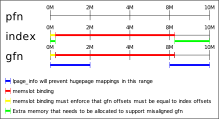
>> >> >> Adding checks at binding time will allow hugepage-unaligned offsets (to
>> >> >> be at parity with non-guest_memfd backing memory) but still fix this
>> >> >> issue.
>> >> >>
>> >> >> lpage_info will make sure that ranges near the bounds will be
>> >> >> fragmented, but the hugepages in the middle will still be mappable as
>> >> >> hugepages.
>> >> >>
>> >> >> [1]
>> >> >> https://lpc.events/event/18/contributions/1764/attachments/1409/3706/binding-must-have-same-alignment.svg