________________________________
Rosa Parks


>From Wikipedia, the free encyclopedia.

Jump to: navigation, search

Rosa Louise McCauley Parks
Rosa Louise McCauley Parks
<http://upload.wikimedia.org/wikipedia/en/thumb/c/c4/Rosaparks.jpg/200px-Rosaparks.jpg>

"Mother of the Civil Rights Movement" Rosa Parks in 1955.
Born     February 4, 1913
Tuskegee, Alabama, USA
Died     October 24, 2005
Detroit, Michigan, USA

Rosa "Lee" Louise Parks (February 4, 1913 – October 24, 2005) was an African
American seamstress and civil rights activist whom the United States Congress
called the "Mother of the Modern Day Civil Rights Movement." She is most famous
for her refusal in 1955 to give up a bus seat to a white man when ordered to do
so by the bus driver, provoking the Montgomery Bus Boycott. Her role in
American history earned her an iconic legacy in American culture and worldwide
civil rights movements.


Contents


*       1 Early life

        *       1.1 Civil rights and legal context
        *       1.2 Montgomery Bus Boycott
        *       1.3 Browder v. Gayle

        *       2 Later life

        *       2.1 Lawsuits and controversy
        *       2.2 Death and funeral

        *       3 Awards and honors
        *       4 Notable quotes and citations about Rosa Parks

        *       4.1 Presidential Medal of Freedom Award Ceremony

        *       5 Notes
        *       6 References
        *       7 See also
        *       8 External links

        *       8.1 Multimedia and interviews
        *       8.2 Official
        *       8.3 Other


[edit]


Early life

Rosa Parks in 1964.
<http://upload.wikimedia.org/wikipedia/en/thumb/9/97/Rosaparks_1964.jpg/180px-Rosaparks_1964.jpg>

Enlarge
Rosa Parks in 1964.

Rosa Parks was born Rosa Louise McCauley in Tuskegee, Alabama, daughter of
James and Leona McCauley, a carpenter and a teacher. Small even as a child, she
suffered poor health and had chronic tonsillitis. When her parents separated,
she moved with her mother to Pine Level, Alabama, just outside Montgomery.
There she grew up on a farm with her maternal grandparents, mother, and younger
brother Sylvester and began her lifelong membership in the African Methodist
Episcopal Church. Her mother Leona home schooled Rosa until she was 11, when
she enrolled in the Industrial School for Girls in Montgomery, where her aunt
lived, taking academic and some vocational courses. She then went on to a
laboratory school set up by the Alabama State Teachers College for Negroes for
secondary education (now known as Alabama State University), but was forced to
drop out to care for her grandmother, and later her mother, after they grew ill.

Under Jim Crow laws, it was quite easy to separate blacks and whites in every
aspect of daily life except on public transportation in the South. Bus and
train companies could not afford separate vehicles and so blacks and whites had
to occupy the same space. Bus transportation was one of the most challenging
areas for race relations in the South. Parks recalled going to elementary
school in Pine Level where school buses took white students to their new school
and black students had to walk to their school. She said, "I'd see the bus pass
every day...But to me, that was a way of life; we had no choice but to accept
what was the custom. The bus was among the first ways I realized there was a
black world and a white world." Though Parks' autobiography recounts that some
of her earliest memories are of the kindness of white strangers, racial
segregation could not be ignored. When the Ku Klux Klan marched in the street
in front of her house, Parks recalls her grandfather guarding the front door
with a shotgun. The Montgomery Industrial School, founded and staffed by
Northern whites for black children was twice burned by arsonists and its
faculty ostracized by the white community. Her younger brother, Sylvester,
would later return from the Second World War as a decorated veteran to a South
where blacks in uniform were regarded as "uppity" and sometimes beaten.

In 1932, she married Raymond Parks, a barber from Montgomery, at her mother's
house. Raymond was a member of the NAACP, at the time collecting money to
support the Scottsboro Boys, a group of blacks falsely accused of raping two
white women. After marriage Rosa worked a number of jobs ranging from domestic
worker to hospital aide. At her husband's urging she finished her high school
studies in 1933, at a time when less than seven percent of African-Americans
had a high school diploma. Despite Jim Crow laws that made political
participation by blacks difficult she persevered in registering to vote,
succeeding on her third try.

In December 1943, Parks became active in the American Civil Rights Movement,
joining the Montgomery chapter of the NAACP, and was elected volunteer
secretary to its president, E.D. Nixon. Of her position she said, "I was the
only woman there, and they needed a secretary, and I was too timid to say no."
She would continue as secretary until 1957. In the 1940s, Mr and Mrs. Parks
were also members of the Voters' League. Some time soon after 1944, she held a
brief job on Maxwell Air Force Base, federal property where segregation was not
allowed, and rode on an integrated trolley. Speaking to her biographer, Parks
noted, "You might just say Maxwell opened my eyes up." Parks worked as a
housekeeper and seamstress for a white couple, Clifford and Virginia Durr. The
politically liberal Durrs became her friends and encouraged Parks to attend,
and eventually helped sponsor her to, the Highlander Folk School, an education
center for workers' rights and racial equality in Monteagle, Tennessee in the
summer of 1955.

[edit]


Civil rights and legal context


One of the reasons for the desegregation experienced by Parks on Maxwell AFB
was that she was not the first African American to refuse to give up her seat
to a white person. In 1944 Jackie Robinson took a similar stand with an Army
officer in Fort Hood, Texas, refusing to move to the back of a bus. He was
brought before a court martial, which acquitted him. [1]
<http://afroamhistory.about.com/library/blbio_jackierobinson.htm>

The NAACP had accepted and litigated other cases before, such as that of Irene
Morgan ten years earlier, which resulted in a victory in the Supreme Court on
Commerce Clause grounds. That victory only overturned state segregation laws as
applied to actual travel in interstate commerce, such as interstate bus travel.
Black leaders had begun to build a case around a 15-year-old girl, Claudette
Colvin's arrest for refusing to relinquish her bus seat. Colvin was a student
at Booker T. Washington High School. On March 2, 1955, she boarded a public
bus. Colvin was handcuffed, arrested and forcibly removed from the bus when she
refused to give up her seat to a white man. She screamed that her
constitutional rights were being violated. At the time, Colvin was active in
the NAACP's Youth Council. She was advised by none other than Mrs. Rosa Parks.
Colvin said, "Mrs. Parks said always do what was right." Mrs. Parks was raising
money for Colvin's defense. However, when E.D. Nixon learned that Colvin was
pregnant, it was decided that Colvin was an unsuitable symbol for their cause.
She was impregnated by a much older man soon after her arrest, which
scandalized the deeply religious black community. They felt that the white
press would manipulate Colvin's 'illegitimate' pregnancy as a means of
undermining any boycott. Some historians have argued that civil-rights leaders,
who were predominately middle class, were uneasy with Colvin's impoverished
background. The NAACP had considered but rejected some earlier protesters
deemed unable or unsuitable to withstand the pressure and trial cross
examination of a legal challenge to racial segregation laws. Colvin was also
prone to outbursts and cursing episodes. Many of the legal charges against
Colvin were dropped. A boycott and legal case never materialized from the
Colvin case law. [2] <http://en.wikipedia.org/wiki/Rosa_Parks#endnote_colvin>

Parks boarded the Cleveland Avenue bus on Thursday, December 1, 1955 in
Montgomery, Alabama after a day at work at the Montgomery Fair department
store. She was sitting in the 'colored' section of the bus. The "colored"
section of the buses in Montgomery was not fixed in size, but determined by the
placement of a movable sign. On Montgomery buses, the first four rows were
reserved for whites. The bus rear was reserved for blacks, who made up more
than 75 percent of the bus system's riders. Blacks could sit in the middle rows
until those seats were needed by whites. Then blacks had to move to seats in
the rear, stand or, if there was no room, leave the bus. Even getting on the
bus presented hurdles. If whites were already sitting in the front, blacks
could board to pay the fare but then they had to disembark and re-enter through
the rear door. There were times when the bus would depart before the paid-up
customers made it to the back entrance. If the white section was full and
another white person came aboard, blacks were required to relinquish their
seats and move farther to the back. Blacks were not even allowed to sit across
the aisle from whites. The driver could move the 'colored' section sign, or
even remove it altogether. For years the black community had complained about
this severe unfairness, and Mrs. Parks was no exception. Parks said, " My
resisting being mistreated on the bus did not begin with that particular
arrest...I did a lot of walking in Montgomery. " Parks had her first run-in on
the public bus in on a rainy day in 1943 when the bus driver, James Blake
demanded that she get off the bus and reenter through the back door like every
other black person. As she began to exit by the front door, she dropped her
purse. Then Parks deliberately sat in a seat for white passengers, apparently
to pick up her purse. The bus driver was enraged and had barely let her step
off the bus before speeding off. Incensed, Rosa walked the more than five miles
home in the rain.

On that notable day in 1955 at about 6 p.m., Mrs. Parks boarded the bus in
downtown Montgomery, paid her fare, and sat in an empty seat in the first row
of back seats reserved for blacks (near the middle of the bus, behind the 10
seats reserved for whites). Initially, she had not noticed that the bus driver
was the same man, James Blake, who had mistreated her in 1943. As the bus
traveled through its regular route, all of the "white-only" seats in the bus
were filled. The bus reached the third stop in front of the Empire Theater, and
several white passengers boarded the bus. Following the standard practice of
segregation, Blake noted that the front of the bus was filled with white
passengers and there were two or three men standing and thus moved the sign
behind Parks and demanded that four blacks give up their seats in the middle
section so the white passengers could sit. By Parks' account, Blake said,
"Y'all better make it light on yourselves and let me have those seats." [3]
<http://en.wikipedia.org/wiki/Rosa_Parks#endnote_blake>  Three of them
complied. Parks said, "The driver wanted us to stand up, the four of us. We
didn't move at the beginning, but he says, 'Let me have these seats.' And the
other three people moved, but I didn't." [4]
<http://en.wikipedia.org/wiki/Rosa_Parks#endnote_busseat>  The black man
sitting next to her gave his seat up. Parks moved, but toward the window seat.
She did not get up or off her seat.[5]
<http://en.wikipedia.org/wiki/Rosa_Parks#endnote_thirdstop>  Blake said, "Why
don't you stand up?" Parks said, "I said I don't think I should have to stand
up." Blake called the police to arrest Parks. When recalling the incident for
Eyes on the Prize, a 1987 public television series on the civil rights
movement, Parks said, " When he saw me still sitting, he asked if I was going
to stand up and I said, 'No, I'm not'. And he said, 'Well, if you don't stand
up, I'm going to have to call the police and have you arrested.' I said, 'You
may do that.' " When Parks refused to give up her seat, a police officer
arrested her. As the officer took her away, she recalled that she asked, " Why
do you push us around?" The officer's response, "I don't know, but the law's
the law, and you're under arrest." She added, "I only knew that, as I was being
arrested, that it was the very last time that I would ever ride in humiliation
of this kind." Parks was charged with a violation of Chapter 6, Section 11
segregation law of the Montgomery City code even though she had not taken up a
"white-only" seat — she was in a "colored section" but she was told to get up
to allow a white man to sit. Four days later, she was tried on charges of
disorderly conduct and violating a local ordinance. The trial lasted 30
minutes. Parks was found guilty and fined $10, plus $4 in court costs.[6]
<http://en.wikipedia.org/wiki/Rosa_Parks#endnote_arrest>  Parks appealed her
conviction and formally challenged the legality of racial segregation. Years
later, in recollecting the events of the day, Parks said, "When that white
driver stepped back toward us, when he waved his hand and ordered us up and out
of our seats, I felt a determination cover my body like a quilt on a winter
night."


During a radio interview with Sydney Rogers in 1956 in West Oakland (several
months after her arrest in 1955), when asked as to why she decided to not
vacate her bus seat, Parks said:

        "I would have to know for once and for all what rights I had as a human
being and a citizen of Montgomery, Alabama."

Parks detailed her motivation in this moment in her autobiography, My Story:

        People always say that I didn't give up my seat because I was tired,
but that isn't true. I was not tired physically, or no more tired than I
usually was at the end of a working day. I was not old, although some people
have an image of me as being old then. I was forty-two. No, the only tired I
was, was tired of giving in.

In a 1992 interview with NPR's Lynn Neary, Parks recollected:

        "I did not want to be mistreated, I did not want to be deprived of a
seat that I had paid for. It was just time...there was opportunity for me to
take a stand to express the way I felt about being treated in that manner."

        "I had not planned to get arrested. I had plenty to do without having
to end up in jail. But when I had to face that decision, I didn't hesitate to
do so because I felt that we had endured that too long. The more we gave in,
the more we complied with that kind of treatment, the more oppressive it
became."


On Monday, December 5, 1955, the Montgomery Improvement Association (MIA) was
formed. Its members elected as their president a virtual newcomer to
Montgomery, a young and relatively unknown minister of Dexter Avenue Baptist
Church, Dr. Martin Luther King, Jr. That Monday night, 50 leaders of the
African American community, headed by Dr. King, gathered to discuss the proper
actions to be taken as a result of Mrs. Parks' arrest. E.D. Nixon said, "My
God, look what segregation has put in my hands!" Parks was the ideal plaintiff
for a test case against city and state segregation laws. While the 15-year-old
Claudette Colvin, unwed and pregnant, was deemed unacceptable to be the center
of a civil rights mobilization, Dr. King stated that, "Mrs. Parks, on the other
hand, was regarded as one of the finest citizens of Montgomery—not one of the
finest Negro citizens—but one of the finest citizens of Montgomery." Parks was
securely married, employed, possessed a quiet demeanor and was politically
savvy. The selection of Parks for a test case supported by the NAACP has been
speculated to be in part because she was employed by the NAACP.

[edit]


Montgomery Bus Boycott


What ensued next was the Montgomery Bus Boycott. On Sunday, December 4, 1955,
the Montgomery Bus Boycott announcement was made from black churches, and a
front-page article in The Montgomery Advertiser, further spread the word. At a
church rally that night, blacks unanimously agreed to continue the boycott
until they were treated with courtesy, that black drivers be hired, and that
seating in the middle of the bus be done on a first-come basis. On Monday,
December 5, 1955, (the day of Parks' trial), the Women's Political Council
distributed 35,000 leaflets that urged blacks to boycott Montgomery public
buses. The handbill read, "We are...asking every Negro to stay off the buses
Monday in protest of the arrest and trial...You can afford to stay out of
school for one day. If you work, take a cab, or walk. But please, children and
grown-ups, don't ride the bus at all on Monday. Please stay off the buses
Monday." [7] <http://en.wikipedia.org/wiki/Rosa_Parks#endnote_boycottquote>  It
rained on Monday, December 5, but the black community persevered in their
boycott. Some blacks rode in carpools. Others traveled in black cabs that
charged the same fare as the bus fare, 10 cents. Most of the rest of the 40,000
black commuters walked, some for as far as 20 miles. The black community ended
up boycotting public buses for 381 days. Dozens of public buses stood idle for
months until the law requiring segregation on public buses was lifted. The
boycott severely damaged the bus transit company's finances. This event helped
spark many other protests against segregation. As a retaliation against the
black community's bus boycott, many black churches were dynamited. Dr. King's
home was bombed on in the early morning hours of January 30, 1956. E.D. Nixon's
home was also attacked. This mass movement marked one of the largest and most
successful challenges of racial segregation and it catapulted Dr. King to the
forefront of the civil rights movement.

Through her role in initiating this boycott, Rosa Parks helped make other
Americans aware of the civil rights struggle. Dr. King wrote in his 1958 book,
Stride Toward Freedom, Parks' arrest was the precipitating factor rather than
the cause of the protest. "The cause lay deep in the record of similar
injustices...Actually no one can understand the action of Mrs. Parks unless he
realizes that eventually the cup of endurance runs over, and the human
personality cries out, 'I can take it no longer.' "

[edit]


Browder v. Gayle


Immediately after the commencement of the bus boycott, black leaders began
discourse on the need for a federal lawsuit to challenge city and state bus
segregation laws. About two months after the bus boycott began, Claudette
Colvin's case was re-considered by black legal leaders. Attorneys Fred Gray,
E.D. Nixon and Clifford Durr (a white lawyer and his wife, Virginia, who were
activists in the civil rights movement) searched for the ideal case law to
challenge the constitutional legitimacy of city and state bus segregation laws.
Durr believed that an appeal of Mrs. Parks' case would just get tied up in the
Alabama state courts. Gray researched for the law suit, consulting with NAACP
legal counsels Robert Carter and Thurgood Marshall (who would later become U.S.
solicitor general and a U.S. Supreme Court justice). Gray approached Aurelia
Browder, Susie McDonald, Claudette Colvin and Mary Louise Smith, all women who
had been mistreated by the Montgomery bus system the previous year. They all
agreed to become plaintiffs in a civil action law suit. On February 1, 1956,
case Browder v. Gayle (Browder was a Montgomery housewife; Gayle the mayor of
Montgomery) was filed in U.S. District Court by Fred Gray. It was Browder v.
Gayle that caused for segregation on public buses to be eradicated. [8]
<http://en.wikipedia.org/wiki/Rosa_Parks#endnote_browdervgayle>

On June 19, 1956, the U.S. District Court three-judge panel ruled that Section
301 (31a, 31b and 31c) of Title 48, Code of Alabama, 1940, as amended, and
Sections, 10 and 11 of Chapter 6 of the Code of the City of Montgomery, 1952
"deny and deprive plaintiffs and other Negro citizens similarly situated of the
equal protection of the laws and due process of law secured by the Fourteenth
Amendment," (Browder v. Gayle, 1956). The court essentially decided that the
precedent of Brown v. Board of Education (1954) could be applied to Browder v.
Gayle. On November 13, 1956, in Browder v. Gayle, United States Supreme Court
outlawed racial segregation on buses, deeming it unconstitutional. The court
order arrived in Montgomery, Alabama on December 20, 1956. The bus boycott
ended on December 21, 1956. However, more violence erupted following the court
order, as snipers fired into buses as well as Dr. King's home, and bombs were
tossed into churches and into the homes of many church ministers. [9]
<http://en.wikipedia.org/wiki/Rosa_Parks#endnote_supremecourt>

[edit]


Later life

Rosa Parks on a Montgomery bus on December 21, 1956 (the day Montgomery's
public transportation system was legally integrated)).
<http://upload.wikimedia.org/wikipedia/en/thumb/8/80/Rosaparks_bus.jpg/180px-Rosaparks_bus.jpg>

Enlarge
Rosa Parks on a Montgomery bus on December 21, 1956 (the day Montgomery's
public transportation system was legally integrated)).

After her arrest, Parks became an icon of the civil rights movement and
suffered hardship as a result. She lost her job at the department store and her
husband quit his job after his boss forbade him from talking about his wife or
the legal case. Mrs Parks traveled and spoke extensively. In 1957, Raymond and
Rosa Parks left Montgomery for Hampton, Virginia, mostly because Mrs. Parks was
unable to find work, but also due to disagreements with Dr. King and other
leaders of Montgomery's struggling civil rights movement. In Hampton, she found
a job as a hostess in an inn at Hampton Institute. Later that year, at the
urging of her younger brother, Sylvester, Mrs. Parks, Raymond Parks and her
mother, Leona McCauley, moved to Detroit, Michigan. Mrs. Parks worked as a
seamstress until 1965 when U.S. Representative John Conyers (D-Michigan) hired
her as a secretary and receptionist for his Congressional office in Detroit.
She held this position until she retired in 1988.[10]
<http://en.wikipedia.org/wiki/Rosa_Parks#endnote_move>  In a telephone
interview with CNN on October 24, 2005, Conyers recalled, "You treated her with
deference because she was so quiet, so serene—just a very special
person...'there is only one' Rosa Parks."

The No. 2857 (GM Serial Number 1132 and coach ID #2857) bus on which Rosa Parks
was riding is now a museum exhibit at the Henry Ford Museum.
<http://upload.wikimedia.org/wikipedia/en/thumb/5/56/Rosa_parks_bus.jpg/250px-Rosa_parks_bus.jpg>

Enlarge
The No. 2857 (GM Serial Number 1132 and coach ID #2857) bus on which Rosa Parks
was riding is now a museum exhibit at the Henry Ford Museum.

The Rosa and Raymond Parks Institute for Self Development was co-founded in
February 1987 by Mrs Rosa Parks and Ms. Elaine Eason Steele in honor of Rosa's
husband Raymond Parks, who died from cancer in 1977. The institute runs
"Pathways to Freedom" bus tours introducing young people to important civil
rights and underground railroad sites throughout the country. In 1992 she
published, Rosa Parks: My Story, an autobiography leading up to her decision
not to give up her seat aimed at younger readers.

On August 30, 1994, at age eighty one, Rosa Parks was attacked in her Detroit
home by Joseph Skipper, who is also African American. The incident created
outrage throughout America. Skipper said he didn't know he was in Parks' home
but recognized her after entering. Skipper asked, "Hey, aren't you Rosa Parks?"
to which she replied, "Yes." She handed him $3 when he demanded money and an
additional $50 when he demanded more. Before fleeing, Skipper struck Parks in
the face.[11] <http://en.wikipedia.org/wiki/Rosa_Parks#endnote_beating>
Skipper was arrested and charged with various breaking and entering offenses
against Parks and other neighborhood victims. He admitted guilt and on August
8, 1995 was sentenced to eight to fifteen years in prison.[12]
<http://en.wikipedia.org/wiki/Rosa_Parks#endnote_sentence>

In 1995, Parks published her memoirs Quiet Strength concentrating on the role
her faith played in her life. On a 1997 trip, the Pathways to Freedom bus drove
into a river killing Adisa Foluke, called Park's adopted grandson, who was a
chaperon, and injuring several others. Parks served as a member of the Board of
Advocates of the Planned Parenthood Federation of America.

[edit]


Lawsuits and controversy


In 1999 a lawsuit was filed on her behalf against the popular American hip hop
duo OutKast and LaFace Records, claiming that the group had illegally used her
name without her permission for their song "Rosa Parks", the most successful
radio single of their 1998 album Aquemini.

In October 2004, U.S. District Judge George Caram Steeh appointed Dennis
Archer, a former mayor of Detroit and Michigan Supreme Court justice, as
guardian of legal matters for Parks after her family expressed concerns that
her caretakers and her lawyers were pursuing the case based on their own
financial interest.[13]
<http://en.wikipedia.org/wiki/Rosa_Parks#endnote_concerns>  "My auntie would
never, ever go to this length to hurt some young artists trying to make it in
the world," Parks' niece, Rhea McCauley, said in an Associated Press interview.
"As a family, our fear is that during her last days Auntie Rosa will be
surrounded by strangers trying to make money off of her name."[14]
<http://en.wikipedia.org/wiki/Rosa_Parks#endnote_niece>

OutKast was dismissed from the suit in August 2004. Parks' attorneys and
caretaker refiled and named BMG, Arista Records and LaFace Records as the
defendants along with Barnes & Noble and Borders Group for selling the songs,
and several people not connencted to the song, including the director and
producer of the 1998 music video, asking for $5 billion in damages. The lawsuit
was settled on April 15, 2005. In the settlement agreement, OutKast and their
producers and record labels paid Parks an undisclosed cash settlement, agreed
to work with the Rosa and Raymond Parks Institute for Self Development in
creating educational programs on the life of Rosa Parks. The record labels and
OutKast admitted to no wrongdoing. Whether Park's legal fees were paid for from
her settlement money or by the record companies was not disclosed.[15]
<http://en.wikipedia.org/wiki/Rosa_Parks#endnote_fees>

A scene in the 2002 film Barbershop, where characters discuss earlier instances
of African-Americans refusing to give up their bus seats, caused activists
Jesse Jackson and Al Sharpton to launch a boycott against the film. The scene
showed a barber arguing that many other African Americans before Parks had
resisted giving up their seats; but because of her status as an NAACP
secretary, she received undeserved fame.

[edit]


Death and funeral

October 25, 2005 edition of The Montgomery Advertiser after Rosa Parks' death.
<http://upload.wikimedia.org/wikipedia/en/thumb/f/fe/AdvertiserParksDies.jpg/170px-AdvertiserParksDies.jpg>

Enlarge
October 25, 2005 edition of The Montgomery Advertiser after Rosa Parks' death.

Rosa Parks resided in Detroit until she died at the age of 92 on October 24,
2005, at about 19:00 hours EDT, at her apartment in a nursing home on the east
side. She was diagnosed with progressive dementia in 2004.

The United States Senate passed a resolution on October 27 to honor Parks by
allowing her body to lie in honor (also known as "lying in state") in the U.S.
Capitol Rotunda. The House of Representatives approved the resolution on
October 28. Parks became the 31st person so honored since the practice began in
1852, the first woman to ever lie in state in the Rotunda, the first American
who was not previously a government official, and the second non-government
official after the body of Frenchman Pierre L'Enfant was brought to the capitol
in 1909. She was also the second black person, after Jacob Chestnut, one of the
two United States Capitol Police officers who were fatally shot on July 24,
1998. Prior to Parks, the most recent person to lie in state in the Capitol was
former President Ronald Reagan in 2004.


Parks first lay in repose on Saturday, October 29, in the St. Paul African
Methodist Episcopal (AME) church in Montgomery, Alabama, and a memorial service
was held the following morning in that church. Parks' casket was draped in
lace. Her body was dressed in the uniform of a church deaconess as she lay at
the altar of the St. Paul AME Church. Her coffin was taken to the church in a
horse-drawn hearse. On the evening of Sunday, October 30, and her coffin
transported to Washington, D.C. aboard a 1957 bus, and placed in honor in the
Capitol Rotunda. An estimated 50,000 viewed the casket in the Rotunda. On
October 31 people not in the Rotunda could see it on C-SPAN. This was followed
by another memorial service at another St. Paul AME church in Washington on the
afternoon of Monday, October 31. From Monday to Wednesday morning, she lay in
repose at the Charles H. Wright Museum of African American History in Detroit,
Michigan. Her funeral was held on Wednesday, November 2, at the Greater Grace
Temple Church.

Her funeral was covered on many T.V. stations including FOX NEWS, CNN, NBC, and
C-SPAN. However, because of the large number of speakers, most stations outside
of the city of Detroit chose to show only parts of the service. Because of the
large number of speakers, the funeral lasted an incredible seven hours, four
hours more than its planned length. This, combined with an hour start delay
(during which time the family filed past the casket), caused the funeral to run
well into darkness.

After the funeral service ended, an honor guard from the Michigan National
Guard laid the American Flag over the casket. The honor guard then carried her
casket out to a waiting horse-drawn hearse. The original plan had called for
the horse-drawn hearse to carry her casket all the way to the cemetary.
However, because of the darkness, after the casket had gone fewer than two
blocks, the decision was made to transfer the casket to the 1957 Cadillac
hearse that had previously been used, for time and safety reasons. Although the
plan had been for the procession to take place in daylight, one reporter
commented on how the lights outside caused the motorcade to appear as if it
were glowing. As the hearse passed the thousands of people who had turned out
to view the procession, many clapped and released white balloons.

Rosa was interred between her husband and mother at Detroit's Woodlawn Cemetery
in the chapel's mausoleum. (The chapel was renamed the Rosa L. Parks Freedom
Chapel just after her death.) [16]
<http://www.indystar.com/apps/pbcs.dll/article?AID=/20051103/NEWS06/511030463/1012>
  City officials in Montgomery and Detroit announced on October 27 that the
first seats of their city buses would be reserved with black ribbons in honor
of Parks until her funeral. Parks had previously prepared and placed a
headstone on the selected location with the inscription "Rosa L. Parks, wife,
1913— ".

[edit]


Awards and honors

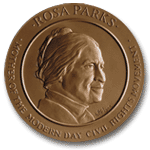
The Rosa Parks Congressional Gold Medal, bears the legend "Mother of the Modern
Day Civil Rights Movement."
<http://upload.wikimedia.org/wikipedia/commons/b/ba/Rosa_Parks_medal.gif>
The Rosa Parks Congressional Gold Medal, bears the legend "Mother of the Modern
Day Civil Rights Movement."
Rosa Parks with NAACP's highest award, the Springarn Medal, in 1979.
<http://upload.wikimedia.org/wikipedia/commons/thumb/c/ce/Rosa_Louise_McCauley_Parks_in_1979.jpg/180px-Rosa_Louise_McCauley_Parks_in_1979.jpg>

Enlarge
Rosa Parks with NAACP's highest award, the Springarn Medal, in 1979.

In 1979, the National Association for the Advancement of Colored People awarded
Parks the Spingarn Medal, its highest honor, and she received the Martin Luther
King Sr. Award the next year. She was inducted into the Michigan Women's Hall
of Fame in 1983 for her achievements in civil rights. However, given the
pivotal role she had played in the nation's history, she had received few
national accolades until very late in life. In 1990, she was called at the last
moment to be part of the group welcoming Nelson Mandela, who had just been
released from his imprisonment in South Africa. Upon spotting her in the
reception line, Mandela called out her name and, hugging her, said, "You
sustained me while I was in prison all those years."[17]
<http://en.wikipedia.org/wiki/Rosa_Parks#endnote_mandela>

Parks received the Rosa Parks Peace Prize in 1994 in Stockholm, Sweden,
followed by the Presidential Medal of Freedom, the highest honor given by the
U.S. executive branch, in 1996. President Bill Clinton presented the
Presidential Medal of Freedom to Rosa Parks on September 9, 1996. In 1998, she
became the first awardee for the International Freedom Conductor Award given by
the National Underground Railroad Freedom Center. The next year Parks was
awarded the Congressional Gold Medal, the highest award given by the U.S.
legislative branch. In 1999, she also received the Detroit-Windsor
International Freedom Festival Freedom Award. Also in 1999, she was a guest of
President Bill Clinton during his 1999 State of the Union Address and Time
magazine named Parks one of the top twenty most influential and iconic figures
of the twentieth century. [18]
<http://www.time.com/time/time100/heroes/profile/parks01.html>  In 2000, her
home state awarded her the Alabama Academy of Honor as well as the first
Governor's Medal of Honor for Extraordinary Courage. She was also awarded two
dozen honorary doctorates from universities worldwide and was made an honorary
member of Alpha Kappa Alpha sorority.

The Rosa Parks Library and Museum in Montgomery, Alabama, was dedicated to her
in November 2001. It is located on the corner where Parks boarded the famed
bus. The most popular item in the museum is a sculpture of Parks sitting on a
bus bench. The documentary "Mighty Times: The Legacy of Rosa Parks" received a
2002 nomination for Academy Award for Documentary Short Subject. That year she
also collaborated in a TV movie of her life starring Angela Bassett.

On October 27 and October 28, the Senate and House (respectively) voted to have
Rosa Parks lie in state, making her the first woman and only the second black
person ever to be accorded the honor.

On October 30 the President issued a Proclamation ordering that all flags on US
public areas be flown at half staff. The proclamation stated, "As a mark of
respect for the memory of Rosa Parks, I hereby order, by the authority vested
in me by the Constitution and laws of the United States of America, that on the
day of her interment, the flag of the United States shall be flown at
half-staff at the White House and upon all public buildings and grounds, at all
military posts and naval stations, and on all naval vessels of the Federal
Government in the District of Columbia and throughout the United States and its
Territories and possessions until sunset on such day. I also direct that the
flag shall be flown at half-staff for the same period at all United States
embassies, legations, consular offices, and other facilities abroad, including
all military facilities and naval vessels and stations."

[edit]


Notable quotes and citations about Rosa Parks

[edit]


Presidential Medal of Freedom Award Ceremony

Rosa Parks joins President Bill Clinton during a Congressional Black Caucus
dinner in Washington in 1996. Rosa Parks was presented the Presidential Medal
of Freedom at this event.
<http://upload.wikimedia.org/wikipedia/en/thumb/c/c6/Rosaparks_clinton.jpg/180px-Rosaparks_clinton.jpg>

Enlarge
Rosa Parks joins President Bill Clinton during a Congressional Black Caucus
dinner in Washington in 1996. Rosa Parks was presented the Presidential Medal
of Freedom at this event.

Excerpt of speech from President Bill Clinton, (September 9, 1996):

"When Rosa Parks refused to give up her seat to a white man on an Alabama bus
40 years ago, she ignited the single most significant social movement in
American history. When she sat down on the bus, she stood up for the American
ideals of equality and justice and demanded that the rest of us do the same.
When our descendants look back in time to trace the fight for freedom, Rosa
Parks will stand among our nation's greatest patriots, the legendary figures
whose courage sustained us and pushed us forward. She is, and continues to be,
a national treasure." [19]
<http://www.clintonfoundation.org/legacy/090996-speech-by-president-at-medal-of-freedom-awards-ceremony.htm>


Award citation: "On December 1, 1955, going home from work, Rosa Parks boarded
a city bus in Montgomery, Alabama, and with one modest act of defiance, changed
the course of history. By refusing to give up her seat, she sparked the
Montgomery bus boycott and helped launch the civil rights movement. In the
years since, she has remained committed to the cause of freedom, speaking out
against injustice here and abroad. Called the First Lady of Civil Rights, Rosa
Parks has demonstrated, in the words of Robert Kennedy, that each time a person
strikes out against injustice, she sends forth the tiny ripple of hope, which,
crossing millions of others, can sweep down the walls of oppression." [20]
<http://www.clintonfoundation.org/legacy/091496-speech-by-president-at-black-caucus-dinner.htm>


[edit]


Notes


*       ^  "Parks Recalls Bus Boycott, Excerpts from an interview with Lynn
Neary", NPR, 1992
*       ^  "Heros and Icons: Rosa Parks", Time.com, June 14, 1999
*       ^  "Civil rights icon Rosa Parks dies at 92", CNN.com, October 25, 2005
*       ^  "Browder v. Gayle: The Women Before Rosa Parks", Tolerance.org, 2005
*       ^  "Is Barbershop Right About Rosa Parks?", Slate, September 27, 2005
*       ^  "Rosa Parks, 92, Founding Symbol of Civil Rights Movement, Dies",
New York Times, October 25, 2005
*       ^  Audio interview of Parks linked to from "Civil Rights Icon Rosa
Parks Dies"
<http://www.npr.org/templates/story/story.php?storyId=4973548&sourceCode=gaw> ,
National Public Radio, 25 October 2005
*       ^  "Civil rights icon Rosa Parks dies at 92", CNN.com, October 25, 2005
*       ^  "Rosa Parks, 92, Founding Symbol of Civil Rights Movement, Dies",
New York Times, October 25, 2005
*       ^  "Assailant Recognized Rosa Parks", Detroit Free Press, September 3,
1994
*       ^  "Man Gets Prison Term For Attack on Rosa Parks", San Francisco
Chronicle, August 8, 1995
*       ^  "'I understand I am a symbol, but I have never gotten used to being
a public person'", Associated Press State & Local Wire, December 4, 2004
*       ^  "Medical records show Rosa Parks had dementia as early as 2002",
Associated Press State & Local Wire, January 13, 2005
*       ^  "Parks settles OutKast lawsuit", Detroit News, April 15, 2005
*       ^  "Tri-state Judge Says Rosa Parks' Work Goes On", WPCO News, 25
October 2005

[edit]


References


*       "Browder v. Gayle: The Women Before Rosa Parks" by Tim Walker,
Tolerance.org, retrieved October 27, 2005
*       "Heroes and Icons: Rosa Parks" by Rita Dove, Time.com, June 14, 1999,
retrieved October 29, 2005
*       "Civil rights icon Rosa Parks dies at 92" by CNN.com, October 25, 2005,
retrieved October 27, 2005
*       "Is Barbershop Right About Rosa Parks?" by Brendan I. Koerner, Slate,
September 27, 2005, retrieved October 27, 2005
*       "Rosa Parks, 92, Founding Symbol of Civil Rights Movement, Dies" by
E.R. Shipp, The New York Times, October 25, 2005, retrieved October 27, 2005
*       Editorial. 1974. "Two decades later." New York Times (May 17): 38.
("Within a year of Brown, Rosa Parks, a tired seamstress in Montgomery,
Alabama, was, like Homer Plessy sixty years earlier, arrested for her refusal
to move to the back of the bus."

[edit]


See also


*       Racism in the United States
*       Montgomery Bus Boycott

[edit]


External links

[edit]


Multimedia and interviews


*       Civil Rights Icon Rosa Parks Dies - National Public Radio
<http://www.npr.org/templates/story/story.php?storyId=4973548&sourceCode=gaw>
*       Civil Rights Pioneer Rosa Parks 1913-2005 - Democracy Now!
democracynow.org <http://www.democracynow.org/article.pl?sid=05/10/25/1412234>

[edit]


Official


*       The Rosa Parks Library and Museum at TSUM <http://www.tsum.edu/museum/>

*       The Rosa and Raymond Parks Institute for Self Development
<http://www.rosaparks.org>

[edit]


Other


*       Rosa Parks's Ancestry and Genealogy
<http://www.progenealogists.com/parks/aqwg01.htm>
*       Complete audio/video and newspaper archive of the Montgomery Bus
Boycott <http://www.montgomeryboycott.com>
*       Bruderhof Peacemakers Guide profile on Rosa Parks
<http://www.peacemakersguide.org/peace/Peacemakers/Rosa-Parks.htm>
*       The mug shot of Rosa Parks after she was arrested in Montgomery
<http://www.thesmokinggun.com/mugshots/rparksmug1.html>
*       Rosa Parks interview and photographs
<http://www.achievement.org/autodoc/page/par0int-1>
*       News of Parks' Death from Reuters
<http://today.reuters.com/news/NewsArticle.aspx?type=topNews&storyID=2005-10-25T025344Z_01_HO508630_RTRUKOC_0_US-PARKS.xml>

*       Rosa and Raymond Parks Marriage Profile
<http://marriage.about.com/od/historical/p/rosaparks.htm>

*       Is Barbershop right about Rosa Parks?
<http://www.slate.com/id/2071622/>
*       Rosa Parks
<http://www.twoop.com/people/archives/2005/10/rosa_parks.html>  - A timeline of
her life
*       Rosa Parks was not the beginning <http://www.alternet.org/story/27687/>
 - Alternet

Retrieved from "http://en.wikipedia.org/wiki/Rosa_Parks";

Categories: 1913 births | 2005 deaths | African Americans | Alabama history |
Civil rights activists | Congressional Gold Medal recipients | Methodists |
People from Alabama | Spingarn Medal winners | U.S. civil rights history |
Presidential Medal of Freedom recipients


Views


*       Article
*       Discussion
*       Edit this page
*       History


Personal tools


*       Create account / log in


Navigation


*       Main Page
*       Community Portal
*       Current events
*       Recent changes
*       Random article
*       Help
*       Contact us
*       Donations <http://wikimediafoundation.org/wiki/Fundraising>


Search


Toolbox


*       What links here
*       Related changes
*       Upload file
*       Special pages
*       Printable version
*       Permanent link


In other languages


*       العربية
<http://ar.wikipedia.org/wiki/%D8%B1%D9%88%D8%B2%D8%A7_%D8%A8%D8%A7%D8%B1%D9%83%D8%B3>

*       Català <http://ca.wikipedia.org/wiki/Rosa_Parks>
*       Česky <http://cs.wikipedia.org/wiki/Rosa_Parksov%C3%A1>
*       Dansk <http://da.wikipedia.org/wiki/Rosa_Parks>
*       Deutsch <http://de.wikipedia.org/wiki/Rosa_Parks>
*       Esperanto <http://eo.wikipedia.org/wiki/Rosa_PARKS>
*       Español <http://es.wikipedia.org/wiki/Rosa_Parks>
*       Suomi <http://fi.wikipedia.org/wiki/Rosa_Parks>
*       Français <http://fr.wikipedia.org/wiki/Rosa_Parks>
*       Gaeilge <http://ga.wikipedia.org/wiki/Rosa_Parks>
*       עברית
<http://he.wikipedia.org/wiki/%D7%A8%D7%95%D7%96%D7%94_%D7%A4%D7%90%D7%A8%D7%A7%D7%A1>

*       Italiano <http://it.wikipedia.org/wiki/Rosa_Parks>
*       日本語
<http://ja.wikipedia.org/wiki/%E3%83%AD%E3%83%BC%E3%82%B6%E3%83%BB%E3%83%91%E3%83%BC%E3%82%AF%E3%82%B9>

*       Lëtzebuergesch <http://lb.wikipedia.org/wiki/Rosa_Parks>
*       Limburgs <http://li.wikipedia.org/wiki/Rosa_Parks>
*       Македонски
<http://mk.wikipedia.org/wiki/%D0%A0%D0%BE%D0%B7%D0%B0_%D0%9F%D0%B0%D1%80%D0%BA%D1%81>

*       Plattdüütsch <http://nds.wikipedia.org/wiki/Rosa_Parks>
*       Nederlands <http://nl.wikipedia.org/wiki/Rosa_Parks>
*       Norsk (bokmål) <http://no.wikipedia.org/wiki/Rosa_Parks>
*       Polski <http://pl.wikipedia.org/wiki/Rosa_Parks>
*       Português <http://pt.wikipedia.org/wiki/Rosa_Parks>
*       Русский
<http://ru.wikipedia.org/wiki/%D0%9F%D0%B0%D1%80%D0%BA%D1%81%2C_%D0%A0%D0%BE%D0%B7%D0%B0_%D0%9B%D0%B8>

*       Slovenščina <http://sl.wikipedia.org/wiki/Rosa_Parks>
*       Svenska <http://sv.wikipedia.org/wiki/Rosa_Parks>
*       中文
<http://zh.wikipedia.org/wiki/%E7%BE%85%E8%96%A9%C2%B7%E5%B8%95%E5%85%8B%E6%96%AF>


MediaWiki <http://www.mediawiki.org/>
Wikimedia Foundation <http://wikimediafoundation.org/>

*       This page was last modified 17:20, 6 November 2005.
*       All text is available under the terms of the GNU Free Documentation
License (see Copyrights for details).
        Privacy policy <http://wikimediafoundation.org/wiki/Privacy_policy>
*       About Wikipedia
*       Disclaimers


_______________________________________________
Marxism-Thaxis mailing list
[email protected]
To change your options or unsubscribe go to:
http://lists.econ.utah.edu/mailman/listinfo/marxism-thaxis