August 15, 2017
Headlines:

  *   Nielsen to Credit Video Views on Facebook, Hulu and YouTube (Multichannel
News)
  *   vMVPD collecting more than double revenue per channel vs. traditional
pay-TV services, misleading study suggests (FierceCable)
  *   Pandora names Sling TV founding CEO Roger Lynch as new CEO and president
(The Verge)
  *   fuboTV Adds NBC Sports to TV Everywhere Slate (Broadcasting & Cable)
  *   Hulu supports live TV service with AWS (Rapid TV News)
  *   Snap stock went up more than 6 percent on the day employees were finally
able to sell their shares (Recode)
  *   Altice says it will reach 1M new homes with fiber by end of 2018
(FierceCable)
  *   The Amazon effect echoes across the industry (Digiday)
Complete stories below:
Nielsen to Credit Video Views on Facebook, Hulu and YouTube (Multichannel
News)<http://www.multichannel.com/news/advanced-advertising/nielsen-credit-video-views-facebook-hulu-and-youtube/414612>
Broadens scope of its Digital Content Ratings
By Jeff Baumgartner<http://www.multichannel.com/users/jbaumgartner>
Aug 15, 2017
Broadening its visibility into the world of digital video and OTT distribution,
Nielsen said it will begin crediting video content distributed on Facebook,
Hulu and YouTube.
That added capability, delivered via Nielsen’s Digital Content Ratings, will
enable TV and digital publisher clients to capture viewing of their content
within their reported audience numbers, Nielsen said, noting that this
“consistent and transparent view ensures a level playing field”  because it
provides access to the same information across both publishers and platforms.
While enabled publisher clients will be able to receive credit for video
offered on Facebook and YouTube in Nielsen’s Digital Content Ratings, Hulu will
be providing “select media partners” with credit for current series content
that it distributes, Nielsen said.
That expansion follows Nielsen’s announcement last month that “eligible TV
viewing” from YouTube TV and Hulu’s new live TV service would be included in
its Digital in TV Ratings
“The inclusion of video content distributed on Facebook, Hulu and YouTube in
Nielsen Digital Content Ratings is a major accomplishment and part of our
ongoing commitment to providing the industry with independent, comprehensive
measurement of the evolving consumer landscape,” Megan Clarken, president of
product leadership at Nielsen, said in a statement. “Through capturing this
audience, Nielsen is providing publishers, agencies and advertisers with a
better picture of today’s media consumption, with comparable metrics.”
“Much of our content is being missed by traditional measurement tools and
Nielsen’s Digital Content Ratings allow us to count content views and viewers
across our owned and operated properties as well as Facebook and YouTube,”
added Edwin Wong, VP of research and insight at BuzzFeed. “With this new tool
at our disposal we are able to have a clearer view of BuzzFeed's true reach.
Nielsen’s Digital Content Ratings are necessary for accurate audience
measurement in today’s digital universe.”
Several other digital media and ad agencies also lauded the move, including
Group Nine Media, Horizon Media, Magna Global, Mic, Tastemade, and Refinery29.
BACK TO TOP
# # #
vMVPD collecting more than double revenue per channel vs. traditional pay-TV
services, misleading study suggests
(FierceCable)<http://www.fiercecable.com/cable/vmvps-program-license-fees-more-than-double-traditional-pay-tv-study-says?utm_source=internal&utm_medium=rss>
by Daniel Frankel<http://www.fiercecable.com/author/daniel-frankel>
Aug 14, 2017 12:54pm
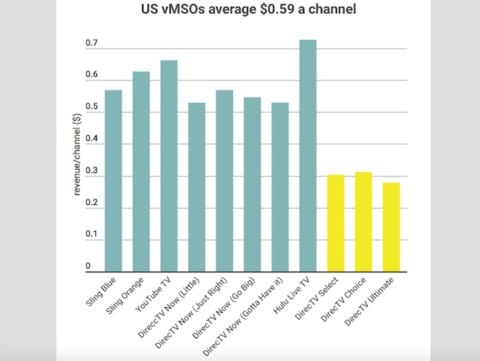
[http://qtxasset.com/styles/breakpoint_sm_default_480px_w/s3fs/FierceCable-1502729743/Ampere_Research_chart.png?vzl2cBjYNxzOwF8HS94pwFfShSa0Kqb.&itok=cSGNMLvm]
Linear pay-TV operators are collectively receiving 23 cents per channel per
user, while operators of virtual services are getting, on average, 59 cents for
every channel they sell to a subscriber each month.
Virtual pay-TV service operators are collecting more than twice as much revenue
per channel than what traditional cable, satellite and telco video platforms
are collecting, according to a study conducted by Ampere
Analysis<https://www.ampereanalysis.com/>.
According to the research, linear pay-TV operators are collectively receiving
23 cents per channel per user, while operators of virtual services are getting,
on average, 59 cents for every channel they sell to a subscriber each month.
DirecTV Now, Ampere said, is collecting 54.5 cents for every channel it streams
to a customer each month, while AT&T’s linear DirecTV Now “Ultimate” tier
yields only 27.8 cents per channel.
“For channels, then, the shift to streaming looks like a potentially strong
play,” Ampere said in its report.
Of course, it’s a lot more complicated than suggesting that a $35-a-month
DirecTV Now user is generating more revenue for programmers than the $75
Ultimate satellite customer.
We can probably start and end with the number of channels involved: The premium
satellite package has more than 245 versus just north of 60 for the base
DirecTV Now skinny bundle, meaning programmers are monetizing a lot more of
their networks. This may explain why NBCUniversal CEO Steve Burke took such a
lukewarm tone regarding vMVPDs during Comcast’s second-quarter earnings call
last month.
“So the over-the-top services that have been launched so far are doing about as
we expected they would do,” Burke said, according to a
transcript<https://seekingalpha.com/article/4091282-comcast-cmcsa-q2-2017-results-earnings-call-transcript?part=single>
 provided by Seeking Alpha.
“And they're not all that material to our business,” he added. “They've all
launched. They have subscribers. We have deals in place with all of them.
They're actually very favorable. So from an NBCUniversal point of view, if
someone goes to an over-the-top provider, it's actually slightly better. But
it's a very tough business. And as we've said before, we're skeptical that it's
going to be a very large business or profitable business for the people that
are in it. And they're off to a relatively slow start.”
BACK TO TOP
# # #
Pandora names Sling TV founding CEO Roger Lynch as new CEO and president (The
Verge)<https://www.theverge.com/2017/8/14/16145558/pandora-sling-tv-founding-ceo-roger-lynch-new-ceo-president>
Snap Inc. chairman Michael Lynton is also joining the Pandora board
by Dani Deahl<https://www.theverge.com/users/Dani%20Deahl>
Aug 14, 2017, 4:05pm EDT
Pandora has announced that Sling TV founding CEO Roger Lynch will join the
company as CEO and president, effective September 18th, 2017. Naveen Chopra,
who served as Pandora’s interim CEO following co-founder Tim Westergren’s
announcement that he was vacating all official
positions<https://www.theverge.com/2017/6/27/15879294/pandora-ceo-tim-westergren-steps-down>
 with the company, will continue as chief financial officer.
As the founding CEO of Dish Network-owned Sling TV, Lynch led the company to
become the leading on-demand over-the-top (OTT) service in the US Before Sling
TV, he held several executive positions with Dish Network, UK IPTV provider
Video Networks International, and Chello Broadband. Though Lynch does not have
executive experience within the music industry, he has a history of leading
companies successfully into new territories and is also a musician himself, as
the lead guitarist in classic rock and R&B band The Merger.
Lynch is taking over at a crucial time: Pandora is still fresh off a rebrand
and platform
overhaul<https://www.theverge.com/2017/3/13/14889122/pandora-premium-music-streaming-service-preview-interview>
 that has it focusing on how to continue converting free users into paying
Premium customers. The company closed the quarter with 4.86 million total paid
subscribers, 390,000 of which were Premium. Pandora’s monthly active users
stands at 76 million, a steady
decrease<https://www.statista.com/statistics/190989/active-users-of-music-streaming-service-pandora-since-2009/>
 since its peak of 81.5 million monthly active users in 2014.
Also joining the Pandora board is Michael Lynton, current chairman of Snap Inc.
Before Snap, Lynton ran Sony Pictures for over a decade, and his rich history
in film could be an indicator in Pandora’s video interest moving forward.
Pandora hasn't said much about its video plans since Westergren
told<https://www.theverge.com/2017/3/13/14889122/pandora-premium-music-streaming-service-preview-interview>
 The Verge that video was “on our list” back in March, but adding Lynton to the
board could mean the company is finally ready to expand into new areas which
could help boost Pandora's revenue in the long term.
BACK TO TOP
# # #

fuboTV Adds NBC Sports to TV Everywhere Slate (Broadcasting &
Cable)<http://www.broadcastingcable.com/news/platforms/fubotv-adds-nbc-sports-tv-everywhere-slate/167877>
Extends access to apps from Golf Channel, NBC Sports, NBCSN, the Olympics
Channel
By Jeff Baumgartner<http://www.broadcastingcable.com/users/jbaumgartner>
fuboTV<http://www.broadcastingcable.com/articles-taging/fubotv>, the
sports-oriented virtual MVPD, said it has added NBC
Sports<http://www.broadcastingcable.com/articles-taging/nbc-sports> to its mix
of authenticated TV Everywhere content.
Using their credentials, fuboTV subs can now access TVE apps from Golf Channel,
NBC Sports, NBCSN and the Olympics Channel.  That TVE access complements live
streaming on fuboTV’s various platforms, including web browsers, iOS and
Android mobile devices, Roku players, Apple TV, Fire TV and Android TV devices,
as well as Google Chromecast streaming adapters.
fuboTV announced its carriage deal with NBCU late last
year<http://www.broadcastingcable.com/news/currency/fubotv-expands-fox-nbcu-agreements/161788>
 and is applying that agreement toward its flagship tier, Fubo Premier, which
is being sold for the discounted, introductory price of $34.99 per month (that
price will eventually  rise to $49.99 per month).
BACK TO TOP
# # #
Hulu supports live TV service with AWS (Rapid TV
News)<https://www.rapidtvnews.com/2017081548421/hulu-supports-live-tv-service-with-aws.html#axzz4ppdHtfnf>
Hulu has selected Amazon Web Services (AWS) as its cloud provider, supporting
the launch its over-the-top (OTT) live TV service.

By Michelle Clancy
August 15, 2017
The company turned to the global cloud provider to support the addition of more
than 50 live channels for the Hulu with Live TV launch in May 2017.

“Hulu is redefining the television experience for viewers and we have set the
technical bar much higher by bringing live TV into the mix,” said Rafael
Soltanovich, vice president of software development at Hulu.

“We selected AWS as our cloud provider because of its leading breadth and depth
of capabilities. The elasticity, agility, and security they provide were key to
deploying our new service. Putting our stream ingest, repackaging, DVR storage,
and origin serving on
AWS<https://www.rapidtvnews.com/2017071147959/multimedios-taps-aws-elemental-for-online-video-support.html#axzz4po3SlNIo>
 freed us from having to build out data centres and led to a faster time to
market with higher availability.”

“Leaders in media and entertainment like Hulu are looking for more efficient
ways to build scalable streaming and OTT solutions,” added Mike Clayville, vice
president of Worldwide Commercial Sales at AWS. “AWS’s unmatched scalability
and reliability allow Hulu<http://www.hulu.com/> to continue to innovate and
break new ground – like delivering live TV alongside their extensive on-demand
programming – without having to spend millions of dollars and thousands of
person hours building and managing data centres.”

BACK TO TOP
# # #
Snap stock went up more than 6 percent on the day employees were finally able
to sell their shares
(Recode)<https://www.recode.net/2017/8/14/16123776/snap-stock-employee-lockup-trading-volume-increase>
BY KURT WAGNER<https://www.recode.net/authors/kurt-wagner> AND RANI
MOLLA<https://www.recode.net/authors/rani-molla>
AUG 14, 2017
Snap employees were able to sell their stock Monday for the first time since
the company went
public<https://www.recode.net/2017/7/17/15975132/snap-stock-lock-up-employees-sell-earnings>
 back in early March. Despite fears of a mass sell-off, Snap stock had a solid
day (along with the rest of the market).
Snap stock jumped more than 6 percent on Monday after a tough second-quarter
earnings
report<https://www.recode.net/2017/8/10/16120580/live-blogging-snap-snapchat-evan-spiegel-q2-earnings-wall-street>
 last week sent the stock to a new all-time low.
The employee lockup looked like it played a part in Monday’s trading, which was
the fourth biggest trading day by volume since Snap went public. Over 84
million shares changed hands. The next biggest trading day followed Snap’s
disappointing first earnings report in May, and the two biggest trading days
took place right when Snap went public on March 2 and March 3.
Early stock holders and insiders have only recently been able to sell their
shares. The first part of a post-IPO lockup expired late last
month<https://www.recode.net/2017/7/31/16072832/snap-stock-lockup-expire-earnings>
 when early investors and former employees were free to sell; the stock fell
just 1 percent that day.
Current employees, who were in a blackout period because of Snap’s looming
earnings report, were only able to sell starting Monday once that additional
restriction was lifted.
One likely reason why Snap stock didn’t tank despite its employees finally
having the chance to cash out: The stock is near an all-time low, and no one
wants to sell at the bottom.
Snap stock closed on Monday more than 48 percent below the $24.48 price it
closed at on its first day of trading.
BACK TO TOP
# # #
Altice says it will reach 1M new homes with fiber by end of 2018
(FierceCable)<http://www.fiercecable.com/cable/altice-says-it-will-reach-1m-new-homes-fiber-by-end-2018?utm_source=internal&utm_medium=rss>
by Daniel Frankel<http://www.fiercecable.com/author/daniel-frankel>
Aug 14, 2017
Altice USA announced today that it’s on pace to deploy fiber to 1 million newly
constructed homes in New York, New Jersey and Connecticut by the end of 2018.
Design and construction of “several hundred thousand” new homes with Altice
FTTH services has already begun, the company added.
“We are incredibly pleased with the progress we are making on our fiber
investment and look forward to lighting up this new, advanced network to enable
innovative products and services to support our customers’ connectivity needs
well into the future,” said Dexter Goei, chief executive officer for Altice’s
North American operation, in a statement. Goei appeared Friday at one of the
Long Island construction sites, along with Altice NV founder Patrick Drahi.
Altice has pledged to deploy FTTH gigabit-speed services across its Optimum
footprint—as well as into some Suddenlink homes and businesses—by 2021,
eschewing the standard DOCSIS 3.1 upgrade protocol.
Altice, however, continues to use DOCSIS technologies to expand gigabit-speed
services in its acquired Suddenlink terrain. Altice said it has now deployed
such services in 60% of that footprint, including areas of Missouri, Arkansas
and Oklahoma.
In Optimum’s Northeast footprint, meanwhile, Altice is now offering broadband
speeds of up to 400 Mbps for residential customers and 450 Mbps for business
subscribers.
BACK TO TOP
# # #
The Amazon effect echoes across the industry
(Digiday)<https://digiday.com/marketing/amazon-effect-echoes-across-industry/>
by Ilyse Liffreing<https://digiday.com/author/ilysedigiday-com/>
AUGUST 15, 2017
If there’s a word that’s echoing through the media and marketing industry these
days, it’s Amazon.
The e-commerce giant, which has made moves everywhere from content, to
advertising, to all sides of the retail coin, is top of mind for most brands.
Amazon was mentioned in over 100 company quarterly earnings calls in the past
90 days, from McDonald’s and Ralph Lauren to CVS and Disney, according to
Seeking Alpha data<https://seekingalpha.com/article/4098508-amazons-impact>.
Investors want to know how companies are working with the increasing power of
the e-commerce giant. The discussion spans categories from retail and real
estate brands to video giants.
Here’s where Amazon’s effect is most keenly being felt.
Brick-and-mortar retail
The rise of Amazon has caused an increase in online shoppers as
brick-and-mortar stores close. So far, 16 real estate companies, concentrating
on everything from retail to senior housing, were questioned about their
strategies to compete with Amazon, according to Seeking Alpha.
David E. Simon, CEO and chairman of Simon Property Group, which owns malls in
37 U.S. states and Puerto Rico, was asked whether a mall chain could be bought
out by Amazon as easily as Whole Foods. “Well, I have a lot of interesting
thoughts on it,” he said, “but I will provide none of them on the record. I
will tell you it’s not a very fun environment. We’re working extra hard. We’re
pounding the pavement more than ever. … We’ll use the best judgment we can. And
hopefully, we make the right decision, some of which we do a lot of times. But
sometimes, we make the wrong decisions.”
Overall, Simon said he isn’t prepared to say the environment will get easier;
however, there is room for optimism. One way the company could compete with
impending closures, said Simon, is to work out more short-term deals with
tenants. The growing number of entrepreneurs also gives hope to malls. “Lots of
people want to start up a business,” said Simon. “We’re seeing an explosion in
the food area. We’ve obviously seen explosion in the fitness and wellness area,
cosmetic area.”
In the retail space, one topic that continued to come up in earnings calls is
Amazon’s recent acquisition of Whole Foods. Most retailers have been comforted
by the news. For instance, Regency Centers Corporation, which owns several
shopping centers, believes the fact that Amazon is investing so much in
physical locations proves the impact of brick-and-mortar stores to the
consumer. “Amazon’s announced purchase of Whole Foods reinforces our conviction
that a well-located bricks-and-mortar presence that is convenient to the
customer is a critical component to the success of any omnichannel platform,”
said Hap Stein, chairman and CEO of Regency Centers Corporation.
Content and video
Amazon’s development of original video content has rivaled Netflix. Disney has
responded by opting out of its partnership with Netflix and launching its own
streaming service. Bob Iger, CEO of The Walt Disney Company, said it’s “an
entirely new growth strategy for the company, one that takes advantage of the
opportunities the changing media and technology industries provide us to
leverage the strength of our great brands.”
Delivery
Even if they don’t directly compete with it, Amazon has changed the game for
many brands when it comes to what customers expect. The growth of same-day
delivery options means other companies feel the pressure to follow suit. That’s
why brands like Rent the Runway have begun altering logistics structures to
start testing same-day delivery in Manhattan, for now. McDonald’s feels the
same way. CEO Steve Easterbrook said Amazon “demonstrates how disruptive the
business world is and how quickly it moves. And we continually challenge
ourselves to be our own internal activists.” He pointed to the chain’s launch
of delivery options as a way to answer that challenge.
Pharmaceutical brands
Amazon seems as though it’s about to enter the health care
market<https://www.cnbc.com/2017/08/11/how-goldman-sachs-sees-amazon-jumping-into-health-care.html>,
 recently testing its Echo device in hospitals and creating a secret team of
health-technology experts. Naturally, investors want to know whether health
care companies are viewing Amazon as a competitor or potential customer.
Express Scripts, Cardinal Health, CVS Health and Walgreens were all asked about
the e-commerce giant in their quarterly earnings calls.
Last week, CVS Health CEO Larry Merlo acknowledged the pressure, but insisted
that CVS could contend with Amazon if it was to enter the space. “There’s no
question that Amazon is a competitor in the marketplace,” he said. “They’ve
done a great job, and you don’t take anything they’re doing for granted. But at
the same time, I think we have a lot of capabilities and a value proposition
that can compete effectively in the market.”
On the other hand, Walgreens CEO Stefano Pessina said the chain wouldn’t turn
down a partnership with Amazon if it came to it. “We wouldn’t exclude to
analyze the new situation of the market,” said Pessina, “and to find our place
adapting ourselves.” Express Scripts, too, sees Amazon as a possible client.
CEO Timothy Wentworth was asked last week if Express Scripts would be willing
to reimburse Amazon for delivering drugs to homes. Wentworth expressed his
enthusiasm for a partnership with the e-commerce giant. “If Amazon were looking
to become an efficient provider in networks, we would welcome that
opportunity,” he said. “We think Amazon is a great client for us. We think they
are a company that if they choose to move in a direction, we’d be interested in
working with them.”
BACK TO TOP
_______________________________________________
Medianews mailing list
[email protected]
http://etskywarn.net/mailman/listinfo/medianews_etskywarn.net