According to
https://math.stackexchange.com/questions/1123312/theory-of-definitions,
(referencing the same book as the question you mentioned) these properties are
required by all definitions, and there are also some criteria listed and
explained for a certain type of definition. Maybe this is a lead in the right
direction?
I wonder how useful the ability to use aliases instead of axiomatic definitions
is in detecting those properties as well, but given that I invented aliases
myself and haven't seen them in any textbook, I don't know of anyone who
studied this and, if so, how they called it.


________________________________
Von: [email protected] <[email protected]> im Auftrag von
Marshall Stoner <[email protected]>
Gesendet: Donnerstag, 13. Juli 2023 01:16:34
An: Metamath
Betreff: Re: [Metamath] Uncomfortable with definitions as axioms ... help?


Thanks.  I got it.  I'm rusty with LaTex and forgot about redefinition
commands.  It was late when I looked so I gave up when I got errors.

It is what I thought it was.  I have proved line 8 of 4.2 in a different way
from other results.  I wrote it as...
⊢ eq( φ  ,φ ) where I define eq( phi , psi ) ≔ ¬ ( ( φ → ψ ) → ¬ ( ψ → φ ) ).

I also have " ⊢ eq( φ , ψ ) →  ( φ → ψ ) ",  " ⊢ eq( φ , ψ ) → ( ψ → φ ) ",
and " ⊢ ( φ → ψ ) → ( ( ψ → φ ) →  eq( φ , ψ ) ) " written up with proofs.

I realize eq( φ , ψ ) is exactly the same as φ ↔ ψ in the practical sense, but
without alias capability, metamath needs to use eq( φ ↔ ψ , eq( φ , ψ ) )
instead since the literal '↔' can only be used with later definitions.

I really should have started a new topic as I confused everyone by reviving an
old discussion with a different question as OP.  I was more interested in how
to formally state and prove the generalized case where I can show any
definition with certain criteria satisfies the precise definition of being
eliminable and non-creative/conservative as in...

https://math.stackexchange.com/questions/1298909/is-criterion-of-eliminability-and-criterion-of-non-creativity-independent

A rigorous proof shouldn't be hard for purely propositional statements, but
predicate logic is much more tricky with free variable clashes and certain
definitions that require auxiliary existence and uniqueness theorems as
justification in order to satisfy the eliminability and non-creativity
properties.

Maybe someone could point me in the direction of a formal 1st order logic text
that covers these topics.  I have a textbook, but this particular topic is not
covered.  I will possibly buy another text but want to make sure all topics I'm
interested in are covered first.  I was just thinking maybe I could dig
something up online in the meantime.

Thanks.
On Wednesday, July 12, 2023 at 10:11:15 AM UTC-4 [email protected]
wrote:
"I couldn't convert them to something I could actually read like latex or
unicode"

The proof format is meant to allow readability by both machines (easy and
flexible when able to code) and humans (in a text editor without word wrapping).

Apart from some missing spaces, these formulas are in LaTeX format, and reasons
are nicely indented for text editors.
You could simply use
 \def\not{\lnot}
 \def\equiv{\leftrightarrow}
 \def\imply{\rightarrow}
 \def\phi{\varphi}
in the .tex file and insert spaces when [a-zA-Z] rather than [0-9] follows a
command via regex-search-and-replace. More seach-and-replace can put it into
any desired LaTeX commands.

If you have issues reading LaTeX-formatted formulas, you can also use search
and replace to convert it to unicode, e.g. replace all "\imply" by "→", all
"\phi" by "φ", and so on.

I used my own converter on my example, which makes some explicit information
(like substitutions and referenced line numbers - useful for programs)
implicit, but makes it even easier to read as a human. I am sending the
resulting .tex file.
Here is what it looks like when parsed: https://i.imgur.com/a31LACW.png

Hope this helps.


________________________________
Von: [email protected] <[email protected]> im Auftrag von
Marshall Stoner <[email protected]>
Gesendet: Mittwoch, 12. Juli 2023 10:01:41

An: Metamath
Betreff: Re: [Metamath] Uncomfortable with definitions as axioms ... help?
Sorry I didn't have time to read the proof you shared.  I couldn't read it
easily and wasn't sure if it completely answered what I really wanted since I
want to show that definitions satisfy the precise meaning of eliminability and
non-creativity.  Maybe the proofs help but I couldn't convert them to something
I could actually read like latex or unicode.  Sorry, reading that format just
hurts my eyes.

https://math.stackexchange.com/questions/1298909/is-criterion-of-eliminability-and-criterion-of-non-creativity-independent

There seems to be some steps missing because nothing inside the formal language
can alone prove a metalogical fact.  It's a meta-theorem like the deduction
theorem that seems intuitively trivial still needs some kind of inductive proof.

On Wednesday, July 12, 2023 at 12:13:34 AM UTC-4 [email protected]
wrote:

"The problem is an alias rule can still fail if the syntax of the definition
doesn't meet certain criteria. [...]"

Maybe I should've been clearer about the syntax definition. In my theory, one
can skip a lot of parentheses since I considered left first bracketing, which I
explained prior to that definition. Metamath however enforces formulas of a
style with fixed parentheses and would thereby deny any input where formulas
omit or introduce those.


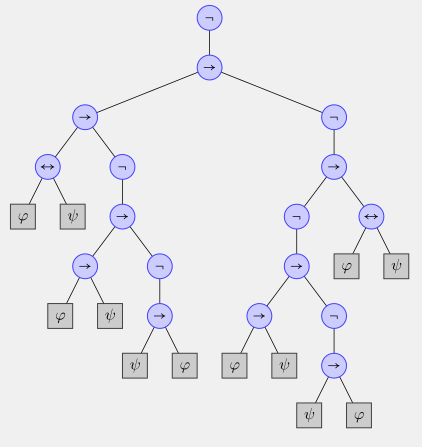
Formulas are actually tree structures, for example the theorem of df-bi has the
following syntax tree:


[https://groups.google.com/group/metamath/attach/4a092de0fb4da/pastedImage.png?part=0.1&view=1]


You could put parentheses around formulas in infinitely many correct ways,
while not changing the identity of the formula. That has nothing to do with
intuition, but is well-defined based on bracketing order, as well as order of
order of precedence for operators (but in this case, all binary operators share
the same priority, and it doesn't matter for nullary and unary operators).

Parentheses in logic work just the same as in all kinds of mathematical
formulas, they merely prescribe order of operation. Some kind of solvers (such
as Metamath) rule this out for efficiency or ease of implementation, but that
is a technical detail that is rather disruptive and inelegant in a theoretical
context.


All the alias replacement rules are well defined, regardless of which
parentheses were used. If the parentheses change in the way that the identity
of the formula (here: the order of operations) changes, the corresponding rules
simply do not apply anymore.


My solution was merely meant to answer your questions on how df-bi can be
justified via a rigorous proof from Metamath's propositional axioms. I have no
better understanding in how Metamath's "definition checker" works than
definitions being treated merely as axioms, as has been confirmed by multiple
people in this thread.

Additionally, I understand that these definitions are well-justified, which is
also pointed out, for example, in the description of df-bi ( see
https://us.metamath.org/mpeuni/df-bi.html ).

I have provided you with a proof for that.


________________________________
Von: [email protected] <[email protected]> im Auftrag von
Marshall Stoner <[email protected]>
Gesendet: Mittwoch, 12. Juli 2023 04:35:51

An: Metamath
Betreff: Re: [Metamath] Uncomfortable with definitions as axioms ... help?
I trust that intuitively that these definitions are valid.  The problem is an
alias rule can still fail if the syntax of the definition doesn't meet certain
criteria.  If the parenthesis surrounding ↔ were missing in the definition of
the biconditional, for instance.  If I could understand how the definition
checker for the set.mm<http://set.mm> database works I would have a better
understanding.  I have my own hypothesis, but I'm not sure if it's fully
sufficient.

My hypothesis would as follows...

Let  LS⁺ᴰ is the set of all WFFs in the system with new definition D and LS is
the set of all WFFs in the system before adding the new definition.  Then let F
≔ { Ψ ⇒ Φ } be the substitution rule replacing the definiendum Ψ with the
definiens Φ.

Now the first criteria should be that for any member of LS⁺ᴰ, a member of LS
should result after applying F a finite number of times.

The second criteria is that if we call the process of applying F a finite
number of times to obtain a member of LS, F*, then F* should be a function.
I.e. the result should be unique.  If in any case the result depends on the
order application (ambiguous nesting of the definiendum or clashing with other
symbols), then the definition is going to be creative.

But are these two criteria alone enough?
On Monday, July 10, 2023 at 12:48:41 PM UTC-4 [email protected] wrote:

I was also disturbed by the issue of definitions being extra axioms according
to Metamath, and solved it via interpreting only 'not' and 'imply' as part of
the propositional core language, and all the other junctors as different ways
to express something in terms of 'not' and 'imply' (which is also done in
https://us.metamath.org/mmsolitaire/pmproofs.txt when proving statements which
contain different junctors, see "Result of Proof" lines which differ from their
theorems).

The concept to build only on what is essentially required leads to much slimmer
definitions that make use of a logical system (e.g. when defining semantics).


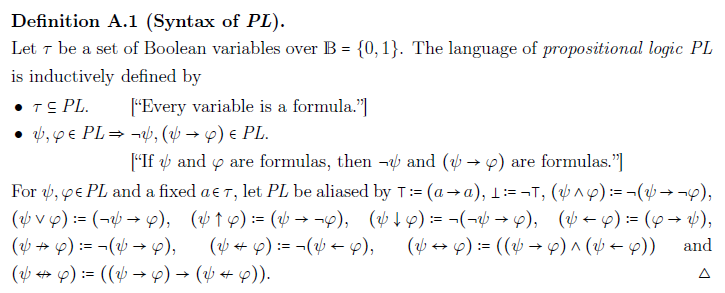
Here is one of my exemplary syntax definitions:

[https://groups.google.com/group/metamath/attach/e80e7ac07742/pastedImage.png?part=0.1&view=1]


Alias step verifications can be done by converting both formulas into the core
language and checking for equality.

Based on


(A1) ⊢\psi\imply(\phi\imply\psi)

(A2) ⊢\psi\imply(\phi\imply\chi)\imply((\psi\imply\phi)\imply(\psi\imply\chi))
(A3) ⊢\not\phi\imply\not\psi\imply(\psi\imply\phi)
(MP) {\psi,\psi\imply\phi}⊢\phi


I gave the below proof of df-bi. Most of it proves that a formula is equivalent
to itself, from where a single alias step leads to df-bi.
Since df-bi, under the previous alias definitions, equals
(\phi\equiv\psi)\equiv(\phi\equiv\psi).

a2i:
1. \phi\imply(\psi\imply\chi)
premise
2. \phi\imply(\psi\imply\chi)\imply(\phi\imply\psi\imply(\phi\imply\chi))  (A2)
; 〈\phi, \psi〉, 〈\psi, \phi〉
3. \phi\imply\psi\imply(\phi\imply\chi)
(MP):1,2

mms-H6:
1. \not1\imply\not2\imply(2\imply1)
                        (A3) ; 〈\phi, 1〉, 〈\psi, 2〉
2.
\not1\imply\not2\imply(2\imply1)\imply(0\imply(\not1\imply\not2\imply(2\imply1)))
                    (A1) ; 〈\phi, 0〉, 〈\psi, \not1\imply\not2\imply(2\imply1)〉
3. 0\imply(\not1\imply\not2\imply(2\imply1))
                        (MP):1,2
4.
0\imply(\not1\imply\not2\imply(2\imply1))\imply(0\imply(\not1\imply\not2)\imply(0\imply(2\imply1)))
  (A2) ; 〈\chi, 2\imply1〉, 〈\phi, \not1\imply\not2〉, 〈\psi, 0〉
5. 0\imply(\not1\imply\not2)\imply(0\imply(2\imply1))
                        (MP):3,4

mms-T13:
1. \not\not0\imply(1\imply\not\not0)
                                         (A1) ; 〈\phi, 1〉, 〈\psi, \not\not0〉
2. \not\not0\imply(\not\not(1\imply\not\not0)\imply\not\not0)
                                         (A1) ; 〈\phi,
\not\not(1\imply\not\not0)〉, 〈\psi, \not\not0〉
3.
\not\not0\imply(\not\not(1\imply\not\not0)\imply\not\not0)\imply(\not\not0\imply(\not0\imply\not(1\imply\not\not0)))
  (mms-H6) ; 5 ; 〈0, \not\not0〉, 〈1, \not(1\imply\not\not0)〉, 〈2, \not0〉
4. \not\not0\imply(\not0\imply\not(1\imply\not\not0))
                                         (MP):2,3
5.
\not\not0\imply(\not0\imply\not(1\imply\not\not0))\imply(\not\not0\imply(1\imply\not\not0\imply0))
                    (mms-H6) ; 5 ; 〈0, \not\not0〉, 〈1, 0〉, 〈2, 1\imply\not\not0〉
6. \not\not0\imply(1\imply\not\not0\imply0)
                                         (MP):4,5
7.
\not\not0\imply(1\imply\not\not0\imply0)\imply(\not\not0\imply(1\imply\not\not0)\imply(\not\not0\imply0))
             (A2) ; 〈\chi, 0〉, 〈\phi, 1\imply\not\not0〉, 〈\psi, \not\not0〉
8. \not\not0\imply(1\imply\not\not0)\imply(\not\not0\imply0)
                                         (MP):6,7
9. \not\not0\imply0
                                         (MP):1,8

mpd:
1. \phi\imply\psi                        premise
2. \phi\imply(\psi\imply\chi)            premise
3. \phi\imply\psi\imply(\phi\imply\chi)  (a2i):2 ; 3
4. \phi\imply\chi                        (MP):1,3

id:
1. \phi\imply(\phi\imply\phi)            (A1) ; 〈\psi, \phi〉
2. \phi\imply(\phi\imply\phi\imply\phi)  (A1) ; 〈\phi, \phi\imply\phi〉, 〈\psi,
\phi〉
3. \phi\imply\phi                        (mpd):1,2 ; 4 ; 〈\chi, \phi〉, 〈\psi,
\phi\imply\phi〉

mms-T35:
1. \not\not(0\imply1)\imply(0\imply1)
                         (mms-T13) ; 9 ; 〈0, 0\imply1〉
2.
\not\not(0\imply1)\imply(0\imply1)\imply(\not\not(0\imply1)\imply0\imply(\not\not(0\imply1)\imply1))
  (A2) ; 〈\chi, 1〉, 〈\phi, 0〉, 〈\psi, \not\not(0\imply1)〉
3. \not\not(0\imply1)\imply0\imply(\not\not(0\imply1)\imply1)
                         (MP):1,2

mms-*4.2:
1. P\implyP
                                             (id) ; 3 ; 〈\phi, P〉
2. P\implyP\imply(\not\not(P\implyP\imply\not(P\implyP))\imply(P\implyP))
                                             (A1) ; 〈\phi,
\not\not(P\implyP\imply\not(P\implyP))〉, 〈\psi, P\implyP〉
3. \not\not(P\implyP\imply\not(P\implyP))\imply(P\implyP)
                                             (MP):1,2
4.
\not\not(P\implyP\imply\not(P\implyP))\imply(P\implyP)\imply(\not\not(P\implyP\imply\not(P\implyP))\imply\not(P\implyP))
  (mms-T35) ; 3 ; 〈0, P\implyP〉, 〈1, \not(P\implyP)〉
5. \not\not(P\implyP\imply\not(P\implyP))\imply\not(P\implyP)
                                             (MP):3,4
6.
\not\not(P\implyP\imply\not(P\implyP))\imply\not(P\implyP)\imply(P\implyP\imply\not(P\implyP\imply\not(P\implyP)))
        (A3) ; 〈\phi, \not(P\implyP\imply\not(P\implyP))〉, 〈\psi, P\implyP〉
7. P\implyP\imply\not(P\implyP\imply\not(P\implyP))
                                             (MP):5,6
8. \not(P\implyP\imply\not(P\implyP))
                                             (MP):1,7
9. P\equivP
                                             alias:8

df-bi:
1. \phi\equiv\psi\equiv(\phi\equiv\psi)

     (mms-*4.2) ; 9 ; 〈P, \phi\equiv\psi〉
2.
\not(((\phi\equiv\psi)\imply\not((\phi\imply\psi)\imply\not(\psi\imply\phi)))\imply\not(\not((\phi\imply\psi)\imply\not(\psi\imply\phi))\imply(\phi\equiv\psi)))
  alias:1

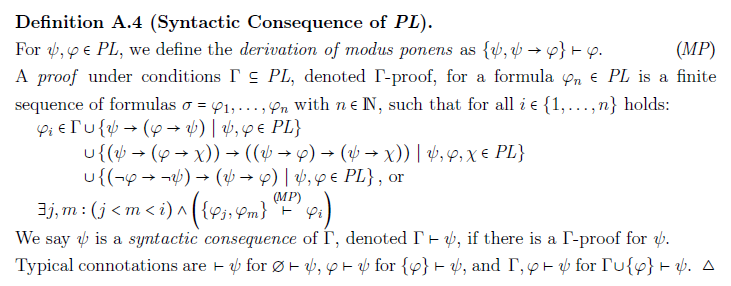
Here is a way to define these formal proofs:
[https://groups.google.com/group/metamath/attach/e80e7ac07742/pastedImage.png?part=0.2&view=1]

Reasons and alias steps are technically not even part of a formal proof, but
they should in practice be provided for clarity.
Depending on the alias step, one might even prefer several sub-steps because it
can be a little too much for our sluggish minds to process.
However, the theory is nice and clean this way, which I think was the focus
here.


________________________________
Von: [email protected] <[email protected]> im Auftrag von
Marshall Stoner <[email protected]>
Gesendet: Samstag, 8. Juli 2023 23:40:22
An: Metamath
Betreff: Re: [Metamath] Uncomfortable with definitions as axioms ... help?

New link.

paper<https://1drv.ms/b/s!AuvNPSOQfN3xjK1_IfOJ7LIT5Pl3NQ?e=5Ou22H>

On Saturday, July 8, 2023 at 5:22:17 PM UTC-4 Marshall Stoner wrote:
I'm currently working on a "textbook-like" introduction to the system used in
set.mm<http://set.mm>.  I'm currently thinking about how I should provide a
proof justifying the definition of  '↔'.

I write the abbreviation eq(𝜑, 𝜓)  ≔  ¬ ((𝜑 → 𝜓) → ¬ (𝜓 → 𝜑)).  Then the
definition is just the expansion of eq((𝜑 ↔ 𝜓), eq(𝜑, 𝜓)).  The elimination
rule becomes (𝜑 ↔ 𝜓)  ≔  eq(𝜑, 𝜓).  Applying the elimination rule to the
definition you get eq(eq(𝜑, 𝜓), eq(𝜑, 𝜓)) which can be proved as a theorem
without any reference to the symbol '↔'.  Any theorem containing '↔' must have
a proof tree that can be traced backwards to a statement of the definition
itself.  You replace (𝜑 ↔ 𝜓) with eq(𝜑, 𝜓) in the definition, you have a proved
a theorem.  You then replace it everywhere else you see it, tracing the same
steps forward as you traced backwards.  Every line along along the way should
still be justified since  eq(𝜑, 𝜓) is a WFF that is self-contained.

Anyways, I'm still working on the exact wording to make this "meta-argument"
absolutely 100% clear to myself and anyone else.  Writing out a formal
induction meta-proof in the way the standard deduction theorem is typically
proved feels a bit cumbersome to me, but I don't want to just handwave anything
away either.  I feel like I should maybe provide an example showing how the
elimination rule would work on a WFF containing nested  '↔'.  The elimination
rule has to be applied recursively until the symbol is gone.

paper<https://1drv.ms/b/s!AuvNPSOQfN3xjK1-DmOLCnCMd9hDrQ?e=5expKV>
On Wednesday, December 21, 2022 at 7:57:14 PM UTC-5 [email protected] wrote:
On Wed, Dec 21, 2022 at 7:12 PM Samuel Goto <[email protected]> wrote:
Hey all,

   As I'm looking into metamath there is something lingering that is making me
uncomfortable: definitions are axioms.

   This is obviously intended and by design by the community (the book has a
whole chapter about it), but I'm still uncomfortable with the justifications
and consequences.

You are right to be concerned. I was also concerned several years ago, and the
solution I came up with was to observe that definitions in
set.mm<http://set.mm> follow a very regular structure, such that all
definitions with that structure can be given a metatheoretic argument for
conservative extension. So I added a "definition checker" module to mmj2, which
checks the rules described in the "Additional rules for definitions" section of
https://us.metamath.org/mpeuni/conventions.html . This program is run as part
of the set.mm<http://set.mm> CI, so we can be sure that (with a small list of
exceptions) every df-* axiom is actually conservative over the ZFC axioms.

    A few irrational feelings I think I'm having:

    - I can't parse or understand df-bi trivially. What does it mean?

df-bi is one of the exceptions, because the first rule is that a definition has
to have <-> or = as the root symbol and this doesn't work when we are defining
<-> itself. That doesn't mean that the definition is not conservative, only
that it can't be automatically checked. The way to read df-bi is that it is
defining (𝜑 ↔ 𝜓) to be ¬ ((𝜑 → 𝜓) → ¬ (𝜓 → 𝜑)) (that is dfbi1), except that the
root ↔ in the definition is itself expanded according to this expression. The
justification that this is a conservative extension is that if you replace all
instances of (𝜑 ↔ 𝜓) with ¬ ((𝜑 → 𝜓) → ¬ (𝜓 → 𝜑)) in df-bi, you get bijust,
which is provable without df-bi. So you can perform that replacement in any
derivation to eliminate the defined symbol.

    - How do I know that the axioms of the definitions aren't introducing
contradictions?

As I mentioned, we can reduce the problem to a small list of exceptions like
df-bi, plus the definition schema given by the definition checker's rules. The
schema can be proved by a direct substitution argument like the one I just gave
for df-bi, except that to handle bound variables we also need to have the
ability to perform alpha-renaming, such as in _V = { x | x = x }, which you can
use to prove the theorem { x |  x = x } = { y | y = y }, so we need to know
that this was already provable before (this is vjust). The ability to perform
alpha renaming in any formula is a metatheorem of set.mm<http://set.mm>'s axiom
system.

    - It seems that definitions aren't supposed to "extend the language", but I
don't get that sentiment as I read them

I'm not sure I would say that. Definitions definitely are intended to extend
the language, but a conservative extension means that no statements expressible
in the original language become provable as a result of the introduction of the
definition. (In particular, if |- F. was not provable before, it is still not
provable, so the extension is sound.)

    - We say "all you need is propositional and first order logic and set
theory axioms" but then proceed to introduce a bunch by definitions

Yes, I tend to agree with this sentiment. It's not *really* true that you don't
need definitions. You don't need them *in principle*, but if you don't like
exponentially long proofs (which can make a qualitative difference if you have
ultrafinitist tendencies and don't trust proofs that cannot be checked on any
computer present or future) then you are more or less forced to accept them.

    I'm sure this can't be a new sentiment, since an entire chapter in the book
was dedicated to it, but I was wondering if:

    (a) Does anyone have some explanation posted online that I could read to
inform myself and perhaps settle my anxiety?
    (b) Is there a version of metamath and/or set.mm<http://set.mm> that don't
rely on definitions as axioms?

For the reasons I stated above, a set.mm<http://set.mm> without definitions
would not be remotely usable. And metamath doesn't really support definitions
in any other way.

Even with the definition checker, the situation was still somewhat problematic
to me, since the definition checker is now essentially a part of the "trusted
code base" of metamath (unless you want to personally review all of those
thousand definitions-as-axioms in set.mm<http://set.mm>) and yet it is not a
required part of metamath verifier operation, and it has only one
implementation, which moreover is tailored to set.mm<http://set.mm> notions. So
I tried to make a version of metamath that includes definitions as part of the
kernel, and the result is Metamath Zero (https://github.com/digama0/mm0). It
unfortunately complicates several things to take definitions as primitive
because you need to have a notion of bound variable to handle examples like
df-v, as well as a conversion judgment to handle definition unfolding without
having to also bake in an equality operator (since not all metamath databases
have one, or only have one for some sorts and not others). You can read about
MM0 in https://arxiv.org/abs/1910.10703 .

Another Metamath variant which adds definitions as a primitive part of the
language is GHilbert by Raph Levien, although this diverges a bit more from
metamath and is closer to lambda calculus / LF in terms of its primitive
operators.

--
You received this message because you are subscribed to the Google Groups
"Metamath" group.
To unsubscribe from this group and stop receiving emails from it, send an email
to [email protected].
To view this discussion on the web visit
https://groups.google.com/d/msgid/metamath/a3d5056d-9e16-4678-af16-1a91431bbffcn%40googlegroups.com<https://groups.google.com/d/msgid/metamath/a3d5056d-9e16-4678-af16-1a91431bbffcn%40googlegroups.com?utm_medium=email&utm_source=footer>.

--
You received this message because you are subscribed to the Google Groups
"Metamath" group.
To unsubscribe from this group and stop receiving emails from it, send an email
to [email protected].
To view this discussion on the web visit
https://groups.google.com/d/msgid/metamath/583ce4fe-d4de-46a5-9a61-1922d45ecfden%40googlegroups.com<https://groups.google.com/d/msgid/metamath/583ce4fe-d4de-46a5-9a61-1922d45ecfden%40googlegroups.com?utm_medium=email&utm_source=footer>.

--
You received this message because you are subscribed to the Google Groups
"Metamath" group.
To unsubscribe from this group and stop receiving emails from it, send an email
to [email protected].
To view this discussion on the web visit
https://groups.google.com/d/msgid/metamath/b3c24569-83ef-4b88-89a5-77e4f1a12bb0n%40googlegroups.com<https://groups.google.com/d/msgid/metamath/b3c24569-83ef-4b88-89a5-77e4f1a12bb0n%40googlegroups.com?utm_medium=email&utm_source=footer>.

--
You received this message because you are subscribed to the Google Groups
"Metamath" group.
To unsubscribe from this group and stop receiving emails from it, send an email
to
[email protected]<mailto:[email protected]>.
To view this discussion on the web visit
https://groups.google.com/d/msgid/metamath/bf2cd422-3cfb-43aa-ba06-03b8462ccb29n%40googlegroups.com<https://groups.google.com/d/msgid/metamath/bf2cd422-3cfb-43aa-ba06-03b8462ccb29n%40googlegroups.com?utm_medium=email&utm_source=footer>.

--
You received this message because you are subscribed to the Google Groups
"Metamath" group.
To unsubscribe from this group and stop receiving emails from it, send an email
to [email protected].
To view this discussion on the web visit
https://groups.google.com/d/msgid/metamath/4b580d9e20504e509697f51a5659b0ea%40rwth-aachen.de.