Howard, Gary, and others:

Let me throw some numbers at you for your comment.
First, assume there is no friction or other losses. :{)

Assume the blade of that 15 ft. oar is 3 ft long.  The distance from the handle
end to the center of the blade is then 13 and 1/2 ft.

Assume the distance from the handle to the oarlock is 3 ft.

The distance from the oarlock to the center of the blade is then 10 and 1/2 ft.

If you apply 10 pounds of pressure to the oar handle, you only transfer 2.9
pounds of force to the water.  That is, 10 pounds multiplied by the ratio of 3
over 10 and 1/2.

If you could locate the oarlock at the midpoint of the 13 and ½ ft. distance,
then 10 pounds of force would be transferred to the water for every 10 pounds
you pull.  So an arm would have to extend roughly 4 ft. from each side to
support the oarlock.  By doing this, you have multiplied your rowing effort by
a factor of 3.5.  If you could row for 1 mile before, now you can row for 3.5
miles with the same effort.

There is an additional benefit as well by reducing the arc.  By my quick
calculations, if you swing an oar through a 90 degre arc, only 63% of your
effort goes into propelling the boat forward.  The reminder goes to pushing
water away from the boat at the beginning of the stroke, and pushing water
toward the boat at the end of the stroke.  If you could reduce the arc to 60
degrees, your propulsion fraction increases to 70%.  For 40 degrees of arc it
is 80%.  I think with oarlocks on the coaming you would have roughly a 90
degree arc if you do “full extension” rowing.  By moving the oarlock to the mid
point it is closer to 30 degrees.

By combining both factors, you would go from rowing one mile to about 4.5 miles
with the same effort.

I have run these numbers by non-sailors and they agree with this analysis.
What do you guys think?

steve

Steve R.
M-15 #119
Lexington, KY


*************************************************************

I thought the way Bob put those oarlocks on was pretty neat. Have
wondered how well it worked to row the boat. I've also heard of guys
fitting oar locks into the top of sheet winches, which are about the
right location, but that leaves the oar height somewhat high.

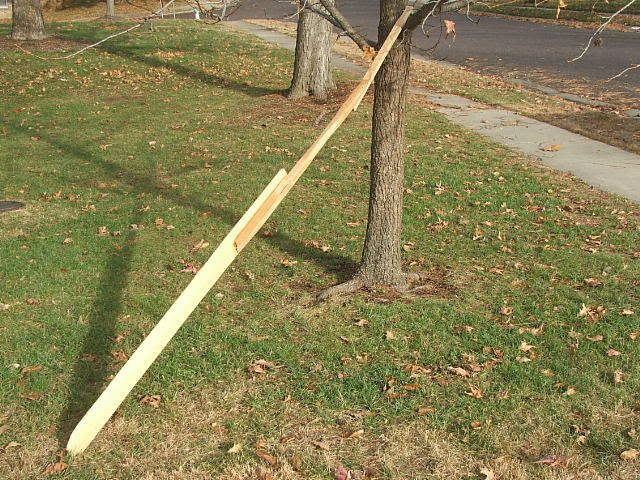
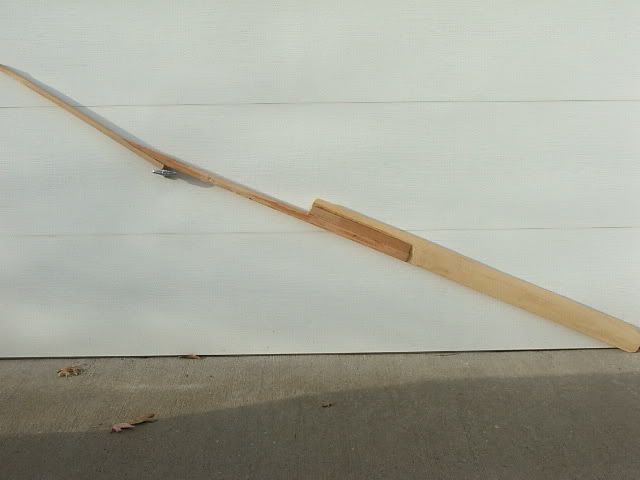
On the Japanese sculling oar, I've built one of those too. First attempt
was a crude one to see how well it worked. Initial attempt on the
Spindrift was disappointing as it didn't want to rotate in the oarlock,
so I went back and modified it some. Didn't have a chance to try it
again and it's gotten pretty cold now for boating. I think it might
work, but so would the other one.

http://i112.photobucket.com/albums/n165/haudsley/Picture260.jpg

http://i112.photobucket.com/albums/n165/haudsley/Picture262.jpg

http://i112.photobucket.com/albums/n165/haudsley/Picture263.jpg

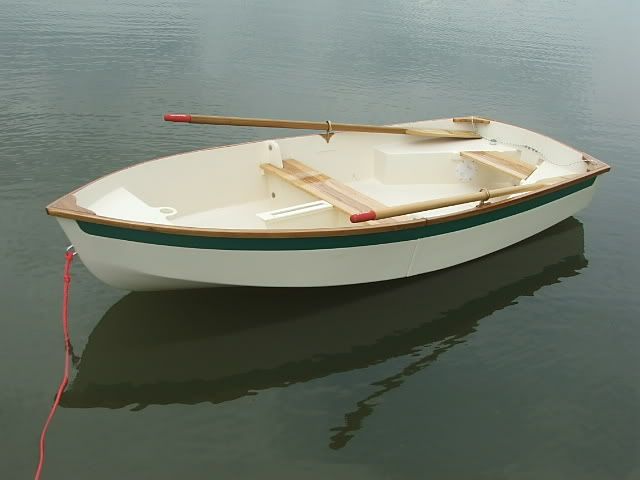
The Spindrift gets rowed or sailed. The oars on it do pretty well and
1.5 to 2 knots is pretty easy to get. You can cover a lot of ground
doing 2 knots. This was just playing around on it. I view the rowing
option on the Montgomery as a third, emergency form of propulsion.
Something I know will work when there is no wind and the motor won't
start.

*****************************************************

Rowing the M17: Check out the Strawanza photos at the following link.
Bob Eeg mounted oarlocks on the toe rail track and used 12-foot break-
down oars.
http://www.MSOGPhotoSite.com/mpage.htm

I'm playing around with the idea of a Japanese sculling oar design,
called a "Ro", ironically. It places the blade vertically at rest
rather than horizontally and may be more efficient.
The following web site discusses that design with video.
http://www.amateurboatbuilding.com/articles/howto/sculling_oar/

--Gary Hyde
2005 M17 sailboat #637 'Hydeaway 2'
We can't change the wind, but we can trim our sails.


On Dec 2, 2007, at 8:41 AM, Steve R. wrote:

> Hi Harry,
>
> Welcome to the group.
>
> You raise some interesting points for an off season discussion.
>
> I have been pondering a post I read here (I think) recently about
> the difficulty of using a single oar as an Oriental yuloh.  I
> believe the geometry is wrong for efficient use of oars with our
> small boats.  Our boats have a narrow beam, short cockpit and high
> freeboard.  If you place an oarlock on the top of the coaming or
> transom, you have poor leverage for seated rowing or use of a yuloh
> (yulohing?).  Some people stand up, which increases the angle of
> the blade in the water, and improves the leverage situation by
> allowing use of a shorter oar.  I would be comfortable standing in
> calm water, but not in extreme conditions.
>
> So…if I HAD to use an oar I would think about installing oar
> ports.  The ports would be located about waist high along the sides
> if I wanted to row or in the transom for a yuloh.  Bolger has used
> oar ports as did the Dovekie.  In extreme weather the ports could
> also function as cockpit scuppers or be closed off if necessary.
> Ports would also have the advantage of allowing the use of shorter
> oars.
>
> Or..I would consider using some sort of an arm that would locate
> the oar lock several feet outboard.  The leverage situation would
> be improved, although longer oars would be needed.  Modern racing
> shells often have oar locks mounted outboard.
>
> And..I would give a lot of thought to a sliding seat with a
> pivoting brace for the feet.
>
> steve
>
> Steve R.
> M-15 #119
> Lexington, KY
>
> ************************************************
>
> Greetings from N. shore of L. Superior: -15F,snow& wind last couple of
> nights but at least my M15 is safely tucked away in its dome shelter!
> Bob Eeg's tale of the specially equipped M17 that he constructed
> for the
> Austrian man was fascinating and raised a couple of questions about
> the
> M15: (1) Has anyone tried rowing one, and if so how was it? and (2)
> What
> were the worst conditions a M15 has survived intact (wind, waves) with
> all sails down and only motor power? Pardon me if these questions have
> been asked before- I joined just last year. If they have please
> point me
> in the right direction and I'll check it out. Thanks and safe
> sailing to
> the lucky souls in the south.     Harry Elmslie
>
> _______________________________________________
> http://mailman.xmission.com/cgi-bin/mailman/listinfo/montgomery_boats
_______________________________________________
http://mailman.xmission.com/cgi-bin/mailman/listinfo/montgomery_boats