This is an automated email from the ASF dual-hosted git repository.

sylviasu pushed a commit to branch master
in repository https://gitbox.apache.org/repos/asf/apisix-website.git
The following commit(s) were added to refs/heads/master by this push:
new 0d3abb9d9da docs: update blog "Why would you choose Apache APISIX
instead of Nginx or Kong" (#1314)
0d3abb9d9da is described below
commit 0d3abb9d9da7d4a45827a37adbecd45cece306f9
Author: 琚致远 <[email protected]>
AuthorDate: Tue Sep 13 08:52:44 2022 +0800
docs: update blog "Why would you choose Apache APISIX instead of Nginx or
Kong" (#1314)
* docs: update blog
* Update blog/en/blog/2021/06/28/why-we-need-Apache-APISIX.md
Co-authored-by: Sylvia <[email protected]>
Co-authored-by: Sylvia <[email protected]>
---
.../blog/2021/06/28/why-we-need-Apache-APISIX.md | 86 +++++++++++-----------
1 file changed, 42 insertions(+), 44 deletions(-)
diff --git a/blog/en/blog/2021/06/28/why-we-need-Apache-APISIX.md
b/blog/en/blog/2021/06/28/why-we-need-Apache-APISIX.md
index 53e5f9ab686..40995d97012 100644
--- a/blog/en/blog/2021/06/28/why-we-need-Apache-APISIX.md
+++ b/blog/en/blog/2021/06/28/why-we-need-Apache-APISIX.md
@@ -1,5 +1,5 @@
---
-title: Why do you need Apache APISIX when you have NGINX and Kong?
+title: Why would you choose Apache APISIX instead of NGINX or Kong?
slug: 2021/06/28/why-we-need-apache-apisix
author: Yuansheng Wang
authorURL: "https://github.com/membphis";
@@ -7,103 +7,101 @@ authorImageURL:
"https://avatars.githubusercontent.com/u/6814606?v=4";
keywords:
- APISIX
- Kong
-- Nginx
+- NGINX
- API Gateway
- Open Source
- API Management
-description: This article describes the history of the open source API Gateway
Apache APISIX architecture's evolution and compares the advantages of the two
frameworks, Apache APISIX and Nginx.
+description: Many companies used to use NGINX or Kong as their API gateway but
switched to Apache APISIX now. As an Open Source API Gateway, Apache APISIX
solves a lot of pain points for businesses.
tags: [Ecosystem]
---
-> This article describes the history of the open source API Gateway Apache
APISIX architecture's evolution and compares the advantages of the two
frameworks, Apache APISIX and Nginx.
+> This article describes the history of the open source API Gateway Apache
APISIX architecture's evolution and compares the advantages of the two
frameworks, Apache APISIX and NGINX.
<!--truncate-->
-In the cloud-native era, dynamic capability and observability have become the
standards for measuring API gateways. Apache APISIX has been following in the
footsteps of cloud-native since its inception. However, as a new-generation API
gateway that was born just three years ago, why can Apache APISIX stand out
from NGINX, which has been born for more than 20 years, and Kong, which has
been open source for 8 years, and become the most popular and active gateway in
the cloud-native era? Th [...]
+API gateway is an important infrastructure component in the cloud-native era.
There are two common criteria to evaluate an API gateway: how dynamic it is,
and how mature its observability is. Many companies used to use NGINX or Kong
as their API gateway, but then later switched to Apache APISIX. As an API
gateway born for the cloud-native era, Apache APISIX indeed solves a lot of
pain points for businesses in various dimensions. Now you might wonder, why?
-## NGINX and Kong's Disadvantages
+## NGINX and Kong's Limitations
-In the era of monolithic services, NGINX can handle most scenarios, but in the
cloud-native era, NGINX has two problems due to its architecture:
+In the era of monolithic services, NGINX can handle most scenarios. While in
the cloud-native era, NGINX has two shortcomings due to its architecture:
-- First, NGINX does not support cluster management. Almost every Internet
manufacturer has its own NGINX configuration management system, and there is no
unified solution.
-- The second is that NGINX does not support hot reloading of configurations.
If a company modifies the configuration of NGINX, it can take more than half an
hour to reload NGINX. And under the Kubernetes system, the upstream will change
frequently. If NGINX is used, the service needs to be restarted frequently,
which is unacceptable for enterprises.
+- NGINX does not support cluster management. Almost every company has its own
NGINX configuration management system. Although the systems are similar, there
is no unified solution.
+- NGINX does not support hot reloading of configurations. If the user modifies
the configuration of NGINX, it will be necessary to reload NGINX. Also, in
Kubernetes, the services will change frequently. So if NGINX is used to handle
the traffic, you must restart the service often, which is unacceptable for
enterprises.
-The emergence of Kong solves the shortcomings of NGINX, but brings new
problems:
+Kong solves the shortcomings of NGINX but brings new limitations:
-- Kong needs to rely on PostgreSQL or Cassandra database, which makes Kong's
entire architecture very bloated and will bring a high availability problem to
the enterprise. If the database fails, the entire API Gateway fails.
-- Kong's routing uses traversal lookup. When there are more than a thousand
routes in the gateway, its performance will drop dramatically.
+- Kong needs to rely on a PostgreSQL or Cassandra database, which makes Kong's
entire architecture very bloated and would bring a high availability limitation
to the enterprise. If the database fails, the whole API Gateway fails.
+- Kong's routing uses traversal search. When there are more than a thousand
routes in the gateway, its performance will dramatically drop.
-The emergence of APISIX solves all the above problems and becomes the most
perfect API gateway in the cloud-native era. So what exactly are the advantages
of Apache APISIX? Why can it become the most active API gateway in the world in
just three years?
+The APISIX resolves all the above limitations and becomes the best API gateway
in the cloud-native era.
## Advantages of Apache APISIX
-### Excellent architecture
+### Well designed architecture
-First, Apache APISIX has excellent architecture, and many applications are now
migrating to microservices and containerization, forming a new cloud-native
era. Cloud-native, as the current technology trend, will rewrite the technical
architecture of traditional enterprises. And APISIX has followed the technology
trend since its inception and designed it as cloud-native architecture:
+First, Apache APISIX has an excellent architecture. Cloud-native, as the
current technology trend, will change the technical architecture of traditional
enterprises. Many applications are migrating to microservices and
containerization. APISIX has followed the technology trend since its inception:
-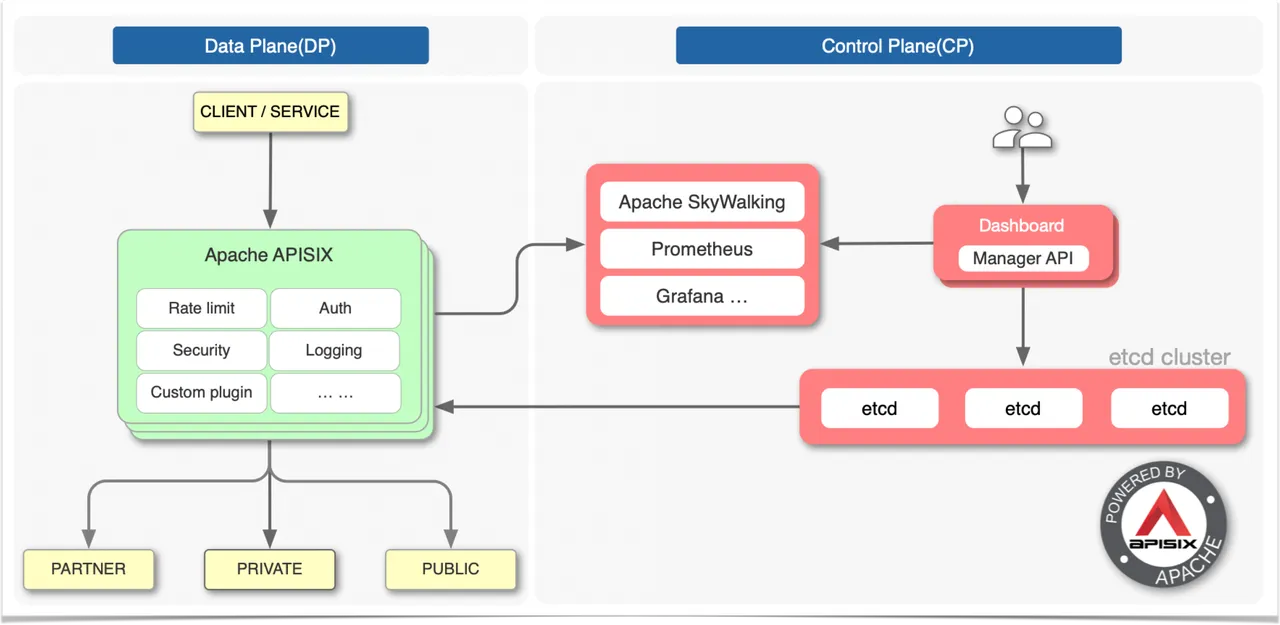
+
As shown in the figure above, the left and right are the Data Plane and the
Control Plane of APISIX:
-- Data Plane: Based on NGINX's network library (without using NGINX's route
matching, static configuration, and C modules), use Lua and NGINX to
dynamically control request traffic;
-- Control Plane: use etcd to store and synchronize gateway configuration data,
administrators can notify all data plane nodes in milliseconds through Admin
API or Dashboard.
+- Data Plane: Based on NGINX's network library (without using NGINX's route
matching, static configuration, and C modules), it uses Lua and NGINX to
dynamically control request traffic;
+- Control Plane: Administrators can operate etcd through the built-in RESTful
API. With the help of the etcd's Watch mechanism, APISIX can synchronize the
configuration to each node within milliseconds.
-When updating data, Kong uses the polling method of the database, but it may
take 5-10 seconds to obtain the latest configuration; while APISIX uses the
method of monitoring etcd configuration changes, which can control the time in
milliseconds.
+For updating data, Kong uses the database polling method; it may take 5-10
seconds to get the latest configuration, while APISIX achieves the same by
monitoring etcd configuration changes, which can control the time in
milliseconds.
-Since both APISIX and etcd support multi-point deployment, in the current
architecture of APISIX, any unexpected downtime of any service will not affect
the ability of APISIX to provide services accurately.
+Since both APISIX and etcd support multi-instance deployment, there is no
single point of failure.
-### Perfect ecosystem
+### Rich ecosystem
-The following figure shows the ecological map of APISIX. From this figure, we
can accurately see that the L7 protocols that APISIX already supports include
HTTP(S), HTTP2, Dubbo and IoT protocol MQTT, etc. The L4 protocol includes
TCP/UDP.
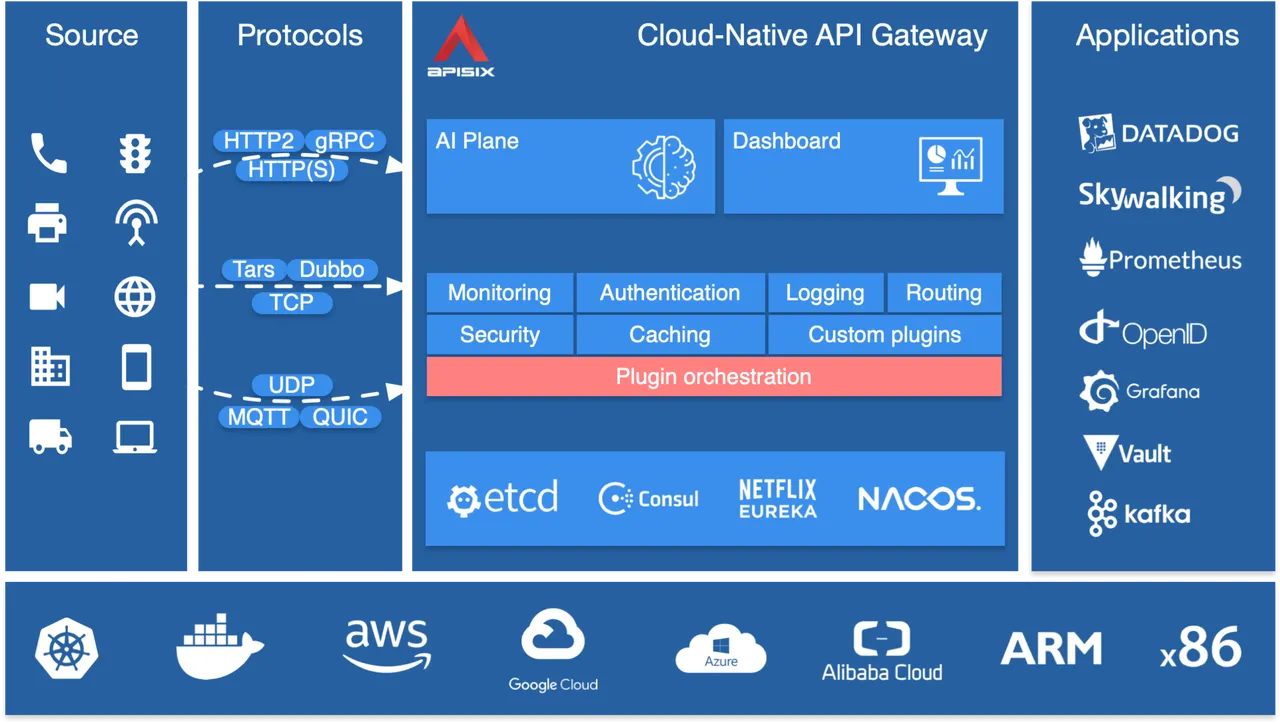
+The following figure shows the ecosystem map of APISIX. From this figure, we
can see that APISIX supports L7 protocols including HTTP(S), HTTP2, Dubbo, IoT
protocol MQTT, etc. In addition, APISIX supports L4 protocols such as TCP/UDP.
-The right part is some open source or SaaS services, such as SkyWalking,
Prometheus, Vault, etc. At the bottom are the more common operating system
environments, cloud vendors, and hardware environments. As open source
software, APISIX also supports running on ARM64 servers.
+The right part of the figure contains some open-source or SaaS services, such
as Apache SkyWalking, Prometheus, HashiCorp Vault, etc. At the bottom of the
figure are the more common operating system environments, cloud vendors, and
hardware environments. As an open-source software, APISIX can also be run on
ARM64 servers.
-
+
-APISIX not only supports many protocols and operating systems, but also
supports multi-language programming plug-ins. When it first came out, APISIX
only supported the use of the Lua language to write plug-ins. In this case,
developers need to master the technology stack related to Lua and NGINX.
However, Lua and NGINX are relatively niche technologies with few developers.
Therefore, we have supported multi-language development plug-ins on APISIX, and
have officially supported languages [...]
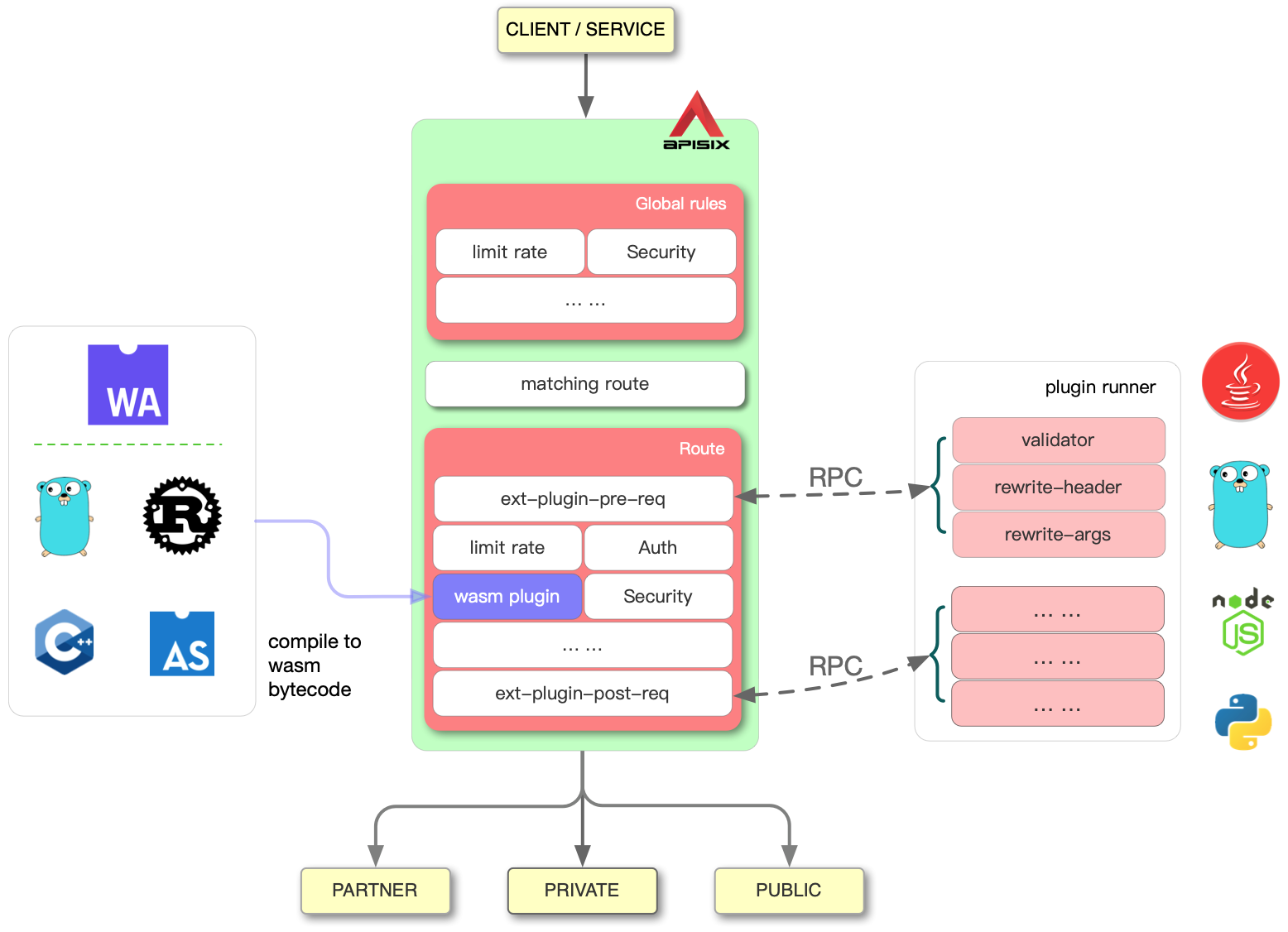
+APISIX supports not only many protocols and operating systems but also
supports [multi-language programming plugins](https://apisix.apache.org/docs/).
When it first came out, APISIX only supported using the Lua language to write
plugins. In this case, developers need to master the technology stack related
to Lua and NGINX. However, Lua and NGINX are relatively niche technologies
familiar to few developers. Therefore, we have then enabled plugin development
on APISIX with multiple languag [...]
-
+
### Active community
-The figure below is the contributor growth curve, where the horizontal axis
represents the timeline and the vertical axis represents the total number of
contributors. We can see that the two projects, Apache APISIX and Kong, are
relatively more active. Apache APISIX has maintained a very good growth rate
from the first day, and is growing rapidly at a rate close to twice that of
Kong, and the number of contributors has exceeded Kong, which shows the
popularity of APISIX. Of course, there [...]
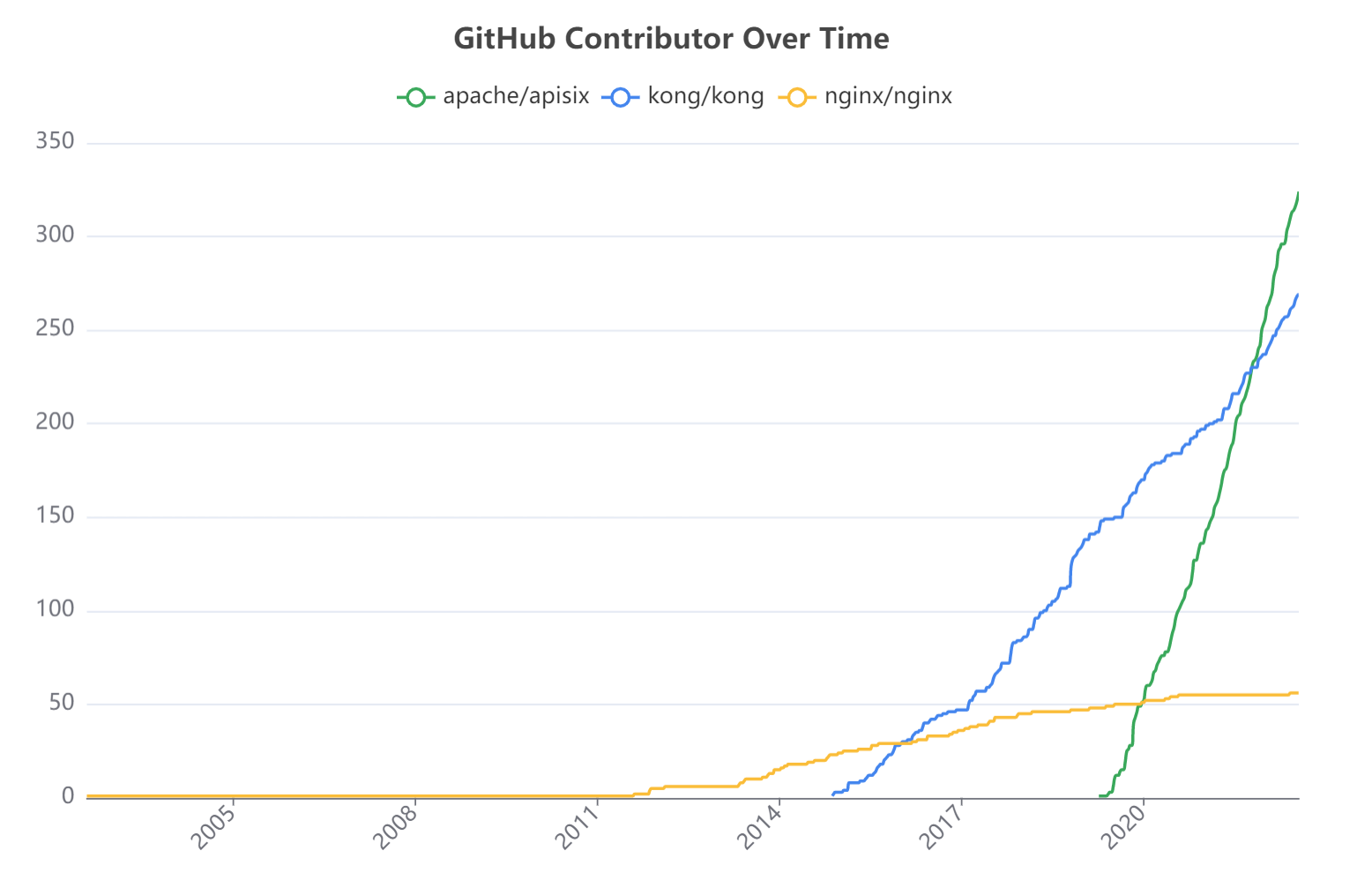
+The figure below is the contributor growth curve, where the horizontal axis
represents the timeline, and the vertical axis represents the total number of
contributors. We can see that the two projects, Apache APISIX and Kong, are
relatively more active. Apache APISIX has maintained an excellent growth rate
from the first day and is growing rapidly at a rate close to twice that of
Kong. As of July 2022, the number of contributors to APISIX has exceeded Kong,
which shows the popularity of [...]
-
+
-## APISIX Application Scenario
+## Unified proxy infrastructure
-From the figure below, I believe you have already seen the goal of APISIX:
**unified proxy infrastructure**.
+From the figure below, I believe you have already understood the goal of
APISIX: unifying the proxy infrastructure.
-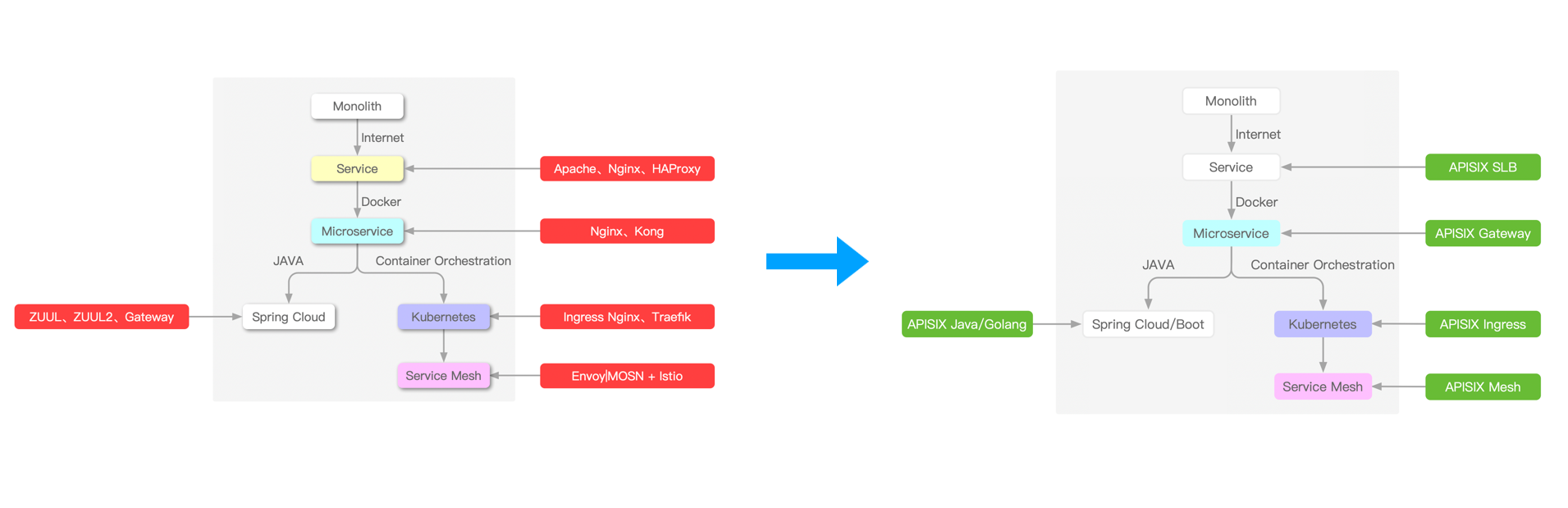
+
-You may have questions: APISIX has to support so many scenarios, will APISIX
become different?
+Because the core of APISIX is a high-performance proxy service, it does not
bind any environment properties. Therefore, when it evolves into products such
as Ingress and Service Mesh, you don't have to change the internal structure of
APISIX. The following will introduce to you step-by-step how APISIX supports
these scenarios.
-Because the core of APISIX is a high-performance proxy service, it does not
bind any environment properties. When it evolves into products such as Ingress,
service mesh, etc., all external services cooperate with APISIX, and it is the
external program that changes rather than APISIX itself. The following will
introduce to you step-by-step how APISIX supports these scenarios.
+### Load balance and API gateway
-### Load Balancer and API Gateway
-
-The first is for traditional LB and API gateway scenarios. Because APISIX is
implemented based on NGINX + LuaJIT, it has features such as high performance
and security, and also supports dynamic SSL certificate offloading, SSL
handshake optimization and other functions. In terms of load balancing service
capabilities, it also performs better. Switching from NGINX to APISIX will not
degrade performance, but also enjoy the improved management efficiency brought
about by features such as dy [...]
+The first is for traditional LB and API gateway scenarios. Because APISIX is
implemented based on NGINX + LuaJIT, it has high-performance and security
features, and supports the dynamically loading of an SSL certificate, SSL
handshake optimization, and other functions. In terms of load balancing, APISIX
also performs better. Switching from NGINX to APISIX will not degrade
performance but rather improve management efficiency brought about by features
such as unified management.
### Microservice Gateway
-APISIX currently supports the writing of extension plug-ins in multiple
languages, which can solve the main problems faced by east-west microservice
API gateways - heterogeneous multi-language and general problems. The built-in
supported service registries include Nacos, etcd, Eureka, etc., as well as the
standard DNS method, which can smoothly replace the microservice API gateways
such as Zuul, Spring Cloud Gateway, and Dubbo.
+APISIX allows you to write extension plugins in multiple languages, which can
solve the main problem faced by east-west microservice API gateways - how to
manage in a unified way in heterogeneous environments. APISIX also supports
service discovery like Nacos, etcd and Eureka, and standard DNS methods, which
can completely replace microservice API gateways such as Zuul, Spring Cloud
Gateway, and Dubbo.
### Kubernetes Ingress
-At present, the official Kubernetes Ingress Controller project of K8s is
mainly based on the NGINX configuration file method, so it is slightly
insufficient in routing capability and loading mode and has some obvious
disadvantages. For example, when adding or modifying any API, you need to
restart the service to complete the update of the new NGINX configuration, but
the restart of the service has a great impact on the online traffic.
+Currently, the official Kubernetes Ingress Controller project of K8s is mainly
developed based on the NGINX configuration file, so it is slightly insufficient
in routing capability and loading mode and has some obvious limitations. For
example, when adding or modifying any API, you need to restart the service to
complete the update of the new NGINX configuration. Restarting the service has
a great impact on online traffic.
-The [APISIX Ingress
Controller](https://apisix.apache.org/zh/docs/ingress-controller/getting-started/)
perfectly solves all the problems mentioned above: it supports full dynamics
and does not need to restart loading. At the same time, it inherits all the
advantages of APISIX and also supports native Kubernetes CRD, which is
convenient for users to migrate.
+The [APISIX Ingress
Controller](https://apisix.apache.org/docs/ingress-controller/getting-started/)
perfectly resolves all the limitations mentioned above: it supports fully hot
reloading. At the same time, it inherits all the advantages of APISIX and also
supports native Kubernetes CRD, which is convenient for users to migrate.
-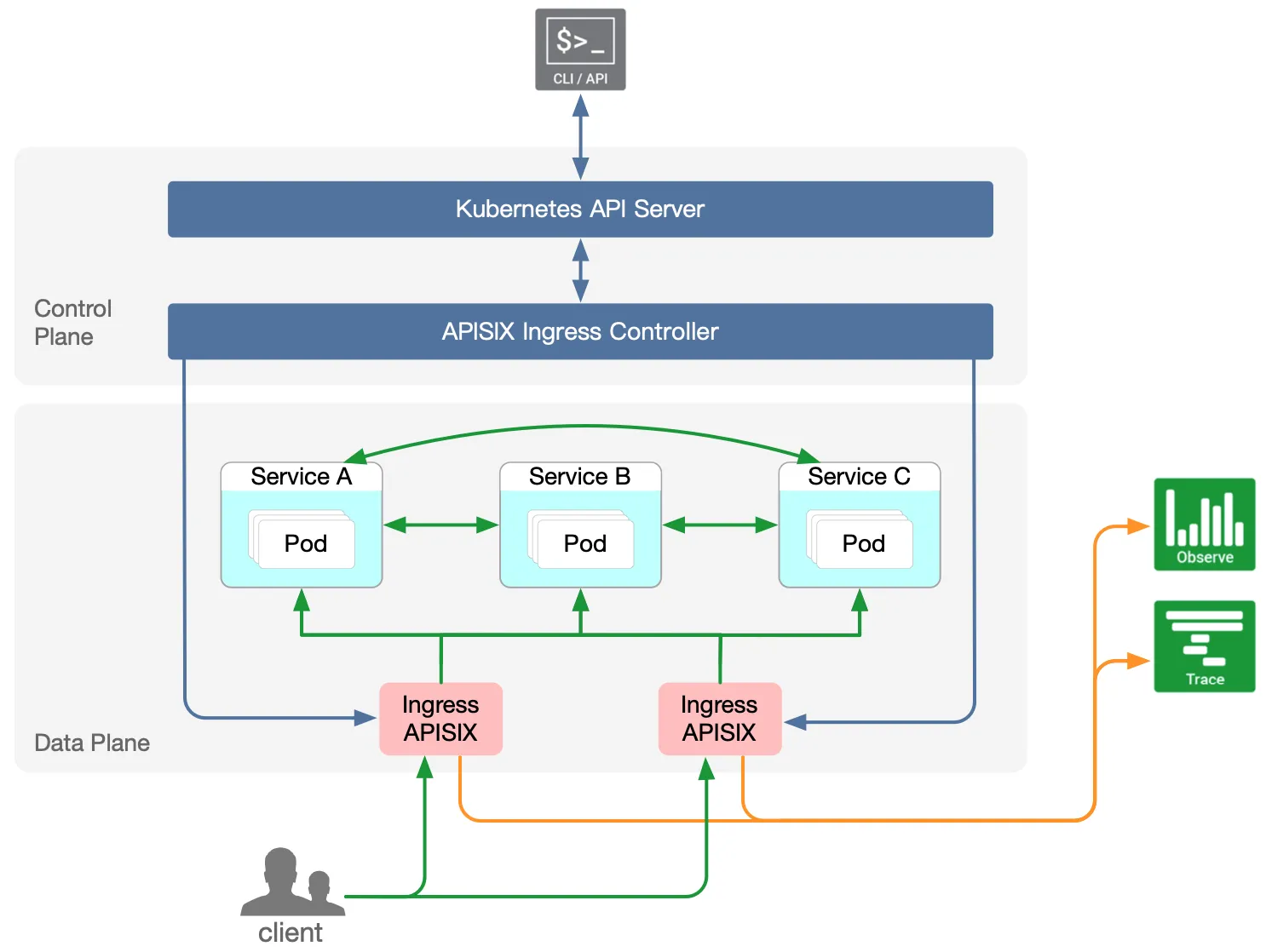
+
### Service mesh
-In the next five to ten years, the service mesh architecture based on the
cloud-native model architecture will begin to emerge. APISIX also started to
lock the track in advance. After research and technical analysis, APISIX has
supported the xDS protocol, and APISIX Mesh was born, and APISIX also has a
place in the field of service mesh.
+In the next five to ten years, the service mesh architecture based on the
cloud-native model will begin to emerge. APISIX has also started to lock the
track in advance. After abundant research and technical analysis, APISIX has
supported the xDS protocol. APISIX Mesh was born, and APISIX also has a place
in the field of service mesh.
-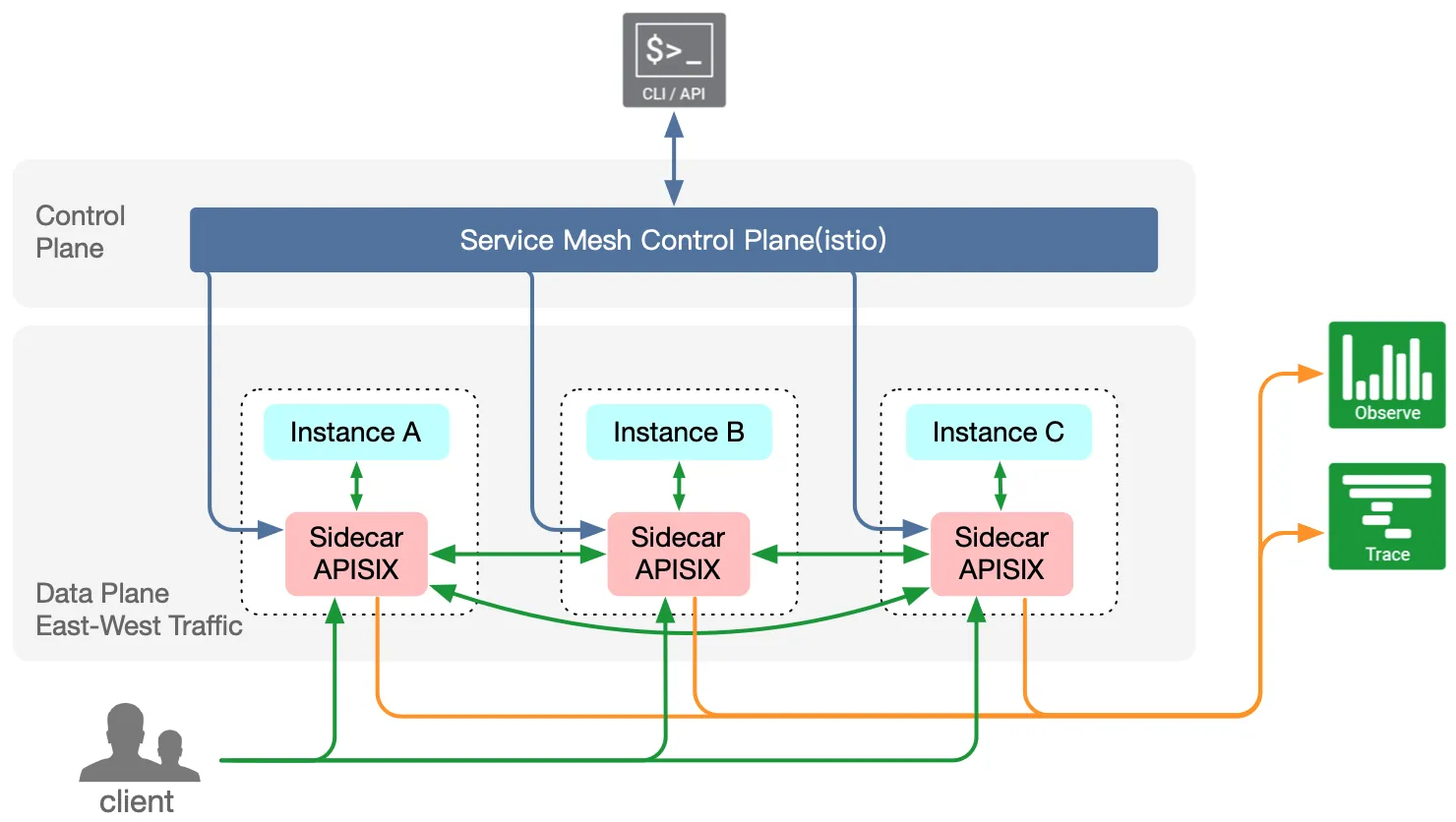
+
## Summary
-It has been three years since the first day when Apache APISIX was
open-sourced. The highly active community and actual user cases have proved
that APISIX is the most perfect API gateway in the cloud-native era. By reading
this article, I believe you have a more comprehensive understanding of APISIX
and look forward to using APISIX as your API gateway in a production
environment.
+It has been three years since the first day Apache APISIX was open-sourced.
The highly active community and [case
studies](https://apisix.apache.org/blog/tags/case-studies/) have proved that
APISIX is the perfect API gateway in the cloud-native era. By reading this
article, I believe you have a more comprehensive understanding of APISIX.
-If you have any questions, you can leave a message in [Github
issue](https://github.com/apache/apisix/issues), community contributors will
respond quickly, of course, you can also join the APISIX Slack channel and
mailing list, Please refer to [Join
Us](https://apisix.apache.org/docs/general/join/).
+If you have any questions, you can leave a message in [GitHub
issue](https://github.com/apache/apisix/issues); community contributors will
respond quickly; of course, you can also join the APISIX Slack channel and
mailing list; please refer to [Join
Us](https://apisix.apache.org/docs/general/join/).














