This is an automated email from the ASF dual-hosted git repository.

bzp2010 pushed a commit to branch master
in repository https://gitbox.apache.org/repos/asf/apisix-website.git
The following commit(s) were added to refs/heads/master by this push:
new 4ca2bc153cb blog: add Honor use case (en) (#1913)
4ca2bc153cb is described below
commit 4ca2bc153cbe008d6c76f2b016265a74470365a9
Author: Yilia Lin <[email protected]>
AuthorDate: Fri May 16 10:33:33 2025 +0800
blog: add Honor use case (en) (#1913)
---
...x-honor-gateway-practice-in-massive-business.md | 460 +++++++++++++++++++++
...x-honor-gateway-practice-in-massive-business.md | 29 +-
2 files changed, 481 insertions(+), 8 deletions(-)
diff --git
a/blog/en/blog/2025/04/27/apisix-honor-gateway-practice-in-massive-business.md
b/blog/en/blog/2025/04/27/apisix-honor-gateway-practice-in-massive-business.md
new file mode 100644
index 00000000000..7f98e2f8c47
--- /dev/null
+++
b/blog/en/blog/2025/04/27/apisix-honor-gateway-practice-in-massive-business.md
@@ -0,0 +1,460 @@
+---
+title: "APISIX Gateway Practices in Honor's Massive Business"
+authors:
+ - name: Jiahao Fu
+ title: Author
+ - name: Weichuan Xu
+ title: Author
+ - name: Yilia Lin
+ title: Technical Writer
+ url: https://github.com/Yilialinn
+ image_url: https://github.com/Yilialinn.png
+keywords:
+ - open source
+ - API gateway
+ - Apache APISIX
+ - Honor
+ - API gateway use case
+description: "Explore Honor's API gateway journey using APISIX, featuring
traffic scheduling, rate limiting, circuit breaking, and observability
enhancements."
+tags: [Case Studies]
+image: https://static.api7.ai/uploads/2025/04/27/qq0YIAxK_honor-case-study.webp
+---
+
+> Authors: Jiahao Fu, Weichuan Xu, Engineers from the PAAS Department at
Honor. This article is based on the presentation given by the two engineers at
the APISIX Shenzhen Meetup on April 12, 2025.
+<!--truncate-->
+
+## About Honor
+
+Established in 2013, [Honor](https://www.honor.com/global/) is a global leader
in smart terminal solutions. Its products are sold in over 100 countries and
regions worldwide, with partnerships established with more than 200 operators.
Honor operates over 52,000 experience stores and dedicated counters globally,
with over 250 million active devices in use.
+
+As a world-class AI terminal ecosystem company, Honor is dedicated to
revolutionizing human-machine interaction. Leveraging its diversified
innovative product portfolio, including smartphones, personal computers,
tablets, and wearable devices, Honor aims to empower every user to effortlessly
enter and enjoy the new intelligent world.
+
+## Evolution and Architecture of Honor's Gateway
+
+### Evolution
+
+- Honor began exploring traffic gateway products in 2021, conducting
preliminary research on APISIX in Q3, and officially introduced APISIX in Q4 to
initiate the construction of its internal traffic gateway platform.
+
+- In 2022, APISIX was officially deployed in Honor's production environment.
In Q1, pilot promotion of traffic access for consumer-facing (To C) business
began; in Q2, APIs were open and available for deployment platforms, supporting
traffic scheduling and container instance reporting. Furthermore, even when the
deployment platform was not yet fully built, traffic access and scheduling can
be performed by invoking APIs through scripts.
+
+- In 2023, Q1 saw the completion of APISIX-CP containerization, followed by
the launch of APISIX-DP elastic scaling in Q3. By Q4, a single cluster
supported over ten million connections, and by year-end, full coverage of cloud
services for To C business was achieved.
+
+- In 2024, APISIX-DP containerization was completed in Q1, the runtime
architecture was optimized to version 2.0 in Q2, and in Q4, Honor reached a
throughput of 1 million QPS (queries per second) in a single cluster. By
year-end, Honor's API gateway, built on Apache APISIX, supported all of Honor's
business projects.
+
+- To date, the APISIX-based gateway platform within Honor has achieved peak
traffic volumes of millions of QPS. Leveraging APISIX's extensibility, nearly
100 custom plugins have been developed.
+
+- Moving forward, Honor's technical team will explore the integration of AI
with gateways and investigate how to enable automatic service reporting of
gateways to Kubernetes.
+
+### Honor Gateway Architecture
+
+
+
+#### Gateway Architecture
+
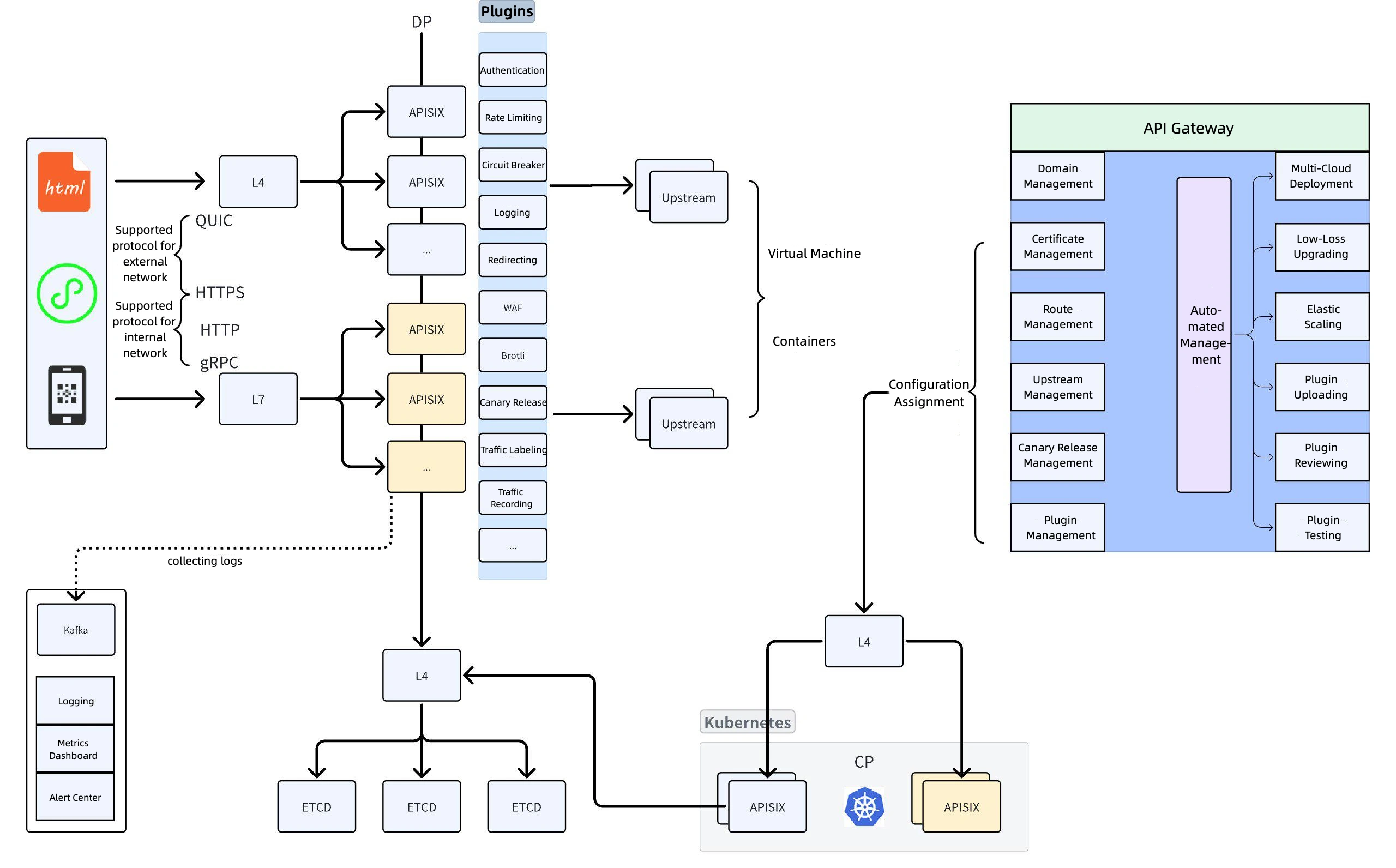
+1. **Protocols Supported for Internal and External Networks**
+
+ Honor's gateway architecture is divided into internal and external network
access:
+
+ a. **Protocols supported for external network**: QUIC and HTTPS.
+
+ b. **Protocols supported for internal network**: HTTP, HTTPS, and gRPC.
Among these, gRPC primarily handles AI-related traffic, with its QPS showing
significant growth over the past year.
+
+2. **Load Balancer and Proxy Selection**
+
+ a. A **load balancer** (LB) is deployed in front of APISIX to connect with
both layer 4 and layer 7 traffic in the public clouds.
+
+ b. **Layer 4 proxy**: Initially used to publish all routes, but due to
business launch issues that layer 4 proxy could not resolve, the setup was
switched to layer 7 proxy.
+
+3. **API Clusters and Plugin Marketplace**
+
+ a. **API clusters**: Multiple clusters share an etcd instance.
+
+ b. **Plugin marketplace**: Lists common plugins such as authentication,
rate limiting, WAF, and traffic labeling.
+
+ c. **Upstream deployment**: Primarily based on containers, with a small
number of virtual machines. Containers are connected to the deployment
platform, which calls APIs to report traffic and instance information after
container deployment.
+
+4. **Log Collection and Analysis**
+
+ The Prometheus plugin is not used. Instead, logs are collected via Kafka
and combined with Elastic Stack for metric analysis and alerting.
+
+5. **etcd Load Balancing Optimization**
+
+ An additional layer of LB is added in front of etcd to address load
imbalance issues when directly connecting to etcd nodes (e.g., excessively high
node connection counts).
+
+#### Gateway Features
+
+- **User Workflow Management**: Covers domain management, certificate
management, route registration, and canary release.
+
+- **Plugin Management**: Users upload plugins via the plugin marketplace, and
the gateway platform conducts reviews and deployments.
+
+- **Intelligent Deployment**: Shields underlying cloud differences, supporting
automated deployment and public cloud adaptation.
+
+#### Low-Loss Upgrades
+
+Frequent plugin changes during regular operations raise concerns about
downtime. By detaching APISIX nodes via LB to ensure all traffic is fully
offline before upgrading, automated low-loss upgrades is achieved.
+
+#### Elastic Scaling
+
+To handle high-traffic scenarios, the gateway can be rapidly scaled out and
promptly recovered via virtual machines, supporting automatic scaling. For
example, when CPU usage exceeds a threshold, machines are automatically scaled
out and attached to the load balancer.
+
+#### Plugin Deployment and Automation
+
+- **Plugin Deployment**: The management plane is connected to the runtime
plane, with configurations pushed to CP for containerized deployment.
+
+- **CP and DP Isolation**: CP and DP connect to the etcd cluster, achieving
isolation between the management and runtime planes.
+
+## Gateway Practice in Honor's Massive Business
+
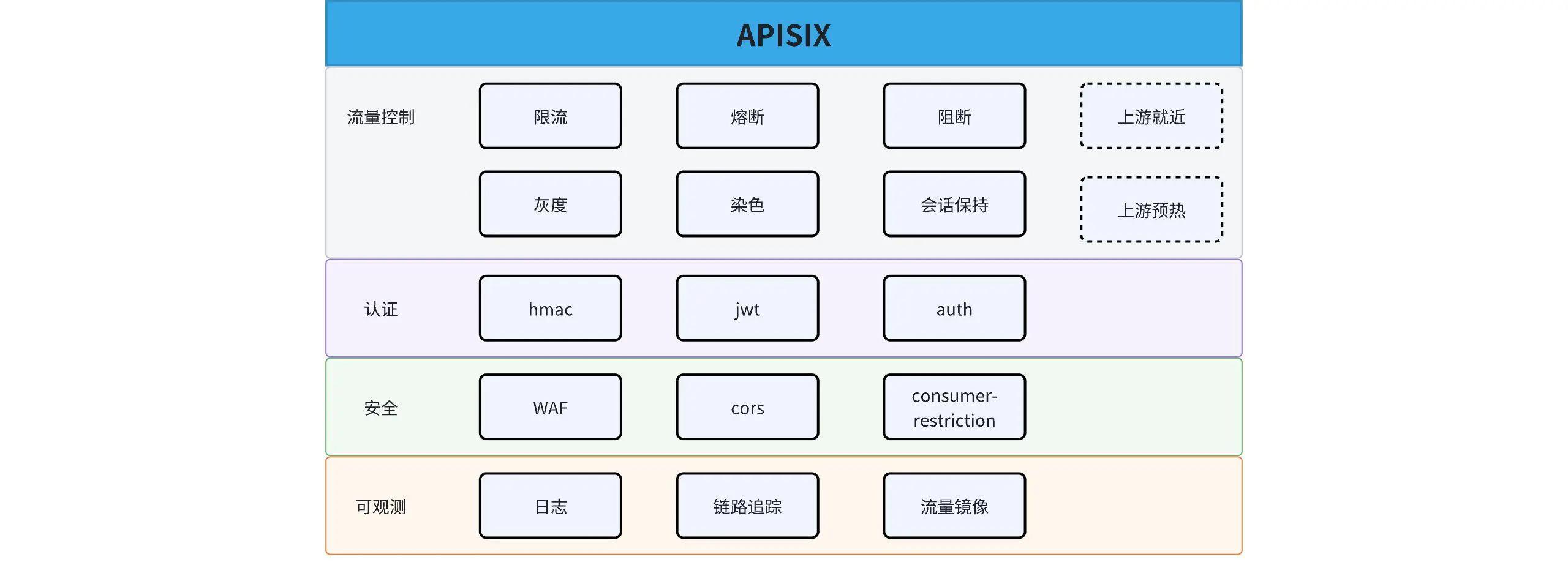
+Initially, we utilized APISIX's native plugins. As business grew and
requirements evolved, native plugins became insufficient. Consequently, we
expanded plugins based on the platform or user-specific needs, resulting in
over 100 plugins to date.
+
+<div align="center">
+<img alt="Honor Plugin Ecosystem" style="width: 65%"
src="https://static.api7.ai/uploads/2025/05/13/Pk221A8e_2-honor-plugins-2.webp";></img>
+</div>
+
+Plugins are categorized into four groups: traffic control, authentication,
security, and observability. Since our clusters are predominantly deployed
across dual Availability Zones (AZs) to ensure reliability, this setup
introduces cross-AZ latency issues. To address this, the gateway facilitates
local routing within the same AZ, ensuring traffic is forwarded to the nearest
node.
+
+### 1. Observability: Traffic Mirroring
+
+<div align="center">
+<img alt="Traffic Mirroring" style="width: 80%"
src="https://static.api7.ai/uploads/2025/05/13/1wt6a77m_3-traffic-mirror-2.webp";></img>
+</div>
+
+#### Request Processing and Traffic Mirroring
+
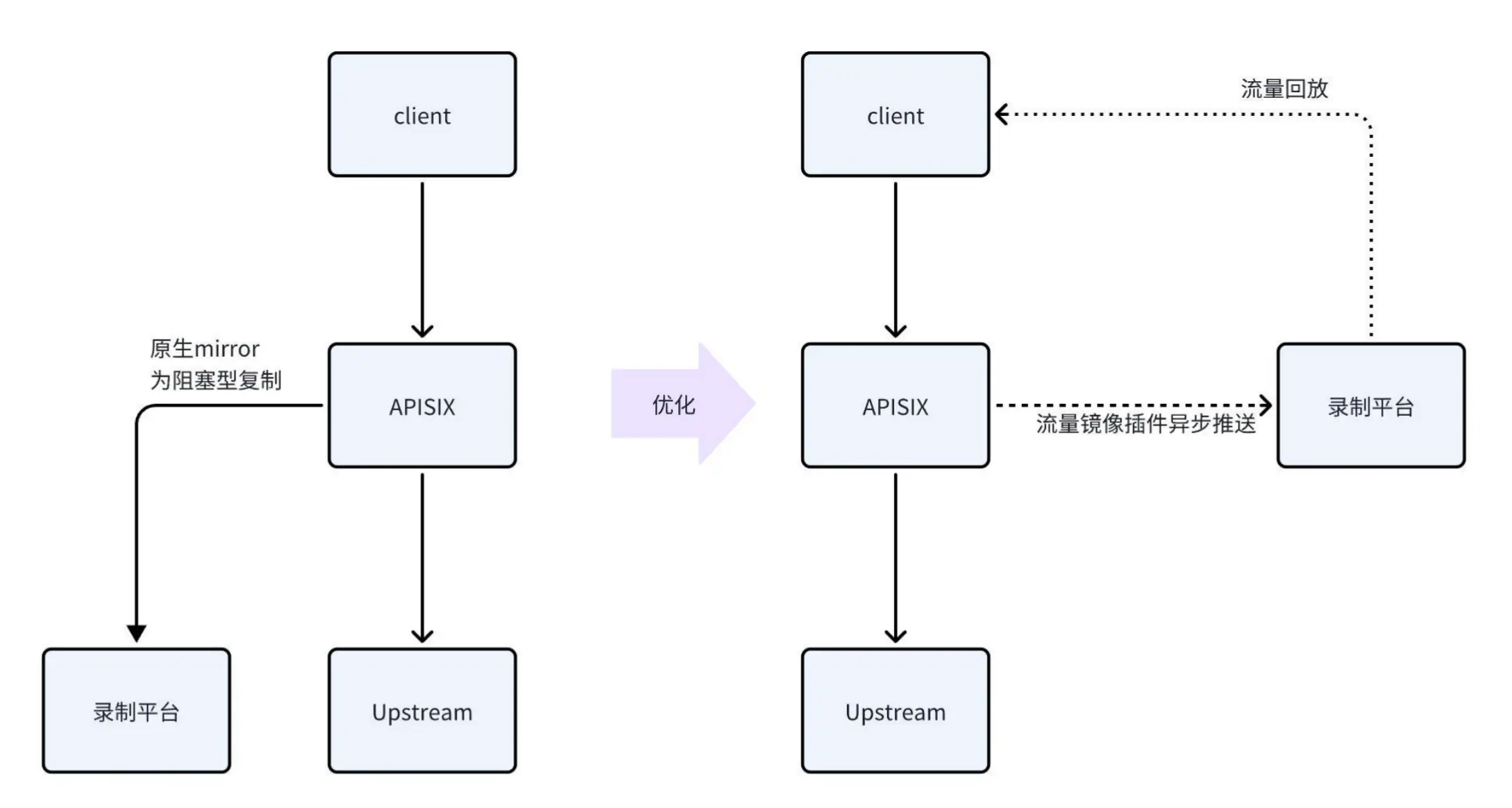
+After a request reaches APISIX, the traffic is forwarded to the upstream
service. During this process, the request is mirrored to a third-party asset
platform. However, this mirroring operation is blocking, meaning that if the
recording platform does not return a response, the client's request is blocked.
If the recording platform experiences a failure, it can severely impact the
stability of production traffic. Therefore, instead of using the built-in
mirroring features of NGINX or APIS [...]
+
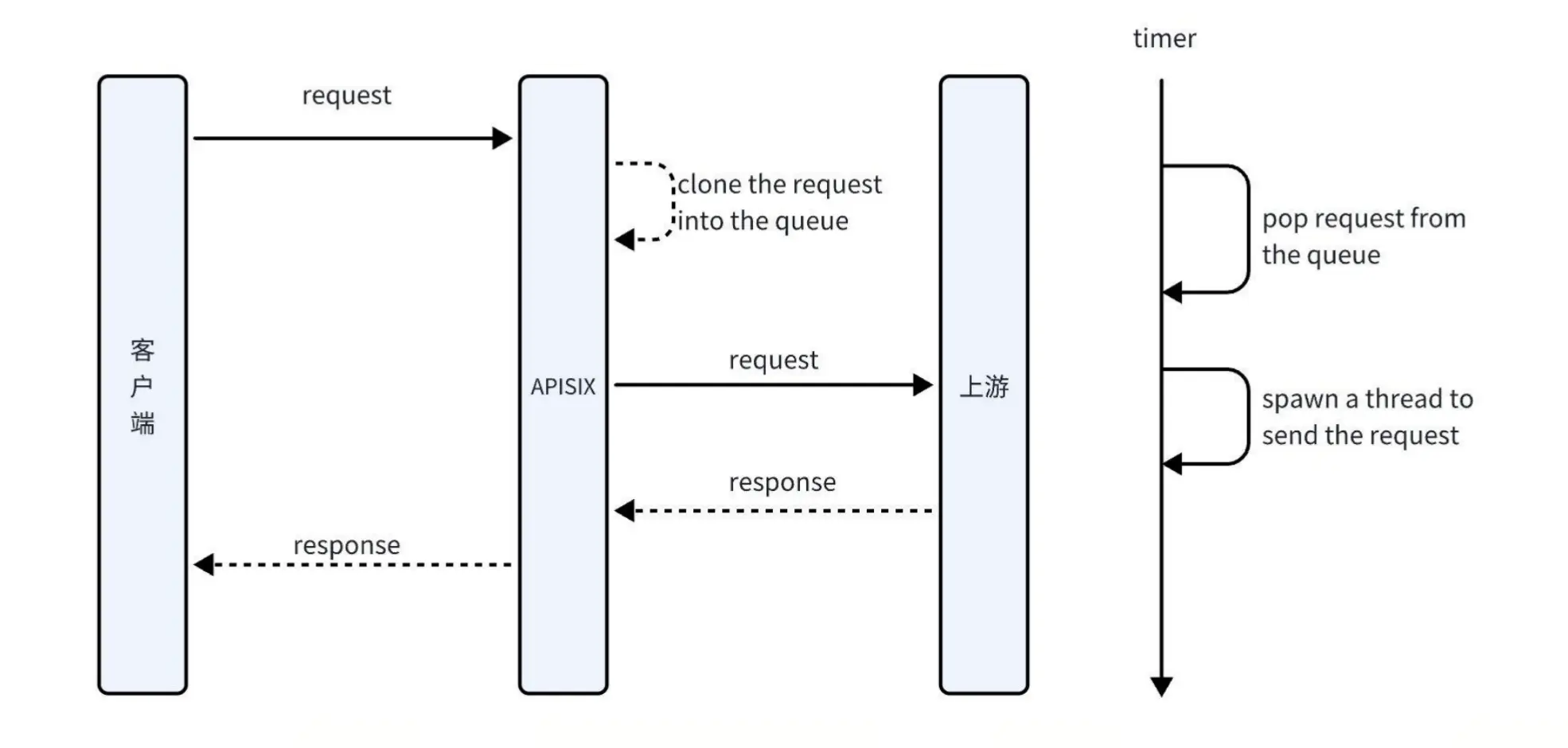
+#### Asynchronous Traffic Processing via Custom Plugin
+
+1. When a request arrives: The request is asynchronously saved to a queue.
+
+2. Upstream processing: APISIX forwards the request to the upstream server.
Once the upstream response is returned, the client request process concludes.
+
+3. Asynchronous recording: Asynchronous threads extract requests from the
queue and send them to the analytics platform for data recording. Since
recording requests include timestamps, asynchronous operations do not affect
production traffic.
+
+<div align="center">
+<img alt="Custom Plugin Implementation" style="width: 80%"
src="https://static.api7.ai/uploads/2025/05/13/7jNxZpWR_4-custom-plugin-2.webp";></img>
+</div>
+
+#### Recording Platform Features
+
+The recording platform is responsible for data collection and supports the
following functionalities:
+
+- Allowing scaling of the traffic up or down during playback.
+
+- Adding specific headers to replayed requests, thus facilitating end-to-end
stress testing.
+
+#### Queue and Thread Optimization
+
+To ensure system performance, we support configuring queue sizes and thread
performance parameters. Although asynchronous forwarding does not directly
impact formal requests, excessive asynchronous traffic can still increase
APISIX's CPU load. Therefore, it is recommended to select optimal parameters
based on business requirements to balance performance and recording efficiency.
+
+### 2. Traffic Scheduling: Canary Release Plugin
+
+We have platformized the canary release feature and optimized the canary
release plugin.
+
+#### Optimized Canary Release Plugin
+
+Traditionally, canary release plugins support traffic distribution based on
predefined rules or percentage-based allocations. However, percentage-based
routing can lead to inconsistent traffic assignments; for instance, the same
request might be routed to different environments at different times,
potentially impacting stability in 2C scenarios.
+
+To address this, a `key-hash` plugin is introduced in front of the canary
release plugin, combining with the canary release plugin to achieve stable
traffic percentage allocation. The specific implementation is as follows:
+
+1. Supports hash calculation based on specific request headers or Cookies.
+
+2. Uses the hash result as input for the canary release plugin to determine
traffic allocation percentages.
+
+This ensures consistent and stable traffic allocation, meeting the business
requirements of To C scenarios.
+
+#### Transformed End-to-End Canary Release Plugin
+
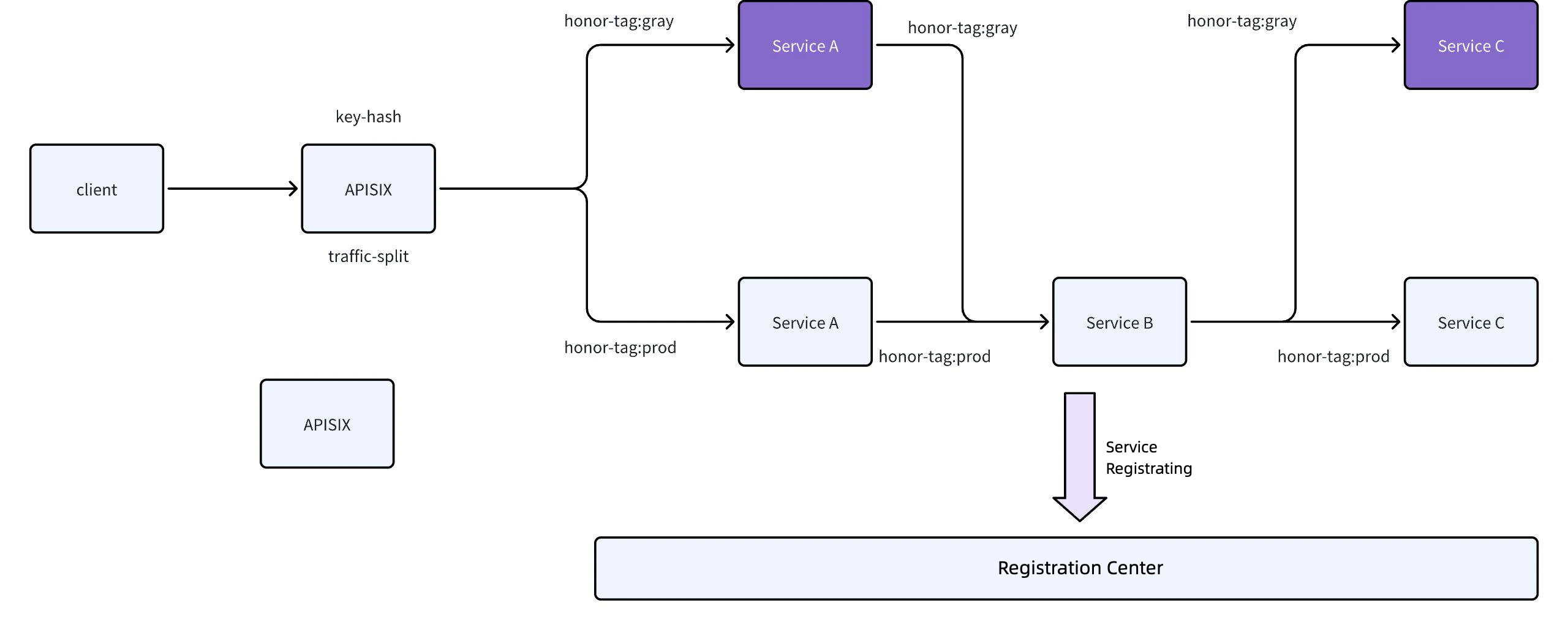
+In the end-to-end canary release scenario, we have transformed the canary
release plugin to achieve precise traffic scheduling. As shown in the diagram
below, Service A is in a canary state, while Services B and C are in the
production environment. To maintain the current traffic flow from Service A to
B while directing the traffic of Service C to the canary environment, this goal
is achieved through an API gateway. The specific implementation is as follows:
+
+
+
+1. **Tag Traffic and Insert Request Header**
+
+ a. When traffic passes through the APISIX API gateway, it is tagged based
on canary release policies.
+
+ b. If the traffic is canary traffic, the gateway inserts a specific
request header (e.g., honor-tag:gray) into the request to indicate it as canary
traffic.
+
+2. **Register and Tag Service**
+
+ a. When Service A registers with the registration center, it also
registers its canary tag (e.g., gray).
+
+ b. The registration center maintains the mapping between service canary
tags and instances.
+
+3. **Service-to-Service Scheduling**
+
+ a. Service A calling Service B:
+
+ i. After receiving a request, Service A first checks if the request
contains a canary tag (e.g., honor-tag:gray).
+
+ ii. If the request includes a canary tag, Service A retrieves Service
B's canary instances from the registration center based on the tag and
prioritizes scheduling to canary instances.
+
+ iii. If Service B has no canary instances, it falls back to scheduling
production instances.
+
+ b. Service B calling Service C:
+
+ i. After receiving the canary tag (e.g., honor-tag:gray) passed from
Service A, Service B retrieves Service C's canary instances from the
registration center based on the tag.
+
+ ii. If Service C has canary instances, the request is scheduled to the
canary instance; otherwise, it is scheduled to a production instance.
+
+4. **End-to-End Canary Release**
+
+ a. Through the transparent transmission of request headers (e.g.,
honor-tag:gray), the canary tag remains consistent throughout the service chain.
+
+ b. Each node in the service chain makes scheduling decisions based on the
canary tag, enabling end-to-end canary release.
+
+Through these transformations, we have achieved precise traffic scheduling for
end-to-end canary releases, ensuring consistency and stability of canary
traffic across the entire service chain.
+
+### 3. Rate Limiting and Security
+
+APISIX offers rich plugins covering single-node rate limiting and distributed
rate limiting solutions. Below are optimization practices for the single-node
rate-limiting solution.
+
+#### 3.1 Rate Limiting
+
+##### Single-Node Rate Limiting
+
+**Background and Challenges**
+
+Initially, when adopting the single-node rate limiting solution, we
encountered several challenges.
+
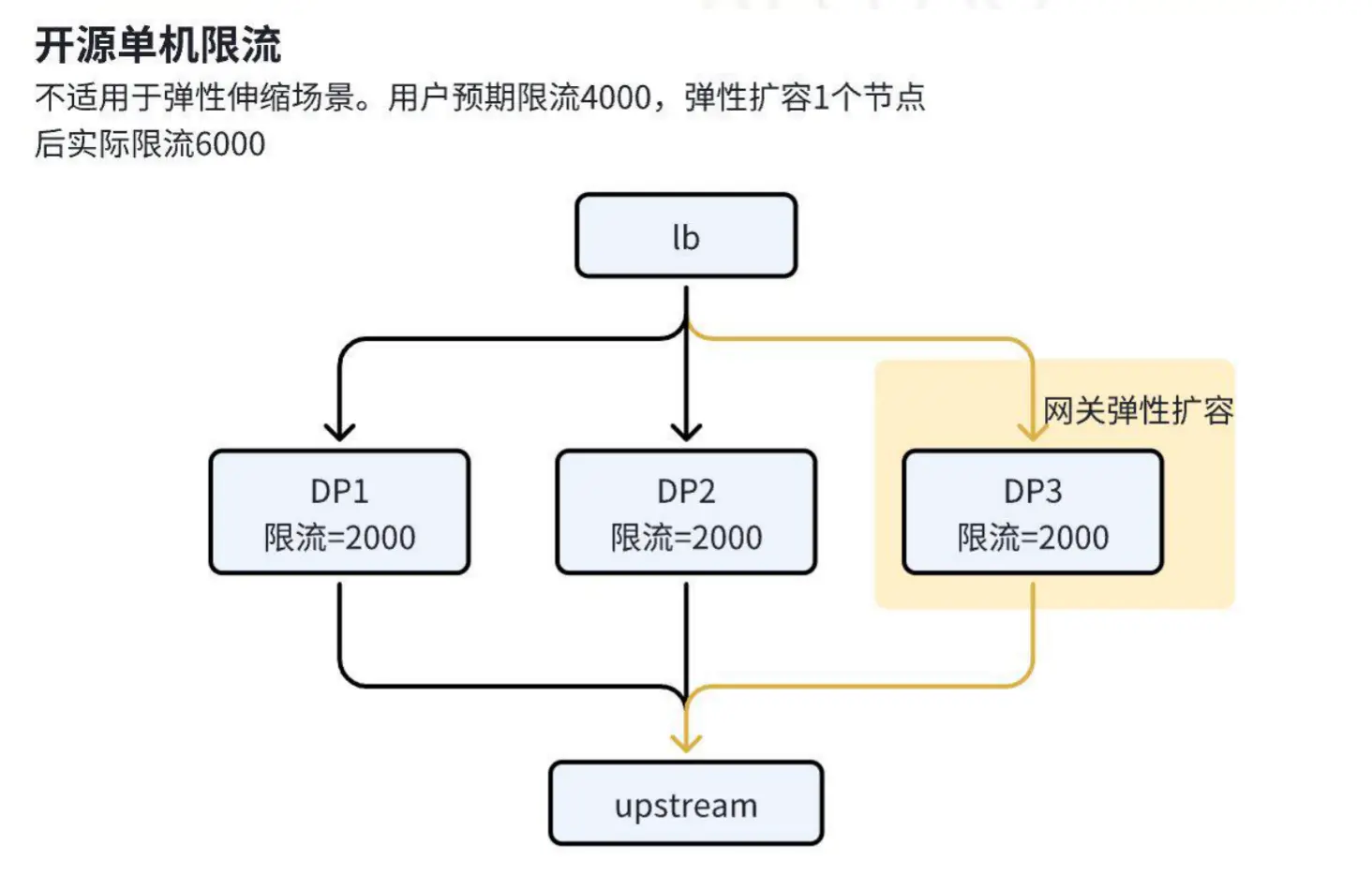
+1. If users needed to set a global rate limit (e.g., 4,000 QPS), they had to
manually coordinate with platform administrators to confirm the number of
gateway nodes and allocate the rate limit value accordingly (e.g., 2,000 QPS
per node for two nodes). This process was cumbersome and error-prone.
+
+2. In the elastic scaling scenario, when the gateway triggers scaling up or
down, there may be a mismatch in the throttling values. For example, the CPU
usage reached 80%, triggering an automatic scale-out. Assume each node was
initially configured with a 2000 QPS limit; increasing the node count to three
would inadvertently raise the total rate limit to 6000 QPS. This could
overwhelm backend services, leading to potential system anomalies.
+
+<div align="center">
+<img alt="Single-Node Rate Limiting" style="width: 50%"
src="https://static.api7.ai/uploads/2025/05/13/GzaePNL2_6-rate-limiting-2.webp";></img>
+</div>
+
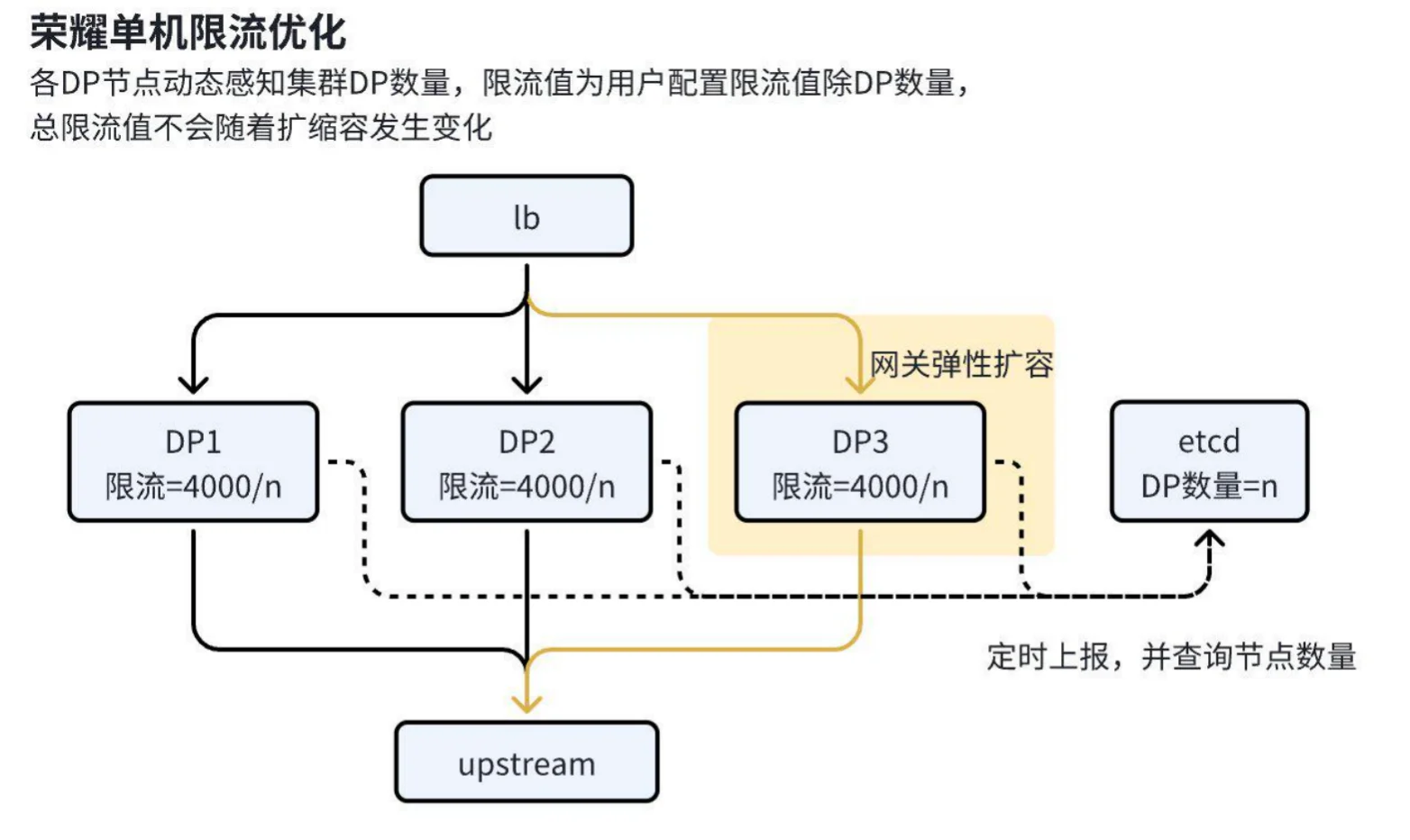
+**Solution**
+
+To address these issues, we implemented the following solutions:
+
+<div align="center">
+<img alt="Upgraded Single-Node Rate Limiting Solution" style="width: 60%"
src="https://static.api7.ai/uploads/2025/05/13/9egDM2V0_7-rate-limiting-upgrade-2.webp";></img>
+</div>
+
+1. **Node Reporting and Maintenance**
+
+ a. Implementation: Utilizing the `server-info` plugin of APISIX, each DP
node's information, such as hostname, is written to etcd as a leased key at
regular intervals.
+
+ b. "Heartbeat Mechanism": By periodically updating (similar to a heartbeat
mechanism), etcd consistently maintains all active DP node information in the
API gateway.
+
+2. **Dynamic Rate Limiting Calculation**
+
+ a. Plugin Development: A new plugin periodically retrieves all the node
information from etcd to determine the total number of gateway nodes.
+
+ b. Excluding CP Nodes: Due to control plane nodes do not handle traffic,
only count the number of DP nodes.
+
+ c. Dynamic Rate Limit Adjustment: During rate limiting, the plugin
dynamically calculates the base rate limit each node should handle, ensuring
the rate limit aligns with the actual number of nodes.
+
+3. **Performance Optimization**
+
+ a. Privileged Process Pulling: Only privileged processes are allowed to
periodically retrieve gateway information from etcd, reducing etcd load and
minimizing APISIX overhead.
+
+ b. Shared Memory Mechanism: Privileged processes write retrieved data to
shared memory, and other processes periodically query shared memory to obtain
node information.
+
+4. **Plugin Abstraction and Reuse**
+
+ a. Common Plugin Abstraction: The dynamic rate limiting optimization
capability is abstracted into a common plugin, providing a unified interface.
+
+ b. Plugin Reuse: Many internal plugins (e.g., fixed window rate limiting,
custom performance plugins) can query the number of nodes from shared memory
and dynamically adjust configurations to meet optimization requirements.
+
+##### Distributed Rate Limiting
+
+The open-source APISIX community also provides a distributed rate-limiting
solution.
+
+**Background and Challenges**
+
+When applying the open-source distributed rate limiting solution, we
encountered the following key issues:
+
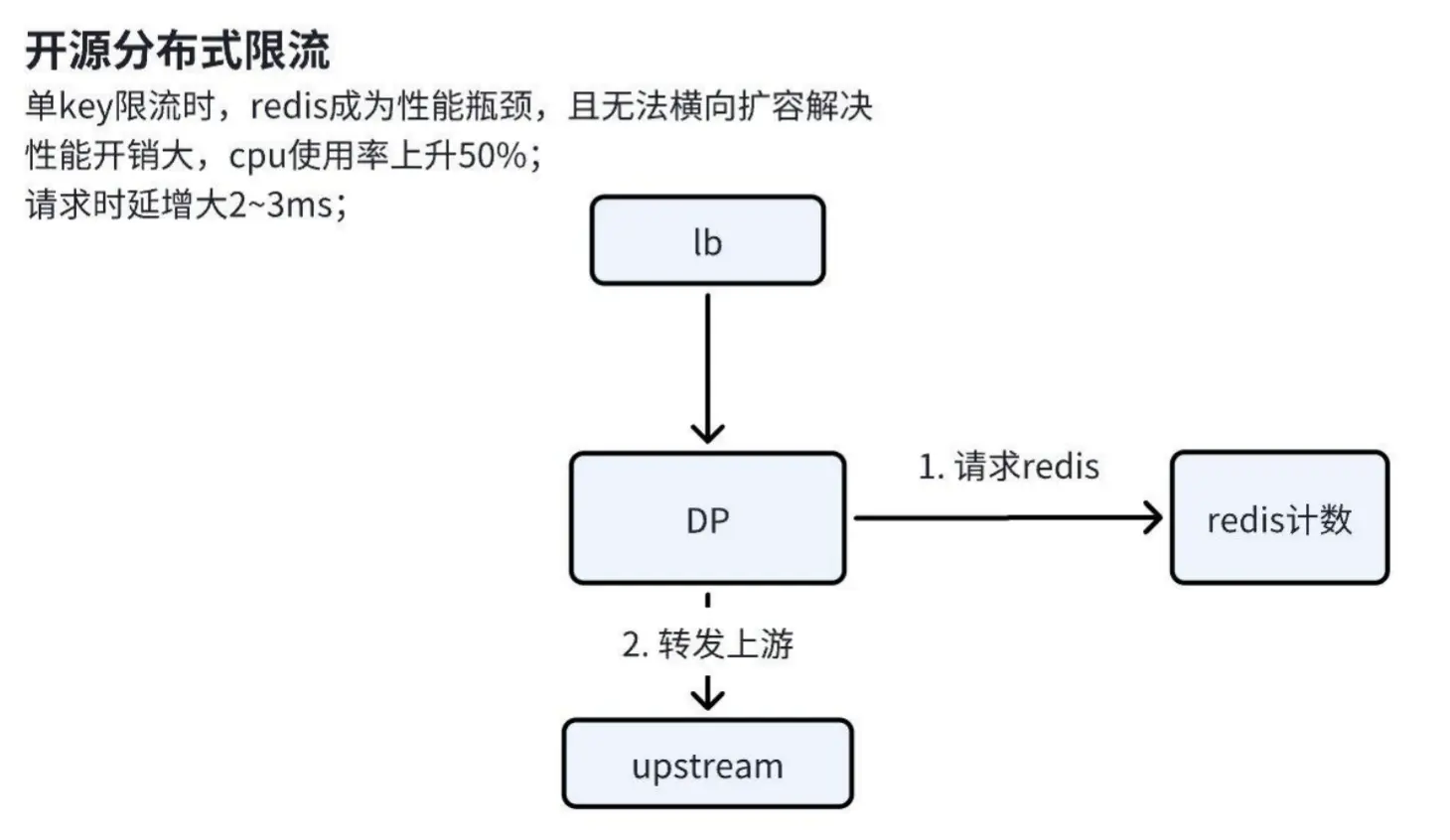
+1. **Redis Performance Bottleneck**: In scenarios where rate limiting is
applied using a single key, particularly when the rate limit rule targets an
entire route rather than specific route characteristics, the Redis key becomes
overly singular. This leads to all requests being directed to the same Redis
shard, preventing effective load balancing through horizontal scaling.
+
+2. **Network Performance Overhead**: Frequent Redis requests result in a
significant increase in CPU usage, with utilization rising by over 50%.
+
+3. **Increased Request Latency**: Open-source distributed rate limiting
solutions typically require accessing Redis to complete counting before
forwarding the request upstream. This process adds 2–3 milliseconds to the
latency of business requests.
+
+<div align="center">
+<img alt="Distributed Rate Limiting" style="width: 40%"
src="https://static.api7.ai/uploads/2025/05/13/XLwUO4Gc_8-distributed-rate-limiting-2.webp";></img>
+</div>
+
+**Solution**
+
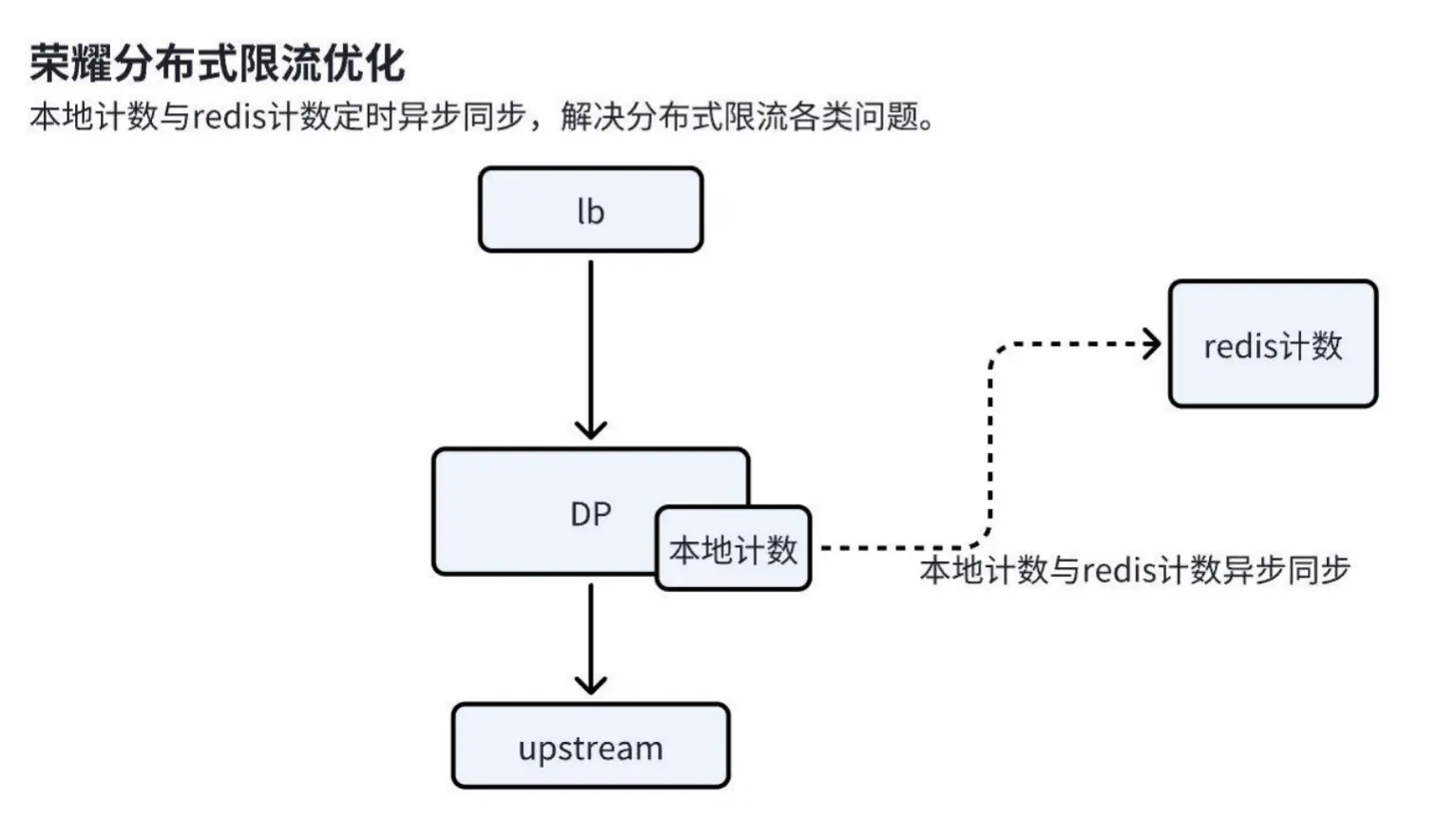
+To address these issues, we designed the following optimizations:
+
+<div align="center">
+<img alt="Upgraded Distributed Rate Limiting Solution" style="width: 45%"
src="https://static.api7.ai/uploads/2025/05/13/J4Ie3Hkg_9-distributed-rate-limiting-upgrade-2.webp";></img>
+</div>
+
+1. **Introducing Local Counting Cache**:
+
+ a. **Local Counting Mechanism**: When a request arrives, a count is first
deducted from the local counting cache. If the count does not reach zero, the
request is allowed to proceed.
+
+ b. **Asynchronous Synchronization Mechanism**: The local count is
periodically synchronized with Redis asynchronously. The number of requests
between two synchronization periods is counted and deducted from Redis. After
synchronization, the Redis count overrides the local cache, ensuring
consistency in distributed rate limiting.
+
+2. **Error Control**: By applying reasonable formulas and parameter
configurations, the error rate is controlled within 3–4%, ensuring rate
limiting accuracy meets business requirements.
+
+**Applicable Scenarios**
+
+- **High QPS Applications**: This solution is suitable for high QPS
applications, significantly reducing Redis performance bottlenecks and network
overhead.
+
+- **Low QPS Applications**: For low QPS applications (e.g., a few hundred
QPS), the existing distributed rate limiting solution generally meets
requirements without additional optimization.
+
+#### 3.2 High-Reliable Circuit Breaker Plugin
+
+**Background and Challenges**
+
+Although the open-source community provides a circuit breaker plugin,
evaluation revealed it does not meet internal requirements in two aspects:
+
+1. **Lack of Failure Rate Support**: The open-source circuit breaker plugin
strategy does not support circuit breaking based on failure rates.
+
+2. **State Transition**: The circuit breaker plugin has only on/off states,
which may allow a large number of requests to pass during state transitions,
exacerbating upstream service degradation and potentially collapsing the
gateway due to upstream response timeouts.
+
+**Custom Circuit Breaker Plugin**
+
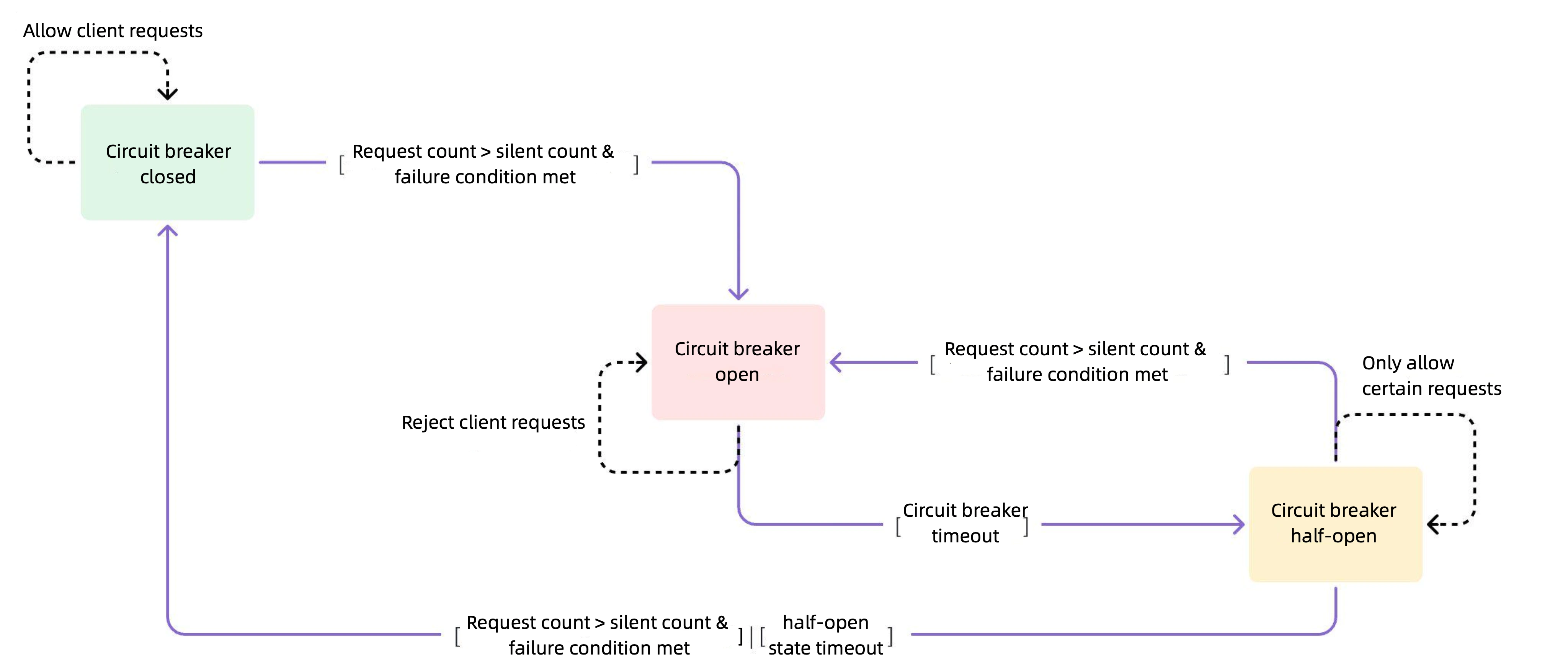
+To address these issues, Honor developed a new circuit breaker plugin based on
APISIX. Its design features include:
+
+
+
+1. **Percentage-Based Circuit Breaking Strategy**: Supports circuit breaking
based on percentages, offering finer control.
+
+2. **Three-State Control Mechanism**:
+
+ a. Closed State: All requests are allowed to pass.
+
+ b. Open State: All requests are rejected until the circuit breaker time
expires.
+
+ c. Half-Open State: A limited number of requests are allowed to pass to
assess whether upstream services have recovered.
+
+3. **Silent Count Mechanism**: The concept of a silent count is introduced to
prevent state transitions triggered by a small number of requests. Only when
the request count reaches the silent count and the failure rate exceeds the
threshold does the state transition to open.
+
+**State Transition Process**
+
+- **Closed to Open**: When the request count reaches the silent count and the
failure rate exceeds the threshold, the circuit breaker transitions to the open
state.
+
+- **Open to Half-Open**: After the circuit break time expires, the state
transitions to half-open.
+
+- **Half-Open to Closed**: In the half-open state, if the number of allowed
requests reaches the configured value and upstream services recover, the state
transitions to closed; if the failure rate remains high or there is no
response, it reverts to the open state.
+
+**Design Updates Based on Sentinel**
+
+- **Window Mechanism**: Unlike Sentinel's sliding window, we adopted a fixed
window focused on failure rates within a time period, simplifying
implementation and reducing performance overhead.
+
+- **Architecture Adaptation**: To accommodate NGINX's multi-process
architecture, shared memory was introduced to store state, ensuring consistent
behavior across workers and avoiding the complexity and performance costs
associated with sliding windows.
+
+#### 3.3 Enhance Reliability with Bypass WAF
+
+**Limitations of Inline WAF**
+
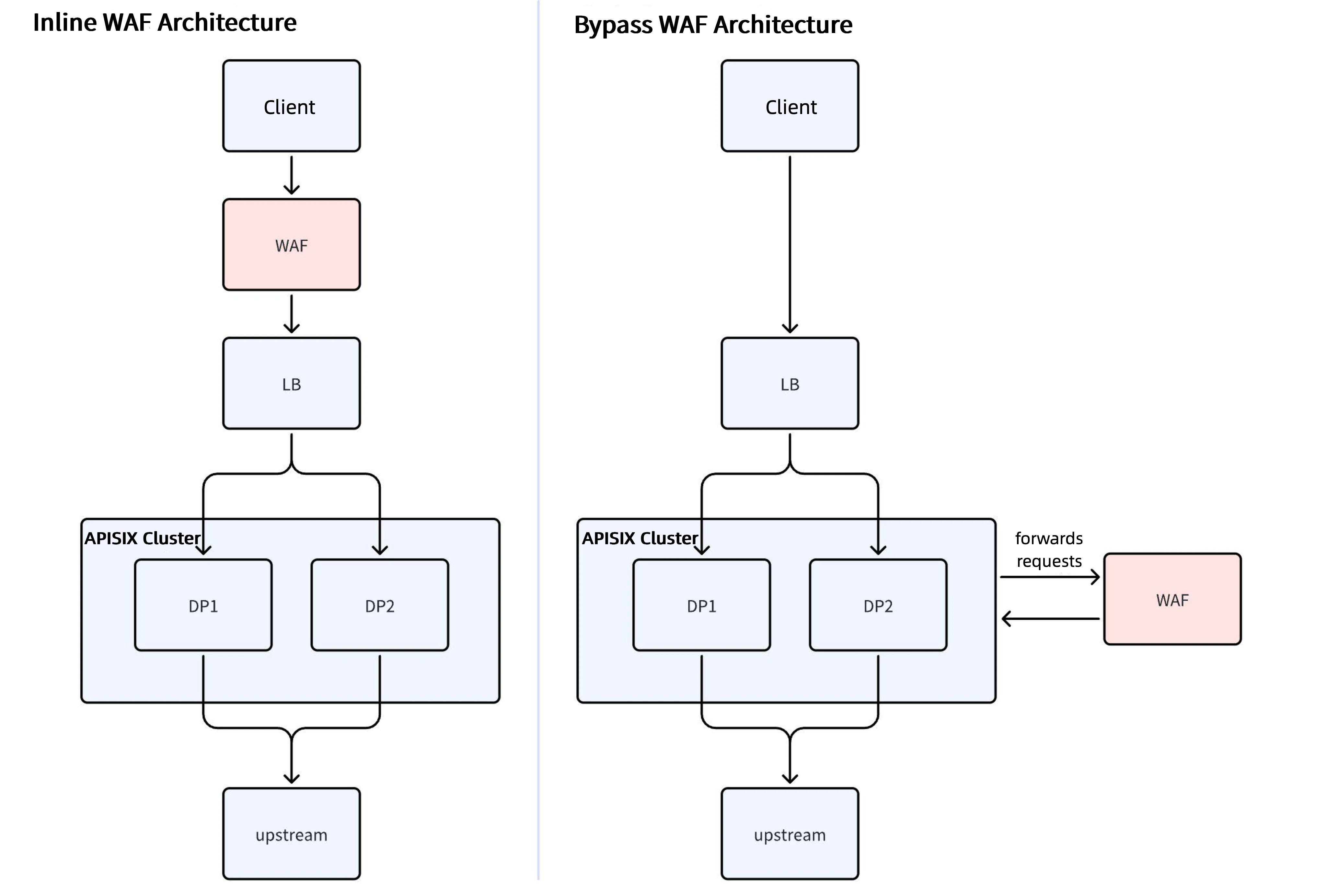
+As shown in the left architecture diagram, traditional WAFs require modifying
DNS records to route traffic to the WAF. After inspecting and filtering the
traffic, WAFs forward it back to the origin server. However, this architecture
is prone to single points of failure. If the WAF itself encounters a
malfunction, it can disrupt the entire traffic flow, adversely affecting
business operations.
+
+
+
+**Bypass WAF**
+
+To resolve this issue, Honor, in collaboration with
[API7.ai](https://api7.ai/) and Tencent Cloud, implemented a bypass WAF
architecture:
+
+1. **Optimized Traffic Path**: Traffic no longer needs to pass through the
WAF; instead, it is directed straight to the APISIX cluster.
+
+2. **Traffic Splitting for Detection**: Within the APISIX cluster, a portion
of the traffic is forwarded to the WAF for inspection to determine whether it
is normal or contains malicious attacks (e.g., egress attacks and command
egress attacks).
+
+3. **Status Code Response Mechanism**:
+
+ a. If the WAF detects normal traffic, it returns a `200` status code,
allowing the request to pass through to the upstream server.
+
+ b. If the WAF detects malicious attacks, it returns a status code similar
to `403`, rejecting the request.
+
+4. **Fault Tolerance**: If the WAF fails, traffic can be directly forwarded to
the backend, preventing link interruption due to WAF failure and enhancing
overall link reliability.
+
+## Performance and Cost Optimization
+
+### Performance Optimization
+
+#### Health Checker Optimization
+
+**Background and Challenges**
+
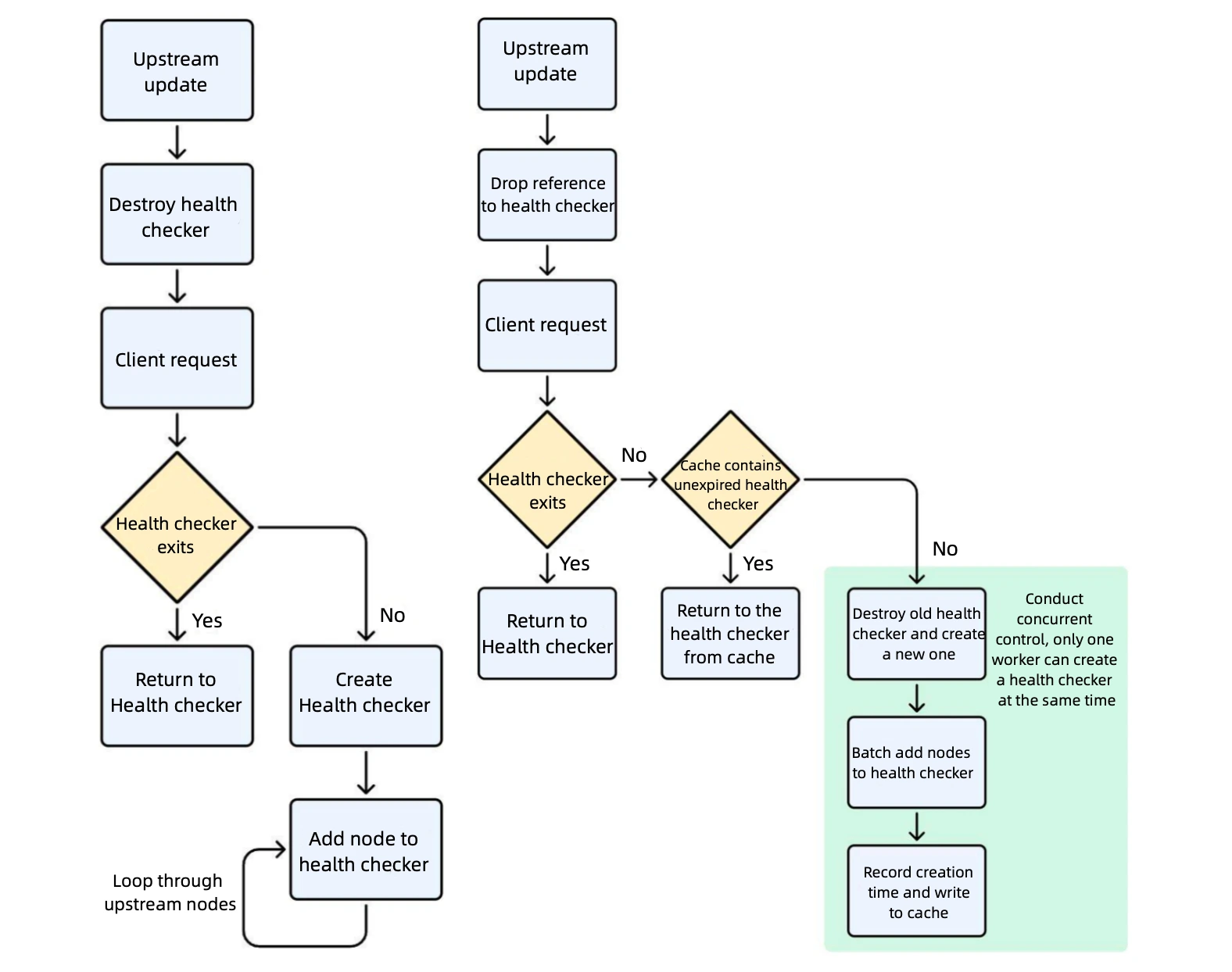
+In high-traffic internal business scenarios, with over a thousand upstream
nodes, frequent rolling updates triggered the destruction and creation of
health checkers. This led to significant CPU usage spikes.
+
+1. Upstream Destruction and Creation: Upon upstream updates, health checkers
were destroyed. Health checkers are only probed when client requests arrive; if
they do not exist, they are immediately created.
+
+2. Node-by-Node Addition: During creation, all nodes had to be traversed and
individually added to the health checker's shared memory. This process involved
extensive locking operations and memory writes, resulting in significant
performance degradation.
+
+**Solutions**
+
+1. **Delayed Destruction**: During upstream updates, health checkers are
temporarily not destroyed but merely lose their references, reducing
performance overhead from frequent destruction and creation.
+
+2. **Caching Mechanism**: When creating health checkers, they are cached with
their creation time recorded. Subsequent requests first check if the health
checker exists. If not, the cache is replenished. If not expired, it is
directly returned; if expired, it is recreated.
+
+3. **Batch Updates**: All upstream nodes are batch-updated to the health
checker's shared memory, reducing the overhead of node-by-node operations.
+
+4. **Concurrency Control**: A concurrency control mechanism is introduced to
ensure only one worker is responsible for creating health checkers at any given
time, preventing multiple workers from performing the same operation
simultaneously and significantly reducing CPU consumption.
+
+**Results**
+
+In scenarios involving frequent updates of 2,000 upstream nodes, the optimized
approach resulted in only a ~2% increase in CPU usage, a substantial
improvement compared to the previous 20% increase. This demonstrates a
significant reduction in performance overhead and highlights the effectiveness
of the optimization.
+
+
+
+#### Cost Optimization
+
+Cost optimization primarily focuses on three aspects: traffic compression,
static single-line EIP transformation, and gateway scaling.
+
+#### Traffic Compression
+
+**Background**
+
+Through statistics on gateway costs, approximately three-quarters of the total
cost is attributed to traffic costs. Therefore, our optimization efforts first
target traffic reduction.
+
+**Solutions**
+
+Honor provides compression plugins such as br and gzip, supporting dynamic
compression. These plugins are user-friendly; businesses only need to include a
compression identifier in the request, and clients and browsers typically
support decompression.
+
+**Results**
+
+In cloud providers' LB billing models, traffic volume is the primary billing
factor. By using compression plugins, LB costs and EIP bandwidth costs can be
reduced, with a maximum compression rate exceeding 70%, significantly lowering
traffic costs.
+
+#### Static Single-Line EIP Transformation
+
+**Background**
+
+BGP EIP bandwidth costs are prohibitively high.
+
+**Solutions**
+
+1. Configure a static single-line EIP for gateway clusters, supplemented by a
backup BGP EIP.
+
+2. Use DNS intelligent resolution to direct mainstream carrier routes to
corresponding single-line EIPs.
+
+**Results**
+
+Single-line EIP costs are one-third of BGP EIP costs, saving approximately
two-thirds of public network bandwidth expenses.
+
+#### Gateway Scaling
+
+**Optimization**
+
+Implement elastic gateway scaling based on CPU and memory utilization.
+
+**Results**
+
+Ensure resource utilization remains within a reasonable range to avoid
resource waste or insufficiency.
+
+## Summary
+
+Since adopting APISIX in 2021, Honor has developed a high-performance,
scalable, and reliable API gateway to support the rapid growth of its extensive
business through continuous optimization and expansion. The following are the
achievements of Honor using Apache APISIX:
+
+- **Traffic Handling**: Honor's API gateway has evolved from pilot deployments
to comprehensive coverage, handling peak traffic volumes reaching millions of
QPS.
+
+- **Plugins**: To meet diverse business requirements, Honor has developed
nearly 100 custom plugins.
+
+- **Architecture Stability and Scalability**: Through optimizations such as
internal and external network protocol supports, load balancer upgrades, and
plugin marketplace development, the platform's stability and scalability have
been enhanced.
+
+- **Features**: optimizations such as canary releases, rate limiting, circuit
breaking, and bypass WAF architecture ensure precise traffic scheduling and
enhance reliability.
+
+- **Performance**: Health checker optimizations and concurrency control
significantly lower CPU usage.
+
+- **Cost**: Strategies like traffic compression, EIP transformation, and
scaling techniques substantially reduce expenses.
+
+## Future Outlook
+
+Moving forward, Honor plans to integrate artificial intelligence into its API
gateway platform to enhance intelligent traffic management and decision-making
processes. Additionally, through innovative approaches such as containerized
auto-reporting mechanisms, Honor aims to help internal teams achieve efficient
resource management and business deployment in Kubernetes environments.
diff --git
a/blog/zh/blog/2025/04/27/apisix-honor-gateway-practice-in-massive-business.md
b/blog/zh/blog/2025/04/27/apisix-honor-gateway-practice-in-massive-business.md
index a313e904228..8894de14bfc 100644
---
a/blog/zh/blog/2025/04/27/apisix-honor-gateway-practice-in-massive-business.md
+++
b/blog/zh/blog/2025/04/27/apisix-honor-gateway-practice-in-massive-business.md
@@ -22,7 +22,6 @@ image:
https://static.api7.ai/uploads/2025/04/27/qq0YIAxK_honor-case-study.webp
---
> 作者:付家浩、许伟川,荣耀 PAAS 平台部工程师。本文整理自 2025 年 4 月 12 日两位工程师在 APISIX 深圳 Meetup 的演讲。
->
<!--truncate-->
## 关于荣耀
@@ -98,7 +97,9 @@ image:
https://static.api7.ai/uploads/2025/04/27/qq0YIAxK_honor-case-study.webp
关于 APISIX 在荣耀海量业务下的实践,最初我们使用 APISIX
的原生插件,随着业务发展和要求,原生插件已经无法满足我们的需求。因此我们基于平台或者用户基于自身的需求扩展了一些插件,目前已经有 100 多个。
-
+<div align="center">
+<img alt="Honor Plugin Ecosystem" style="width: 65%"
src="https://static.api7.ai/uploads/2025/05/16/eycp2ZaK_2-honor-plugins-ecosystem.webp";></img>
+</div>
### 插件分类
@@ -106,7 +107,9 @@ image:
https://static.api7.ai/uploads/2025/04/27/qq0YIAxK_honor-case-study.webp
### 1. 可观测:流量镜像
-
+<div align="center">
+<img alt="Traffic Mirroring" style="width: 80%"
src="https://static.api7.ai/uploads/2025/04/27/N6bqzJgO_3-traffic-mirror.webp";></img>
+</div>
#### 请求处理与流量镜像
@@ -120,7 +123,9 @@ image:
https://static.api7.ai/uploads/2025/04/27/qq0YIAxK_honor-case-study.webp
2. **上游处理**:APISIX 将请求转发至上游,上游返回响应后,客户端请求流程结束。
3. **异步录制**:通过异步线程从队列中提取请求,并将其发送至录制平台进行数据录制。由于录制请求包含时间戳,异步操作不会影响正式流量。
-
+<div align="center">
+<img alt="Custom Plugin Implementation" style="width: 80%"
src="https://static.api7.ai/uploads/2025/04/27/0x2hYRcj_4-custom-plugin.webp";></img>
+</div>
#### 录制平台功能
@@ -204,13 +209,17 @@ APISIX 提供了丰富的插件能力,涵盖单机限流和分布式限流方
在弹性伸缩场景下,网关触发扩容或缩容时,限流值可能出现不匹配问题。例如,当 CPU 使用率达到 80% 时触发弹性扩容,假设初始配置为每个节点限流值为
2000,扩容后节点数量增加至 3 个,总限流值会变为 6000,这可能导致后端服务因流量超出承载能力而异常。
-
+<div align="center">
+<img alt="Single-Node Rate Limiting" style="width: 50%"
src="https://static.api7.ai/uploads/2025/04/27/35KRFtE7_6-rate-limiting.webp";></img>
+</div>
**优化方案**
为解决上述问题,我们引入了以下优化措施:
-
+<div align="center">
+<img alt="Upgraded Single-Node Rate Limiting Solution" style="width: 60%"
src="https://static.api7.ai/uploads/2025/04/27/BsEyxG1X_7-rate-limiting-upgrade.webp";></img>
+</div>
**1. 节点信息上报与维护**
@@ -252,13 +261,17 @@ b. **插件复用**:内部大量插件(如固定窗口限流、自定义性
3. **请求时延增加**:开源分布式限流方案需先访问 Redis 完成计数,再将请求转发至上游,导致业务请求时延增加 2-3 毫秒。
-
+<div align="center">
+<img alt="Distributed Rate Limiting" style="width: 40%"
src="https://static.api7.ai/uploads/2025/04/27/Jg0gGugw_8-distributed-rate-limiting.webp";></img>
+</div>
**优化方案**
为解决上述问题,我们设计了以下优化方案:
-
+<div align="center">
+<img alt="Upgraded Distributed Rate Limiting Solution" style="width: 45%"
src="https://static.api7.ai/uploads/2025/04/27/peXIhano_9-distributed-rate-limiting-upgrade.webp";></img>
+</div>
**1. 引入本地计数缓存**: