This is an automated email from the ASF dual-hosted git repository.

jianbin pushed a commit to branch docusaurus
in repository https://gitbox.apache.org/repos/asf/incubator-seata-website.git
The following commit(s) were added to refs/heads/docusaurus by this push:
new d2ef1a4684f Translate the seata-namingserver blog into English (#1000)
d2ef1a4684f is described below
commit d2ef1a4684fbf23e4bd4c5096bb04f4a204335f6
Author: funkye <[email protected]>
AuthorDate: Tue Jul 8 22:13:11 2025 +0800
Translate the seata-namingserver blog into English (#1000)
---
.../seata-namingserver.md | 154 +++++++++++++++++++++
1 file changed, 154 insertions(+)
diff --git a/i18n/en/docusaurus-plugin-content-blog/seata-namingserver.md
b/i18n/en/docusaurus-plugin-content-blog/seata-namingserver.md
new file mode 100644
index 00000000000..eca294718f2
--- /dev/null
+++ b/i18n/en/docusaurus-plugin-content-blog/seata-namingserver.md
@@ -0,0 +1,154 @@
+---
+title: Seata Namingserver
+author: Jiang Junmin
+description: In this article, I will share the design philosophy and usage of
Seata's naming server as a registry center
+date: 2024/9/25
+keywords: [seata,distributed transaction,registry center,namingserver]
+---
+
+# 1. Project Background
+Seata currently supports multiple registry center implementations. To provide
complete end-to-end functionality, Seata has designed and launched its native
registry center called namingserver.
+
+# 2. Domain Model
+
+### 2.1 Namespace and Transaction Groups
+
+- Namespace: In the NamingServer model, namespaces are used to achieve
environment isolation. They allow service instances to be isolated across
different environments (such as development, testing, and production).
+- Cluster and Unit: Clusters handle transaction group processing, while Units
perform load balancing within each cluster. Transaction groups (vgroups) locate
specific TC nodes through metadata coordination between namespaces and clusters.
+
+### 2.2 Transaction Processing Flow and NamingServer Interaction
+
+
+The interaction flow between transaction processing and namingserver is as
follows:
+
+1. Configure the NamingServer address and related settings on the client side
+
+2. After client startup, TM sends a service discovery request to namingserver
+
+3. NamingServer returns the related cluster list based on the vGroup
parameters sent by TM and the transaction group mapping relationships in
memory. The cluster list metadata returned by namingserver is as follows:
+
+```json
+{
+ "clusterList": [
+ {
+ "clusterName": "cluster2",
+ "clusterType": "default",
+ "groupList":[group1,group2]
+ "unitData": [
+ {
+ "unitName": "115482ee-cf27-45d6-b17e-31b9e2d7892f",
+ "namingInstanceList": [
+ {
+ "ip": "172.31.31.191",
+ "port": 8092,
+ "nettyPort": 0,
+ "grpcPort": 0,
+ "weight": 1.0,
+ "healthy": true,
+ "timeStamp": 1695042063334,
+ "role": member,
+ "metadata": {
+ "weight": 1,
+ "cluster-type": "default"
+ }
+ }
+ ]
+ },
+ {
+ "unitName": "097e6ab7-d2d2-47e4-a578-fae1a4f4c517",
+ "namingInstanceList": [
+ {
+ "ip": "172.31.31.191",
+ "port": 8091,
+ "nettyPort": 0,
+ "grpcPort": 0,
+ "weight": 1.0,
+ "healthy": true,
+ "timeStamp": 1695042076481,
+ "role": member,
+ "metadata": {
+ "weight": 1,
+ "cluster-type": "default"
+ }
+ }
+ ]
+ }
+ ]
+ }
+ ],
+ "term": 1695042076578
+}
+```
+
+4. The client identifies the appropriate TC node through load balancing
strategy to start transactions
+
+5. TM passes the transaction group and TC node to RM
+
+6. RM sends branch registration requests to the TC node
+
+7. TC node completes the second-phase distribution
+
+# 3. Design Philosophy
+
+### 3.1 AP or CP?
+
+The CAP theorem, also known as the CAP principle, states that in a distributed
system, Consistency, Availability, and Partition tolerance cannot all be
achieved simultaneously. The CAP theory for distributed systems categorizes
these three characteristics as follows:
+
+● Consistency (C): Whether all data backups in a distributed system have the
same value at the same moment (equivalent to all nodes accessing the same
latest data copy)
+
+● Availability (A): Whether the cluster as a whole can still respond to client
read and write requests after some nodes in the cluster fail (high availability
for data updates)
+
+● Partition tolerance (P): In practical terms, partitioning is equivalent to
time limit requirements for communication. If the system cannot achieve data
consistency within the time limit, it means partitioning has occurred, and a
choice must be made between C and A for the current operation.
+
+For namingserver, we prefer to use the AP model, emphasizing availability and
partition tolerance while sacrificing some consistency. As a service registry
center, NamingServer's primary responsibility is to provide efficient service
discovery and registration services, while requirements for short-term data
consistency can be appropriately relaxed. In distributed environments, there
may be brief inconsistencies in registration data across multiple nodes. For
example, when multiple Namin [...]
+
+For NamingServer, we consider this temporary inconsistency tolerable. Since
service registration and discovery don't require strong consistency, even if
some nodes have lagged or inconsistent registration data at a given moment, it
won't immediately affect the normal service of the entire system. Through
heartbeat mechanisms and periodic synchronization, eventual consistency can be
gradually guaranteed.
+
+### 3.2 Application of Quorum NWR Mechanism in NamingServer
+Quorum NWR (Quorum Read-Write) is a mechanism used in distributed systems to
ensure data consistency. This mechanism coordinates data consistency by setting
the total number of replicas (N), the number of replicas required for
successful write operations (W), and the number of replicas to access for read
operations (R). In NamingServer's design, a multi-write + compensation
mechanism is adopted to ensure information consistency among multiple
NamingServer nodes, while clients interact wi [...]
+
+1. Write Operations (W-Write Quorum):
+ When cluster node changes occur, the server side sends requests to multiple
nodes in the NamingServer cluster.
+ According to the NWR mechanism, the system ensures that at least W replicas
successfully write registration information. Through the multi-write mechanism,
even if some nodes are temporarily unavailable or experience network delays,
write operation high availability can still be ensured. Once W nodes
successfully write, the client receives a success response.
+ Compensation Mechanism: For replicas that don't immediately succeed in
writing, the system uses asynchronous compensation to synchronize these nodes
at a later time, ensuring eventual consistency.
+
+2. Read Operations (R-Read Quorum):
+ Clients interact with any node in the NamingServer cluster, sending read
requests to obtain service registration information.
+ The system reads data from at least R replicas, using the latest version of
data as the return result. Even if some nodes have temporarily inconsistent
data, clients can ensure they read the latest registration information by
reading multiple replicas and comparing their version numbers or consistency
markers.
+ Since clients only interact with one NamingServer node, read operation
efficiency is improved, and complex coordination between multiple nodes is
avoided while the system still ensures eventual consistency.
+
+3. NWR Parameter Design and Trade-offs:
+ In namingserver, we set W=N and R=1. While W=N means writes need to be sent
to all nodes, it doesn't require all nodes to immediately succeed in writing.
The system allows some nodes to temporarily fail, synchronizing these nodes
through compensation mechanisms in subsequent stages, thereby improving system
fault tolerance. Even if some nodes fail or experience network interruptions
during writing, data updates can still eventually propagate to all nodes
through compensation mechanism [...]
+ When clients perform read operations, they can read data from any
NamingServer node without worrying about data inconsistency. Even if some nodes
don't immediately succeed during writing, clients can still obtain the latest
registration information from other successfully written nodes. Thus, the R
value can be set relatively low (such as R=1) to improve read operation
efficiency, while the system ensures all nodes eventually reach consistency
through compensation mechanisms.
+
+
+
+## 3.2 Architecture Diagram
+
+
+
+The namingserver operation flow is shown in the diagram above:
+
+1. Create a transaction group vgroup under a certain cluster through the
console.
+2. The vgroup->cluster creation request is sent to namingserver, which then
forwards it to the corresponding TC node.
+3. The TC node persistently saves the vgroup->cluster mapping relationship.
+4. During heartbeats, the TC node updates the vgroup->cluster mapping
relationship to all namingservers.
+5. The client obtains corresponding cluster metadata from namingserver using
its configured transaction group vgroup.
+6. During transaction flow, the client uses units under the cluster for load
balancing, then performs begin, registry, commit, rollback operations.
+7. After transaction decision, the leader node under the corresponding unit
distributes the second phase. In stateless nodes, the unique node under each
unit is the leader.
+
+## 3.3 Design Details
+
+### 3.3.1 Long Polling for Cluster Change Notifications
+
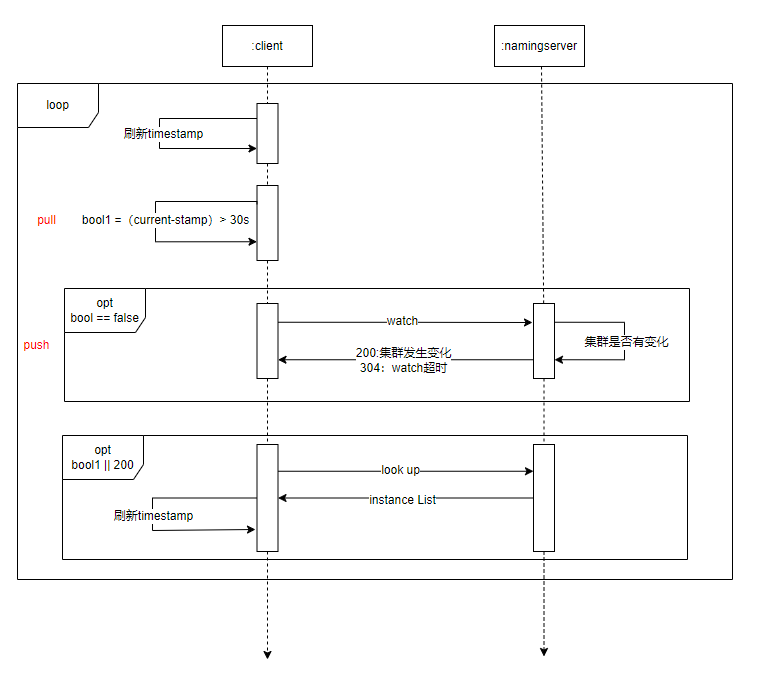
+
+
+As shown in the diagram above, every 30 seconds the client needs to send a
service discovery request to namingserver to pull the latest TC list. During
this 30-second interval, the client uses HTTP long polling to continuously
watch the namingserver node. If the namingserver side has the following changes:
+
+> 1. Changes in transaction group mapping relationships;
+>
+> 2. Addition or removal of instances in the cluster;
+>
+> 3. Changes in cluster instance properties;
+
+Then the watch returns a 200 status code, informing the client to obtain the
latest cluster information. Otherwise, namingserver will keep the watch method
pending until the HTTP long polling times out, then return a 304 status code,
telling the client to proceed with the next round of watching.
---------------------------------------------------------------------
To unsubscribe, e-mail: [email protected]
For additional commands, e-mail: [email protected]
