http://www.rferl.org/featuresarticle/2007/12/d08d2c1a-1569-4361-a2f8-ebd3c8d
f6789.html

Iran: Internet Cafes Shut Down In Drive Against Un-Islamic Behavior
By Farangis Najibullah


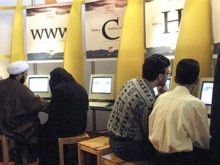
 Iran -- People surf the internet at a cafe in Tehran, 03Jun2001
<http://gdb.rferl.org/40b12b5b-2a47-4c02-b5ed-f61576b5cec9_w220.jpg>
'Immoral' games and 'improper' photos have led to the closure of many
Internet cafes
(AFP)
Police in Tehran have raided more than 430 Internet cafes and other shops
during the first days of the latest campaign against what they say is
inappropriate and un-Islamic conduct.


Iranian state media quote the police as saying that in the past few days,
they have closed down 25 Internet cafes and given warnings to 170 cafe
owners for "using immoral computer games and storing obscene photos," and
for the presence of women without "proper hijab" on the premises.

At least 23 people -- including several women -- have been detained for
similar reasons.

The owner of one of the Tehran Internet cafes that was inspected and
temporarily closed down by police, who gave his name as Hessam, told
RFE/RL's Radio Farda that police started questioning him when they found
some family photos -- with a female member of the family among them -- on a
computer.

"We had a few family photos in our system. They asked, 'Who is this girl
that is sitting close to you?'" Hessam said. "Just because of those private
photos, they closed this place for three or four days. [The police pressure]
has reached that level! It has become a headache, a problem for everybody.
We don't know what to do."

Independent Information

The Internet, and Internet cafes, have become increasingly popular in Tehran
and other Iranian cities in recent years.

According to official state figures, 60 percent of the country's population
has access to the Internet. However, independent sources say that figure is
exaggerated, given the fact that many Iranians villages do not even have
electricity. International estimates say that some 20 percent of Iranians
have access to the Internet.

Most of the customers at Internet cafes are young people who come to play
computer games, check their e-mail, or take part in website chat rooms and
blogs.

Some Iranian journalists describe the latest campaign as an attempt by the
authorities to limit access to a major source of alternative news and
information and restrict Iranian's intellectual and social freedom.

Badrolsadat Mofeedi, an independent journalist and a campaigner for media
rights, told RFE/RL from Tehran that the latest assault on Internet cafes is
no surprise. Mofeedi said that "in addition to a crackdown on independent
media, every now and then the Iranian authorities put pressure on all other
sources of news and information, such as satellite dishes, the Internet, and
even bookshops."

In October, several Tehran bookstores were given a 72-hour ultimatum to
close down coffee shops that were operating inside their stores. Amaken-e
Omomi, a state body that controls retail trade, said that operating a cafe
inside a bookshop is an "illegal mixture" of trades.

"Some Internet sites have been filtered. A variety of measures has been
taken to restrict the political and social atmosphere for those who are
involved in the distribution of the information," Mofeedi said.

'Immoral' Internet

The Iranian authorities say they have blocked access to "immoral websites"
such as pornographic sites.

According to Iranian independent journalists, however, many political
websites -- including personal weblogs or blogs -- and many independent news
sources are blocked with a filter so that Iranians cannot access them. Those
sites includes radiofarda.com.

Hassem, the Internet-cafe owner, says the "heavy filtering of the websites
has slowed down the Internet in Iran, reducing its speed by almost 50
percent."

The clampdown has coincided with the ongoing police campaign against anyone
who violates a strict Islamic dress code.

The police have even installed mobile stations on Tehran's busiest streets
to stop women who disobey the dress code, for instance by wearing a hat
instead of a head scarf or by tucking their pants inside of their boots.

Isa Saharkhiz, an independent journalist and a member of the Association for
Press Freedom in Iran, told RFE/RL from Tehran that enforcing these
restrictions -- on everything from dress to the Internet -- has been part of
the Iranian government's policy since President Mahmud Ahmadinejad came to
power in 2005.

Saharkhiz said the closure of the cafes was partially aimed at preventing
young people and intellectuals from getting together, as well as trying to
restrict the free flow of information.

"None of these practices brought any results in the past," Saharkhiz says.
"No one is able to put barriers on news and information and, especially, no
one can shut down the Internet -- in Iran or elsewhere in the world."

Cafe owner Hassem said that no matter how hard the authorities try to block
access to websites, young Iranians will succeed in circumventing the filter
and find their way to the prohibited sites.


[Non-text portions of this message have been removed]


--------------------------
Want to discuss this topic?  Head on over to our discussion list, [EMAIL
PROTECTED]
--------------------------
Brooks Isoldi, editor
[EMAIL PROTECTED]

http://www.intellnet.org

  Post message: [email protected]
  Subscribe:    [EMAIL PROTECTED]
  Unsubscribe:  [EMAIL PROTECTED]


*** FAIR USE NOTICE. This message contains copyrighted material whose use has
not been specifically authorized by the copyright owner. OSINT, as a part of
The Intelligence Network, is making it available without profit to OSINT
YahooGroups members who have expressed a prior interest in receiving the
included information in their efforts to advance the understanding of
intelligence and law enforcement organizations, their activities, methods,
techniques, human rights, civil liberties, social justice and other
intelligence related issues, for non-profit research and educational purposes
only. We believe that this constitutes a 'fair use' of the copyrighted material
as provided for in section 107 of the U.S. Copyright Law. If you wish to use
this copyrighted material for purposes of your own that go beyond 'fair use,'
you must obtain permission from the copyright owner.
For more information go to:
http://www.law.cornell.edu/uscode/17/107.shtml
Yahoo! Groups Links

<*> To visit your group on the web, go to:
    http://groups.yahoo.com/group/osint/

<*> Your email settings:
    Individual Email | Traditional

<*> To change settings online go to:
    http://groups.yahoo.com/group/osint/join
    (Yahoo! ID required)

<*> To change settings via email:
    mailto:[EMAIL PROTECTED]
    mailto:[EMAIL PROTECTED]

<*> To unsubscribe from this group, send an email to:
    [EMAIL PROTECTED]

<*> Your use of Yahoo! Groups is subject to:
    http://docs.yahoo.com/info/terms/