<http://www.dw-world.de/dw/article/0,,14786939,00.html> DW-WORLD.DE |
<javascript:window.print()> Print
26.01.2011    http://www.dw-world.de/dw/article/0,,14786939,00.html

European Muslims can do better, says leading Islamic scholar

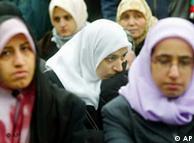
 A group of Muslim women in headscarves
<http://www.dw-world.de/image/0,,1076247_1,00.jpg>

One of Time Magazine's 100 most influential thinkers of the 21st century,
Tariq Ramadan says Islam in Europe needs to be redefined. With Islamophobia
passing the dinner-table test, his message is more urgent than ever.

According to a recent study carried out at the University of Leipzig, more
than a third of Germans believe Germany would be better off without Islam.
Last week Europe's foremost Muslim thinker, Tariq Ramadan, spoke to a
captive audience in Berlin about the tide of Islamophobia sweeping Europe
and his own vision of a "shared pluralism." A professor of Islamic Studies
at Oxford University, Ramadan is also president of the European Muslim
Network. He is a polarizing figure, seen by some as the "Muslim Martin
Luther" and by others as a master of doublespeak. He spoke to Deutsche Welle
about western perceptions of Islam today and the need for Muslims to become
full partners in democratic societies.

Is it Germans' job to understand Islam better, or is it Muslims' job to
explain Islam better?

Islamophobia and rejection of Muslims is everywhere in Europe today, and
Germany is no exception. It is a two-way process. We have to change our way
of talking about Islam, our way of creating and building the 'Other.' To
this end, it's important to work on education and a better understanding of
what Germany and Europe is today and to accept that Islam is a European
religion, because we have millions of citizens who are French, British,
German and Muslim. But Muslims as citizens have to be more vocal and
assertive by explaining their religion and the way they deal with it in
their daily lives, so that it is not only perceived as a problem but as a
gift and a positive presence.

They also need to avoid the victim mentality that might be nurtured by this
atmosphere and to avoid identifying as a minority, saying: we don't want to
be targeted, so we will isolate ourselves. No, they should do the opposite,
even though to withdraw from being visible would be a natural psychological
reaction.

In your book "What I Believe," you say that the debate about integration
borders on the obsessive and that what we need now is a 'post-integration'
approach based on contribution.

We need to stop referring to integration. By 'post-integration,' I mean that
we need to come to an understanding that the success of integration is to
stop talking about it. If we keep on repeating year after year, generation
after generation, that 'they' need to integrate, we imply that there is a
host country, and they are its immigrants. It's over! Muslims are not
immigrants in Germany. They are German, they are European.

Then, what we need to do is ask: as a member of this society, what is my
contribution going to be? If you are always perceived as 'to be integrated,'
the question is: where do you come from? We have to stop asking: where do
you come from and ask: where are we going - together?

We have to be visible and vocal not only in the religious field but
everywhere. Our contribution can be philosophical, artistic, and as I
advocate in my book, creative! To be a Muslim isn't just to say: Islam is
not violent, it is not discriminatory - no, it's more than that. It is
architecture, books, imagination, ethics. And the more you give to society,
the less you will be perceived as a negative factor.

What [controversial German author] Thilo Sarazzin basically said was: look
at these Muslims, they are a problem and they are lowering our level of
intelligence. He is wrong, of course, and this was a racist stand. But the
only way to answer it is to point to contribution. The only right answer is
practical: we have to be witnesses of the potentialities we have in our
societies to express ourselves in a positive way.

But when you have public and institutional hostility to Muslims, it
restricts the scope of their participation in social, economic, political
and cultural life. How can we break this deadlock?

When I come to Germany and other European countries I can see that, yes,
there is a trend to Islamophobia, racism and a rejection of Muslims, but
lots of people are not happy about it and know there's something wrong.

So you are right, a fracture within society is possible. But what I see
behind the scenes at the local level are a lot of Europeans willing to
listen. This should be the driving force of change: not Muslims on their
own, but Germans from different backgrounds sharing the same principle: we
are not going to allow racism to return to this country in a way that is
very, very damaging for all citizens.

 <http://www.dw-world.de/popups/popup_lupe/0,,14786939_ind_1,00.html> Tariq
RamadanBildunterschrift: Großansicht des Bildes mit der Bildunterschrift:
<http://www.dw-world.de/popups/popup_lupe/0,,14786939_ind_1,00.html>
Ramadan says European Muslims need to be visible and vocal

According to the surveys, what Germans are most bothered by is the way they
see women treated in Islam: You believe that a woman can find liberation in
Islam, that Islam was originally a feminist religion. Germans see it as
patriarchal and oppressive in its practice. How do you explain this gulf?

Because both are right. When you study the scriptural sources then you
understand that there is a message of equality and liberation. But when you
look at what Muslims are doing, Germans are not completely wrong to see a
problem. In Muslim communities, I can see myself that there is a lot of
discrimination; women are not involved in education, the mosque, not always
respected as human beings and within marriages. There is a problem. I
constantly repeat: Islam has no problem with women, but Muslims do. This is
why I train Muslim women in the way they deal with the scriptural sources
and they way they deal with the community.

The missing discourse in Islam is about women: not as mother, not as
daughter, not as sister, but woman as woman. What does spiritual liberation
of the being mean?  What do we mean by femininity and liberation? As a
woman, I don't want to be reduced to my body but you have to accept that I
have a heart, I have a soul.

Then there is the question of commitment within the community, in mosques,
in the scholarship and the legal Islamic authority. Women need to be
involved. We can't just repeat: we are equal before God and complementary in
society. The relationship between the master and the slave is complementary,
but the master is the master, and the slave is the slave.

But our fellow citizens also have a responsibility not to essentialize the
Islamic discourse and say: all Muslims are like this or this. There are very
practicing Muslim women liberating themselves from cultural oppression and
literalist understandings.

Interview: Jane Paulick
Editor: Nancy Isenson

 <http://www.dw-world.de/dw/article/0,,14786939,00.html> DW-WORLD.DE |
<javascript:window.print()> Print

| www.dw-world.de | © Deutsche Welle.

  _____

  _____


[Non-text portions of this message have been removed]


------------------------------------

--------------------------
Want to discuss this topic?  Head on over to our discussion list,
[email protected].
--------------------------
Brooks Isoldi, editor
[email protected]

http://www.intellnet.org

  Post message: [email protected]
  Subscribe:    [email protected]
  Unsubscribe:  [email protected]


*** FAIR USE NOTICE. This message contains copyrighted material whose use has
not been specifically authorized by the copyright owner. OSINT, as a part of
The Intelligence Network, is making it available without profit to OSINT
YahooGroups members who have expressed a prior interest in receiving the
included information in their efforts to advance the understanding of
intelligence and law enforcement organizations, their activities, methods,
techniques, human rights, civil liberties, social justice and other
intelligence related issues, for non-profit research and educational purposes
only. We believe that this constitutes a 'fair use' of the copyrighted material
as provided for in section 107 of the U.S. Copyright Law. If you wish to use
this copyrighted material for purposes of your own that go beyond 'fair use,'
you must obtain permission from the copyright owner.
For more information go to:
http://www.law.cornell.edu/uscode/17/107.shtmlYahoo! Groups Links

<*> To visit your group on the web, go to:
    http://groups.yahoo.com/group/osint/

<*> Your email settings:
    Individual Email | Traditional

<*> To change settings online go to:
    http://groups.yahoo.com/group/osint/join
    (Yahoo! ID required)

<*> To change settings via email:
    [email protected]
    [email protected]

<*> To unsubscribe from this group, send an email to:
    [email protected]

<*> Your use of Yahoo! Groups is subject to:
    http://docs.yahoo.com/info/terms/