I posted this on a different forum the other day and thought people here
might find it interesting. Unless I mention otherwise, all facts, figures
and graphs are from Chris Bramall's "Sources of Chinese Economic Growth"
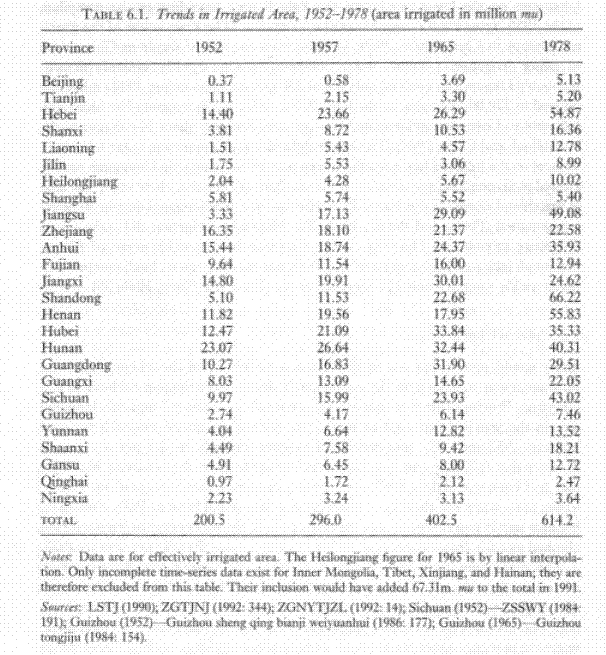
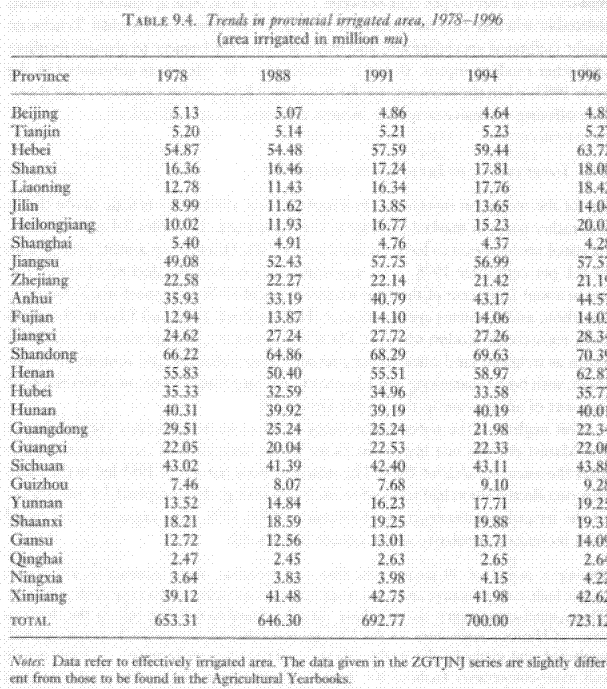
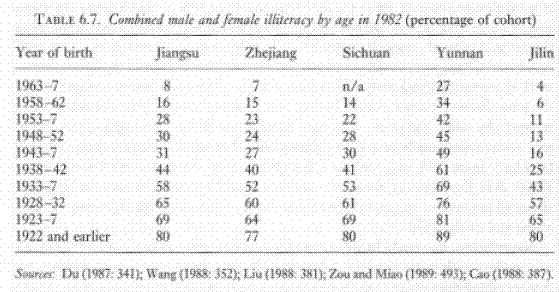
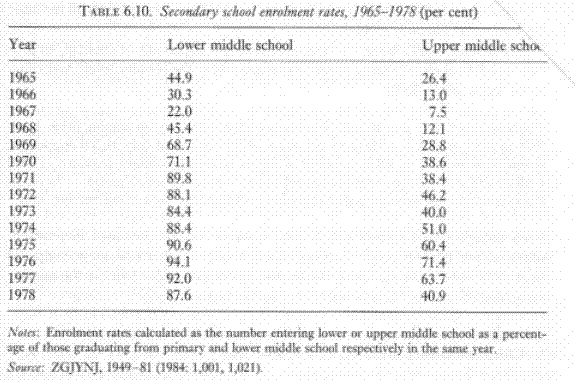
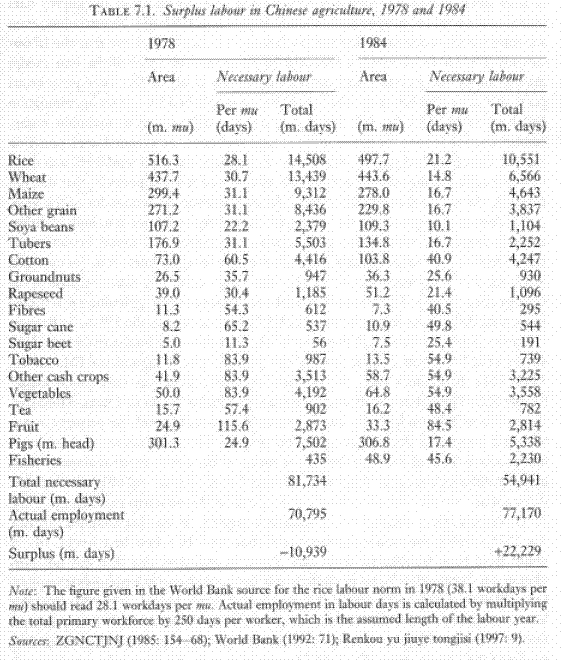
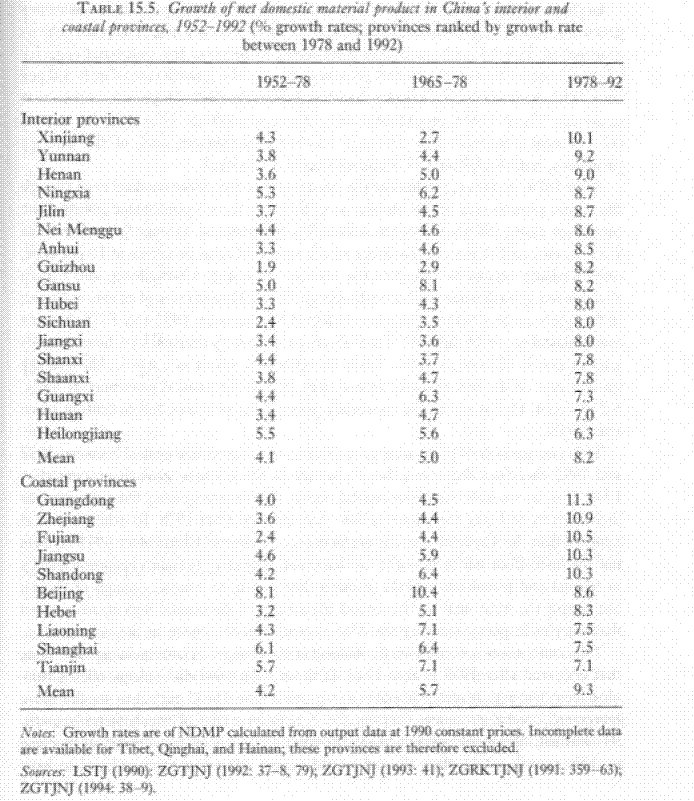
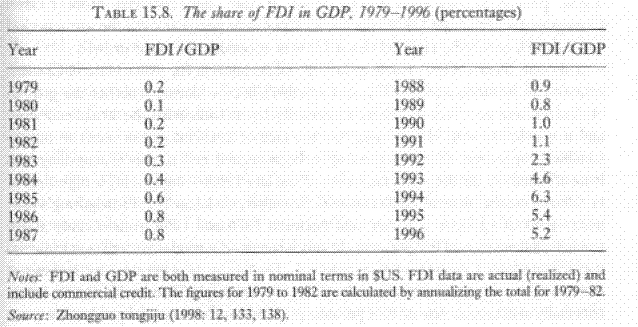
The Maoist contribution to infrastructure As we see, Irrigated area tripled over the Maoist era. In the post Mao era, the rate of growth of irrigated area was not as great, which can be explained somewhat by the fact that less was necessary by then. Now, what was the quality of this irrigation? Pretty good, in fact. We hear horror stories about Maoist irrigation being ineffective or worse, Jung Chang's latest piece of shit book is a case in point. However, Bramall reviews a ton of micro-level evidence (too much to cite here unless someone really wants it) that shows irrigation was generally pretty good about raising yields. http://img.photobucket.com/albums/v488/waltbyars/irrigation.gif http://img.photobucket.com/albums/v488/waltbyars/irrigation2.gif Under the Maoist era, railroad track increased by 3% per year, from 20k KM to 48k KM. The length of metalled roads increased at 8% per year. They both increased at much lower rates during the Dengist era, although utilization rates increased at a very high rate. Thus, mathematically, they had to have inherited substantial underutilized capacity from the previous period. Maoist contribution to education In 1982, the year of the first comprehensive census, total illiteracy was at 32%. We don't have great figures from a year like 1949 or so, but estimates from the 1930s put the male/female rural illiteracy rates at 64%/97% and the urban at 40%/85%. From the major 1982 census, we have detailed information from 5 provinces, including China's largest, on literacy rates and age structure. As is clear from this chart, during the Mao period there was a huge increase in literacy compared to the earlier period. In fact, the chart seriously understates this effect because it ignores the large impact of adult education programs ( see Lavely, Xiao, Li and Freedman "The Rise in Female Education in China" China Quarterly 121 1990). http://img.photobucket.com/albums/v488/waltbyars/education.gif Primary school enrollment in 1952 was 49%. By 1957 it was 62%. By 1965 it was 85% and 97% in 1975. No wonder literacy increased. Secondary school enrollment experienced a large upward trend as well. http://img.photobucket.com/albums/v488/waltbyars/secondary.gif China's "Agricultural Miracle" One of the biggest misconceptions is that decollectivization caused the agricultural "miracle" in China from 1980-84. This is untenable because in the 1980s, agricultural output increased at a similar rate in areas which were decollectized and not decollectivized, as well as among areas which had made different progress on the decollectivization process. Bramall makes this argument in detail in "Chinese Land Reform in the Long run Perspective and the Wider East Asian Context" Journal of Agrarian Change 4.1-2 (2004). As he states "The early group (Anhui, Gansu, Guangxi, Guizhou and Ningxia) saw their median agricultural growth rate rise from 3.5 per cent during 197680 to 9.3 per cent during 19804, a ratio (the growth bonus) of 2.7.25 However, the late group (Heilongjiang, Jilin and Liaoning provinces) did equally well; their median growth rate rose from 3.9 to 10.5 per cent." He points out also that agricultural output grew at a rate of 4.6% per annum in 1976-80, twice as high as the previous ten years. Also, the weather was much poorer during this time than before or after. However, there was no decollectivization except in parts of Anhui during this period! What did cause the miracle? Bramall documents in detail that the Chinese state had recently completed important infrastructural projects and scientific development projects of great relevance to agricultural inputs. What were the consequences of this miracle? the creation of surplus labor that could go into industry, of course. There is this myth about "surplus labor" in the Maoist period that Bramall utterly refutes in detail. Thankfully, he includes a chart the gives a good "gee whiz" statistic. At Mao's death the surplus in labor was negative(i.e. people had to work more than the typical working year in order to produce everything), the surplus was created by the agricultural miracle! http://img.photobucket.com/albums/v488/waltbyars/surplus.gif the Role of Foreign Trade and FDI The conventional wisdom holds that the role of trade in China's economy grew heavily in the post Mao period, and that this to a large extent facilitated growth. It is correct that the role of trade grew alot, but first of all its difficult to determine causality. There is lots of evidence that as economies grow, they start exporting more (see any of Dani Rodrik's writings criticizing studies that try to show cross-national correlations between growth and "openness") because it takes strong firms to be competitive in alot of export markets. The sophsiticated versions of the "trade caused growth" argument point to the greater growth of the coastal than the interior provinces. However, these coastal provinces grew more than the interior provinces during the Mao period as well. http://img.photobucket.com/albums/v488/waltbyars/provincialgrowth.gif It is very difficult to argue that FDI caused China's growth because until the mid 1990s, it was a negligible portion of investment. http://img.photobucket.com/albums/v488/waltbyars/fdi.gif Then we get to the supposedly large portion of GDP that Chinese foreign trade accounts for. The problem is that China's currency is significantly undervalued and, as is well known, their nominal GDP is seriously understated. It is almost certain that their foreign trade, however, is not understated or only neglibgibly so by the official figures. The following is Bramall's comparison of exports to GDP in purchasing power parity terms. I think PPP is a useless measure but I'll just point out that the role of exports in GDP calculated in PPP terms never gets more than 10 percent. The Third Front One of the main reasons China's economy performed better in the post Mao period is the cessation of the third front program. This was the practice of building interdependent parts of China's industry in a geographically dispersed fashion. This led to a highly inefficient use of resources, but made their industrial base capable of withstanding nuclear attack. So, it was not so unreasonable. In a way, socialism "caused" the external threats to China, but the viciousness of the capitalist powers and the USSR is no compelling argument against socialism. See Barry Naughton "The Third Front" China Quarterly 115 (1988) Industrial Policy in the Dengist Era The Chinese state employed a highly activist fiscal policy. SOE's played a big role and are generally unfairly maligned as inefficient. Large and medium sized (in the official classification) SOEs are as efficient as similar private firms. SOEs also face unfavorable tax policy, pay benefits to workers that private firms don't, and are meant to do more than just make a profit. See Dic Lo "Reappraising the Performance of China's State Owned Industrial enterprises" Cambridge Journal of Economics 23.4 (1999) The Chinese state also provided most of the capital for "township and village collective enterprises" and does so in a discriminatory manner. There is a debate over whether these enterprises are dee facto capitalist firms or not, but what isn't debatable is that they were the driving proximate force in China's growth, at least in interior provinces. Jean c. Oi's book Rural China Takes Off is the best source on what she calls "Local State Corporatism" The Chinese statee also intervened heavily in trade and invested in lots of scientific development. Now, I will leave to the interested reader to read Bramall's book (I've never heard of someone who read it and wasn't convinced) or, alternatively, to debate me on specific issues at hand and I'll go in to as much depth as necessary. Obviously, I didn't prove beyond doubt all my claims about what the Chinese state did but I am intending to just muddy the waters as I see people citing China's experience as a self evident example of the virtues of neoliberalism. However, again, if you want me to provide a more in depth argument for you then I probably will. I also don't intend for this post to be some general endorsement of Maoism, although it is no secret I have a positive view of it. I don't want this thread to turn into a debate about anything Mao other than his legacy for China's "Economic miracle"