2009/2/22 Alexandre Bergel <[email protected]>:
> Thanks to all of you for your prompt answer.
>
>> You could test before drawing if the shape is visible at all, however
>> in my experience you do not gain any speed because the graphic engine
>> is much faster at performing such tests. At some points I also
>> experimented with R- and Generalized Search Trees, but I figured out
>> that in most cases it is not worth the troubles. For Mondrian
>> visualization the whole dataset is normally displayed anyway. These
>> kind of trees only bring speed improvement, if typically only a
>> fraction of a huge amount of data is visible, like this is the case in
>> a game world or a CAD application.
>
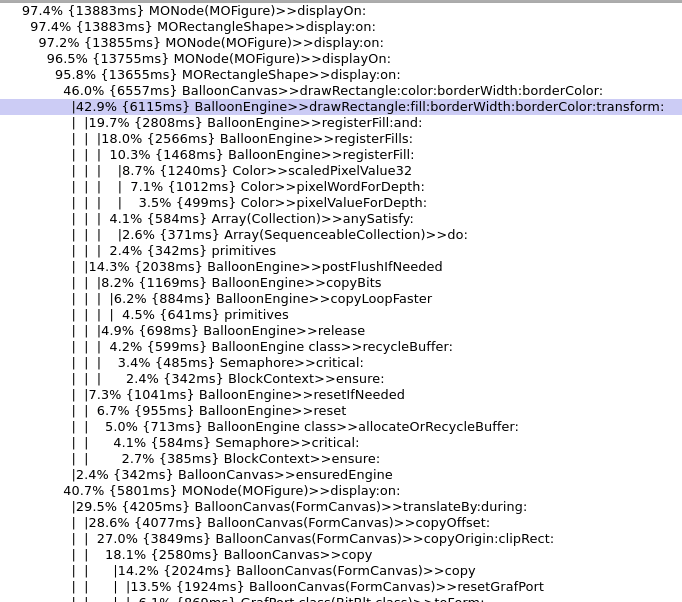
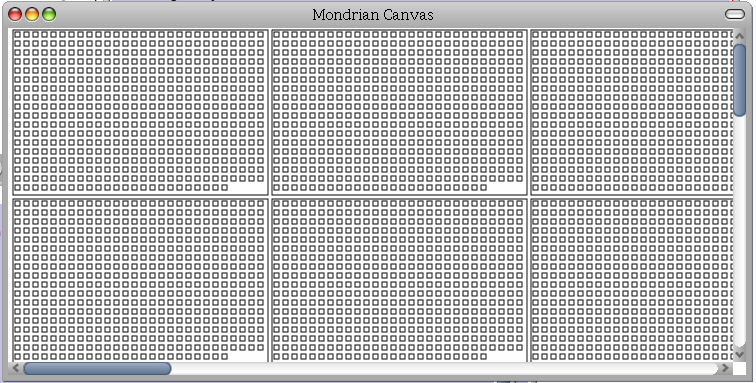
> This is also what I would expect. But Apparently, displaying a lot of
> nodes outside the window slow the whole thing down.
>
> I get this profiling: http://bergel.eu/Picture1.png
> For this window being displayed: http://bergel.eu/Picture2.png
>
> I think I will try to the display boxes that I am sure they are
> contained in the visible part of the window. The polymorph extension
> seem to ease this.
>
you can test whether you drawing primitive is visible on the screen:
canvas isVisible: aRectangle
> Thanks again,
>
> Cheers,
> Alexandre
>
> --
> _,.;:~^~:;._,.;:~^~:;._,.;:~^~:;._,.;:~^~:;._,.;:
> Alexandre Bergel  http://www.bergel.eu
> ^~:;._,.;:~^~:;._,.;:~^~:;._,.;:~^~:;._,.;:~^~:;.
>
>
>
>
>
>
> _______________________________________________
> Pharo-project mailing list
> [email protected]
> http://lists.gforge.inria.fr/cgi-bin/mailman/listinfo/pharo-project
>


--
Best regards,
Igor Stasenko AKA sig.

_______________________________________________
Pharo-project mailing list
[email protected]
http://lists.gforge.inria.fr/cgi-bin/mailman/listinfo/pharo-project