http://arstechnica.com/information-technology/2013/12/inside-the-nsas-leaked-catalog-of-surveillance-magic/
*Your USB cable, the spy: Inside the NSA’s catalog of surveillance magic*

*Latest batch of documents leaked shows NSA's power to pwn.*

by Sean Gallagher <http://arstechnica.com/author/sean-gallagher/> - Dec 31
2013, 8:15am EST

   - Cyberwar <http://arstechnica.com/discipline/cyberwar-2>
   - National Security<http://arstechnica.com/discipline/national-security-2>

240<http://arstechnica.com/information-technology/2013/12/inside-the-nsas-leaked-catalog-of-surveillance-magic/?comments=1>

[image:
http://cdn.arstechnica.net/wp-content/uploads/2013/12/nsa-ant-swap-640x424.jpg]

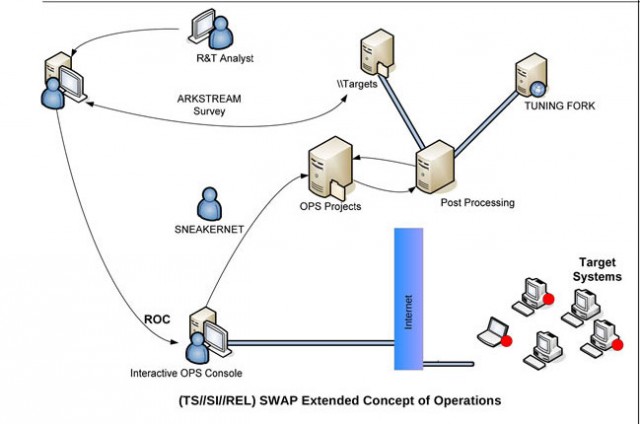
A diagram of an NSA BIOS-based attack, brought to you by sneakernet.

*NSA leaks*

   - Report: Obama set to approve “public advocate” position, more NSA

reforms<http://arstechnica.com/tech-policy/2014/01/report-obama-set-to-approve-public-advocate-position-more-nsa-reforms/>
   - NSA dreams of quantum computer that can break
encryption<http://arstechnica.com/information-technology/2014/01/nsa-dreams-of-quantum-computer-that-can-break-encryption/>
   - Snowden speaks from Moscow: “The mission’s already
accomplished”<http://arstechnica.com/tech-policy/2013/12/snowden-speaks-from-moscow-the-missions-already-accomplished/>
   - Feds admit start of NSA surveillance, still say it’s too secretive for

court<http://arstechnica.com/tech-policy/2013/12/feds-admit-start-of-nsa-surveillance-still-say-its-too-secretive-for-court/>
   - US changes its mind, tells FISA Court it’s cool to publish metadata

rulings<http://arstechnica.com/tech-policy/2013/12/us-changes-its-mind-tells-fisa-court-its-cool-to-publish-metadata-rulings/>

View all… <http://arstechnica.com/series/nsa-leaks/>

The National Security Agency’s sophisticated hacking operations go way
beyond using software vulnerabilities to gain access to targeted systems.
The agency has a catalog of tools available that would make James Bond’s Q
jealous, providing NSA analysts access to just about every potential source
of data about a target.

In some cases, the NSA has modified the firmware of computers and network
hardware—including systems shipped by Cisco, Dell, Hewlett-Packard, Huawei,
and Juniper Networks—to give its operators both eyes and ears inside the
offices the agency has targeted. In others, the NSA has crafted custom BIOS
exploits that can survive even the reinstallation of operating systems. And
in still others, the NSA has built and deployed its own USB cables at
target locations—complete with spy hardware and radio transceiver packed
inside.

Documents obtained by *Der Spiegel
<http://www.spiegel.de/international/world/catalog-reveals-nsa-has-back-doors-for-numerous-devices-a-940994.html>*reveal
a fantastical collection of surveillance tools dating back to 2007
and 2008 that gave the NSA the power to collect all sorts of data over long
periods of time without detection. The tools, ranging from back doors
installed in computer network firmware and software to passively powered
bugs installed within equipment, give the NSA a persistent ability to
monitor some targets with little risk of detection. While the systems
targeted by some of the “products” listed in the documents are over five
years old and are likely to have been replaced in some cases, the methods
and technologies used by all the exploit products could easily still be in
use in some form in ongoing NSA surveillance operations.

*Special delivery*

There’s no indication from the documents that the manufacturers played any
role in the development or delivery of the backdoors (something that
manufacturers are now loudly telling their customers, too). The documents,
which appear to be pages from a catalog of capabilities provided by the
NSA's ANT division for the NSA’s Tailored Access Operations (TAO) division,
show that many of the tools on offer are ordinary Windows exploits designed
to use parts of the operating system to “phone home” to the NSA with data;
like most malware, these packages can be dropped in place remotely and are
probably the least interesting of the new revelations.

Hardware- and firmware-based backdoors, by contrast, require laying hands
on the actual target systems. In some cases, the NSA’s operators install
backdoor hardware and firmware directly onto the systems by
“interdiction”—the systems are diverted during shipping to “load stations”
where the surveillance components are installed. (This interception may
have been accomplished with the cooperation of shipping companies or other
government agencies; details of the process remain murky.) In other cases,
the NSA uses an insider with a USB device or remote access tools deployed
by other means to gain access to computer systems, allowing the NSA to
“reflash” their low-level BIOS firmware.

Either way, the altering of systems’ firmware or hardware gives the NSA the
ability to install backdoors that can survive a total operating system wipe
and re-installation. One BIOS attack, called SWAP, was developed by the NSA
to attack a number of types of computers and operating systems by loading
surveillance and control software at boot-up. SWAP uses the Host Protected
Area on a computer’s hard drive to store the payload and installs it before
the operating system boots.

More specialized BIOS attacks were developed to take advantage of
motherboard-based System Management Mode (SMM) capabilities on Dell and
Hewlett-Packard servers. Dell PowerEdge servers were targeted with an
implant called DEITYBOUNCE, while HP Proliant 360DL G5 servers were
targeted with one called IRONCHEF. Both allowed NSA operators to gain
remote control of systems in SMM mode—giving the agency firmware-level
control over infected servers and the ability to do things like run
“rootkits” on the server operating system.

[image:
http://cdn.arstechnica.net/wp-content/uploads/2013/12/nsa-ant-ironchef.jpg]

The ANT "product" listing for IRONCHEF, the BIOS attack on HP servers,
showing an example attack scenario where remote operators use a covert
wireless network to take control of servers.

Network hardware is also a target for the NSA’s BIOS attacks. For example,
one collection of BIOS hacks called the “MONTANA” family  (SCHOOLMONTANA,
SIERRAMONTANA, and STUCCOMONTANA), was designed to target Juniper Networks
routers using the JUNOS operating system—a FreeBSD derivative. Once
installed, the hacked BIOS actually modifies the operating system kernel in
memory when the router is booted, giving an NSA remote operations center
full command and control over the router and allowing for selected network
traffic to be sent back to the operations center over an external network
connection. Even physically replacing the CompactFlash memory card the
router boots from wouldn't get rid of this back door.

Juniper routers weren’t the only targets of these sorts of BIOS “implants,”
either—firewalls and routers from Cisco and Huawei were also on the 2007
menu for firmware and software exploits. Such router exploits didn’t even
require interception of the hardware but could in many cases be remotely
installed by way of another hack.

For systems where a BIOS hack is impractical, the NSA has other tools to
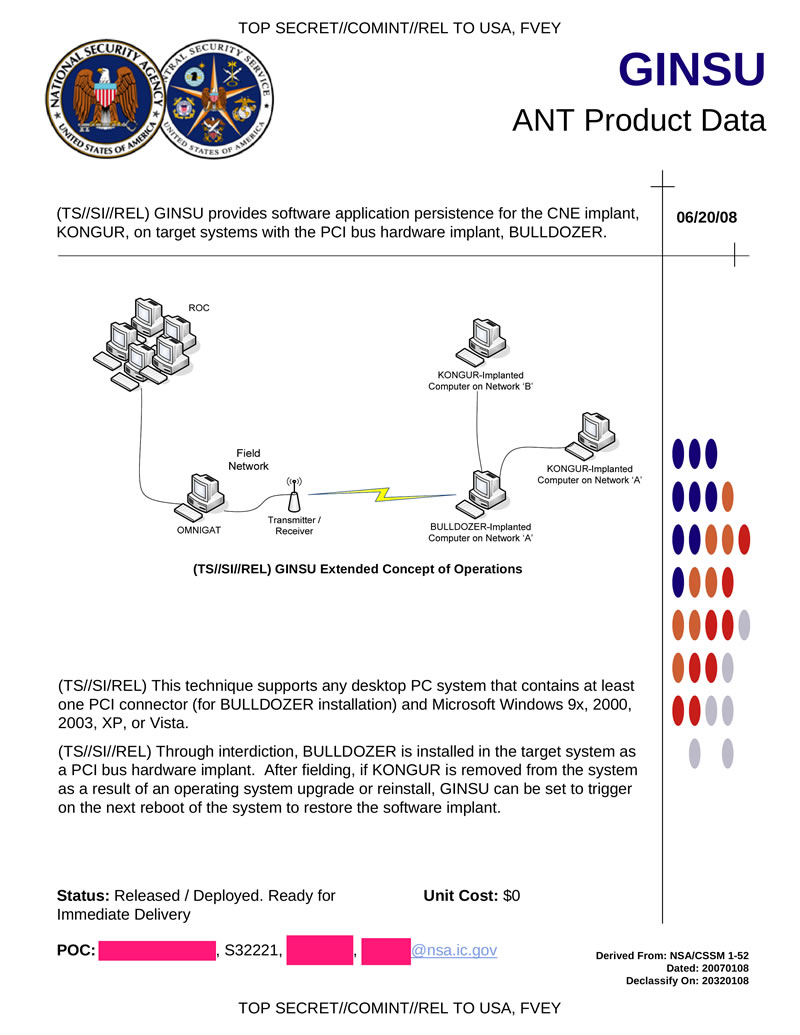
install a persistent backdoor. One, called GINSU, uses a PCI bus device
installed on the computer. An implant called BULLDOZER creates a stealth
wireless bridge, providing radio-based remote control of the backdoor to
TAO operators. If the rootkit on the system (called KONGUR) is removed by a
system re-installation, the GINSU backdoor can re-install the software on
the next boot-up.

[image:
http://cdn.arstechnica.net/wp-content/uploads/2013/12/nsa-ant-ginsu-640x828.jpg]<http://cdn.arstechnica.net/wp-content/uploads/2013/12/nsa-ant-ginsu.jpg>

Enlarge<http://cdn.arstechnica.net/wp-content/uploads/2013/12/nsa-ant-ginsu.jpg>/
GINSU allows the NSA to slice and dice computers' hard drives and
control
them remotely over a covert radio connection.

*Reach out and touch someone*

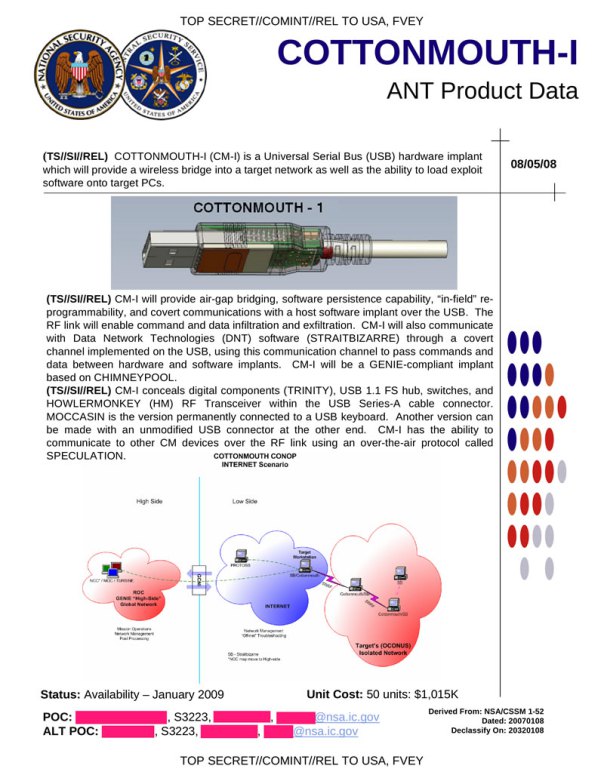
An implanted wireless device is the NSA’s go-to approach for dealing with
“air-gapped” networks—networks that don’t have an Internet connection for
security reasons. There are a number of other implanted devices that the
NSA has in its TAO arsenal, including USB and Ethernet implants that can
transmit short-range radio signals and more robust implanted hardware for
longer-range transmissions. These radio links create a shadow Internet that
allows the NSA to move data out of an adversary’s network and into its TURMOIL
and X-KEYSCORE collection
system<http://arstechnica.com/information-technology/2013/08/building-a-panopticon-the-evolution-of-the-nsas-xkeyscore/>
.

[image:
http://cdn.arstechnica.net/wp-content/uploads/2013/12/nsa-ant-cottonmouth-i.jpg]

The COTTONMOUTH series of implants are USB devices that provide a covert
wireless bridge into a target network. They can be integrated into any USB
plug, so check your mouse.

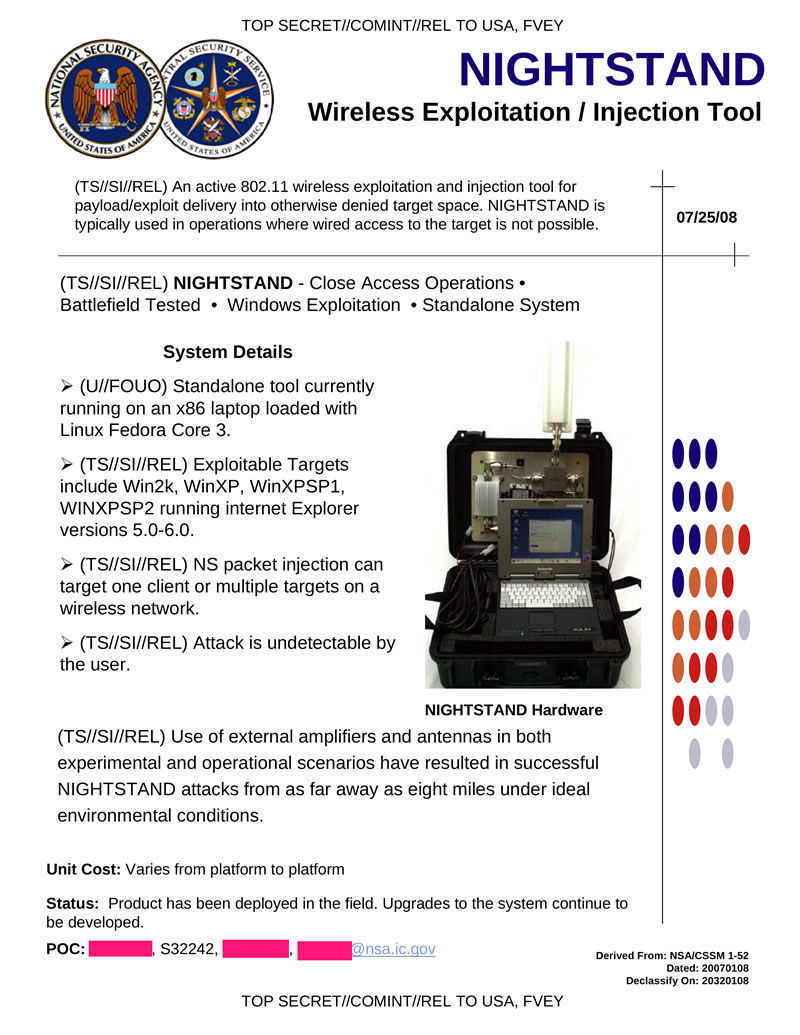
For networks that the NSA can't get to physically, there's NIGHTSTAND, a
self-contained Wi-Fi hacking system that can break into networks up to
eight miles away, in optimum conditions. NIGHTSTAND hijacks the target
network and uses packet injection attacks to install exploits on the target
network's computers. Combined with a Windows exploit called SOMBERKNAVE,
which uses a computer's Wi-Fi adapter to "phone home" with data, it could
be used to collect data from target computers even when they're not
intentionally connected to a network.

[image:
http://cdn.arstechnica.net/wp-content/uploads/2013/12/nsa-ant-nightstand-640x828.jpg]<http://cdn.arstechnica.net/wp-content/uploads/2013/12/nsa-ant-nightstand.jpg>

Enlarge<http://cdn.arstechnica.net/wp-content/uploads/2013/12/nsa-ant-nightstand.jpg>/
According to the ANT catalog, the NIGHTSTAND Wi-FI exploit system's
attack is "undetectable by the user."

But why stop at network data? The NSA also uses some fairly exotic tools to
grab computer video, keyboard strokes, and even audio from inside more
difficult-to-reach places by using passive electronic devices that are
actually *powered by radar*. These devices, charged by a specially tuned
continuous wave radio signal sent from a portable radar unit (operating at
as little as 2W up to as much as 1kW of power in the 1-2GHz range), send
back a data stream as a reflected signal, allowing the NSA’s operators to
tune in and view what’s happening on a computer screen or even listen to
what’s being said in the room as they paint the target with radio frequency
energy—as well as giving a relative rough location of devices within a
building for the purposes of tracking or targeting.

*Hacking smartphones*

The 2007 NSA wish book for analysts also includes a number of software
tools that allow data to be stolen from a variety of smartphones and dumb
cell phones. One software hack, called DROPOUTJEEP, is a software implant
for Apple iOS devices that allows the NSA to remotely control and monitor
nearly all the features of an iPhone, including geolocation, text messages,
and the microphone and camera. (Researcher and developer Jake Appelbaum,
who helped write the *Spiegel* article revealing the documents, said
separately this week that the NSA claims DROPOUTJEEP installations are*
always* successful <http://privacysos.org/node/1288>.) Another package,
called TOTEGHOSTLY, does the same for phones based on the Windows Mobile
embedded operating system.

Both the DROPOUTJEEP and TOTEGHOSTLY releases mentioned in the 2007 product
listing required “close access methods” for installation—in other words, a
human being getting up close and personal with the phone to install it. “A
remote installation capacity will be pursued for a future release,” the
document states. But another tool, called MONKEYCALENDAR, allowed the NSA
to remotely install location-tracking software onto any GSM phone by way of
a software implant for SIM cards.

But these aren't the only way the NSA can get to cell phone data. Also in
the bag of tricks are a number of wireless monitoring devices, as well as
“networks in a box” and other gear that can pose as cell towers and
networks—intercepting devices as they enter an area and grabbing up their
voice, data, and SMS traffic. A "tripwire" program called CANDYGRAM can
send out alerts whenever a cell phone hits a specified cell tower.

*Old tricks, new tricks*

It’s important to note that the exploits in the documents are largely over
five years old, so they don’t necessarily give a complete picture of what
the NSA is capable of today. That doesn’t mean that these techniques are no
longer in circulation—given the stubbornness of Windows XP, many of the
exploits developed for older Windows platforms may have years left in them,
and some of the adversaries the NSA is trying to monitor don’t have Fortune
500 hardware refresh rates.

A frequent defense of what the NSA does with its bag of tricks is that in
many ways it is no different from what other countries (including China,
Russia, and France) try to do to the United States and other countries via
their intelligence organizations. These documents show the key way the NSA
is different—its vast technical resources and ability to essentially put
itself into the supply chain for technology flowing to the rest of the
world. US officials have long suspected China of doing the same thing with
hardware from companies such as Huawei and ZTE, but these documents
essentially spell out that "interdiction" is part of the US intelligence
strategy, too.

The exposure of the techniques and capabilities of the NSA creates another
problem for the agency, in that it provides those hard-to-get-at
organizations the TAO was created to go after with an idea of how the NSA
has targeted and will target them. It also creates a problem for companies
like Cisco and Juniper, who now face the same sort of scrutiny the US and
others put Huawei under for its connections to the Chinese military. Even
if Dell, HP, Cisco, and Juniper had no hand in creating the backdoors for
their products, the documents will undoubtedly be used against them the
next time they try to sell hardware to a foreign government.


__._,_.___


__,_._,___

--
--
Thanks for being part of "PoliticalForum" at Google Groups.
For options & help see http://groups.google.com/group/PoliticalForum

* Visit our other community at http://www.PoliticalForum.com/
* It's active and moderated. Register and vote in our polls.
* Read the latest breaking news, and more.

---
You received this message because you are subscribed to the Google Groups
"PoliticalForum" group.
To unsubscribe from this group and stop receiving emails from it, send an email
to [email protected].
For more options, visit https://groups.google.com/groups/opt_out.
<<image002.png>>
<<image001.png>>
<<image003.png>>