*August 2014*
The Tower Magazine <http://www.thetower.org/magazine>
Qatar’s Rise and America’s Tortured Middle East Policy

[image: Jonathan Spyer]
*Jonathan Spyer* <http://www.thetower.org/?author=41>

Senior Fellow at the Inter-Disciplinary Center at Herzliya.
How did it happen that Washington has such close relations with a country
actively and massively sponsoring terror, even after 9/11? One of the most
notable aspects of the current conflict between Israel and Hamas in Gaza is
the prominent role being played by the Emirate of Qatar in supporting the
terrorist organization, whose genocidal charter calls for the murder of
Jews and destruction of Israel.

Emir Sheikh Tamim Bin Hamad al-Thani, the leader of the Emirate of Qatar,
is acting as Hamas’ “channel of communication” to the international
community. Hamas leader Khaled Mashaal is now in the Qatari capital of Doha
directing his organization’s war effort in Gaza, where the Qatari royals
welcomed him with open arms after his welcome in Damascus came to an abrupt
end.  Qatari funds have been crucial to Hamas’ military build-up in recent
years, as they were to the Muslim Brotherhood’s attempted takeover of Egypt
under Mohammed Morsi. And the Doha-based satellite channel Al-Jazeera is
energetically backing Hamas, as it has other terrorist-connected and
supporting movements.

Yet Qatar is not part of the regional bloc of anti-Western states and
movements led by the Islamic Republic of Iran. While Qatar has a far warmer
relationship with Tehran and Hezbollah than others Arabs states, it also
remains America’s landlord, handsomely leasing the U.S. military
its largest foreign air base in the world—Al-Udeid. Nor has Qatar
consistently pursued a policy of unremitting, unambiguous hostility to
Israel. In fact, Doha maintained a trade mission in Israel until the
2008 Operation Cast Lead, also aimed at stopping Hamas rocket attacks on
Israel.

At least for now, Qatar’s clear support for a designated terrorist
organization does not appear to be hampering its flourishing relations with
the West. In recent days, at a time when Hamas was openly engaged in
attempts to murder Israeli civilians, it was announced that Qatar had
sealed an arms deal with the U.S. worth $11 billion. The deal includes the
purchase of Apache attack helicopters, as well as Javelin and Patriot air
defense systems. Indeed, last December, the U.S. signed a 10-year Defense
Cooperation Agreement with the Emirate.

Ironically, Qatar’s relations with fellow Arab states have been far less
cozy, even downright hostile. Qatar’s massive funding of terrorists and
support of Islamic radicals seeking to destabilize neighboring Arab
governments, has sharpened tensions in the region, highlighting the three
way divide in today’s Middle East – moderate and Western-oriented Sunni
Arab states, like the Egypt, Jordan, UAE, Saudi, Bahrain, Kuwait and
others; the Sunni extremists terrorist supporting states, Qatar and Turkey,
who fund and promote forces like the Muslim Brotherhood and Hamas; and the
dangerous and radical axis of Iran, Assad, and Hezbollah. In recent weeks,
the U.S. appeared to momentarily favor the Qataris—alongside the Hamas
supporting government of Turkey —over Egypt in the diplomatic effort to end
the Gaza conflict. On July 26, Secretary of State John Kerry met with the
foreign ministers of Turkey and Qatar in Paris as part of his attempt to
broker a ceasefire between Israel and Hamas. Egypt and Israel were
furious—and so was the Palestinian Authority. PA officials blasted the U.S.
for “appeasing” Qatar, and referred to the Paris meeting as a gathering of
“friends of Hamas.”

This move, fronted by John Kerry, was especially ironic, given his personal
record on the fundamental contradiction posed by Qatar and its support for
terrorism.  It was Kerry himself, speaking at the Brookings Institution in
March 2009, shortly after the last defensive war Israel waged against
Hamas, who *warned that*
<http://www.brookings.edu/~/media/Events/2009/3/04%20leadership/0304_leadership.PDF>
“Qatar
cannot continue to be an American ally on Monday that sends money to Hamas
on Tuesday.”

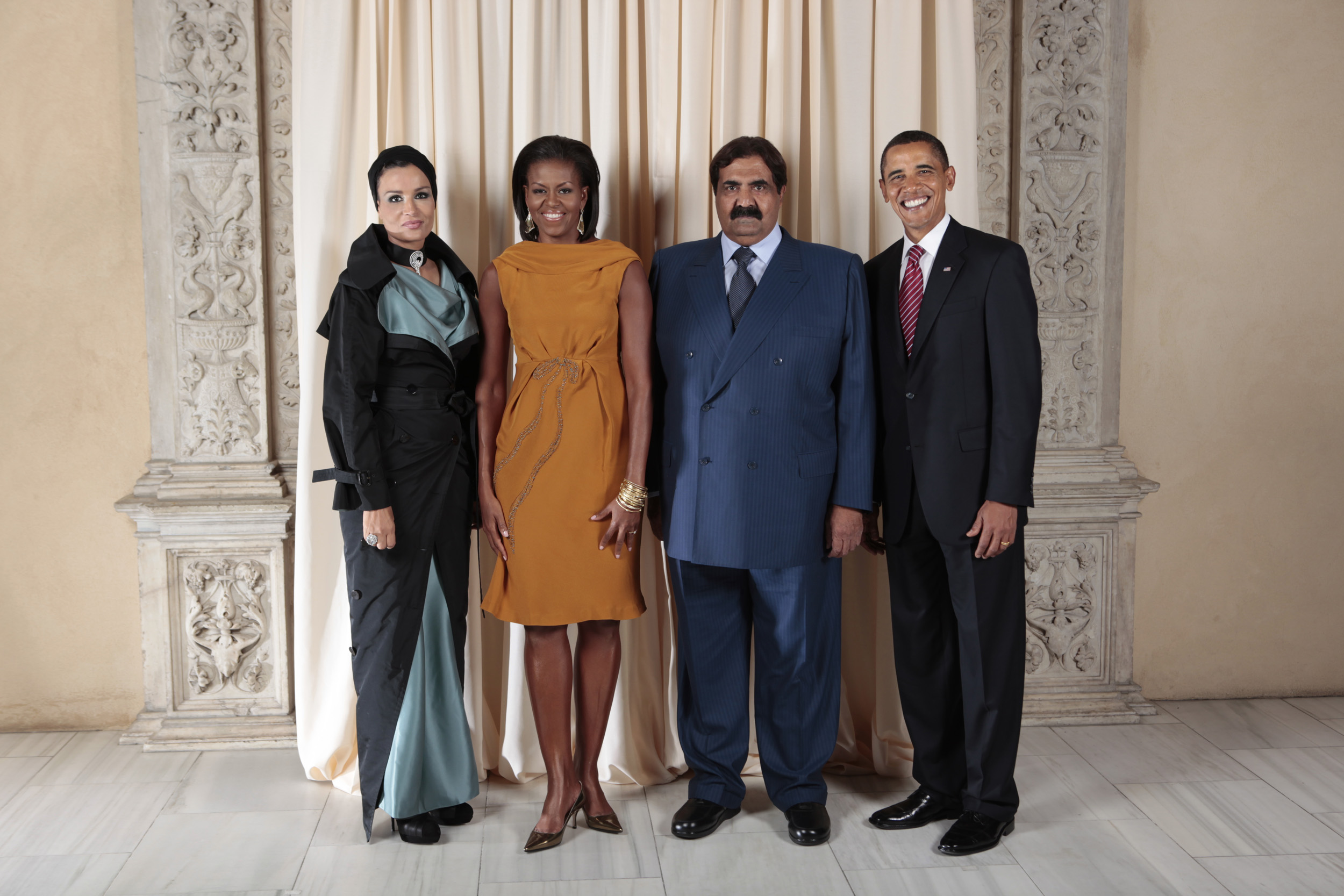
*[image: President Barack Obama and First Lady Michelle Obama pose for a
photo during a reception at the Metropolitan Museum in New York with His
Highness Sheikh Hamad Bin Khalifa Al-Thani, Emir of the State of Qatar, and
H.H. Sheikha Mozah Consort of H.H. The Emir of the State of Qatar,
Wednesday, Sept. 23, 2009. Photo: Lawrence Jackson / U.S. Department of
State / flickr]*
<http://www.thetower.org/wp-content/uploads/2014/07/3949395199_c7cbb46ebe_o.jpg>

President Barack Obama and First Lady Michelle Obama pose for a photo
during a reception at the Metropolitan Museum in New York with His Highness
Sheikh Hamad Bin Khalifa Al-Thani, Emir of the State of Qatar, and H.H.
Sheikha Mozah Consort of H.H. The Emir of the State of Qatar, Wednesday,
Sept. 23, 2009. Photo: Lawrence Jackson / U.S. Department of State / flickr

In one of the most telling responses to the disturbing shift on ceasefire
terms, an unnamed PA official quoted by the respected *Sharq al-Awsat*newspaper
said that Kerry was seeking to sabotage the Egyptian peace effort by
offering his own plan “in order to restore the influence of the Muslim
Brotherhood in the region.”

The official explained the U.S. stance by suggesting that the Americans
“wrongly believe that moderate political Islam, represented by the Muslim
Brotherhood, would be able to combat radical Islam.” He further contended
that PA President Mahmoud Abbas was furious with the attempt to hold
“Palestinian blood” hostage to “regional rivalries.”

More substantively, the ceasefire proposal formulated by the U.S. and
rejected by Israel on July 25 was seen by many observers, in Israel and
beyond, as leaning toward the Qatari-Turkish ceasefire plan, and away from
that proposed by Egypt, which Israel had already accepted.

The proposal did not refer to the need to dismantle the tunnel system built
by Hamas or ensure the demilitarization of the Gaza Strip—both key war aims
for Israel. Yet Kerry’s proposal did support a number of Hamas’ key
demands, including the opening of border crossings and the need to pay the
salaries of civil servants in Gaza.

So what is going on? Why has Qatar emerged as the key backer of the Muslim
Brotherhood in Egypt and Hamas and its control of Gaza? What are the
implications for Israel and the West of this stance? Why has the U.S.
tolerated Qatar’s increasingly shift away from longstanding American
interests and allies in favor of adversaries like Hamas and Tehran? And why
is Qatar’s pro-Hamas position so far having no effect on its relations with
the U.S. and the West in general, who regard Hamas as an
unrepentant terrorist organization?
Qatar’s support for Hamas is part of a broader regional policy of building
a strategic partnership with the Muslim Brotherhood movement, of which
Hamas is an offshoot. Sheikh Yusuf al-Qaradawi, the movement’s most famous
and influential preacher, is a resident of the Qatari capital. His sermons,
broadcast on Al-Jazeera from Qatar, replete with anti-Semitic hatred and
loathing for Israel, are listened to by millions. Qatar supported the
Muslim Brotherhood in its push for power in Egypt, and was a major
financier of the Morsi government during its chaotic and disastrous year in
power. Many Egyptian Brotherhood leaders have now found refuge in Qatar.
The Emirate has also promoted militias supportive of Muslim
Brotherhood-type ideology in the Syrian civil war, such as the Tawhid
Brigade in Aleppo, and alongside Turkey, supported groups even more radical.

>From 2011 to 2013, it looked like the alliance between Qatar and the Muslim
Brotherhood was about to emerge as a major Middle Eastern power bloc. In
early 2013, the movement held power in Egypt and Tunisia. The Syrian rebels
looked set for victory, having taken control of much of Aleppo and broken
into the eastern suburbs of Damascus. Qatar’s enormous wealth, deriving
from its extensive natural gas reserves, was financing all of this. And its
influential Al-Jazeera channel was celebrating it.

In this period, Hamas drew closer to Qatar. Hamas found itself facing a
dilemma when the Arab revolutions of 2011-12 took place, particularly as
the attempted Syrian revolution became a bloody civil war. Since the early
1990s, Hamas, which emerged out of the Palestinian branch of the Muslim
Brotherhood, had been a member of the so-called “resistance axis” led by
Iran. This alliance included the Assad regime in Syria, Hezbollah in
Lebanon, Palestinian Islamic Jihad, and a number of other elements.

The growth of a new, Brotherhood-centered regional bloc represented both a
dilemma and an opportunity for Hamas. On the one hand, the movement was
thrilled by the bloc’s emergence, and particularly by the Brotherhood’s
rise to power in Egypt. For Hamas, this represented a potential
game-changer. It now expected to have an overtly sympathetic regime to the
immediate south of Gaza.

Why is Qatar’s pro-Hamas position having no effect on its flourishing
relations with the U.S. and the West in general, who regard Hamas as an
unreconstructed terrorist organization?

But the importance of the Brotherhood’s rise in Egypt was not merely
geographical. With its ideological confreres in power in the most populous
and traditionally most influential Arab country, Hamas could begin to
seriously contemplate a future in which it would entirely eclipse its Fatah
rivals and emerge as the dominant party among the Palestinians.

Due to its Iranian leadership, the “resistance bloc” had always been
vulnerable to the charge that it represented a “foreign” non-Arab and
non-Sunni interest. No such charge could be leveled against Qatar or a
Muslim Brotherhood-led Egypt. Hamas was a natural fit for this emerging
Sunni extremist Islamist bloc. But moving toward this bloc also meant that
the movement would in effect be distancing itself from its mainly Shia
allies in the “resistance” bloc. Because the two blocs were effectively at
war in Syria, it seemingly eased the decision.

Hamas made its choice. Over the course of 2012,
following Hamas’ condemnation of Assad’s shelling of Palestinians in Syria
which precipitated a schism with Assad and strained their ties with his
backers in Tehran, the movement’s leadership cadres departed the Syrian
capital of Damascus. Doha and to a lesser extent Cairo became the new home
of the Hamas leadership.

Ties with Iran were not entirely severed, however. Teheran remained a
crucial source of arms to Hamas’ Gaza enclave. But Qatar and Turkey were
set to emerge as Hamas’ main political and financial backers.

Sheikh Hamad bin Khalifa al-Thani, the then-Emir of Qatar, visited Gaza in
October 2012, cementing the new alliance. At the same time, Qatar pledged
$400 million to Gaza. Because the alliance with the Muslim Brotherhood was
undertaken in order to acquire regional diplomatic and strategic influence,
and support for the Palestinians remains an important tool to generate
legitimacy in the Sunni Arab world, sponsorship of Hamas formed an
important part of this larger project.

But in recent months, a problem has emerged for both Hamas and Qatar:
Things have not turned out as they had hoped. Their regional ambitions are
largely in ruins. And their enemies have proved more resilient than they
expected. General Abd al-Fattah al-Sisi’s military takeover of July 3, 2013
abruptly ended the Brotherhood’s rule in Egypt. In Tunisia, the Nahda party
peacefully gave up power. The Syrian rebellion has run aground and is now
in disarray—pushed back by both the Assad regime and the murderous Islamic
State (IS) forces.

Today, the alliance of Egypt, Saudi Arabia, and other moderates is the
strongest force among the Sunni Arab states. Qatar has few regional allies
left. Neither does Hamas. Indeed, over the last year, the movement has been
trying to regain favor with the Iranians. So the war on Israel, supported
by Qatar, was a desperate move by Hamas. Broke and presiding over a failed
economy, unable to break through Egypt’s sealed border and restored power,
the terrorist group and its allies sought escalation with Israel. It was
a way for the Emirate and its Muslim Brotherhood partner to try and achieve
a return to relevance and influence, and to end a period in which Qatar’s
regional star appeared to be fading. Notably, of Hamas’ *initial five
demands*
<http://www.thetower.org/0652-idf-launches-operation-protective-edge-to-stop-hamas-onslaught/>
to
end the conflict, only one was of Israel, while four were of Egypt.
Qatar’s aid to Hamas is not military, but it is hugely important
nonetheless. It doesn’t supply weapons to Hamas, and as a purchaser of U.S.
weapons systems, it is not in a position to do so. Instead, Hamas acquires
its weapons from Iran and Syria, or its own domestic production capacities.

Qatar’s support is financial, and very considerable indeed. Hamas has been
in financial straits since 2012, when Iranian financial support declined.
Then, after the Egyptian military coup of July 2013, the Sisi government in
Cairo began to destroy the tunnel system which had served as a lucrative
source of income for Hamas members. The movement controlled access to the
tunnels and charged Gazans for using them. Hamas itself also used the
tunnels to smuggle in weapons and funds.

The tunnels’ destruction thus left the movement increasingly strapped for
cash. Qatar attempted to step in by transferring funds to Hamas in order to
help pay the salaries of 40,000 civil servants in Gaza. (The transfer was
blocked by the U.S., and so far no bank has been willing to risk sanctions
to do so. Getting the money has been one of Hamas’ key demands for ending
the recent conflict.)

Qatar also championed the cause of Hamas in Arab diplomatic forums. In
recent days, for example, the Arab League backed the Egyptian ceasefire
plan, which effectively called for a restoration of the *status quo ante
bellum*. But Qatar formulated its own plan, together with non-Arab,
pro-Brotherhood Turkey, which was far more favorable to Hamas’ demands.

As can be seen from the resulting diplomacy, Qatari support for Hamas has
had the effect of “sanitizing” the movement, allowing it to present itself
as a normal political actor, rather than a terrorist group committed to the
destruction of Israel and the murder of Jews.

This is partly because Qatar is regarded in Western capitals as a
legitimate regional actor. The fury now felt toward it by the main bloc of
Sunni Arab states is not shared in Europe or the U.S. As a result, Qatar is
able to insert Hamas’s demands into the negotiations for ending the current
conflict between Hamas and Israel.

It is noteworthy, for example, that the controversial ceasefire proposal
supported by Secretary Kerry specifically mentioned only three countries
that might play a role in the implementation of the plan. According to the
leaked wording of the proposal:
 Members of the international community, including the United Nations, the
Arab League, the European Union, the United States, Turkey, Qatar, and many
others, support the effective implementation of the humanitarian ceasefire
and agreements reached between the parties.

Qatar and Turkey, both supporters of Hamas, are thus placed alongside the
U.S. as the key implementers of the proposed deal, while Egypt is nowhere
to be found. Moreover, the deal itself, as noted above, privileges Hamas’
demands over Israel’s. Presumably the insertion of these demands is the
result of successful diplomacy on the part of Hamas’s “interlocutor” with
the international community, which faithfully communicated the minimum the
Hamas feels willing to accept. That interlocutor is Qatar.

So while Qatar cannot match the “hard power” of the Shia resistance bloc in
providing arms and weaponry to its clients, it possesses a diplomatic power
and influence in the West of a very different kind. The current war between
Israel and Hamas has demonstrated for the first time, perhaps, the
pernicious role this influence can play. But it is in the nature of
diplomatic power that it works by consent, rather than coercion. Qatar is
able to play an outsized role because the West, and most importantly the
United States, permits it to do so. Why is this the case?
First, it is vital to remember Qatar’s role as a provider of natural gas to
Europe, and its investments in both Europe and the U.S. Qatar sits on 26
trillion cubic meters of natural gas—the world’s third largest reserve. It
has a sovereign wealth fund of $85 billion. And European countries are
currently seeking private investment as they emerge out of austerity into
growth.

The Qataris have money to spend, and have already invested heavily. They
own, for example, London’s tallest skyscraper, the Shard, and London’s most
exclusive shop, Harrods. This is a friendship which the British and other
Europeans naturally wish to preserve. If this means permitting Qatar to
play the outsize role it seeks in Mideast diplomacy, there are few signs of
objection from the Europeans. If it includes championing an organization
the European Union considers a terrorist group, at least one aligned
against Israel, this doesn’t seem to present too much of a problem either.

Among Western European countries, the notion that the appropriate response
to terror groups is dialogue, or at least keeping the possibility of
dialogue open, is prevalent. Thus the Qatari desire to promote Hamas is
easy to accept.

But the Europeans are only peripheral players in Mideast diplomacy, despite
their substantial economic relationship with the region.

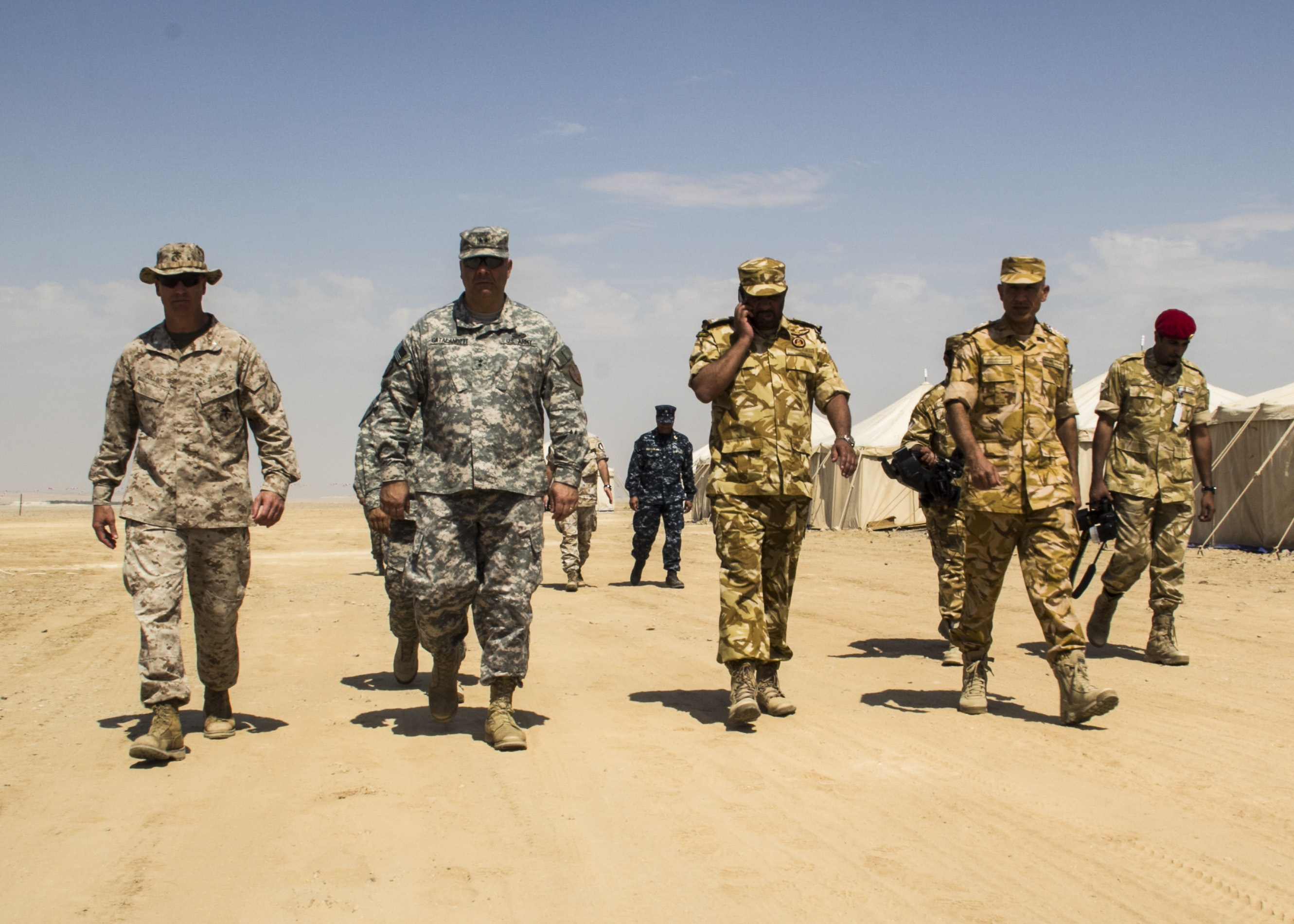
*[image: Officers from the United States Army and Marine Corps accompany
officers from the Qatari Emiri Land Force during Eagle Resolve, a
multilateral military exercise that took place in Qatar in 2013. Photo:
Juanenrique Owings / Wikimedia]*
<http://www.thetower.org/wp-content/uploads/2014/07/Eagle-Resolve-2013.jpg>

Officers from the United States Army and Marine Corps accompany officers
from the Qatari Emiri Land Force during Eagle Resolve, a multilateral
military exercise that took place in Qatar in 2013. Photo: Juanenrique
Owings / Wikimedia

The central actor is the United States. And the U.S. is far less dependent
on Qatari money and natural gas. Yet it is this U.S. administration that
has been most visible in welcoming and encouraging Qatar’s role as a
mediator in the current conflict—as evidenced by Kerry’s high profile
meeting with the Qatari and Turkish foreign ministers, the wording of his
ceasefire proposal, and so on. What is the reason for this stance?

There are two, related explanations. First, as noted above, Sunni Arab
regional politics are currently dominated by an alliance of the Kingdom of
Saudi Arabia with the Sisi government in Egypt. U.S. relations with Sisi
are particularly bad, and there is a legacy of mistrust felt by Cairo,
Riyadh, and their regional partners toward the current administration. In
the Saudi case, this derives from what the Saudis regard as the failure of
the Obama administration to adequately back its allies and contain Iranian
regional and nuclear ambitions.

With regard to Sisi, the differences are perhaps deeper. The Egyptian
military holds the administration responsible for toppling former President
Mubarak and the rise to power of the Muslim Brotherhood — a rise to power
the White House supported after helping engineer then demise of a
longstanding ally. It is easy to see the continued mutual distaste and
incomprehension between Sisi’s government and the Obama administration.
Washington views Sisi as essentially grabbing power through a military coup
and engaging in severe political repression of the Muslim Brotherhood.

Cairo sees Obama as inexplicably championing the forces of instability in
Egypt against elements long allied with the U.S. who are interested in
continuing that alliance. Given the strained relationship between Cairo and
Washington, it becomes easier to understand U.S. acceptance, if not
preference, for the Qataris as mediators.

*[image: U.S. Marine Corps Master Sgt. Cory Paskavan re-enlists during a
parachute operation as part of Eagle Resolve 13 over Qatar, April 26, 2013.
Photo: Chris Stone / Wikimedia]*
<http://www.thetower.org/wp-content/uploads/2014/07/Parachute-square.jpg>

U.S. Marine Corps Master Sgt. Cory Paskavan re-enlists during a parachute
operation as part of Eagle Resolve 13 over Qatar, April 26, 2013. Photo:
Chris Stone / Wikimedia

Such a view only makes sense, of course, if Hamas is viewed not as an enemy
to be vanquished or at least contained, but rather as a player whose
desires and needs must be met on some level. This is the final part of the
picture.

The U.S. administration in the 2011-12 period regarded the Muslim
Brotherhood as a legitimate movement with a legitimate hold on power,
despite its extremist and anti-Western ideology. Thus, the U.S. championed
the Brotherhood’s right to stand in the presidential and parliamentary
elections, and continued to relate to the Morsi Administration as a
partner, in spite of Morsi’s openly antisemitic remarks and his *demanding the
release*
<http://investigations.nbcnews.com/_news/2012/09/25/14098101-blind-sheik-terrorist-will-stay-in-us-prison-white-house-says>
 and *return to Egypt* <http://video.foxnews.com/v/2085850026001> of “The
Blind Sheikh,” Omar Abd al-Rahman, convicted in the U.S. for his
involvement in the 1993 World Trade Center bombing and effort to blow-up
the Holland Tunnel, Lincoln Tunnel and George Washington Bridge, as well as
assassinating a U.S. Senator.

American agreements to supply sophisticated weapons systems to the Morsi
government were strictly fulfilled, despite the Muslim
Brotherhood-dominated government’s clear lurch toward the construction of
an Islamist regime, *evidenced by*
<http://www.washingtonpost.com/world/egypts-president-morsi-takes-sweeping-new-powers/2012/11/22/8d87d716-34cb-11e2-92f0-496af208bf23_story.html>,
for example, Morsi’s awarding of broad, new,*pharaoh-like powers*
<http://www.worldaffairsjournal.org/blog/michael-j-totten/egypts-morsi-proclaims-himself-pharaoh>
to
himself in November 2012, and by the passing of a new, repressive,
Islamist-drafted constitution in December of that year. After 30 million
Egyptians took to the streets objecting to the Islamic radicalism being
imposed on the secular country, and the Egyptian military stepped in to
reestablish calm by removing the Muslim Brotherhood from power, the White
House called for Egypt “to move quickly and responsibly to return full
authority back to a democratically elected civilian government as soon as
possible.”

All of this took place in spite of the clear and *available evidence*
<http://www.progressivepolicy.org/blog/nine-questions-about-the-muslim-brotherhood/>regarding
the nature of the Muslim Brotherhood regime and its ambitions. The
Brotherhood seeks not to participate in democratic politics, but rather to
re-construct the Islamic “caliphate.”  Thus, a book published in 1995 by
Muslim Brotherhood leader Mustafa Mashhur called *Jihad is the Way* openly
notes this objective. Mashhur writes that Brotherhood founder Hassan
al-Banna “felt the grave danger overshadowing the Muslims and the urgent
need and obligation which Islam places on every Muslim, man and woman, to
act in order to restore the Islamic Caliphate and to reestablish the
Islamic state on strong foundations.” Mashhur’s foundational work contains
a vision of jihad until all lands formerly under the control of Islam are
returned to it.
 Jihad for Allah…is not limited to the specific region of the Islamic
countries, since the Muslim homeland is one and is not divided, and the
banner of Jihad has already been raised in some of its parts, and shall
continue to be raised, with the help of Allah, until every inch of the land
of Islam will be liberated, and the State of Islam established.

These are not the messages of a movement committed to a pragmatic path of
liberty and tolerance. They, and the Brotherhood’s track record in power in
Egypt in the 2012-13 period, confirm its extremist nature. The Brotherhood
has, for the most part, lost power and influence over the course of 2013
and 2014. This does not, however, mean that there has been a fundamental
change in the way the movement is seen by the administration. In fact, it
appears that in the mind of the Obama White House, this basic acceptance of
the Muslim Brotherhood’s legitimacy, as well as the willful denial of its
true nature, remains unchallenged. As a result, the U.S. administration
appears keen to work alongside and in cooperation with the two main
champions of the movement—Turkey and Qatar—in resolving the current Gaza
conflict in a way that, at least partly, addresses Hamas’ wants and needs.
Qatar has emerged in recent years as the main diplomatic and financial
backer of Hamas and its enclave in the Gaza Strip. The current conflict
shows how this is reflected in regional diplomacy, as Qatar uses it to
carve out a central role in the Mideast, to the dismay and anger of the
rival Sunni bloc of Cairo and Riyadh.

Qatar’s regional strategy is based on support for and sponsorship of the
Muslim Brotherhood, the destabilizing of its fellow Sunni Arab neighbors,
and hedging its bets on American regional leadership with warmer ties with
Tehran. Support for Hamas constitutes a part of this. The Muslim
Brotherhood is an anti-Western, anti-Jewish movement, and Hamas is a
designated terrorist organization.

Yet, for the present time at least, Qatar’s deep links to this movement,
far from incurring penalties, are enabling it to reap rewards. This
worrisome trend derives from a short-sighted Western attitude toward Hamas,
and to a lesser extent toward the Muslim Brotherhood in general. Hamas is
not favored, but neither is the extent of the movement’s commitment to its
genocidal ideology—or the danger it represents—properly acknowledged, let
alone accepted in various capitols.

In the U.S. case, strained relations with the government of Egypt, which
fiercely opposes Hamas, are further contributing to the willingness, if not
outright desire, to award a central diplomatic role to Qatar, in spite of
its championing of violent anti-Western, anti-Israel, and
anti-moderate-Arab forces across the region. This indulgence of terror
sponsoring Qatar ought to end, and there are small signs that this
complacency is ebbing, at least outside the confines of the White House and
Foggy Bottom. U.S. legislators are* circulating a letter*
<http://www.thetower.org/congressional-letter-to-call-on-qatar-to-take-another-look-at-its-hamas-funding/>
questioning
Qatar’s behavior, *beginning to voice*
<http://www.thetower.org/0743-on-al-jazeera-congressman-calls-stations-support-of-hamas-a-war-crime/>deep
objections to their dangerous and unacceptable actions.
Congressional leaders must continue to call out Qatar for its support for
Hamas, and the administration for its apparent support for Qatar. In
Europe, it is possible that Qatari financial investment and gas exports
make adequate opposition to the Emirate hard to imagine. But neither of
these constraints exist in the U.S., where the main reason for its stance
toward Qatar and its terrorist allies is a naïve view of the region.

 Banner Photo: Tiffini Jones Vanderwyst / U.S. Navy / Wikimedia


__._,_.___
 ------------------------------
Posted by: "Beowulf" <[email protected]>
------------------------------


 Visit Your Group
<https://groups.yahoo.com/neo/groups/grendelreport/info;_ylc=X3oDMTJmMzZlNzAwBF9TAzk3MzU5NzE0BGdycElkAzIwMTk0ODA2BGdycHNwSWQDMTcwNTMyMzY2NwRzZWMDdnRsBHNsawN2Z2hwBHN0aW1lAzE0MDkwMDYyMzk->


 [image: Yahoo! Groups]
<https://groups.yahoo.com/neo;_ylc=X3oDMTJlamozMm5rBF9TAzk3NDc2NTkwBGdycElkAzIwMTk0ODA2BGdycHNwSWQDMTcwNTMyMzY2NwRzZWMDZnRyBHNsawNnZnAEc3RpbWUDMTQwOTAwNjIzOQ-->
• Privacy <https://info.yahoo.com/privacy/us/yahoo/groups/details.html> •
Unsubscribe <[email protected]?subject=Unsubscribe>
• Terms of Use <https://info.yahoo.com/legal/us/yahoo/utos/terms/>

__,_._,___

--
--
Thanks for being part of "PoliticalForum" at Google Groups.
For options & help see http://groups.google.com/group/PoliticalForum

* Visit our other community at http://www.PoliticalForum.com/
* It's active and moderated. Register and vote in our polls.
* Read the latest breaking news, and more.

---
You received this message because you are subscribed to the Google Groups
"PoliticalForum" group.
To unsubscribe from this group and stop receiving emails from it, send an email
to [email protected].
For more options, visit https://groups.google.com/d/optout.