http://legalinsurrection.com/2014/08/why-use-of-a-gun-can-be-lawful-even-against-an-unarmed-person/
When can you legally use a gun against an unarmed person?
One of the most common laments to come out of Ferguson these last days has
been that surely it was outrageous for Office Darren Wilson to use his
service pistol to shoot an “unarmed” Mike Brown.  (Earlier iterations of
this narrative went further in their misinformation, describing the
18-year-old 6’4″ 292 pound Brown as a “kid” or “child,” as well as falsely
claiming that Wilson shot Brown in the back, but such misinformation
falls outside the scope of this post.)  Similar arguments were made in the
context of the shooting by George Zimmerman of the “unarmed” Trayvon Martin.

The notion that a defender may use a firearm in self-defense only if they
themselves are faced with a firearm is entertainingly naive, but has no
basis in actual law, nor in common sense.

In the eyes of the law a gun is not some magical talisman of power, it is
merely one of perhaps an infinite number of means of exerting force.
 Legally speaking the law tends to divide force into two broad buckets:
 non-deadly force and deadly force.  There is some stratification in the
context of non-deadly force–a poke to the chest is not the same degree of
non-deadly force as a punch to the face–but really none whatever in the
context of deadly force.  Deadly force is simply deadly force. For purposes
of conciseness, I limit this discussion to cases in which deadly force is
involved, as was the case in both Ferguson and Zimmerman.
Deadly Force: Force Likely to Cause Death or Grave Bodily Harm

It should also be noted that when the legal system uses the phrase “deadly
force,” it is not merely referring to force than can literally cause death.
 Of course, force likely to cause death qualifies, naturally.  But the
law’s view of “deadly force” is broader than the phrase might suggest.  In
fact, “deadly force” includes BOTH force likely to cause death, as well as
force likely to cause “grave bodily harm.”

We all understand “death,” but what could possibly be meant by “grave
bodily harm.”? Typically, grave bodily harm means something along the
following lines:  the temporary loss of an important bodily function/organ,
the permanent loss of even a minor bodily function/organ, maiming, rape, or
debilitation to the point of defenselessness.

Note, also, that under the law of self-defense, NONE of these must ACTUALLY
be experienced by the victim before the victim can lawfully respond.
 Rather, there must be an imminent threat of one of these occurring, as
perceived by a reasonable and prudent person, in the same or similar
circumstances, possessing the same or similar capabilities as the defender,
having the same or similar knowledge as the defender, and experiencing the
same or similar mental stress as would a defender being threatened with
such harm.
Proportionality of Force

One of the five elements of the law of self-defense is proportionality (the
others being innocence, imminence, avoidance, and reasonableness).
Proportionality governs the degree of force that a defender can lawfully
use in self-defense.  In brief, the defender’s force must be proportional
to the force with which he is threatened.

Again, limiting ourselves to instances of the use of deadly force in
self-defense, such use of deadly force is permissible only where the
defender was facing an imminent threat of deadly force.  Or, more
accurately, the use of deadly force is permissible only where the defender
was facing an imminent threat of death or grave bodily harm.

A gun almost always represent a threat (or, if fired, a use) of deadly
force.  So in order for a defender to be lawfully permitted to “go to the
gun,” they must be facing a reasonably perceived imminent threat of death
or grave bodily harm against which they are defending themselves.

Does that mean that they can only go to the gun if they are faced with a
gun?  Of course not.  There are myriad ways that an attacker can represent
a threat of death or grave bodily harm, only one small slice of which
involve the attacker using a gun.  Naturally, an attacker bringing to bear
a “classical” deadly weapon such as a gun or knife would represent a threat
of death or grave bodily harm.  But such a classical deadly weapon is not
required.
Disparity of Force

What the law actually looks at is not whether the attacker possessed a
classical weapon, but whether the attacker presented the defender with a
disparity of force, such that the defender faced a reasonably perceived
imminent threat of death or grave bodily harm unless the defender himself
resorted to deadly force.  Again, for a defender facing a gun or knife, the
disparity of force is obvious.  This disparity of force also arises,
however, in many other circumstances.
Disparity of Numbers

One very common situation that gives rise to a disparity of force is where
the defender is facing a disparity of numbers.  A defender faced with a
single attacker of similar size and fighting ability might be legally
obliged to defend himself only with non-deadly force in the absence of the
attacker possessing a classical weapon.  Where the attackers are numerous,
however, that disparity of numbers creates an obvious disparity of force–no
man can be expected to defend himself against the simultaneous attack of
numerous foes without resort to a weapon to balance the scales.
Disparity of Fighting Ability

Another very common situation that gives rise to a disparity of force is
where the attacker possesses an exceptional fighting skill, at least
relative to the defender.  A defender of no particular fighting skill (most
of us) cannot be expected to defend themselves against a highly trained
martial artists or even a street fighter, without resort to a weapon to
balance the scales.
Disparity of Size/Strength

A third very common situation that gives rise to a disparity of force is
where the attacker is substantially larger and more powerful than the
attacker.  A 120 pound woman cannot be expected to defend herself against a
200 pound rapist without resort to a weapon to balance the scales.
 Similarly, a 200 pound man cannot be expected to defend himself against a
300 pound man without similar recourse to a weapon.  It is worth noting in
this context that under Olympic wrestling rules a weight difference of as
little as 18 pounds is considered so profoundly unfair that wrestlers are
segregated into separate weight classes, and a 100 pound weight difference
spans fully five Olympic wrestling weight classes.
Disparity of Physical Fitness

Finally, it is important to recognize that a disparity of force may not be
present at the start of a fight, but can come into existence over the
course of the fight itself.  Imagine two men of equal size and fighting
ability, such that there was no disparity of force between them.  During
the fight, one man’s arm is broken.

Obviously, a disparity of force now exists that wasn’t previously present,
and under such circumstances the seriously injured man might well be
legally entitled to resort to a deadly weapon even if he would not have
been so entitled prior to the injury.
Zimmerman’s Shooting of “Unarmed” Martin

In the case of the Zimmerman/Martin conflict, at least two of these factors
were in play.  First, there was evidence that Trayvon Martin was an active
participant and keen student of street fighting, to the point of having
shared with friends his preferred strategy of a vicious first strike
followed by a sustained attack until his victim was utterly defeated.
 Thus, there existed a disparity of fighting ability.

Second, where there was arguably little disparity of force at the start of
Martin’s attack up on Zimmerman, after repeated blows to the face
(Zimmerman would tell police that it felt like being hit by a brick),
having his head smashed repeatedly on a sidewalk, and Martin attempting to
muffle Zimmerman’s cries for help by using his hands to cover Zimmerman’s
mouth and nose, the two men were clearly no longer on equal footing, if
they ever had been.

In addition, every successive blow to Zimmerman’s head on the sidewalk
could well be the one to render him unconscious or even to induce a fatal
cerebral hemorrhage or skull fracture, thus representing an imminent threat
of death or grave bodily harm.  Thus, there emerged a disparity of physical
fitness.

*[image: George Zimmerman]*
<http://legalinsurrection.com/wp-content/uploads/2014/08/George-Zimmerman.png>

It was this combination of disparity of force factors that legally
justified George Zimmerman resorting to his pistol against an “unarmed”
Martin.

It should also be noted that Zimmerman told police that he only drew his
pistol after he felt Martin reaching for it.  An attacker seeking to seize
a defender’s gun is really no different than an attacker reaching to pick
his own gun off a table–indeed, it is worse, in the sense that in the
former case the defender is being simultaneously disarmed.  A defender
otherwise in reasonable fear of death from the attacker need not wait until
the attacker has gripped the pistol before they can defend themselves–the
deadly threat is imminent when the attacker reaches for the weapon.

Finally, it should be noted that being “armed” doesn’t require a weapon,
and being without a weapon doesn’t make one “unarmed.” In this case,
Trayvon Martin was “armed” with his fists, his body weight astride
Zimmerman, the sidewalk against which he smashed Zimmerman’s head, and one
might argue the planet Earth itself.
Wilson’s Shooting of “Unarmed” Brown

A similar analysis can be applied to the shooting by Officer Darren Wilson
of the “unarmed” Mike Brown.

The pro-Wilson narrative–to which we give due deference, given the
presumption of innocence attached to any criminal defendant–is that Brown,
along with his cohort Dorian Johnson, first attacked Wilson in his patrol
car. There Wilson appears to have suffered a fracture of his orbital bone,
the bone that surrounds and protects the eye. During this fight Brown also
sought to seize Wilson’s service pistol. In the course of this fight the
pistol discharged inside the vehicle.

Brown and Johnson distanced themselves from the vehicle by 30 feet or so.
 Wilson emerged form the car, and challenged the men to stop.  Brown,
either independently or in response to Wilson’s challenged, verbally
challenged Wilson in return, then (as attested to by more than a dozen
witnesses) lowered his head and charged back at Wilson.

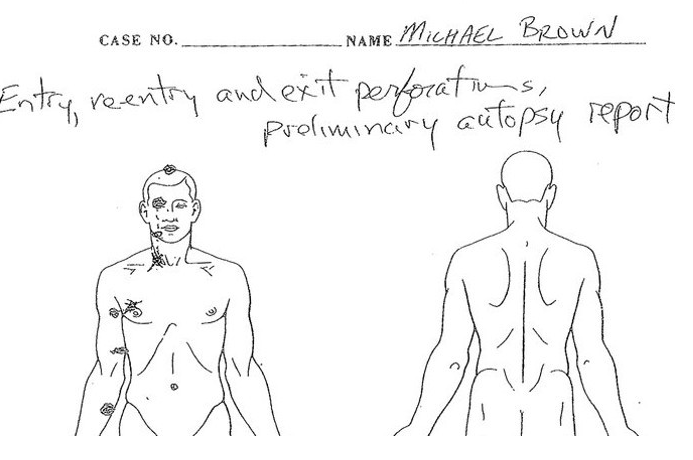
It was at this point that Wilson began firing at Brown, striking him (it
appears) four times in the arm, once in the eye, and once in the crown of
the head.  The eye injury was certainly mortal, and likely dropped Brown in
his tracks. (Note: There was no evidence of gun shot wounds to Brown’s
back, contrary to claims by Dorian Johnson that Wilson had shot Brown in
the back.)

*[image: Mike Brown autopsy sketch]*
<http://legalinsurrection.com/wp-content/uploads/2014/08/Mike-Brown-autopsy-sketch.png>

Here we have a considerable number of the described disparity of force
elements.

There was disparity of numbers, in that Wilson was initially (at least)
faced by an attack by both Brown and Johnson.

There was an enormous disparity of size/strength, but during the first
fight inside the patrol car when Wilson was fighting both men, but then
also when Wilson was facing the imminent charging attack of the 292 pound
Brown (Wilson’s own weight appears to be in the range of 200 pounds).

*[image: Mike Brown]*
<http://legalinsurrection.com/wp-content/uploads/2014/08/Mike-Brown.png>

There was also a disparity of physical fitness by the time Wilson deployed
his sidearm against Brown. Having suffered a fracture of his orbital lobe
it is likely that Wilson had lost considerable visual capability, was in
excruciating pain, and was to at least some degree cognitively stunned by
the blow. An attacker who has already dispensed such grave bodily harm and
who is charging again into the fight against an officer displaying his
sidearm can only reasonably be understood to intend to imminently do the
same again, or much worse.  Having already struggled once for his service
pistol, Wilson would know–as all police officers in such circumstances
would know–that he was in a life-or-death fight.

And, as was the case in the Zimmerman trial, Brown attempting to seize
Wilson’s gun is no different than if Brown had reached for a gun in his own
belt–indeed, it is worse, as it would simultaneously arm Brown and disarm
Wilson.

It is this combination of disparity of force factors that legally justified
Darren Wilson in resorting to his pistol against an “unarmed” Brown.


__._,_.___
 ------------------------------
Posted by: "Beowulf" <[email protected]>
------------------------------


 Visit Your Group
<https://groups.yahoo.com/neo/groups/grendelreport/info;_ylc=X3oDMTJmNWNjdXJhBF9TAzk3MzU5NzE0BGdycElkAzIwMTk0ODA2BGdycHNwSWQDMTcwNTMyMzY2NwRzZWMDdnRsBHNsawN2Z2hwBHN0aW1lAzE0MDk2MDMzOTA->


 [image: Yahoo! Groups]
<https://groups.yahoo.com/neo;_ylc=X3oDMTJlMDlsYzd2BF9TAzk3NDc2NTkwBGdycElkAzIwMTk0ODA2BGdycHNwSWQDMTcwNTMyMzY2NwRzZWMDZnRyBHNsawNnZnAEc3RpbWUDMTQwOTYwMzM5MA-->
• Privacy <https://info.yahoo.com/privacy/us/yahoo/groups/details.html> •
Unsubscribe <[email protected]?subject=Unsubscribe>
• Terms of Use <https://info.yahoo.com/legal/us/yahoo/utos/terms/>

__,_._,___

--
--
Thanks for being part of "PoliticalForum" at Google Groups.
For options & help see http://groups.google.com/group/PoliticalForum

* Visit our other community at http://www.PoliticalForum.com/
* It's active and moderated. Register and vote in our polls.
* Read the latest breaking news, and more.

---
You received this message because you are subscribed to the Google Groups
"PoliticalForum" group.
To unsubscribe from this group and stop receiving emails from it, send an email
to [email protected].
For more options, visit https://groups.google.com/d/optout.