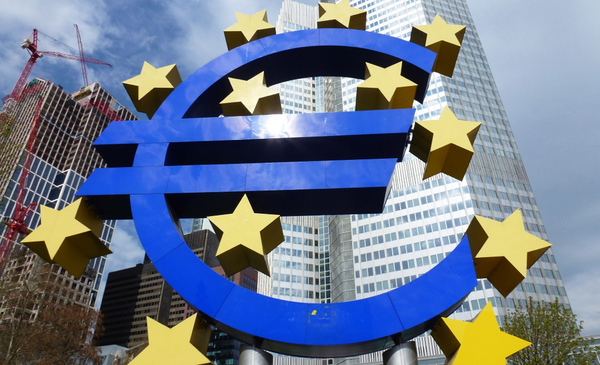
*Euroflop: Europe Dilutes the Euro*
*by Peter Martino
<http://www.gatestoneinstitute.org/author/Peter+Martino>January 26, 2015 at
3:30 am*

*http://www.gatestoneinstitute.org/5146/euro-dilution
<http://www.gatestoneinstitute.org/5146/euro-dilution>*


Every criminal printing money can now argue in court that he should be
given a medal for "stimulating the economy."

The refusal of some European countries, such as France, to tackle their
high debt level and lack of competitiveness, is now also affecting the
non-eurozone.

Europe now wants the rest of the world to foot the bill for its own
economic mismanagement.

Suppose a family can no longer pay its debts and dad decides to solve the
problem by going down to the cellar and printing extra money. Society would
not approve. Printing money is a form a robbery, stealing from everyone
else by diluting the value of their financial assets.

Last week, Mario Draghi, the president of the European Central Bank [ECB],
announced that in the coming months the ECB is going to pump an additional
€1.1 trillion into the economy, at a rate of €60bn a month. When dad does
it, it is called "counterfeiting," but when Mr. Draghi does it, it is
called "quantitative easing" and one euphemistically speaks of a "stimulus
package for the Eurozone
<http://www.theguardian.com/business/2015/jan/22/ecb-big-bazooka-bigger-than-expected-qe-stimulus>."
Every criminal printing money can now argue in court that, rather than a
jail sentence, he should be given a medal and a reward for stimulating the
economy.

[image: http://www.gatestoneinstitute.org/pics/large/903.jpg]

The headquarters of the European Central Bank in Frankfurt, Germany. (Image
source: Flickr/Solvency II Wire)

The European debt crisis began in late 2009 after Southern European
countries, using the euro as a common currency with Germany and other
Northern European countries, were no longer able to pay the debts they had
foolishly accumulated during the preceding years. To prevent the eurozone
from collapsing and its banks from going bankrupt, the ECB began to
purchase the government bonds of countries in difficulty, including the
junk-rated bonds issued by Greece and Portugal. As a result, the ECB
balance sheet swelled to almost €2 trillion. Mr. Draghi has now solved that
problem by using his big bazooka
<http://www.telegraph.co.uk/finance/financetopics/davos/11367503/Mario-Draghis-1-trillion-bazooka-is-just-the-beginning.html>
and creating €1.1 trillion out of thin air.

The effects were immediate. The euro fell against all other currencies. It
hit an 11-year low against the dollar. In July 2008, one dollar was worth
€0.62, and one month ago still €0.81; today it is worth €0.89. Analysts
expect that the effects of Draghi's "bazooka" will soon push the euro to parity
with the dollar <http://www.cnbc.com/id/102364696>, perhaps even lower
<http://www.cnbc.com/id/102361060>.

The Swiss central bank SNB anticipated Draghi's decision. Two weeks
ago, it stopped
pegging
<http://seekingalpha.com/article/2845946-swiss-central-bank-wizards-wave-white-flag>
the Swiss franc to the euro. In 2011, the SNB had decided to fix the
exchange rate between the Swiss franc and the euro at 1.20 or higher. The
aim was to keep the franc from getting too strong compared to the euro. On
January 15, the SNB surprised the markets with its dramatic decision to
reverse its policy. Traders came to refer to the decision as the "
Francogeddon
<http://www.biznews.com/global-investing/2015/01/19/francogeddon-lessons-currency-traders-investors/>":
it led to huge losses for those who had not expected it and resulted in an
immediate 30% rise of the franc versus the euro. Meanwhile, the Swiss
franc, which in October 2007 was worth €0.57 and on January 14 of this year
stood at €0.83, is now already worth slightly over €1.

Obviously, this is extremely bad news for Swiss companies and for the Swiss
tourism sector. The SNB reckons, however, that keeping the franc
artificially low compared to the euro by buying large quantities of euros,
which are rapidly going to lose their value as a result of Draghi's
strategy, would be an infinitely worse scenario. So they stepped out of the
currency war. Other economic competitors of the eurozone, such as the
British, the Americans, the Japanese and the Chinese, will either have to
do the same or try to keep their own currencies low by buying large
quantities of euros or by following the ECB's example and switching on
their own money presses.

Within the eurozone, however, Draghi's decision is also leading to
tensions. France and the southern countries are supporting Draghi, while
the central bankers of northern eurozone countries, such as Germany's
Bundesbank president, Jens Weidmann, and his colleagues from the
Netherlands, Austria and Estonia, opposed the decision
<http://www.reuters.com/article/2015/01/22/us-ecb-policy-idUSKBN0KU2ST20150122>
.

They are, however, outnumbered by the southerners. The northerners fear
that Draghi's program will reduce the pressure on governments in the south,
including France and Mr. Draghi's own Italy, to reform their economies and
stop living beyond their means. The Greek elections yesterday resulted in
huge gains for the far-left Syriza party, which opposes the current
austerity policies. Now that the ECB is buying Greek junk bonds with newly
created money, the Greeks may well feel that they no longer need to reform
their economy.

Last week, in Davos, Finnish Prime Minister Alexander Stubb warned
<http://www.telegraph.co.uk/finance/financetopics/davos/11367503/Mario-Draghis-1-trillion-bazooka-is-just-the-beginning.html>
that there is a bottom line when it comes to Greece. He said that he even
preferred a "dirty exit" of Greece from the eurozone, rather than allow it
to shirk further economic reforms. "All of us have taken very difficult
structural reforms," Stubb said. "I can't take issue with the Greek
elections. The Finnish position is: we will deal with any
democratically-elected government that Greece has, but it will be very
difficult for us to forgive any loans or restructure debt at this
particular moment."

On Sunday, Bundesbank President Weidmann reiterated his doubts
<http://www.reuters.com/article/2015/01/25/us-ecb-policy-weidmann-idUSKBN0KY01P20150125>
about the effectiveness of the ECB bond-buying plan. He questioned whether
quantitative easing in the eurozone would lead to an economic stimulus --
as it did in the US after the financial crisis of 2008 -- because the
sluggish growth in Europe is largely due to high levels of debt and, in
certain countries, a lack of competitiveness.

It seems that the refusal of some European countries, such as France, to
tackle their high debt levels and lack of competitiveness is now also
affecting the non-eurozone. As a result of the ECB's decision, non-eurozone
countries, such as Switzerland and America, will also be affected. Their
companies will have more difficulty exporting to the eurozone because their
currencies will become too expensive. In short, they will be paying the
price of the ECB's decision to lift the burden from the economies in
Southern Europe.


__._,_.___
 ------------------------------
Posted by: "beowulf" <[email protected]>
------------------------------


 Visit Your Group
<https://groups.yahoo.com/neo/groups/grendelreport/info;_ylc=X3oDMTJmcmFhbHAzBF9TAzk3MzU5NzE0BGdycElkAzIwMTk0ODA2BGdycHNwSWQDMTcwNTMyMzY2NwRzZWMDdnRsBHNsawN2Z2hwBHN0aW1lAzE0MjIzMDYzNzY->


 [image: Yahoo! Groups]
<https://groups.yahoo.com/neo;_ylc=X3oDMTJlOTMxYnYwBF9TAzk3NDc2NTkwBGdycElkAzIwMTk0ODA2BGdycHNwSWQDMTcwNTMyMzY2NwRzZWMDZnRyBHNsawNnZnAEc3RpbWUDMTQyMjMwNjM3Nw-->
• Privacy <https://info.yahoo.com/privacy/us/yahoo/groups/details.html> •
Unsubscribe <[email protected]?subject=Unsubscribe>
• Terms of Use <https://info.yahoo.com/legal/us/yahoo/utos/terms/>

__,_._,___

--
--
Thanks for being part of "PoliticalForum" at Google Groups.
For options & help see http://groups.google.com/group/PoliticalForum

* Visit our other community at http://www.PoliticalForum.com/
* It's active and moderated. Register and vote in our polls.
* Read the latest breaking news, and more.

---
You received this message because you are subscribed to the Google Groups
"PoliticalForum" group.
To unsubscribe from this group and stop receiving emails from it, send an email
to [email protected].
For more options, visit https://groups.google.com/d/optout.