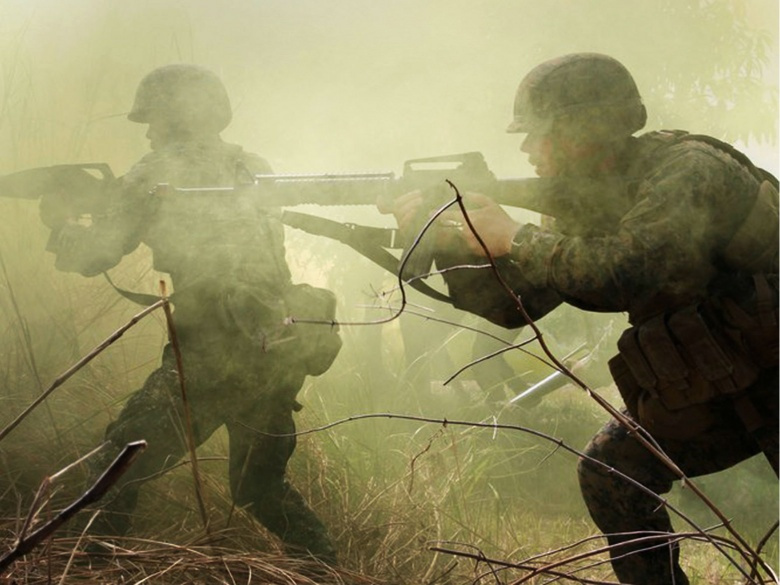
They are called the principles of war. Specifically, they are: objective,
offensive, mass, economy of force, maneuver, unity of command, security,
surprise and simplicity.
---
6 Painful Truths About the War on Terrorism
<http://www.wakingtimes.com/2015/11/18/6-painful-truths-about-the-war-on-terrorism/>
*1.)* The war on terror was never about ensuring the security of Americans
at home or abroad
*2.)* The war on terror doesn’t stop terror, because it is terror.
*3.)* Our worst terrorist enemies are the products of government, the
military industrial complex and Western intelligence agencies.
*4.)* The mainstream media plays a crucial in perpetuating the war on
terrorism.
*5.)* State-sponsored False flag attacks
<http://www.wakingtimes.com/2015/06/23/a-brief-history-of-false-flag-terror/>
still
work to achieve political objectives.
*6.)* Suicide is more deadly to our soldiers than any terrorist
organization.
more truths:
*Iran and its Shiite allies are crucial opponents of ISIS*

*The major Sunni powers are unreliable allies against ISIS*

*Russia will insist on being a player in the Middle East*

*The Kurds are a complicating factor*

*Western attacks on ISIS strengthen the narrative of Muslim victimization*

*a soldier guilt*

*https://www.facebook.com/CollectiveEvolutionPage/videos/10151968966863908/*


On Thursday, May 5, 2016 at 2:41:14 PM UTC-5, Travis wrote:
>
>
>
>
>
>
>
>
>
>
> http://nationalinterest.org/feature/its-time-return-the-principles-war-16054
>
>
> It's Time to Return to the Principles of War
>
> [image: Description:
> http://nationalinterest.org/files/styles/main_image_on_posts/public/main_images/Marines_3.jpg?itok=NTkUVcNM]
>
> Newfangled theories distract from the unchanging art of war.
>
> James Jay Carafano
> <http://nationalinterest.org/profile/james-jay-carafano>
>
> May 4, 2016
>
> Most modern military doctrine should be scrapped. The Pentagon would be
> far better served if our military thinkers got back to the basics and
> taught the principles of war—and little more.
>
> Conflict just keeps getting more complicated. In the modern era, the
> general response has been to develop new concepts for the how the armed
> forces ought to conduct themselves. “Bold reimaginings” have sprung forth
> as quickly as weeds. Getting the “strategic narrative” right
> <http://nationalinterest.org/feature/how-get-war-wrong-the-21st-century-15346>
>
> is but the latest doctrinal flavor of the month.
>
> But while explanations of how we should fight keep getting more cerebral,
> sophisticated and sensitive to the conditions surrounding contemporary
> conflicts, the fighting hasn’t gotten any easier. Occam’s razor suggests
> that maybe all that fresh thinking isn’t helping win wars.
>
> Why do smart, elegant doctrines come up short? The easiest explanation
> would simply dismiss modern military theorists as feckless
> pseudo-intellectuals. Colin Gray has compared the defense community
> <http://amzn.to/1T1RhvB> to the fashion industry. “Expert defense
> professionals quite literally follow the fashion in ideas. . . The bigger
> the idea, the greater its conceptual reach and hence its organizing
> potency, and hence the more compelling the felt need to jump aboard the
> intellectual bandwagon.” There may be some truth there, but more is going
> on.
>
> Defense thinkers are not fashion designers. Their debates are about
> changing outcomes, not aesthetics.
>
> Sure, Pentagon brass may be quick to embrace the latest terms of art. But
> new terms don’t enter the lexicon unless there’s an original idea that gets
> people talking. And, make no mistake, thinking anew is important. Attacking
> orthodoxy, convention and unquestioned assumptions in pursuit of a
> competitive edge—that’s a good thing.
>
> What’s wrongheaded, though, is the premise of the modern defense debate.
> The presumption seems to be that, just as farmers must plow the fields and
> rotate crops every year to get better results, so military thinkers must
> turn over fundamental military concepts on a regular basis. The belief that
> intellectual advances will inevitably deliver a better understanding of
> complex phenomenon is a tenet of faith—and one of the biggest blind
> spots—in the modern world.
>
> As the Western world moved from the Renaissance to the Enlightenment, the
> Western mind embraced the notion that it had embarked on a sure, steady
> march of human progress—one that would ultimately lead to a perfect
> understanding of the physical world. This transformation was most
> profoundly seen in the scientific revolution.
>
> In search of absolute dominion, other fields of human enterprise,
> including military affairs, began to don the trappings of scientific
> thinking. We see it quite plainly in Clausewitz’s magisterial *On War*
> <http://amzn.to/26U8uLt>. That nineteenth-century treatise is suffused
> with jargon that appealed to the Enlightenment crowd.
>
> The tradition continues to this day. Western military writers commonly
> embrace scientific jargon, symbolic of the faith that there is always a
> better way to think about the natural world. But shoehorning thinking about
> war into a scientific-sounding narrative is insufficient.
>
> In an essay on rethinking military concepts, James Dubik invokes an
> Enlightenment-sounding answer about progress in military affairs. “A brief
> look at scientific revolutions,” he writes
> <https://books.google.com/books?id=WHhch-AyYjkC&lpg=PT15&vq=A%20brief%20look%20at%20the%20scientific%20revolutions&dq=%22fundamental%20is%20the%20continuing%20transformation%20in%20the%20profession%22&pg=PT15#v=onepage&q=%22A%20brief%20look%20at%20scientific%20revolutions%22&f=false>,
>
> “provides a glimpse of how fundamental is the continuing transformation in
> the profession of arms.” Yet the comparison is nonsensical. Dubik is trying
> to comprehend the changing conditions of contemporary conflict. Physical
> science is trying to gain a greater understanding of an unchanging physical
> reality.
>
> Even science has a hard time discovering truth, and war is not a science
> experiment. There is no preordained path to military enlightenment.
>
> More military thinking doesn’t lead inevitably to better thinking. Indeed,
> lately it seems to have put more trees in front of the forest.
>
> When General Mattis took over Joint Forces Command in 2007, he spearheaded
> an effort to fight back against overthinking war. At the time,
> “effects-based operations” served as favored term of art. Mattis pushed
> back
> <http://strategicstudiesinstitute.army.mil/pubs/parameters/articles/08autumn/mattis.pdf>.
>
> “We must return clarity to our processes and operational concepts,” he
> wrote. Military doctrine had created “unrealistic expectations of
> predictability and a counterproductive information appetite. . . requiring
> unattainable levels of knowledge about the enemy exercising its independent
> will.”
>
> Mattis argued that a far better approach would be to “re-baseline our
> terminology and concepts by returning to time-honored principles.” He was
> right. Military minds need to get back to first principles.
>
> What if military thinking stripped itself of the modern era’s futile
> effort to mimic the Enlightenment goal of gaining perfect knowledge and
> mastery over the affairs of men? What would be left?
>
> They are called the principles of war. Specifically, they are: objective,
> offensive, mass, economy of force, maneuver, unity of command, security,
> surprise and simplicity.
>
> The origins of these principles are best explained in *The Quest for
> Victory* <http://amzn.to/26UaQtI> by military historian John Alger. He
> writes that “[a]n examination of some of the more important writings on
> war—by Sun Tzu, Vegetius, Machiavelli, the duke of Rohan, Jean Charles de
> Folard. . . the marquis de Silva and Henry Lloyd—conveys both the form and
> concept of martial principles before Napoleon.” The common thread among
> this diverse cohort of thinkers is that they all predate the intellectual
> conceits of the Enlightenment.
>
> The principles of war survived into modernity. While military theory got
> more complex, convoluted, and complicated from the age of Napoleon on
> forward, “old-fashioned” maxims managed to hang in there. Even Clausewitz,
> before he got bogged down in *On War*, paid them heed in his essay, “The
> Most Important Principles on the Conduct of War to Complement My
> Instruction to His Royal Highness the Crown Prince.”
>
> Ironically, the broad acceptance of principles as a valid guide to the
> study of war was fostered by the military’s growing obsession with the
> certainty of science as the basis for truth. The preface to Folard’s *History
> of Polybius* affirmed: “Science has made progress only through the
> knowledge of its true principles. War is no different. The knowledge of its
> principles becomes the foundation on which its study is made.”
>
> Over the course of the nineteenth century, the principles of war were
> codified and refurbished. They stuck around, though they were pushed
> further and further into the background as militaries developed more
> elegant ways of thinking and planning.
>
> By the end of the Cold War, the principles were under all-out assault.
> They were included in Joint Doctrine
> <http://www.dtic.mil/doctrine/new_pubs/jp1.pdf>—although the Joint Staff
> tinkered with them by adding three new principles: restraint, perseverance
> and legitimacy.
>
> As Antulio Echevarria observes
> <https://books.google.com/books?id=WHhch-AyYjkC&lpg=PT218&dq=%22rethinking%20the%20principles%20of%20war%22&pg=PT66#v=onepage&q&f=false>,
>
> the additional axioms weren’t really “general rules requiring judgment in
> application.” In other words, they weren’t principles at all. Rather, the
> additions were “little more than common-sense advice” added to address
> post–Cold War concerns for sustaining political will in modern conflict.
> Essentially, the military was playing politics with the fundamental
> concepts of war. The change illustrates how the principles had drifted from
> their original purpose; they were ceasing to serve as a critical conceptual
> framework to think about conflict.
>
> The JCS principles marked the beginning of the end. Military thinkers
> looked for more relevant, modern conceptual tools. In 1989, Robert Leonhard
> penned a new set of principles: *The Principles of War for the
> Information Age* <http://amzn.to/21xzzAc>. Appearing in print right
> around the time of the collapse of the Berlin Wall, the book garnered a lot
> of attention from military minds thirsting for new thinking. “Under
> Leonhard’s system,” Echevarria writes, “military leaders would *not* have
> to memorize ‘eternal truths’ for later application; instead, they would
> learn to weigh the pros and cons of opposing concerns. . . ” Still,
> Leonhard tried to remain true to the traditional notion of providing a
> simple model to guide strategists’ understanding of the factors that must
> be considered in military decisionmaking.
>
> Under the stress of ambivalent operations in the Balkans and then
> intractable conflicts in Iraq and Afghanistan, the effort to sustain the
> “simple” completely collapsed. In the modern military mind, modern war
> became too hard for old ideas.
>
> New thinking, however, has not made war any easier.
>
> It is time to reverse course. *Let’s stop clinging to the notion that the
> new generation of thinkers is, axiomatically, smarter than those who
> preceded them.*
>
> At its heart, armed conflict remains a dynamic competition between
> adversaries; each conflict is tinged by the unique circumstances under
> which it is fought. Why waste time trying to develop complex intellectual
> tools that, in the end, deliver no better insights than simple, timeless
> constructs?
>
> There is a case to be made for going simple. For that, the principles
> might serve well enough.
>
> *A Heritage Foundation vice president, James Jay Carafano directs the
> think tank’s research on foreign policy and national security issues.*
>
>
>
>
> __._,_.___
> ------------------------------
> Posted by: "Beowulf" <[email protected] <javascript:>>
> ------------------------------
>
>
> Visit Your Group
> <https://groups.yahoo.com/neo/groups/grendelreport/info;_ylc=X3oDMTJmNHIyaGg4BF9TAzk3MzU5NzE0BGdycElkAzIwMTk0ODA2BGdycHNwSWQDMTcwNTMyMzY2NwRzZWMDdnRsBHNsawN2Z2hwBHN0aW1lAzE0NjI0NjQ3MTM->
>
>
>
> [image: Yahoo! Groups]
> <https://groups.yahoo.com/neo;_ylc=X3oDMTJlZWVnZGxtBF9TAzk3NDc2NTkwBGdycElkAzIwMTk0ODA2BGdycHNwSWQDMTcwNTMyMzY2NwRzZWMDZnRyBHNsawNnZnAEc3RpbWUDMTQ2MjQ2NDcxMw-->
>
> • Privacy <https://info.yahoo.com/privacy/us/yahoo/groups/details.html> •
> Unsubscribe <javascript:> • Terms of Use
> <https://info.yahoo.com/legal/us/yahoo/utos/terms/>
>
> __,_._,___
>
>
>

--
--
Thanks for being part of "PoliticalForum" at Google Groups.
For options & help see http://groups.google.com/group/PoliticalForum

* Visit our other community at http://www.PoliticalForum.com/
* It's active and moderated. Register and vote in our polls.
* Read the latest breaking news, and more.

---
You received this message because you are subscribed to the Google Groups
"PoliticalForum" group.
To unsubscribe from this group and stop receiving emails from it, send an email
to [email protected].
For more options, visit https://groups.google.com/d/optout.