**
   February 15: The World’s First General Purpose Digital Electronic
Computer is Dedicated at the University of Pennsylvania | Today I
Found Out<http://www.todayifoundout.com/>
<http://fusion.google.com/add?source=atgs&feedurl=http://feeds.feedburner.com/TodayIFoundOut>
------------------------------
February 15: The World’s First General Purpose Digital Electronic Computer
is Dedicated at the University of
Pennsylvania<http://feedproxy.google.com/~r/TodayIFoundOut/~3/MNuSAsl2rFQ/?utm_source=feedburner&utm_medium=email>

Posted: 15 Feb 2012 07:00 AM PST

* <http://www.todayifoundout.com/wp-content/uploads/2012/02/ENIAC.jpg>This
Day in History: February 15, 1946*

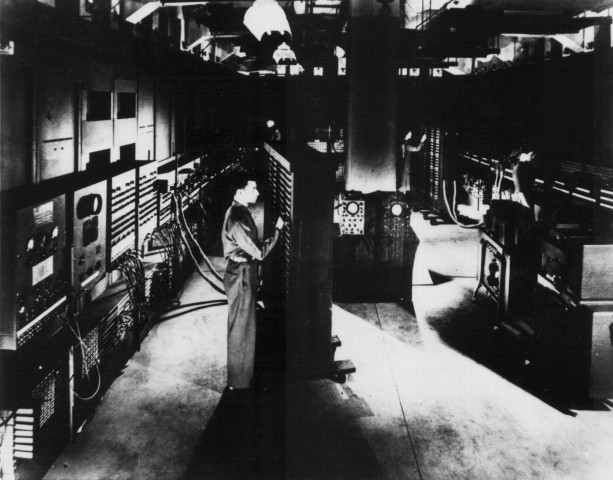
On this day in history, 1946, the first ever general purpose digital
electronic computer was dedicated at the University of Pennsylvania.  The
machine was called the ENIAC (Electronic Numerical Integrator and
Computer).  It cost over $500,000 (around $6 million today), weighed around
57,000 pounds and took up 1800 square feet.  Further, it featured 17,468
vacuum tubes, 70,000 resistors, 7,200 diodes, 10,000 capacitors, and most
impressively of all there were around 5 million joints that needed hand
soldered. In order to power all this, it took a whopping 150 kW of
electricity, which is enough to power around 114 homes in the U.S. based on
the U.S. Energy Information Administration’s average electricity usage in
American homes in 2010.

The ENIAC was the brainchild of several different people, most notably John
Mauchly and J. Presper Eckert.  Four years previous to the ENIAC’s
auspicious debut, Mauchly wrote a memo outlining the incredible speed boost
one would be able to get if, rather than relying on mechanical, moving
parts, a computer was designed to use only digital electronics.  This memo
came to the attention of Lieutenant Herman Goldstine of the U.S. Army, who
then asked Mauchly to create a formal proposal and give it to him to give
to the army.  Mauchly did so and the army contracted with he and J. Presper
Eckert on June 5, 1943 to create the machine, under the code-name “Project
PX”.

There was already at this time several different other computers available,
but they either weren’t built to be “general purpose” or relied on
electromechanical parts, which drastically reduced the speed in which they
could perform calculations.  The ENIAC was both general purpose and was a
fully digital electronic computer.  Among its more impressive attributes,
once completed, the ENIAC could perform around 5,000 additions per second
or 357 multiplications per second, which was around 1000 times faster than
existing machines of the day.  On top of the basic mathematics calculations
(add/subtract/divide/multiple/square root), it also was capable of doing
conditional branches, loops, and I/O.  Most importantly, it was a Turing
complete machine, which just means it was capable of doing anything a
theoretical single taped Turing machine can do.  For those not familiar,
why this is important, in layman’s terms, is that it means that it can
basically be used to solve any computational problem that is solvable (in
theory, though not in practice because of the real world limits on system
resources).

The first task it was put to was to perform calculations pertaining to the
development of the hydrogen bomb.  This resulted in over one million I/O
cards being produced from this one task alone, which proved to ultimately
be a successful trial run.  This task was run at the behest of
mathematician John von Neumann who was working on the Manhattan project and
who later accidentally lent his name to the “Von Neumann Architecture” of
computers that is still commonly used today.

The ENIAC subsequently ran for about 9 months straight before being shut
down for upgrades (specifically upgrading the memory system).  It was then
moved and put back together and powered back up seven months later and
stayed on for the next 8 years, being used continuously, performing a
variety of tasks, such as calculating artillery tables for the military and
doing various calculations for aeronautics, meteorology, etc.

It should be noted that von Neumann had that particular computer
architecture incorrectly named after himself due to a memo he wrote *First
Draft of a Report on the EDVAC* on June 30, 1945 (EDVAC being the successor
to the ENIAC, designed at the same school where the ENIAC was in the final
stages of being completed and with many of the same people working on the
project as were working on the ENIAC, including Eckert and Mauchly).  The
paper was basically a synopsis, written using formal logic, outlining the
ideas the group had been discussing on creating a general purpose stored
program computer.  As it was meant to be more of a memo, rather than a
published paper, he never mentioned the names of all the people who’d
helped developed the architecture and indeed, already had done the majority
of the design before von Neumann became a consultant on the project
(particularly Eckert and Mauchly).

When he sent his hand written notes back to Philadelphia, Lieutenant Herman
Goldstine had them typed up and distributed to the 24 people involved in
the EDVAC project, listing von Neumann as the sole author, as it wasn’t
intended to be distributed beyond those working on the project.  However,
in the end, due to widespread interest in the report, he had it copied and
sent to various other educational and government institutions, which
resulted in it being further copied and spread all over the world with von
Neumann ending up getting most of the credit for the design as he was the
sole author listed, even though he really wasn’t a huge part of that
project.  As such, we now call it the “Von Neumann Architecture”, even
though it wasn’t really his design and probably more accurately should have
been called the Eckert-Mauchly Architecture.

This is to take nothing away from von Neumann who was truly an amazing
individual that had a significant impacted in variety of fields including
quantum mechanics, computer science, economics, geometry, etc. (the full
list is amazingly long). Basically, one of the brightest people in the
world who managed to accomplish an amazing amount in the 53 years he lived,
before dying of cancer, possibly due to his exposure to radiation while
working on the Manhattan project.  As one mathematician, Isreal Halperin,
who worked with him said: “Keeping up with him was impossible. The feeling
was you were on a tricycle chasing a racing car.”  One of Von Neumann’s
professors, George Pólya, who himself had a pretty impressive resume also
stated: “Johnny was the only student I was ever afraid of. If in the course
of a lecture, I stated an unsolved problem. He’d come to me at the end of
the lecture with the complete solution scribbled on a slip of paper.”

Von Neumann also had reportedly had a true photographic memory.  As
Goldstine noted:

“One of his remarkable abilities was his power of absolute recall. As far
as I could tell, von Neumann was able on once reading a book or article to
quote it back verbatim; moreover, he could do it years later without
hesitation. He could also translate it at no diminution in speed from its
original language into English. On one occasion, I tested his ability by
asking him to tell me how The Tale of Two Cities started. Whereupon,
without any pause, he immediately began to recite the first chapter and
continued until asked to stop after about ten or fifteen minutes.”

When he was dying in the hospital, von Neumann also reportedly whiled away
the hours with his brother by playing a game of reciting from memory the
first few lines of each page of the play, Faust.

If you’re interested in more on von Neumann, I’d recommend picking up his
biography: John Von Neumann: The Scientific Genius Who Pioneered the Modern
Computer, Game Theory, Nuclear Deterrence, and Much
More<http://www.amazon.com/gp/product/082182676X/ref=as_li_ss_tl?ie=UTF8&tag=vicastingcom-20&linkCode=as2&camp=1789&creative=390957&creativeASIN=082182676X>,
by Norman MacRae.  It’s not the best biography in the world, in terms of
how the author wrote it, but a fascinating read none-the-less and arguably
the most complete single book on von Neumann.

Bonus
Factoids<http://www.todayifoundout.com/index.php/2010/02/the-difference-between-a-fact-and-a-factoid/>
:

   - One simple example of von Neumann’s genius was when he was presented
   with the following problem: “Two bicyclists start twenty miles apart and
   head toward each other, each going at a steady rate of 10 mph. At the same
   time a fly that travels at a steady 15 mph starts from the front wheel of
   the southbound bicycle and flies to the front wheel of the northbound one,
   then turns around and flies to the front wheel of the southbound one again,
   and continues in this manner till he is crushed between the two front
   wheels. Question: what total distance did the fly cover?”  There is a
   simple trick to solving this, but von Neumann did it the complicated way…
   in his head… in a matter of seconds.  Basically, he took the sum of the
   infinite series in his head and spit out the answer within seconds after
   the question was asked.
   - If you’re curious, the simple answer really is quite simple and just
   about anyone who sees the trick should be able to answer it in a matter of
   seconds, no genius required…  *spoiler ahead*:  The simple solution is just
   to realize that the two bicycles are traveling for exactly one hour (twenty
   miles apart, going straight at each other at a rate of 10 mph).  Thus, if
   the fly is traveling back and forth between them at a rate of 15 mph, it
   must have traveled exactly 15 miles in that hour.  The fact that it went
   back and forth is inconsequential.   Obviously it can also be solved the
   way von Neumann did it, but I personally don’t think I’ve ever met anyone
   who could do that in a couple seconds in their head and I’ve met several
   people that are true geniuses.  Apparently, there’s genius, compared to
   normal people, then there’s von Neumann genius, who was a genius compared
   to geniuses. [image: ;-)]
   - Von Neumann also managed to get both a degree in chemical engineering
   at the Federal Institute of Technology in Zurich and a Ph.D. in
   mathematics  at the University of Budapest… at the same time, starting at
   the age of 17 and finishing at the age of 22, despite the fact that it was
   two different fields and the universities were about 600 miles apart.
   - Another interesting, slightly less flattering factoid about von
   Neumann was that he was quite the ladies’ man, and not always in a good
   way.  For instance, he had a habit of attempting to look up the skirts of
   the various secretaries working at Los Alamos during WWII when they were
   sitting at their open front desks.  As a result of this, the secretaries
   would put cardboard in place to block the opening in their desks.  This
   “girl-gawking” was apparently a habit of his he indulged in frequently.
   - The group involved in making the EDVAC was further upset by the *First
   Draft of a Report on the EDVAC* being widely sent out as an official
   publication because this paper now made it so that the EDVAC design could
   not be patented.  It also ultimately helped get the ENIAC patent
   invalidated some 27 years later as its architecture was very similar to the
   EDVAC.  Needless to say, I’m guessing Goldstine wasn’t the most popular
   member of the group after having von Neumann’s notes types up and
   distributed.
   - One of the chief criticisms of the ENIAC when it was being built came
   from skeptics who felt that while in theory this was a great idea, in
   practice it wouldn’t be practical because the vacuum tubes would blow out
   constantly, making it expensive to maintain and requiring the machine to be
   unavailable for computations for long periods of time through the day and
   night while tubes were replaced.  The reality was though, that this wasn’t
   really a problem because most of the tubes that were going to go out
   quickly, tended to do so when it was powering up, or powering down.  To get
   around this problem, they simply just left the computer on all the time.
   This was expensive (150 kW and all), but reduced the tube failure rate to
   only about 15 per month, which required only about 15 minutes to locate
   which tube was out and was fairly quick to replace.  Given how few
   computers there were in the world at the time and that it was for a short
   period one of the fastest out there by far, there was always work for it,
   so it wasn’t sitting around idle, wasting money on electricity.
   - The longest time between vacuum tube failures was 4 days and 20 hours.
   - All total, it took about 200,000 man hours to create the ENIAC.
   - Besides helping design the ENIAC and EDVAC, among others, and helping
   design the most successful general purpose computer architectures to date
   (the von Neumann architecture), Dr. Mauchly also founded the Association
   for Computing Machinery (ACM), which pretty much every person involved in
   Computer Science should be well familiar with; it being the world’s largest
   educational computing society today.  He also helped found the Society of
   Industrial and Applied Mathematics (SIAM).
   - Dr. Mauchly and Dr. Eckert also subsequently started the world’s first
   commercial computer company, the Eckert-Mauchly Computer Corporation.
   - The process of programming the ENIAC was long and tedious, being done
   primarily by six women who were later inducted into the Women in Technology
   International Hall of Fame.  Those women were: Kay McNulty, Betty Jennings,
   Betty Snyder, Marlyn Wescoff, Fran Bilas, and Ruth Lichterman.
   - The first ever computer programmer was also a women, Ada Lovelace.
   She became the world’s first computer programmer 104 years before the ENIAC
   made its debut.  You can read more about this here: In 1842, Ada
   Lovelace Wrote the World’s First Computer
Program<http://www.todayifoundout.com/index.php/2011/02/in-1842-ada-lovelace-wrote-the-worlds-first-computer-program/>

Sources and Further Reading:

   - Engines of the Mind: The Evolution of the Computer from Mainframes to

Micropocessors<http://www.amazon.com/gp/product/0393314715/ref=as_li_ss_tl?ie=UTF8&tag=vicastingcom-20&linkCode=as2&camp=1789&creative=390957&creativeASIN=0393314715>,
   by Joel N. Shurkin
   - John Von Neumann: The Scientific Genius Who Pioneered the Modern
   Computer, Game Theory, Nuclear Deterrence, and Much
More<http://www.amazon.com/gp/product/082182676X/ref=as_li_ss_tl?ie=UTF8&tag=vicastingcom-20&linkCode=as2&camp=1789&creative=390957&creativeASIN=082182676X>,
   by Norman MacRae
   - The First Computer <http://the-eniac.com/first/>
   - John Machly <http://en.wikipedia.org/wiki/John_Mauchly>
   - J. Presper Eckert <http://en.wikipedia.org/wiki/J._Presper_Eckert>
   - The Machine <http://the-eniac.com/machine/>
   - ENIAC <http://en.wikipedia.org/wiki/ENIAC>
   - Atanasoff-Berry
Computer<http://en.wikipedia.org/wiki/Atanasoff%E2%80%93Berry_Computer>
   - Association for Computing
Machinery<http://en.wikipedia.org/wiki/Association_for_Computing_Machinery>
   - How Much Energy Does an American Home
Use?<http://205.254.135.7/tools/faqs/faq.cfm?id=97&t=3>
   - Herman Goldstine <http://en.wikipedia.org/wiki/Herman_Goldstine>
   - First Draft of a Report on the
EDVAC<http://qss.stanford.edu/~godfrey/vonNeumann/vnedvac.pdf>
   - John von Neumann <http://en.wikipedia.org/wiki/John_von_Neumann>
   - Passing of a Great
Mind<http://books.google.ca/books?id=rEEEAAAAMBAJ&pg=PA89#v=onepage&q&f=false>
   - Image
Source<http://en.wikipedia.org/wiki/File:Classic_shot_of_the_ENIAC.jpg>


  . Email delivery powered by Google Google Inc., 20 West Kinzie, Chicago
IL USA 60610

--
Thanks for being part of "PoliticalForum" at Google Groups.
For options & help see http://groups.google.com/group/PoliticalForum

* Visit our other community at http://www.PoliticalForum.com/
* It's active and moderated. Register and vote in our polls.
* Read the latest breaking news, and more.