No other docs than the pydoc and code at this point.  I think the only
substantial released example which uses it is POXDesk, which is a quickly
hacked together mess, but more or less works. ;)
https://github.com/MurphyMc/poxdesk
There are a couple messenger "services" in POX which use the messenger (e.g.,
log service and OpenFlow service); looking at those is maybe equally valuable
as looking at the messenger code itself.

Especially if you can reuse some of the bot code, writing services can be
pretty easy.  There's some fairly trivial examples in messenger/example.py.

Also, if you use the TCP transport, see the test_client code for an example
that handles "deframing" JSON messages.

-- Murphy

On Apr 22, 2013, at 9:58 PM, Eric Chou wrote:

> Thanks Murphy. Definitely helps. Messenger seems to be much more elegant and
> worth the time investment. I am starting with reading
> pox/messenger/example.py and in interactive prompt 'from pox.messenger import
> *' then reading help(Channel) or what not. Wondering if there are other
> documentations of example that I can get quickly up to speed on usage?
>
> Eric
>
>
> On Apr 22, 2013, at 9:27 PM, Murphy McCauley <[email protected]>
> wrote:
>
>> There are any number of ways you might do this.  Two examples...
>>
>> One would be to have your POX component just watch the config file to see if
>> it changes.  When it changes, reconfigure.
>>
>> POX also contains the messenger subsystem which is infrastructure for
>> communicating with outside applications over JSON, which it can do over TCP
>> or HTTP (further "transports" can be added).  The POXDesk web UI uses this
>> to configure POX logging and switch flow tables "live" without restarting
>> POX.
>>
>> Hope that helps.
>>
>> -- Murphy
>>
>> On Apr 22, 2013, at 9:13 PM, Eric Chou wrote:
>>
>>> Hi, apologies if this has been asked before, seems this should've been
>>> asked but I couldn't find it in the pox-dev archive.
>>>
>>> Can somebody point me the direction on how to update the component without
>>> restarting the controller? For example, I wrote a component that redirect
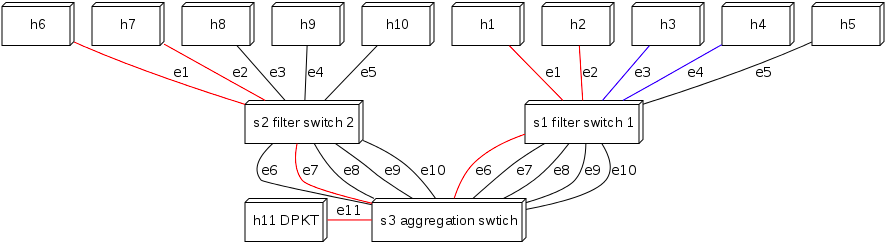
>>> flow traffic to a 'sniffer' port thru several switches. This is the
>>> topology,
>>> http://3.bp.blogspot.com/-BWiv9Kvn_-c/UXQVIT67p0I/AAAAAAAAAOA/8WEdV_TlasY/s1600/Topology_Simulation.png,
>>>  h1 <> h2, h3 <> h4, h6 <> h7 all have bi-dir flows installed based on
>>> ports. Then I carbon copy the traffic on h1 to e6 on s1, traffic on h6 to
>>> e7 on s2, then both traffic redirects to e11 on s3 that connects to an
>>> analysis host. This is all running fine, the code is here
>>> https://github.com/ericchou-python/PyTapDEMON/blob/master/ext/echou_pytapFinal.py.
>>>
>>>
>>> But suppose I have a web frontend that allows user to pick and choose which
>>> source port to start/stop sniff traffic. Currently I take the input and put
>>> that into a text file, the component reads that file and parse it out into
>>> the specific mirror ports/destination. Every time I make a change, I need
>>> to:
>>>
>>> 1. write the updated information to that text file.
>>> 2. restart the pox controller: "./pox.py <myComponent>"
>>>
>>> The switch usually registers pretty fast, but there is still a delay. I
>>> wonder if there is a to dynamically write that information somewhere and do
>>> an in-place update without restarting the controller?
>>>
>>> Thanks in advance for your help, :)
>>>
>>> Eric
>>
>