Hey all,

> On Feb 16, 2016, at 06:34, C. Titus Brown <[email protected]> wrote:
>
> I'm not sure how many people realize it, but Python (+ ipython/jupyter,
> pandas,
> matplotlib, scikit-learn, etc. etc.) has become one of the two mainstays of
> data analysis and visualization in the biological sciences -- along with R.
>
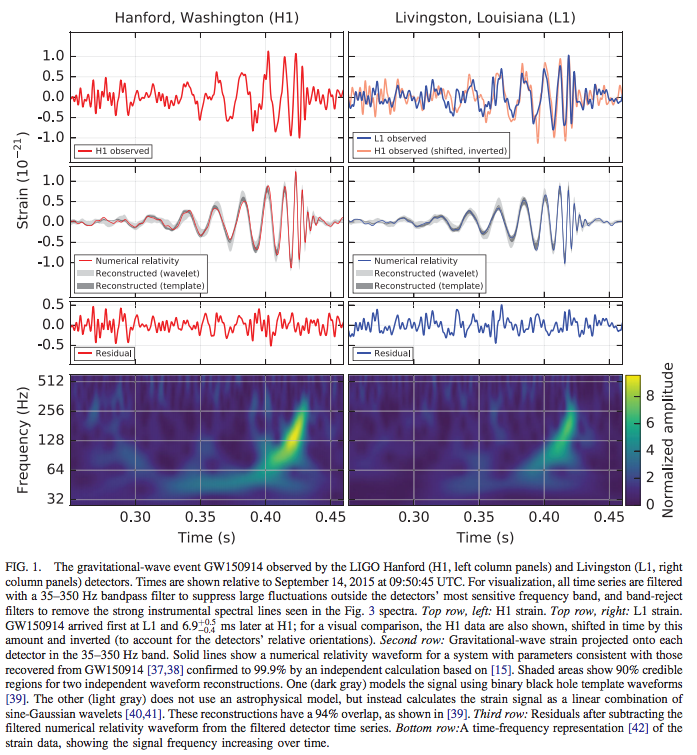
And for those who have not seen, you can play with the date in your browser:

http://mybinder.org/repo/minrk/ligo-binder/GW150914_tutorial.ipynb

It spawn a Docker instance with the analysis just for you after a few second
(and yes http, there is no login involved),
so that you can play with the data.

Enjoy.
--
M

Source on github: https://github.com/minrk/ligo-binder
<https://github.com/minrk/ligo-binder>Binder: http://mybinder.org/
<http://mybinder.org/>

> Everyone should keep up the good work - the science crowd is doing its best
> to put it to good use :)
>
> cheers,
> --titus
>
> On Mon, Feb 15, 2016 at 01:32:33PM -0400, John Gill wrote:
>> Thanks for posting this.
>>
>> I am thrilled to hear that python has played such a key role in an
>> incredible piece of work.
>>
>> And I will second your thanks to John Hunter.
>>
>> Many years ago I was looking for some plotting software and stumbled on
>> matplotlib.  I sent off a patch for stacked bar plots.  A few hours
>> later I received an incredibly encouraging email that spurred me to make
>> more changes.  He was a delight to work.
>>
>> I remember him fondly every time a matplotlib plot renders.
>>
>> John
>>
>> Khaled Monsoor <[email protected]> writes:
>>
>>> hello everyone in this wonderful community,
>>>
>>> probably, we already know about the recent confirmation by LIGO about
>>> existence of "gravitational waves", a major prediction by the "theory of
>>> relativity" by Albert Einstein. It is a huge milestone to human endeavour
>>> to understand nature.
>>>
>>> what we may or may not know that Python was the de-facto language of
>>> software components of the experimentation. It was extensively used in
>>> day-to-day operations, from orchestrating the instruments[1], gathering
>>> data, analytics, to generating the finally published pretty graphs[2].
>>> Usage of Python, IPython notebook & matplotlib was extensive among the
>>> team-members of LIGO.[3], [4]
>>>
>>> i am not a part of LIGO, or any of the member organisations.??
>>> Rather, as a common enthusiast of natural-sciences as well as a open-source
>>> believer, I would like to take a moment to thank every single
>>> contributor of Python. Please keep up pushing your commits.
>>> We facilitated something bigger than us.
>>>
>>> i would also like to take a moment to remember our lost friend, John D.
>>> Hunter, the creator of matplotlib. Whom we lost in 2012 in a battle with
>>> cancer. Dear John, you are long gone, but you will live generations through
>>> 2-D matplotlib plots.
>>>
>>> Thanks everyone.
>>>
>>> Khaled Monsoor,
>>> a common user of Python
>>>
>>> refs:
>>> [1]:
>>> https://www.reddit.com/r/IAmA/comments/45g8qu/we_are_the_ligo_scientific_collaboration_and_we/czxnlux
>>> [2]: https://pbs.twimg.com/media/Ca8jlVIWcAUmeP8.png
>>> [3]: https://losc.ligo.org/s/events/GW150914/GW150914_tutorial.html
>>> [4]: https://github.com/ligo-cbc
>>>
>>> _______________________________________________
>>> PSF-Community mailing list
>>> [email protected]
>>> https://mail.python.org/mailman/listinfo/psf-community
>> _______________________________________________
>> PSF-Community mailing list
>> [email protected]
>> https://mail.python.org/mailman/listinfo/psf-community
>
> --
> C. Titus Brown, [email protected]
> _______________________________________________
> PSF-Community mailing list
> [email protected]
> https://mail.python.org/mailman/listinfo/psf-community
_______________________________________________
PSF-Community mailing list
[email protected]
https://mail.python.org/mailman/listinfo/psf-community