I think from my perspective as a staffer in another RIR, with users
who are concerned about abuse of their resources in the RIPE IRR, this
is a good proposal. Anyone who is able to create a signed assertion of
intent has a strong-proof of intent, which should stand, if older data
contradicts it.  If this proposal means that the IRR will honour the
signed intent, It feels like a good outcome.
I am also aware of a number of BGP speakers in the APNIC region who
appear to have long-held, stable state in the RIPE IRR data who may be
adversely affected by removal so I am keen that the contact from RIPE
happens, but its understood older objects may have stale contact info:
This simply may not get all cases. Since the specifics here are that a
ROA leads to removal, it requires the prime resource holder (inetnums)
to consent. That feels respectful of their intent. If they have
"forgotten" as a company they depend on IRR data, they are also
actively engaged in routing (made the ROA) inside the correct RIR's
systems, so the solution appears tractable.

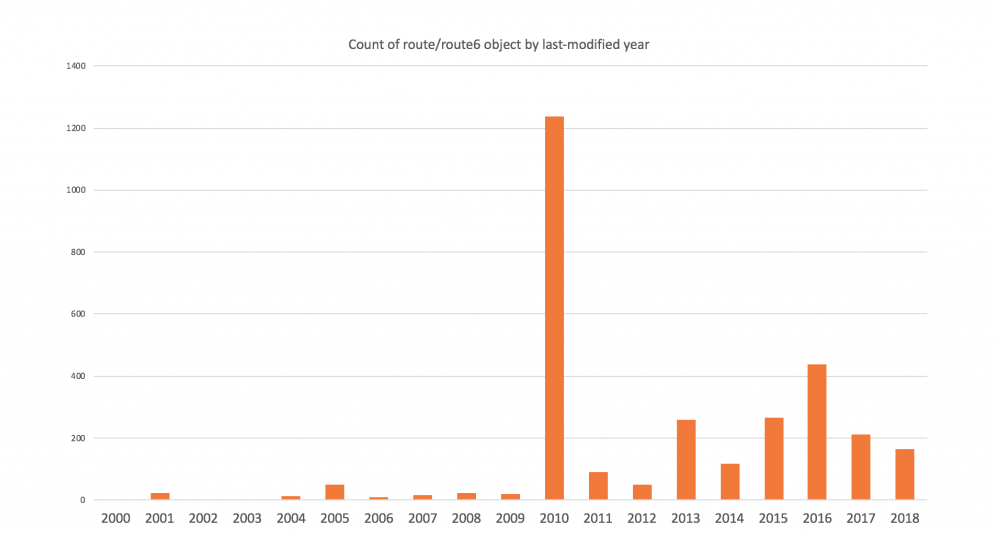
https://blog.apnic.net/wp-content/uploads/2018/08/Count-of-route-route6-object.png

This shows the histogram of objects by age, which refer to APNIC
region resources.  Approximately 2,900 distinct APNIC region prefixes
are represented in route: and route6: objects in the RIPE NCC
database. These prefixes distribute over 385 distinct address holders,
indirect (NIR sub-account) address holders, a mix of Members, and
historical Non-Member resource holders.

(from
https://blog.apnic.net/2018/08/30/ripe-ncc-moves-to-close-off-a-routing-registry-loophole/)

I don't think RIR staff should participate in the consensus call on
these things, so I offer this as "information around the subject"

-George


On Thu, Oct 11, 2018 at 3:16 PM Marco Schmidt <[email protected]> wrote:
>
> Dear colleagues,
>
> A new RIPE Policy proposal, 2018-06, "RIPE NCC IRR Database Non-Authoritative
> Route Object Clean-up", is now available for discussion.
>
> The goal of the proposal is to delete an non-authoritative object stored in
> the RIPE IRR, if it conflicts with an RPKI ROA.
>
> You can find the full proposal at:
> https://www.ripe.net/participate/policies/proposals/2018-06
>
> As per the RIPE Policy Development Process (PDP), the purpose of this
> four-week Discussion Phase is to discuss the proposal and provide feedback to
> the proposers.
>
> At the end of the Discussion Phase, the proposers, with the agreement of the
> Working Group Chairs, decides how to proceed with the proposal.
>
> We encourage you to review this proposal and send your comments to
> <[email protected]> before 9 November 2018.
>
> Kind regards,
>
> Marco Schmidt
> Policy Officer
> RIPE NCC
>
> Sent via RIPE Forum -- https://www.ripe.net/participate/mail/forum
>