On Wed, 23 Jan 2019, Paul Koning wrote:
On Jan 23, 2019, at 1:54 AM, Mattis Lind <[email protected]> wrote:


onsdag 23 januari 2019 skrev Brett Bump <[email protected]>:


On Tue, 22 Jan 2019, Paul Koning wrote:

On Jan 22, 2019, at 6:00 PM, Richard <[email protected]> wrote:

In article <cabr82sjodd8hhsgzjy8o_l5uqc3j1orjb7ht90vizykjdq0...@mail.gmail.com>,
   Mattis Lind <[email protected]> writes:

I have some DEC EDU material which I can scan if there are interest (and if
it isn't scanned already by someone else):

https://i.imgur.com/tqmcieK.jpg

I'd like to see this one about MINI-RSTS!

I remember seeing that before, quite possibly the same data sheet.  I never
heard of it while at DEC (in RSTS development).  Perhaps it was a short lived
early (V4 vintage) RSTS marketing exercise.


        paul


Yes. I forgot that I already scanned that one. Here is the mini RSTS flyer in
full pdf.

http://storage.datormuseum.se/u/96935524/Datormusuem/mini-rsts.pdf

Since the other documents are printed around 1972/1973 I guess that this one is
the same vintage.

/Mattis


Paul and I had this discussion before about 12 years ago on Wikipedia:

https://en.wikipedia.org/w/index.php?title=RSTS-11&action=history

I believe RSTS-11 V4A-12 was probably given the name Mini-Rsts-11
by the marketing department (somewhat the same as MicroRSTS later).
MicroRSTS was a pregenned distribution with exactly the same code
that came on the distribution tapes, starting with RSTS/E V8.0-06.
There are many references to MicroRSTS, but I have only seen 2 for
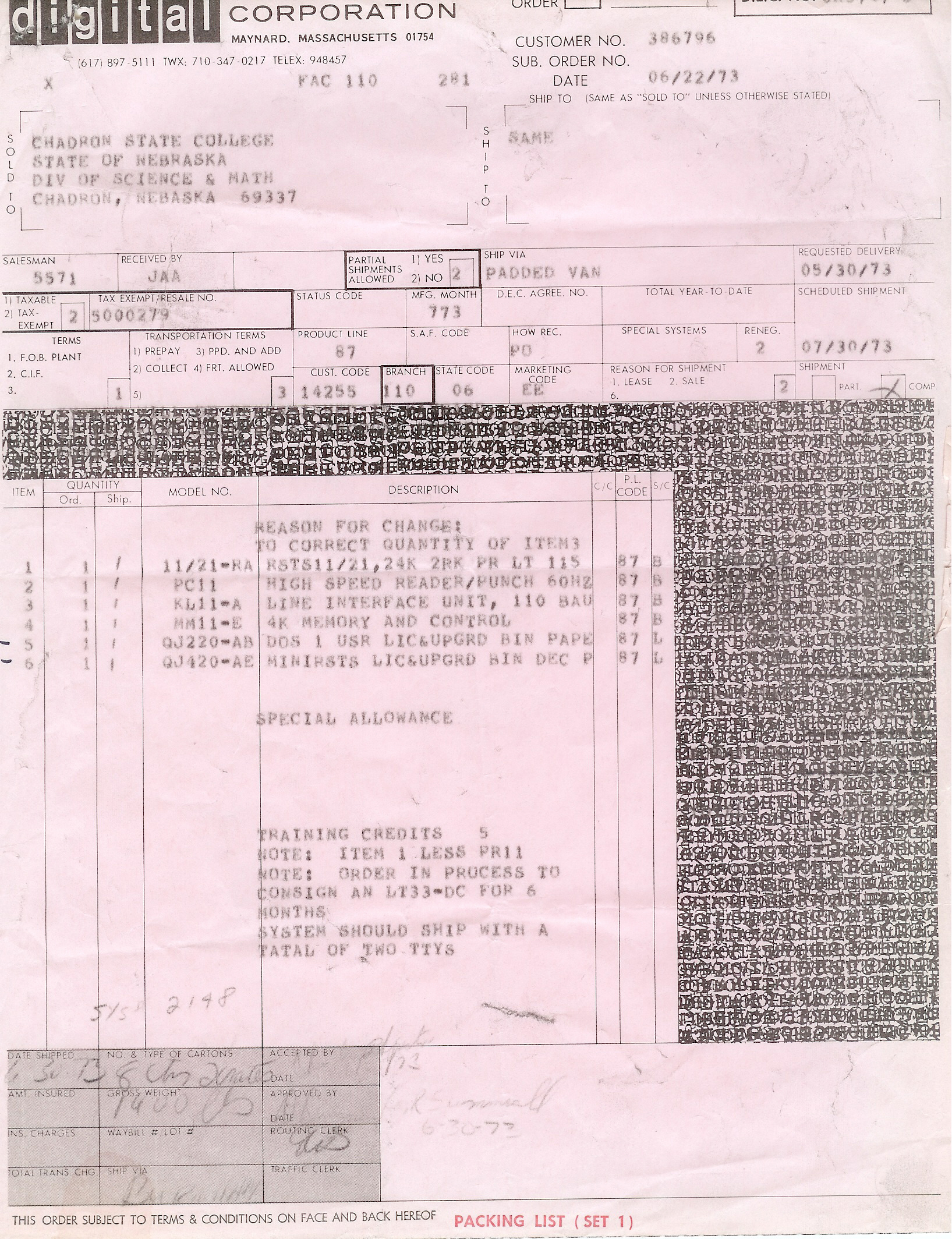
Mini-Rsts (below is a link for our colleges RSTS-11 receipt).

http://www.rsts.org/images/minirsts.jpg

I know that this original distribution was V4A-12 so the name was
probably dropped by the time RSTS/E V5A-21 was released eight (8)
months later.

Brett
Interesting that there is no date on that document. The term "RSTS-11" makes it clear we're talking about RSTS V4 or earlier. For that matter, so does the hardware configuration: a boatload of DL11s for the user terminals rather than a DH11 or DZ11 mux, because V4 only supported single line interfaces. It's not clear if this is V4 or an older version. 24kW memory is a minimal V4 configuration, pretty marginal actually but possibly ok for 8 users max. (In college I used V4A on a 28kW machine, 16 terminal lines, 16 users max though it tended to crash at around 12.) The feature list doesn't mention some V4 (optional) features like "record I/O" so it's possible this was actually V3. I also found the term "PDP-11/21" interesting. Has that been used anywhere else? It's pretty clearly an 11/20 configuration. paul _______________________________________________ Simh mailing list [email protected] http://mailman.trailing-edge.com/mailman/listinfo/simh
No, I never saw the 11/21 reference before either.  The machine was
an 11/20 with 28k of memory when I was working with it.  There was a
copy of DOS-11 V08-02 (which was the distro medium for RSTS V4A), a
couple of data disks and a copy of RT-11 V2 (all RK05 packs).  When
I got a hold of the machine the RK03 Diablo drives barely ran and I
replaced them with RK05's.  Some genius in the math department had
RT-11 running one day and /ZE'ed the pack.  I told him he just blew
away the distribution pack (not the DK1 pack).  He denied this and
showed me how PIP was still running (till he hit control-c).

I remember getting a number of DL11's and pulling the caps out so we
could make them run (woohoo) all the way up to 2400 baud.  I wrote a
program that spit the alphabet out to that device until we could get
the pot dialed in (away went the ASR33's and in with the VT-52s).

It was so much fun at the time considering the rest of the college
had 1 TRS-80 and 1 or 2 Apple II's.  But Paul was pretty accurate in
that I think we had a max of 3 VT52s and the LA36 console.

Brett
_______________________________________________
Simh mailing list
[email protected]
http://mailman.trailing-edge.com/mailman/listinfo/simh