Continuing a series related to the movement for seed sovereignty, we are
presenting an insightful and timely analysis of U.S. seed law and its
implications for the organization and exercise of the right of citizens and
residents to participate in seed saving and exchange networks. The
Sustainable Economies Law Center (SELC <http://www.theselc.org/>) in
California prepared the analysis and the primary conclusion they arrive at
is that we need to
*…change laws to create a clear legal space for seed libraries, we should
perhaps also do so for small-scale seed enterprises….[D]uring times of food
insecurity, climate disruption, and genetic consolidation of the sources of
our food (seeds!), the benefit of seed libraries is enormous as compared to
the potential harm of a seed packet gifted within a community. Let’s make
sure our laws get with the times!*

This is a timely analysis by colleagues at the Sustainable Economies Law
Center given the recent events we reported on last week
<http://bit.ly/1mjjYOR> involving seemingly unconstitutional actions taken
by the Pennsylvania Department of Agriculture (PDA) in closing down a local
seed library in Cumberland County.
This is a pivotal issue facing the environmental and food justice movements
and their shared vision of the rebuilding of communities from the bottom up
through more cooperative forms of economic organization. The struggle for
seed freedom is part of the larger struggle for Earth democracy.
To continue reading, scroll down or use this link: http://bit.ly/XhNsqY

--
Devon G. Peña, Ph.D.

"Memory is a moral obligation, all the time."
 -J. Derrida

  <http://ejfood.blogspot.com/2014/08/la-lucha-por-la-sierra-machismo.html>
 <http://ejfood.blogspot.com/>
  AUG
13

<http://ejfood.blogspot.com/2014/08/seed-sovereignty-us-seed-law-policy.html>
Seed
Sovereignty | U.S. seed law policy, politics, and food justice movements
<http://ejfood.blogspot.com/2014/08/seed-sovereignty-us-seed-law-policy.html>


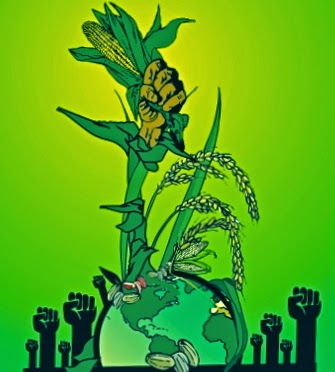
<http://1.bp.blogspot.com/-kcd7imVDr7Y/U-umLar3ggI/AAAAAAAAP5c/2Whgbk8g-k8/s1600/Via%2BCamp%2BMaize.jpg>
Campaign
for Seed Sovereignty <http://www.seed-sovereignty.org/EN/>, La Via Campesina
*Moderator’s Note:* Continuing a series related to the movement for seed
sovereignty, we are presenting an insightful and timely analysis of U.S.
seed law and its implications for the organization and exercise of the
right of citizens and residents to participate in seed saving and exchange
networks. The Sustainable Economies Law Center (SELC
<http://www.theselc.org/>) in California prepared the analysis and the
primary conclusion they arrive at is that we need to

*…change laws to create a clear legal space for seed libraries, we should
perhaps also do so for small-scale seed enterprises….[D]uring times of food
insecurity, climate disruption, and genetic consolidation of the sources of
our food (seeds!), the benefit of seed libraries is enormous as compared to
the potential harm of a seed packet gifted within a community. Let’s make
sure our laws get with the times!*

This is a timely analysis given the recent actions that we reported on last
week <http://bit.ly/1mjjYOR> involving seemingly unconstitutional actions
taken by the Pennsylvania Department of Agriculture (PDA) in closing down a
local seed library in Cumberland County.
This is a pivotal issue facing the environmental and food justice movements
and their shared vision of the rebuilding of communities from the bottom up
through more cooperative forms of economic organization. The struggle for
seed freedom is part of the larger struggle for Earth democracy.
Setting the Record Straight on the Legality of Seed Libraries
Janelle Orsi, Neil Thapar,[a]
<https://www.blogger.com/blogger.g?blogID=7322220305190081041#_edn1>  Neal
Gorenflo,[[b]
<https://www.blogger.com/blogger.g?blogID=7322220305190081041#_edn2> and
Sarah Baird[c]
<https://www.blogger.com/blogger.g?blogID=7322220305190081041#_edn3> | San
Francisco, CA | August 11, 2014


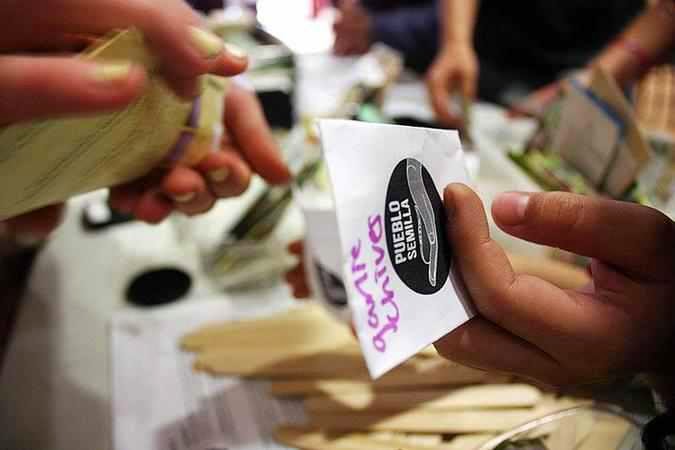
<http://1.bp.blogspot.com/-Cw6eT36yj7Y/U-umk0tfc5I/AAAAAAAAP5k/xEDwdqPA_VA/s1600/seed_paket_0.jpg>
Pueblo
Semilla Seed Library and Exchange*. Photo credit: **Pueblo Semilla*
<http://www.shareable.net/blog/seeds-of-the-people-growing-local-knowledge>

 <http://www.shareable.net/blog/seeds-of-the-people-growing-local-knowledge>
After the Pennsylvania Department of Agriculture cracked down on a seed
bank in the Joseph T. Simpson Public Library in Mechanicsburg, Pennsylvania
<http://www.shareable.net/blog/pennsylvania-seed-library-investigated-by-department-of-agriculture>,
hundreds of seed libraries in the U.S. are suddenly wondering if they are
breaking the law. According to Pennsylvania regulators
<http://www.cumberlandcountylibraries.org/sites/default/files/SIM/Documents/Misc/2014_PADeptAgriculture_Letter.pdf>,
in order to give out member-donated seeds, the Simpson Seed Library
<http://www.cumberlandcountylibraries.org/?q=SIM_SeedLibrary> would have to
put around 400 seeds of each variety through impractical seed testing
procedures <http://www.aosaseed.com/publications.htm> in order to determine
quality, germination rate, and so on. The result of the Pennsylvania
crackdown is that the library will no longer give out seeds other than
those which are commercially packaged.

Ironically, this is in the name of “protecting and maintaining the food
sources of America.” In this news article that went viral,
<http://cumberlink.com/news/local/communities/carlisle/department-of-agriculture-cracks-down-on-seed-libraries/article_8b0323f4-18f6-11e4-b4c1-0019bb2963f4.html>
regulators
said that “agri-terrorism is a very, very real scenario.” In reality, seed
libraries have emerged to protect our food sources and ensure access to
locally adapted and heirloom varieties. The public’s access to seeds has
been decreasing since a 1980 Supreme Court ruling
<http://caselaw.lp.findlaw.com/scripts/getcase.pl?court=US&vol=447&invol=303>
that
a life-form could be patented. Since then, big seed companies have shifted
away from open-pollinated seeds to patented hybridized and
genetically engineered varieties. The companies prohibit farmers from
saving and replanting such seeds, requiring that they buy new seeds each
year. Counter to this trend, seed libraries give members free seeds and
request that members later harvest seed and give back to the library
thereby growing the pool of seeds available to everyone.

*Seed Law Basics*

It’s important to set the record straight about the legalities of seed
libraries. Let’s begin with the basics: In every state
<http://www.amseed.org/issues/state-federal/resources/>, there are laws
requiring seed companies to be licensed, test seeds, and properly label
them. At the federal level, there is a comparable law governing seed
companies that sell seeds interstate. All of these laws exist for good
reason: If a tomato grower buys 10,000 tomato seeds, the grower’s
livelihood is on the line if the seeds turn out to be of poor quality or
the wrong variety. Seed laws, like other truth-in-labeling laws, keep seed
companies accountable, prevent unfair competition in the seed industry, and
protect farmers whose livelihoods depend on access to quality seeds. The
testing and labeling of the seeds also helps to prevent noxious weeds and
invasive species from getting into the mix.

In some states, the licensing, labeling, and testing laws only apply if you
sell seed. In other states, such as California, the laws apply if you even
offer seeds for barter, exchange, or trade. How do you define words like
sell, barter, exchange, and trade? And how do they apply to seed libraries?
Read on if you are ready to venture into interesting legal grey areas.

In at least one state (yup, Pennsylvania), even supplying seeds make you
subject to at least some regulation. But the Pennsylvania seed law is about
to be put to the test, and we think that regulators should have read their
law more carefully.

*Using the Letter of the Law*

When you see a law enforced in what seems like an unfair way, we recommend
reading the letter of the law to see if you can find any holes in it. We
did just that, and found one! In Pennsylvania, supplying seed likely makes
you subject to the requirement to get a license, which involves filling out
a form and paying an annual $25 fee (Section 7103
<https://govt.westlaw.com/pac/Document/NFAFD9570342811DA8A989F4EECDB8638?viewType=FullText&originationContext=documenttoc&transitionType=CategoryPageItem&contextData=%28sc.Default%29>,
Chapter 71 of Pennsylvania Consolidated Statutes). However, the sections of
the law (7104,
<https://govt.westlaw.com/pac/Document/NFA22ECE0342811DA8A989F4EECDB8638?viewType=FullText&originationContext=documenttoc&transitionType=CategoryPageItem&contextData=%28sc.Default%29>
 7105
<https://govt.westlaw.com/pac/Document/NFA39D040342811DA8A989F4EECDB8638?viewType=FullText&originationContext=documenttoc&transitionType=CategoryPageItem&contextData=%28sc.Default%29>,
etc.) that mandate testing and labeling only apply if you sell seed. Not
“supply,” but “sell!”

Has anyone in Pennsylvania noticed this nuance since the whole Simpson Seed
Library kerfuffle began? Seed libraries in Pennsylvania could perhaps test
this strategy: Fill out the license form, pay the $25 fee, and continue to
operate as usual. If the Pennsylvania Department of Agriculture demands
testing and labeling of seeds, a seed library could try holding its ground
until the regulators see their own error or until a court makes a
determination that the library is not “selling” seeds. (Note: We’re not
giving legal advice here! Get legal advice from a Pennsylvania lawyer,
because breaking this law the first time could result in up to 90 days of
prison time, and breaking it the second time can result in up to two years.)


*Working Within Grey Areas*

California and other states define “sell” to include exchange, barter, or
trade. This broad definition helps to ensure that people can’t sidestep
regulation simply because they aren’t using dollars to bargain. Bargaining
is a key concept in all of this. We have innumerable regulations designed
to temper the potential harms that arise when people bargain in the context
of commerce. Merchants have an incentive to seek high prices and to reduce
their costs in order to get more. When people transact within the “get
more” frame of mind, it is far more likely they will cut corners, disregard
risks, be careless, mislead people, and so on. That’s why regulations apply
when people sell things, but rarely when people give things.

Seed libraries have a “give more” frame of mind, which motivates the
libraries to do right by their members and the community. They ask people
to donate seed back to the library, but do so with the goal of giving away
more seed. The letter of the law doesn’t tell us that seed libraries are
clearly exempt from regulation, but the spirit of the law does.

When the application of a law is unclear, we must go deeper to hone our
legal arguments. Although the libraries both give and receive seeds,
there’s a strong argument that they do not, in fact, exchange seed in the
way the California regulation envisions. To find solid legal ground for
this argument, seed libraries can borrow legal arguments from time banks. A
time bank is an organization through which members do favors for one
another and award one another a “time dollar” or “time credit” for every
hour of service. People can use their time credits to reward favors they
receive from other members of the network. The IRS has acknowledged in
private letter rulings that this activity is distinct from that of a barter
exchange for two primary reasons: 1) the giving and receiving of favors
happens informally, meaning that people get no contractual right to have
their favor returned, and 2) the exchanges are non-commercial, as
demonstrated by the fact that everyone’s hour is valued equally, meaning
that people are not bargaining for services at market rate.

Similarly, seed libraries generally give and receive seeds on an informal
basis, meaning that neither the library nor its members have a right or
requirement to give seed. Members likely have a sense of responsibility to
give back to the seed library, but the library cannot force them to do so.
In addition, seed libraries give and receive seeds on a non-commercial
basis. People neither pay money for seeds, nor do they measure the value of
seeds they give in proportion to what they get. You can learn more the
about nuanced differences between giving, swapping, exchanging, and selling
here and here
<http://www.shareable.net/blog/how-to-barter-give-and-get-stuff>.

Note that it’s important for seed libraries to ensure that their policies,
languaging [sic], and practices reflect what we’ve described in the above
paragraph. If the library makes people feel as if they are required to give
seed later on or if the library is counting seeds in order to keep score
somehow, then the library might actually come under the regulations. We
have seen at least one seed library that has members sign a contract
indicating that the member “shall” or “agrees to” donate twice the amount
of seed that they checked out. This is risky. We suggest that all seed
libraries review their documents and revise paperwork in order to simply
collect information
<http://www.sfseedlibrary.org/how-to-use-the-seed-library> from members
about what kind of seed they received, what they are donating, their
experience with the plant, and so on.


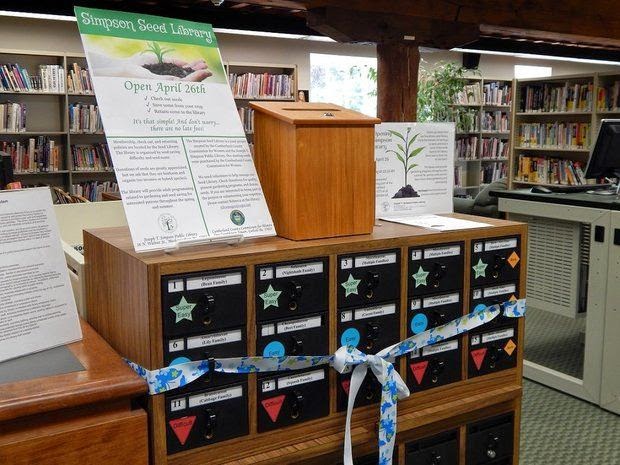
<http://2.bp.blogspot.com/-SnT-VXOen0k/U-umy-dIHfI/AAAAAAAAP5s/fk9_vtHBcY0/s1600/seed%2Blibrary.jpg>
The
Simpson Seed Library before its opening this past April. *Credit: **Rebecca
Swanger*
<http://blog.pennlive.com/gardening/2014/04/mechanicsburgs_new_seed_librar.html>


<http://blog.pennlive.com/gardening/2014/04/mechanicsburgs_new_seed_librar.html>
*Crowdsourcing a Seed Law Library*

Drawing upon the spirit of reciprocity that motivates seed libraries, we’d
like to urge readers to take 30 minutes and give back by doing research on
other states’ seed laws. We’ve created a Hackpad
<https://hackpad.com/ep/group/BdawSUkxAQE> where anyone can add links to
state seed laws, copy and paste in key provisions, and add your comments
and questions. Wanna take a crack at it? It’s very empowering to learn how
to find and navigate laws.

The American Seed Trade Association compiled a list of state seed laws
<http://www.amseed.org/issues/state-federal/resources/>, but many of the
links are broken, so you may need to access the laws by navigating through
state agricultural codes. Commonly, state seed laws live in two places: 1)
state statutes created by legislators, and 2) regulations created by the
state department of agriculture. You need to review both.

*We Still Need to Change These Laws!*

Even though we have arguments that seed libraries are not subject to state
and federal testing and labeling requirements, it would be ideal for our
laws to say this explicitly. No matter what state you are in, you could
look on either end of the political spectrum and probably find a legislator
who would be sympathetic to these issues. You could ask a legislator to
introduce a bill that has simple language such as:

Notwithstanding any other provision of this [law, act, chapter, article],
Seed Libraries shall be exempt from all licensing, testing, labeling, and
other requirements of this [law, act, chapter, article]. ‘Seed Library’
shall be defined as a nonprofit, cooperative, or governmental organization
that donates seed and receives donations of seed.

Depending on how much discretion your state department of agriculture has
with regard to the crafting of regulations, you could, instead, simply ask
the department to amend the regulations.

Also, we recommend that seed libraries and other advocates write letters to
the Association of American Seed Control Officials
<http://www.seedcontrol.org/index.html> (AASCO), a national membership
organization comprised of state seed regulatory officials. Among other
activities, AASCO developed and maintains the Revised Uniform State Seed Law
<http://www.seedcontrol.org/pdf/russl_2013.pdf>, the model law on which
many states’ seed laws are based. If AASCO were to expressly exempt seed
libraries from regulation, several states would likely follow suit, since
they often adopt wholesale AASCO’s recommendations. AASCO’s membership
directory <http://www.seedcontrol.org/membership_directory.html> also
contains mailing and email addresses for seed regulators in each state, so
we recommend that everyone write to them as well.

If we change laws to create a clear legal space for seed libraries, we
should perhaps also do so for small-scale seed enterprises. If current law
requires a seed business to test 400 seeds of each variety, this privileges
large seed companies, and effectively blocks farmers from starting small
seed enterprises. Further, the scale of operation should make a difference
when it comes to achieving the goals of these laws. If a package of 100
seeds ends up being of poor quality or if it contains noxious weeds, the
harm to the grower or to society is much lower than if the packet contained
10,000 seeds. Likewise, seed sales that are conducted direct-to-consumer
within a small geographic area present minimal risk of introducing new
invasive or noxious species.

Thus, when we change the laws, we should also create exemptions and lower
compliance hurdles for seed enterprises that sell seeds in small
quantities, direct-to-consumer, and/or within a confined region.

In the big picture, laws should not try to protect citizens from all
imaginable harms nor should laws overreach into all areas of our lives.
Every law requires a balancing act. Although driving a car is quite
dangerous, people are allowed to do it, because society has decided that
the benefit of mobility outweighs the risk of harm. Similarly, during times
of food insecurity, climate disruption, and genetic consolidation of the
sources of our food (seeds!), the benefit of seed libraries is enormous as
compared to the potential harm of a seed packet gifted within a community.
Let’s make sure our laws get with the times!

------------------------------
[i] <https://www.blogger.com/blogger.g?blogID=7322220305190081041#_ednref>
Sustainable
Economies Law Center <http://www.theselc.org/>.
b <https://www.blogger.com/blogger.g?blogID=7322220305190081041#_ednref>
Shareable <http://www.shareable.net/>.
c <https://www.blogger.com/blogger.g?blogID=7322220305190081041#_ednref> Center
for a New American Dream <http://www.newdream.org/>.

Posted 1 hour ago by Devon G. Peña
<http://www.blogger.com/profile/16444690604040637632>
Labels: Food justice
<http://ejfood.blogspot.com/search/label/Food%20justice> Pennsylvania
<http://ejfood.blogspot.com/search/label/Pennsylvania> seed libraries
<http://ejfood.blogspot.com/search/label/seed%20libraries> seed saving
<http://ejfood.blogspot.com/search/label/seed%20saving> seed sovereignty
<http://ejfood.blogspot.com/search/label/seed%20sovereignty> Sustainable
Economies Law Center
<http://ejfood.blogspot.com/search/label/Sustainable%20Economies%20Law%20Center>
 US seed law <http://ejfood.blogspot.com/search/label/US%20seed%20law>
 --
"I would feel more optimistic about a bright future for man if he spent
less time proving that he can outwit Nature and more time tasting her
sweetness and respecting her seniority."
E. B. White

For more information about sustainability in the Tompkins County area, please
visit:  http://www.sustainabletompkins.org/
If you have questions about this list please contact the list manager, Tom
Shelley, at [email protected].