Hi All,

I have a 70ft 80m self-supporting vertical, which I've baseloaded to bring
it down to 160m. The antenna is about 800 ft. from my shack, fed with buried
hardline. The vertical has sixty 120 ft radials fanning out over the desert
floor.
When I built the baseloaded inductor I didn't have any suitable AirDux coil
stock on hand, so I experimented using a toroid. I wrapped two 2.25 inch
diameter T-43 cores together with fiberglass tape, and wound the wrapped
core with thin RG316 coax. RG316 is thin, flexible, high-temperature coax,
with a silver-plated shield, about 0.1 in in diameter. I shorted the inner
conductor to the shield, so I was just using the coax as flexible, high
temperature wire. I use a shunt coil of about 2 uH (23 ohms reactance at 1.8
MHz) made of plated copper tubing between the toroid and ground, reasoning
that the RF current at this low Z end of the toroid will be pretty large.


I didn't know how well the toroid would work in this application, but the
assembly came to resonance very smoothly and seems to work well to 2000W. I
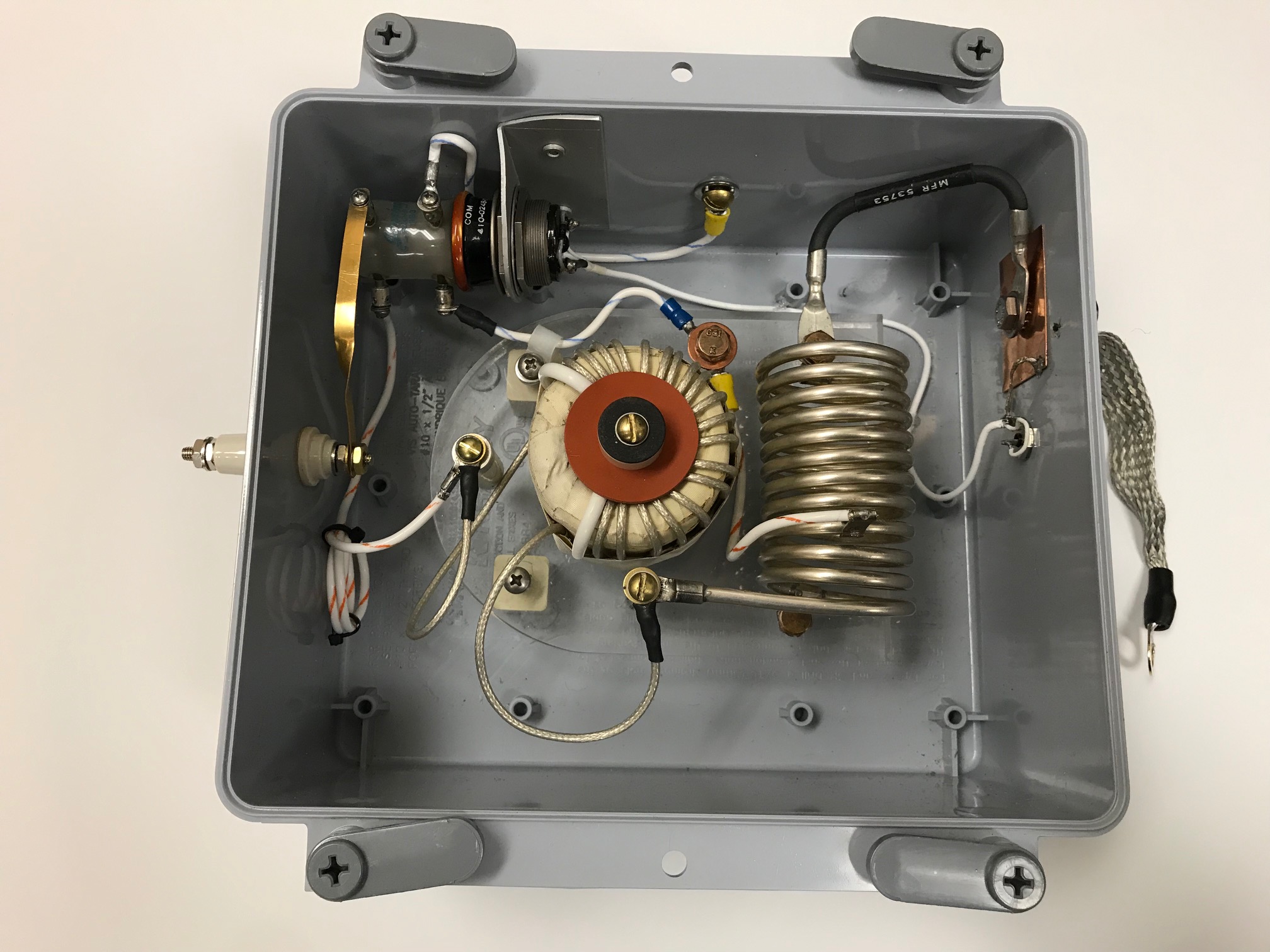
use a DPDT vacuum relay to switch in the 160m toroid from my shack. As shown
in the photos, (links below) the assembly is very compact. I mounted it in
an inexpensive (about $22) NEMA waterproof enclosure.) To give a sense of
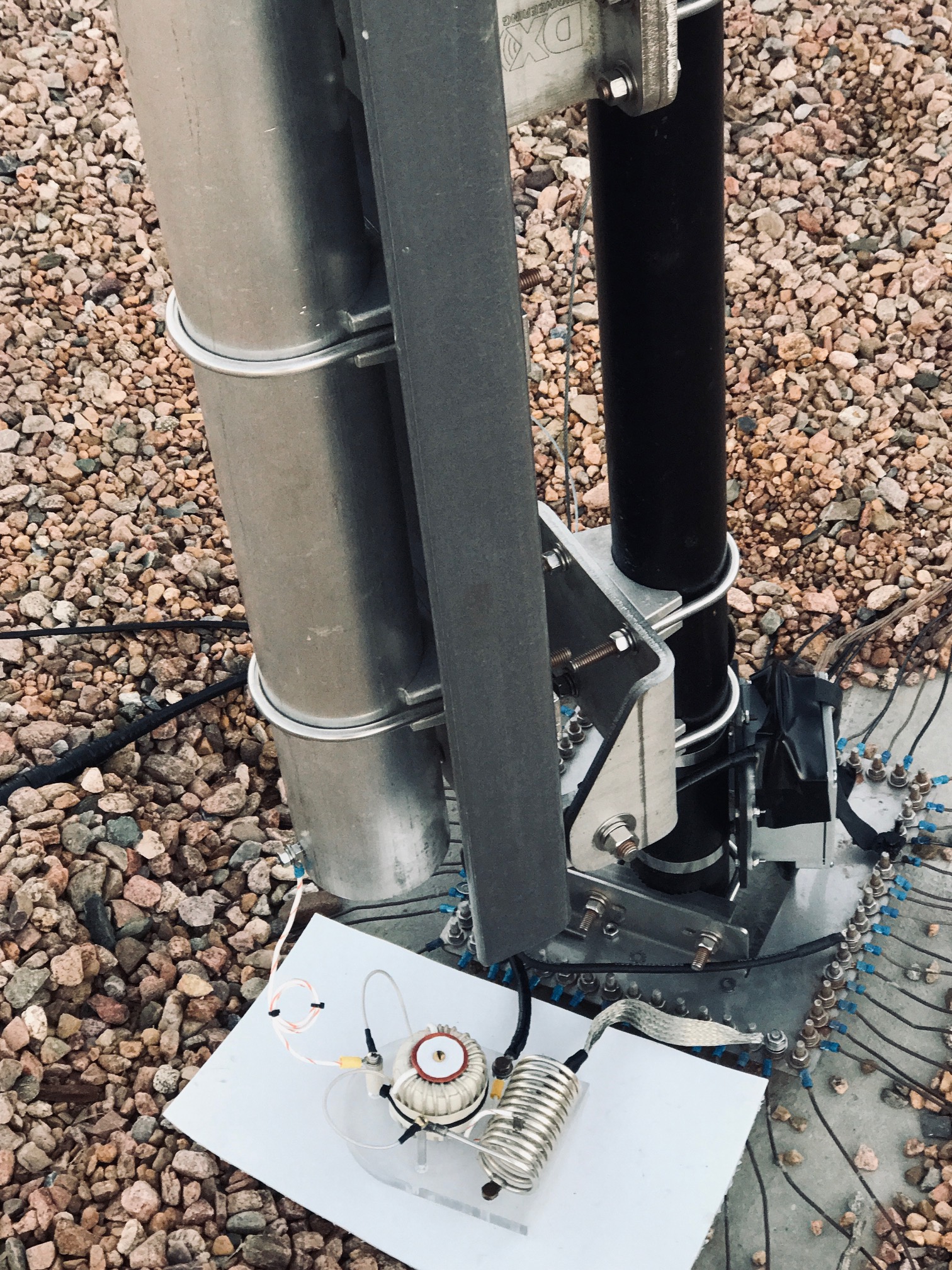
the scale, one photo shows the toroid and shunt coil breadboarded on a piece
of plastic and resting on a sheet of teflon at the base of the vertical (to
keep it from arcing to the grounded radials.)


http://www.w8zr.net/160amplifier/images/160m%20toroid%20assembly.jpg


http://www.w8zr.net/160amplifier/images/160m breadboard test.jpg
<http://www.w8zr.net/160amplifier/images/160m%20breadboard%20test.jpg>


Here are some observations about this hookup. As expected, the toroid and
wire get pretty hot at QRO power levels, although I didn't try to measure
the temperature. (It takes two people to do this: one to key up the
transmitter and a second to hold the IR thermometer.) However, intially the
toroid rested on an acrylic (plexiglass) post, but the post got hot enough
to soften and deform. I swapped the plexiglass for a ceramic post with no
further problems. There's no evidence of core saturation, and the SWR is
unchanged over the full power range. There's no visible effect of heating on
the wires either, all of which use teflon insulation. I don't know how much
power I'm wasting in heating the toroid, but I'd guess it be about 100-200W
at full power, or roughly ten percent of total power. I don't know how that
power loss would compare to using an air-wound coil. I can argue it both
ways: an air wound coil wouldn't have any core losses, but the resistive
loss in the wire would be several times greater than that in the toroid.


In this sort of hookup, one has to be very careful about high voltage
insulation. With my first toroid, I spaced the turns out around the core,
and at about 500W the bottom of the winding flashed over to the top of the
winding, even though the wire had teflon insulation. Now the winding uses
only about 2/3 of the available core space, and I have an extra length
(probably unneeded) of teflon sleeving over each end of the winding.


The little coil wound of stranded 12 AWG white wire (with orange stripe)
visible in the photo at the HV end of the toroid provides about 0.6 uH of
inductance. Its purpose is to fine tune the inductance, since the toroid
doesn't lend itself to fine adjustments. For this vertical, the shunt coil
is about 2uH and the toroid is about 23uH. On 80m, the native 2:1 bandwidth
on 80m is about 400 kHz (1.3 SWR minimum at 3550 kHz), while on 160m it is
only about 35 kHz, with a minimum 1.15 SWR at 1815 kHz.


There are only four connections to the NEMA enclosure: RF input, Output to
the vertical, Ground, and +26V (approx) to power the vacuum relay. The
arrangement is exceptionally convenient and compact, and can be connected to
the vertical in five minutes. I use a 24V wall wart to power the relay, with
a toggle switch and LED indicator back in the shack.


I have a question for the antenna gurus on the list. I know base-loaded
verticals have a bad rap compared to verticals with top capacity hats, the
rationale being that most radiation occurs at the low Z, high current end of
the antenna. However, with a toroid, almost all the electromagnetic energy
circulates in the core of the toroid and does not radiate. If I'm right that
the core is dissipating only about ten percent of the total power, then that
would suggest that the toroidal baseloaded antenna is actually a very good
radiator. I have no idea how its other parameters, e.g., angle of radiation,
compares to a top-loaded antenna, or to a full 1/4 vertical. My previous
iteration of this antenna used top-loading in a guyed vertical, and while
the BW was a bit larger (and the maintenance was hugely larger!) I've not
noticed any qualitative performance difference. Both versions seemed very
competitive.

73,

Jim W8ZR


_________________
Searchable Archives: http://www.contesting.com/_topband - Topband Reflector