On 20.02.25 10:56, Sughosh Ganu wrote:
The actual logic to allocate a region of memory is in the
_lmb_alloc_base() function. The lmb_alloc() API function calls
lmb_alloc_base(), which then calls _lmb_alloc_base() to do the
allocation. Instead, call the _lmb_alloc_base() directly from both the
allocation API's, and move the error message to the _lmb_alloc_base().
Signed-off-by: Sughosh Ganu <[email protected]>
---
Changes since V1: New patch

  lib/lmb.c | 16 ++++++----------
  1 file changed, 6 insertions(+), 10 deletions(-)

diff --git a/lib/lmb.c b/lib/lmb.c
index 874063fc1f5..6bfc0dbc9ce 100644
--- a/lib/lmb.c
+++ b/lib/lmb.c
@@ -758,26 +758,22 @@ static phys_addr_t _lmb_alloc_base(phys_size_t size,
ulong align,
                        base = ALIGN_DOWN(res_base - size, align);
                }
        }
+
+       log_err("Failed to allocate 0x%lx bytes below 0x%lx\n", (ulong)size,
+               (ulong)max_addr);
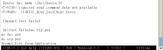
Printing such a line is not expected in an EFI application. It would
mess up the output of menus in EFI applications like GRUB.
I think this line should be debug output.

Best regards

Heinrich
+
        return 0;
  }
phys_addr_t lmb_alloc(phys_size_t size, ulong align)
  {
-       return lmb_alloc_base(size, align, LMB_ALLOC_ANYWHERE, LMB_NONE);
+       return _lmb_alloc_base(size, align, LMB_ALLOC_ANYWHERE, LMB_NONE);
  }
phys_addr_t lmb_alloc_base(phys_size_t size, ulong align, phys_addr_t max_addr,
                           uint flags)
  {
-       phys_addr_t alloc;
-
-       alloc = _lmb_alloc_base(size, align, max_addr, flags);
-
-       if (alloc == 0)
-               printf("ERROR: Failed to allocate 0x%lx bytes below 0x%lx.\n",
-                      (ulong)size, (ulong)max_addr);
-
-       return alloc;
+       return _lmb_alloc_base(size, align, max_addr, flags);
  }
phys_addr_t lmb_alloc_addr(phys_addr_t base, phys_size_t size, u32 flags)