Op 19/06/2019 om 17:00 schreef Greg Gallagher:
On Wed, Jun 19, 2019 at 8:44 AM Harco Kuppens <[email protected]> wrote:
The ipipe patched not entirely cleanly on the rpi kernel source; I had to make
little changes in the patch, but not anything really seriously. So I expect it
to be fine.

I used the rasbpian kernel source because it has better support for the
raspberry pi's and mainly because it has better support for the gpio pins in
its kernel.

However to help you debug I did a similar install using the mainline kernel
source. The ipipe patch just worked smoothly, however to get the gpio pins
running in xenomai I had to still port some code of the file

     ./drivers/pinctrl/bcm/pinctrl-bcm2835.c
What did you have to change here to get the pins to work with Xenomai?
You shouldn't need to change anything here.  If you did then it may be
a bug in the ipipe.  Can you try with 4.14 ipipe ?
I did try with ipipe 4.19 and when compiling the kernel I got lot of
errors. Some I could solve, but at the end I gave up.
See my notes on
https://github.com/harcokuppens/xenomai3_rpi_gpio/blob/master/install/__INSTALL_FAILURES__/install__compile_vanilla_kernel_4.19_with_xenomai_3.0.8__assert_error.txt
Maybe this is also interesting for you.
I shall try 4.14, maybe that works...
So I did, the description you can find at:
https://github.com/harcokuppens/xenomai3_rpi_gpio/blob/master/install/installation_of_xenomai_3.0.8_on_mainline_kernel_branch_v4.14.110_from_kernel.org__problem_linux_gpio.md
However the results are exactly the same. I need the extra patch for
pinctrl-bcm2835.c from the raspbian kernel source to have the rtdm gpio
pins working in xenomai. Then xenomai gpio examples work fine, however
in linux gpio doesn't work.
So because we get the same result for two different kernels, I suspect
that the problem is somewhere in pinctrl-bcm2835.c which is the same for
both.
to the mainline kernel source.

With this kernel I get the same problem : gpio pins work find with rtdm in
xenomai, but they don't work with linux anymore.
Unclear to me why?

The description of this mainline installation and how to get my example
scripts which show you that the linux gpio pins are not working
are described in:

https://github.com/harcokuppens/xenomai3_rpi_gpio/blob/master/install/installation_of_xenomai_3.0.8_on_mainline_kernel_branch_v4.9.51_from_kernel.org__problem_linux_gpio.md

Hope you can help me solving this problem?
Xenomai gpio seems to work ok, and the image seems to be fine to be used in our
course at the Radboud university.

However because the fact that in linux the gpio pins don't work anymore does me
little bit worry if it is really ok???
Is suspect something is wrong in ./drivers/pinctrl/bcm/pinctrl-bcm2835.c .
Can you post a diff of the changes you made (as mentioned above)?
I made a diff/patch for  ./drivers/pinctrl/bcm/pinctrl-bcm2835.c
from the version v4.9.51 after the ipipe patch is applied
to the raspbian kernel version 4.9.y after the ipipe patch is applied.


You can download that patch at :

https://raw.githubusercontent.com/harcokuppens/xenomai3_rpi_gpio/master/install/how_pinctrl-bcm2835_patch_for_rpi-4.9_is_derived/pinctrl-bcm2835.c.after-ipipe-patch-extra-rpi-4.9.patch
So after applying the ipipe patch on the v4.9.51 mainline kernel, you
must apply this patch to get the latest raspbian patches to this file.
I needed it to get the rtdm gpio pin numbers correct. (see the problems
in my installation description).
You get then the version of pinctrl-bcm2835.c which I used in my
installation description.
In my previous email I already described points where this file differs from
the version in my previous raspian/rpi/xenomai image for which everything
worked fine. So take a look at that.

I think to test you don't need an raspberry pi 3b+, byt an older raspberry pi 2
 or a raspberry 3 would also suffice.

Hopefully somebody can help me?
I can try this on a rpi 2b this week, when I did this last i was able
to use the gpio from sysfs and rtdm.  How are you confirming that
Linux doesn't see the interrupt?
I use python test scripts using the piwire library in linux to test the
gpio ports. On a normal raspbian image they just work fine. But with the
patched kernel they just don't work anymore. So my conclusion is that
linux doesn't get the interrupts anymore.
How to fetch these scripts is explained at:
https://github.com/harcokuppens/xenomai3_rpi_gpio/blob/master/install/installation_of_xenomai_3.0.8_on_mainline_kernel_branch_v4.9.51_from_kernel.org__problem_linux_gpio.md#user-content-test-code
I also described a whole procedure to test whether everything is working at:

|https://github.com/harcokuppens/xenomai3_rpi_gpio/blob/master/install/test_xenomai_installation_and_test_gpio_pins_are_working_correct.txt|
|
|If you want to try these scripts then you also need some hardware
setup. Otherwise the gpio ports cannot be tested.
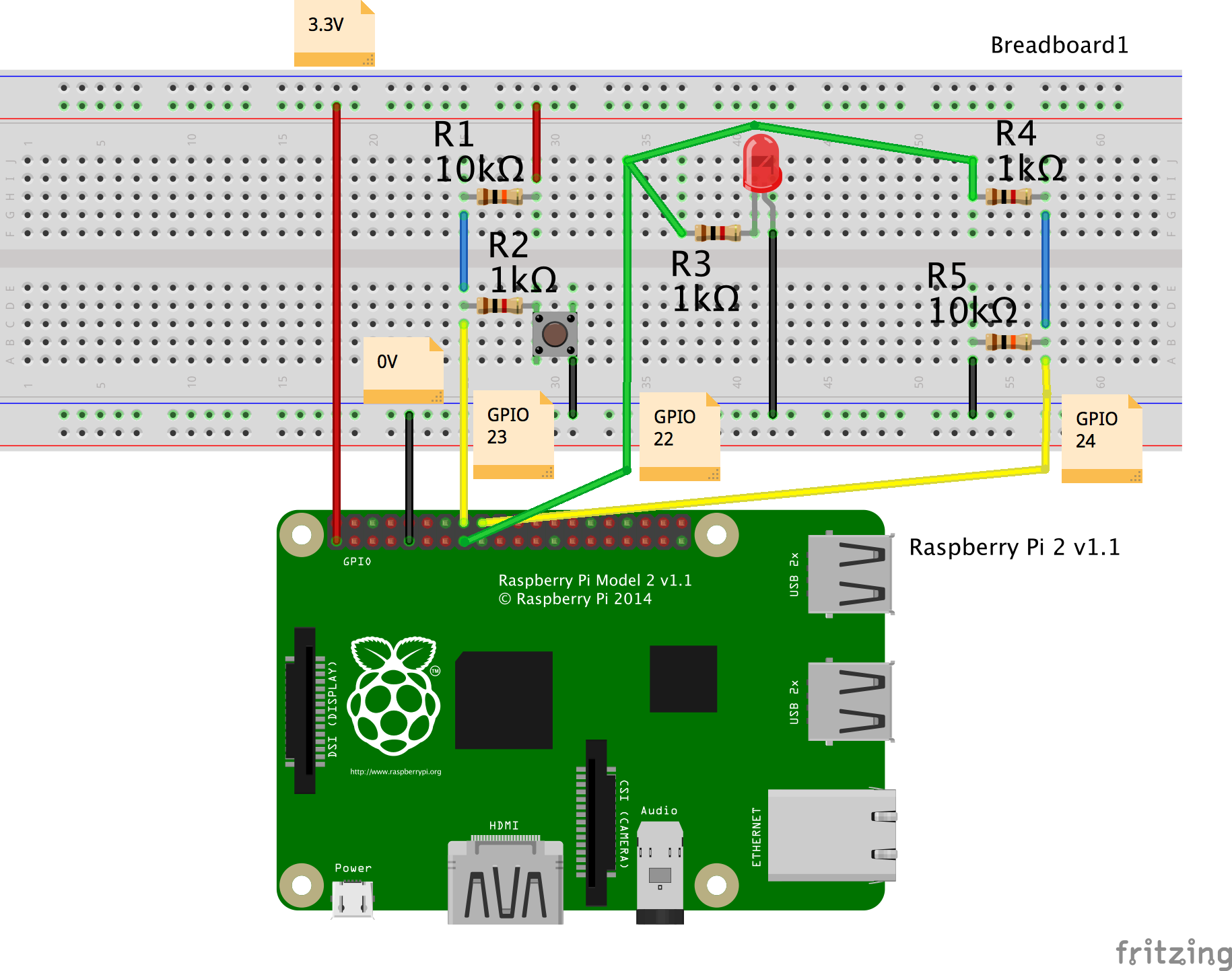
The hardware setup is shown in
http://www.cs.ru.nl/J.Hooman/DES/XenomaiExercises/combined__button_toggles_led__output_driven_irq.png
and described in
http://www.cs.ru.nl/J.Hooman/DES/XenomaiExercises/Exercise-7.html
||

||||
cheers
Harco
|
|
We'll need to track down where in
the pipeline the interrupt is lost.
Best regards,

Harco Kuppens
-Greg
Op 13/06/2019 om 16:13 schreef Greg Gallagher:

On Wed, Jun 12, 2019 at 5:40 PM Harco Kuppens via Xenomai
<[email protected]> wrote:

I put the raspberry pi image with xenomai2 I build for the raspberry pi
2 and 3, also supporting the latest raspberry pi3b+ online at:

    http://www.cs.ru.nl/lab/xenomai/raspberrypi.html

I'm still wondering what the reason is that I don't receive the gpio
interrupts in linux. Unfortunately nobody could answer my questions so
far. If somebody knows the problem, then I will fix the image.

Except for this linux gpio interrupt problem the above image seems to
work of for realtime xenomai gpio interrupts.

Best regards,
Harco Kuppens

Op 07/06/2019 om 12:34 schreef Harco Kuppens via Xenomai:

Hi,

In juli 2017 I managed to port xenomai 3.0.5 to rasbpian jessie on the
rpi3b. See https://xenomai.org/pipermail/xenomai/2017-July/037515.html

But this image doesn't boot on the new raspberrypi 3b+ board. So I had
to build a new image. I succeeded to build this image. The
instructions are at:

https://github.com/harcokuppens/xenomai3_rpi_gpio/blob/master/install/install_xenomai-3.0.8_on_rpi2_3_3B%2B.txt


Xenomai and handling gpio interrupts in realtime work fine on this
image, however somehow handling gpio interrupts in linux don't work
anymore. I have several test scripts using the wiringpi library within
linux. Writing and reading gpio pins works fine, but somehow we don't
get any interrupts.

Even if do not load the xeno_gpio_bcm2835 module, then xenomai doesn't
use the gpio pins, but still then in linux with wiringpi examples we
don't get any gpio interrupts.

However if I boot the standard raspbian image with the standard
raspbian kernel which does not support xenomai/cobalt then the
wiringpi examples work fine, and we get the gpio interrupts.

In my older image from juli 2017 both in a realtime xenomai program or
in a wiringpi linux program I received interrupts. (when run
separately at different times, so they cannot influence each other; so
they are not sharing interrupts!)

So I wonder why do the interrupts only work in xenomai realtime, and
not in linux anymore?

Or is there something maybe changed because we now use

  * newer kernel version 4.9 instead of 4.1
  * xenomai 3.08 instead of xenomai 3.05

I would expect that it just should work, they are different points at
the pipeline, and either of them is only watching for interrupt it
should just get it. So instead maybe I did  do something wrong when
patching the rpi 4.9 kernel during the installation?

Patching was not so easy because the raspbian os on the raspberry pi
comes with a customized kernel specificly tuned for the raspberry pi
hardware. I call this the rpi kernel. This kernel is little bit
different then the standard kernel from kernel.org. I call this the
kernel.org kernel.

The ipipe patches for the kernel are made for the kernel.org kernels.
However I managed pretty easily to patch the rpi 4.9 kernel with the
the ipipe patch for the kernel.org 4.9 kernel.
Except for the file pinctrl-bcm2835.c which is the driver for gpio
interrupts. In my installation patching this file for the rpi 4.9
kernel was difficult, but I thought I finally succeeded.

However because the problem with linux not getting any interrupts I
wonder if something still went wrong there.

So if I look at the ipipe-patched version of the pinctrl-bcm2835.c for
my older image using the rpi 4.1 kernel and my ipiped-patch for this
file for rpi-4.9 kernel I am building the image now I find some
differences between the files.
The files you can find at:

  *
https://raw.githubusercontent.com/harcokuppens/xenomai3_rpi_gpio/master/install/how_pinctrl-bcm2835_patch_for_rpi-4.9_is_derived/rpi-4.1.y.ipipe-patched/pinctrl-bcm2835.c
  *
https://raw.githubusercontent.com/harcokuppens/xenomai3_rpi_gpio/master/install/how_pinctrl-bcm2835_patch_for_rpi-4.9_is_derived/rpi-4.9.y.ipipe-patched/pinctrl-bcm2835.c

I found the following changes from the 4.1 to the 4.9 version:
a) spin_lock_init/spin_lock_irqsave/spin_unlock_irqrestore are
replaced with
raw_spin_lock_init/raw_spin_lock_irqsave/raw_spin_unlock_irqrestore calls
b) in bcm2835_gpio_irq_enable function we have an extra call
     ipipe_unlock_irq(data->irq) before calling raw_spin_unlock_irqrestore
c) in bcm2835_gpio_irq_disable we have an extra call ipipe_lock_irq
before
     calling raw_spin_unlock_irqrestore
d) in static struct irq_chip bcm2835_gpio_irq_chip we defined extra
    functions for hold and release
e) in bcm2835_pinctrl_probe the call

         err = devm_request_irq(dev,
pc->irq[i],bcm2835_gpio_irq_handler, IRQF_SHARED,name, &pc->irq_data[i]);

    is replaced with

         if (IS_ENABLED(CONFIG_IPIPE)) {
                     irq_set_chained_handler(pc->irq[i],
gpio_irq_cascade);
                     irq_set_handler_data(pc->irq[i], &pc->irq_data[i]);
         } else {
             err = devm_request_irq(dev,
pc->irq[i],bcm2835_gpio_irq_handler, IRQF_SHARED,name, &pc->irq_data[i]);
             ..
         }

   where we have added an extra function

          static void gpio_irq_cascade(unsigned int irq, struct
irq_desc *desc)
          {
          #ifdef CONFIG_IPIPE
              bcm2835_gpio_irq_handler(irq, irq_get_handler_data(irq));
          #endif
          }

If I look at e) then because I build the kernel with CONFIG_IPIPE then
basicly

           err = devm_request_irq(dev,
pc->irq[i],bcm2835_gpio_irq_handler, IRQF_SHARED,name, &pc->irq_data[i]);

is replaced with the two calls:

           irq_set_chained_handler(pc->irq[i], gpio_irq_cascade);
           irq_set_handler_data(pc->irq[i], &pc->irq_data[i]);

with extra function

             static void gpio_irq_cascade(unsigned int irq, struct
irq_desc *desc)
             {
                 bcm2835_gpio_irq_handler(irq, irq_get_handler_data(irq));
             }

Looking at this immediately I notice the  IRQF_SHARED flag.
I found at https://notes.shichao.io/lkd/ch7/

     IRQF_SHARED. This flag specifies that the interrupt line can be
shared
     among multiple interrupt handlers. Each handler registered on a
     given line must specify this flag; otherwise, only one handler can
     exist per line.


So as I can see IRQF_SHARED is only used on the 4.1 version in
devm_request_irq, but it is unclear if it is used for the 4.9 version.

But if I look at a newer kernel  at
https://github.com/raspberrypi/linux/blob/rpi-4.14.y/drivers/pinctrl/bcm/pinctrl-bcm2835.c
then irq_set_chained_handler+irq_set_handler_data is replaced with

gpiochip_set_chained_irqchip(&pc->gpio_chip,&bcm2835_gpio_irq_chip,pc->irq[i],bcm2835_gpio_irq_handler);


and the ipipe-core-4.14.110-arm-7.patch  seems to leave it like this.

Is any that maybe somehow the cause of the problem?

Or has it do with the changes in a) b) c) or d) ?

So at the end this has become a very long email.
Hopefully somebody can help me answering these questions.

Best regards,
Harco Kuppens

Does the ipipe patch apply cleanly? If you are getting interrupts to
the primary domain but not the secondary domain this is probably an
ipipe issue.  Is there any reason why you can't use mainline?
Mainline issues are easier to debug since we can reproduce them fairly
quickly.

-Greg